
Proposta de Valor
Resposta rápida
Uma proposta de valor é a promessa específica e testável de valor que um produto faz a um cliente definido, incluindo por que ele se destaca em relação à próxima melhor alternativa.
Value Proposition
A value proposition is the specific, testable promise of value a product makes to a defined customer: it names who the customer is, the job they are trying to get done, the benefit they receive, and the reason they would choose this over their next-best alternative. Most teams drop that last clause. The result is a tagline, not a value proposition.
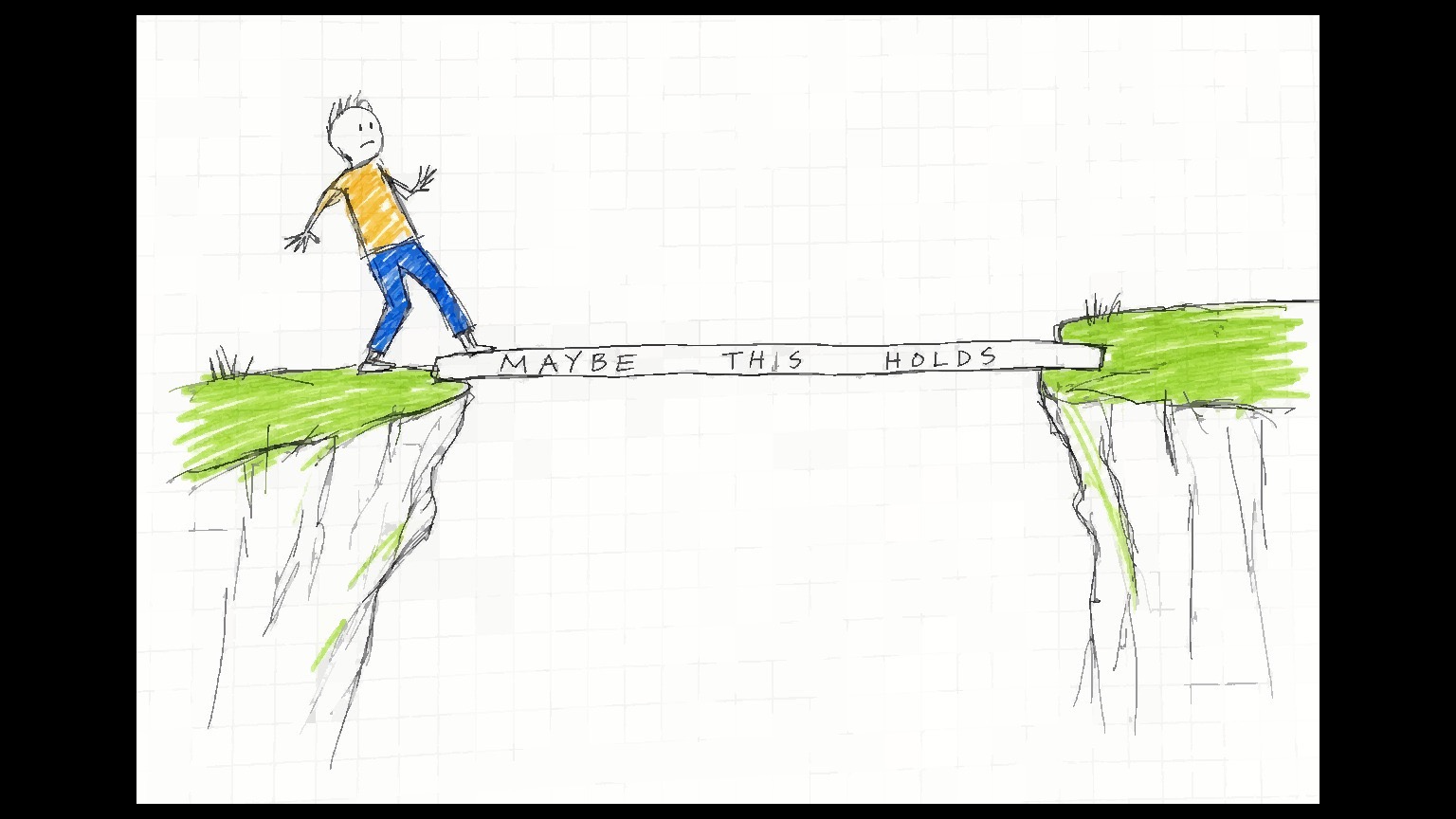
Most competing treatments miss the test that separates a value proposition from a tagline: a tagline cannot be wrong. A value proposition can. It makes an economic claim about a specific customer that either holds up when you test it or collapses. Treating it as marketing copy, a sentence to polish before launch, is the single most common reason value propositions fail. The work is not writing the sentence well. The work is checking whether the promise is true before the whole company starts trying to keep it.
For the step-by-step construction method, the value proposition design page covers the canvas in full.
What Is a Value Proposition?
Remove the next-best alternative from a value proposition and what remains is a slogan. A value proposition is a statement of specific value delivered to a defined customer, and it names four things: the target customer, the job they are trying to do, the benefit delivered, and why that benefit beats what they would otherwise do. All four elements are load-bearing.
The term predates Alexander Osterwalder, whose Business Model Canvas made it ubiquitous. Osterwalder's Business Model Canvas made the phrase ubiquitous, but the coinage predates him. It was two consultants at McKinsey who put it in an internal staff paper in 1988. Lanning and Michaels defined it as "a clear, simple statement of the benefits, both tangible and intangible, that the company will provide, along with the approximate price it will charge each customer segment for those benefits." Notice what that definition contained from the very beginning: a price. Lanning and Michaels understood something that almost every subsequent treatment of the concept chose to ignore. Value is never absolute. It is always net of what the customer pays. The moment you strip out the price (the moment you treat the value proposition as a sentence to polish rather than a claim to test) you have lost the thing that gave the whole concept its power.
The concept is less settled than most treatments suggest. Osterwalder himself called it "pretty fuzzy" on stage at Mind the Product, and a 2017 Journal of the Academy of Marketing Science review still tracked its ongoing "evolution, development, and application in marketing," which is not how a closed question gets described.
So the concept is customer-centric, anchored to a benefit rather than a feature, and tied to price from its origin. Taglines communicate identity, slogans promote campaigns, and mission statements define purpose, functions structurally distinct from a value proposition's economic claim. Those distinctions come in §5 and §6. First, the argument that reframes everything else on this page.
Is a Value Proposition a Marketing Artifact or a Business Model Claim?
Every major strategic framework treats the value proposition as the central structural claim of a business model, not a communications artifact. Porter's activity system, Osterwalder's canvas, and Anderson and Narus's research on business-market value propositions all locate it in the architecture of how a company creates value. The marketing-copy framing is the misapplication, not the definition.
Strategy produces the value proposition; marketing communicates it. It is a structural claim about how the business model creates and keeps value, and writing it before testing it inverts the actual work.
Start with Porter. In "What Is Strategy?" he roots competitive advantage in operations, not messaging:
The essence of strategy is choosing a unique and valuable position rooted in systems of activities that are much more difficult to match.
— Michael Porter, What Is Strategy? (1996)
A position rooted in activities is the opposite of a sentence you write at the end. The value the customer receives is produced by what the company actually does, costs included. Raphael Amit and Christoph Zott make the same move in their work on business-model design, defining the value proposition as a hypothesis about value created for stakeholders, net of any costs — in Business Model Innovation Strategy. The phrase "net of any costs" is the giveaway. This is an economic claim, and economic claims can be false.
A tagline cannot be proven wrong. "Just Do It" is not wrong. It cannot be wrong, because it never claimed anything specific enough to be falsified. A value proposition is different in a way that matters enormously. It says a specific customer will get a specific benefit at a specific price and will prefer it to their current alternative. That is a prediction. And predictions can be wrong. The market votes every single day.
Practitioners who reject the term offer the most precise definition of what it should mean. April Dunford, who has spent a career on B2B positioning, draws the line directly:
people confuse it with marketing copy and it's not. It's this strategic thing that sits underneath everything you do.
— April Dunford, The SaaS Podcast
David Brock goes further, calling the artifact worthless:
The problem is the 'proposition' part, the idea that we can reduce the value we create and the value the customer should expect to one or two pithy sentences, is absolutely meaningless.
— David Brock, Partners in Excellence
A marketer who calls the headline on a landing page a value proposition is not wrong inside that context. In consumer goods and FMCG, the VP-as-marketing-artifact usage is standard, productive, and does not carry the same consequence. The conversion-optimized sentence is a real artifact with a real job. The error is mistaking that extract for the whole claim, then funding a build against it. The cost of the error shows up in the data: 42% of failed startups cite "no market need" as a top reason they died, which is what an untested value hypothesis looks like in a post-mortem. Eric Ries names the same failure in plainer language in his Stanford ETL lecture. The promise was never checked. The business model kept a promise the market had not asked for.
What Are the Four Components of a Value Proposition?
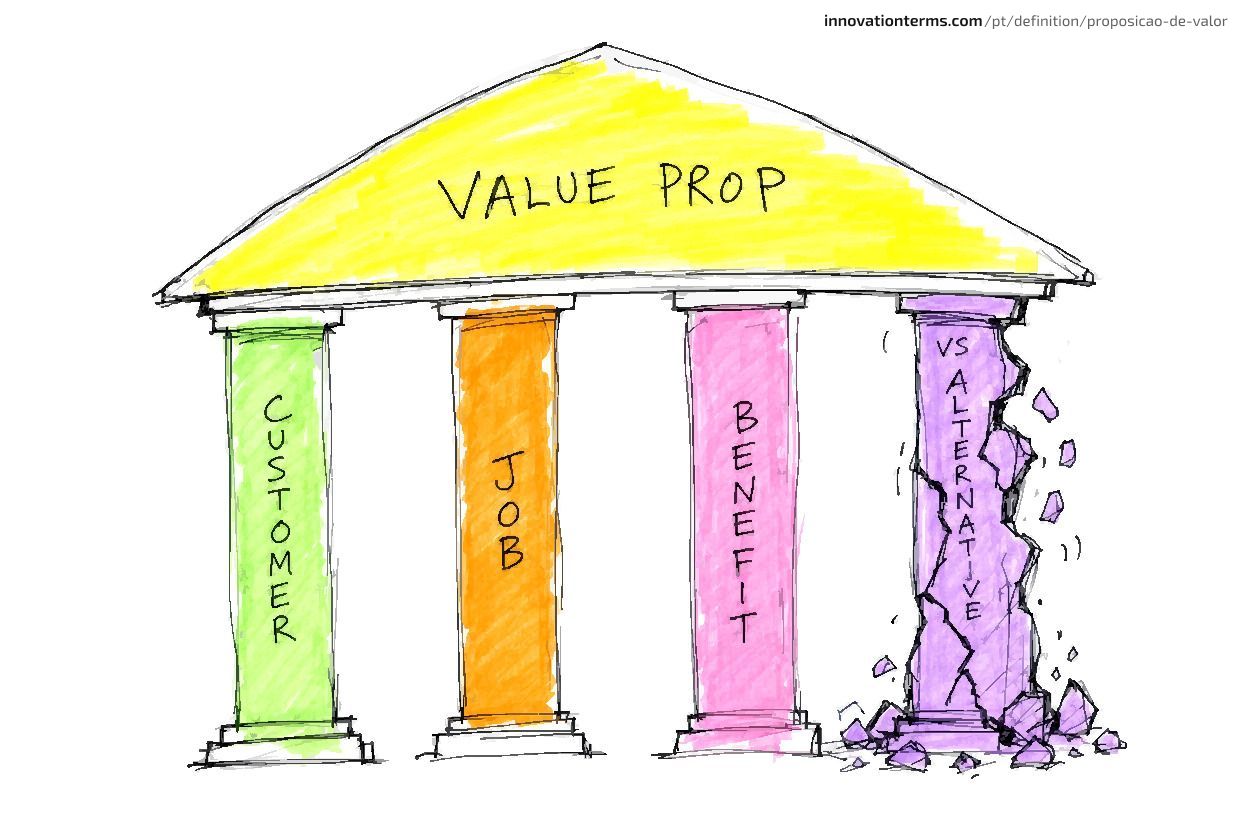
A complete value proposition has four components: the target customer (who), the job being done (what need), the benefit delivered (what gain or pain removed), and the differentiation (why this over the alternative). Collapse any one and the remaining statement stops being a promise. Drop the customer and it is a feature. Drop the differentiation and it is a brochure.
Each component fills a specific gap. The target customer pins the claim to a real person. Without it, the statement fits everyone and convinces no one. The customer job shows what they are trying to accomplish. Without it, the VP is a product description with no problem attached. The benefit names what the customer gets — not a feature, but a gain or pain removed, as Anderson, Narus and van Rossum frame the distinction. The differentiation answers why this product over the next-best alternative. In practice, teams drop it most often. It is also the only component that makes the claim testable.
The fourth component is where the falsifiability lives, because value is always relative to an alternative. Anderson, Narus and van Rossum built their entire framework around it, naming the discipline of competing on points of difference rather than reciting every benefit on offer:
When managers construct a customer value proposition, they often simply list all the benefits their offering might deliver. But the relative simplicity of this all-benefits approach may have a major drawback: benefit assertion.
— Anderson, Narus & van Rossum, Customer Value Propositions in Business Markets (HBR, 2006)
The Slack case illustrates how a value proposition functions as business-model architecture rather than copy. Customer: distributed software teams. Job: coordinate work without drowning in internal email. Benefit: searchable, channel-based async communication. Differentiation: it replaces the email-plus-scattered-tools status quo rather than adding another inbox. All four present, the claim is testable. Strip the fourth and you get "a messaging app for teams," which describes a hundred products and promises nothing.
What Makes Customer Jobs, Pains, and Gains the Foundation of Any Value Proposition?
Customer research is what makes a value proposition valid rather than assumed. Jobs, pains, and gains are the insight categories it must respond to, and any version written before that research is complete is a hypothesis claiming the authority of a conclusion without having earned it.
Christensen's reframe: customers hire products to get a job done, which changes what a value proposition must name. Customers do not buy products, he argued in Competing Against Luck. They hire them to make progress on a specific job they are trying to get done. The job is the unit of analysis, not the demographic. Theodore Levitt had reached the same place from a different direction. People do not want a quarter-inch drill, he wrote. They want a quarter-inch hole. The value proposition, if it is going to mean anything at all, responds to the hole.
Customer jobs
The functional, social, and emotional tasks a customer is trying to complete. For a procurement lead at a manufacturer, the functional job is reducing supplier risk, the social job is being seen as the person who avoided a stockout, and the emotional job is sleeping through quarter-end. A value proposition that speaks only to the functional job leaves two-thirds of the motivation untouched.
Customer pains
The obstacles and bad outcomes the customer is trying to prevent. Late deliveries, hidden integration costs, the audit that finds a compliance gap. Pains are specific and often unspoken until you ask directly, which is why interviews surface more than brainstorming sessions do.
Customer gains
The outcomes the customer actively wants, beyond just removing pain. Faster cycle times, a metric they can take to their own boss, a number that survives scrutiny. Gains are where the differentiation clause usually hides.
The reason this ordering matters: research precedes the statement. The value proposition design page covers the canvas that structures this work. The customer interview and observation tools that surface latent jobs before writing starts are covered in depth on the design thinking page. The trap is writing the elegant sentence first, then hunting for customer evidence to justify it, which guarantees you find only the evidence you went looking for.
How Does a Value Proposition Differ from a Tagline, Slogan, and Mission Statement?
A tagline communicates brand identity. A slogan promotes a specific campaign. A mission statement declares organizational purpose. A value proposition makes an economic claim to a defined customer about what they get and why it beats their alternative. They sit at different altitudes and serve different masters, and using one in the slot meant for another is a common, expensive substitution.
| Artifact | Audience | Function | Falsifiable? | Example |
|---|---|---|---|---|
| Tagline | Broad market | Brand recall | No | "Think Different" (Apple) |
| Slogan | Campaign target | Promote one push | No | "I'm Lovin' It" (campaign) |
| Mission statement | Internal + public | Declare purpose | No | "Organize the world's information" (Google) |
| Value proposition | A defined customer | Claim specific value vs alternative | Yes | "Cut a distributed team's internal email by centralizing work in searchable channels" |
The failure mode shows up in pitch decks. A team drops "Think Different" energy into the value-proposition slot, and an investor asks the only question that matters: value to whom, instead of what, at what price. The tagline has no answer because answering was never its job. Simon Sinek's distinction helps here. The mission is the why, the reason the organization exists. The value proposition is the what, for a specific segment, with a number attached. Conflating the layers produces a business plan that sounds inspiring and predicts nothing.
Value Proposition vs Unique Selling Proposition: What Is the Actual Difference?
A unique selling proposition is a single point of competitive difference optimized for communication. A value proposition is the full economic case, incorporating the USP but adding the target customer, the job, the price, and the business-model claim that the company can actually deliver. Every value proposition contains a USP. Not every USP is anchored to a full value proposition.
The USP is the older idea and the narrower one. Rosser Reeves defined it in Reality in Advertising (1961) with three conditions:
Each advertisement must make a proposition to the consumer... "Buy this product, and you will get this specific benefit." The proposition must be one that the competition either cannot, or does not, offer... it must be unique. The proposition must be so strong that it can move the mass millions.
— Rosser Reeves, Reality in Advertising (1961)
That is the differentiation component of a value proposition, lifted out and sharpened for a 30-second spot. It is ad-copy-scoped. The modern value proposition is business-model-scoped.
The gap between 1961 and 1988 is not incidental to the confusion. The USP was born inside the advertising industry, where Rosser Reeves was trying to solve a specific, bounded problem: how do you make a 30-second television spot do real work? The value proposition was born inside McKinsey, where Lanning and Michaels were trying to solve something much larger: how does a company decide what to build, for whom, and at what price? Twenty-seven years. Two entirely different disciplines asking entirely different questions. The terms got tangled. They have stayed that way ever since, accumulating new layers of conflation with each generation of writers who treated them as interchangeable. The USP is the line you say in a pitch. The value proposition is what the whole company is held accountable for. One is a sentence. The other is a claim.
Steve Blank treats the two as interchangeable in The Four Steps to the Epiphany, which is part of why the confusion persists in startup circles. April Dunford maps the cleaner relationship: positioning determines the VP, and the VP is the customer-facing answer to "what is this thing and why should I care" (April Dunford, Business of Software Podcast).
What Does a Value Proposition Look Like Across a B2B Buying Group?
In a complex B2B purchase, a single org-wide value proposition fails. Each buying role applies its own value lens, so a durable B2B value proposition is a family of role-specific promises sharing one core claim. The single line that works on a consumer landing page breaks the moment six people have to agree.
Decision-maker count is what forces value propositions to operate across stakeholder domains. 6 to 10 decision makers participate in a typical complex B2B purchase — each arriving with four to five independently gathered pieces of research, and buyers spend only about 17% of the journey with any vendor's reps. Your value proposition does most of its work when you are not in the room, in front of people who each care about something different. Frow and Payne's European Journal of Marketing research argues that value propositions operating across multiple stakeholder domains provide "an important mechanism for aligning value within a marketing system," the academic way of saying the B2B buying group requires more than one promise.
A mid-market software deal splits value across at least three roles, each applying a different lens to the same product. Each role evaluates the same tool through a different lens:
| Role | Core concern | Example message |
|---|---|---|
| Operations manager | Cycle speed | "Cut handoff delays so your team ships without chasing status." |
| IT director | Compliance and control | "SSO, audit logs, and SOC 2, so adoption does not become your risk." |
| CFO | Documented ROI | "Documented payback inside two quarters versus the incumbent." |
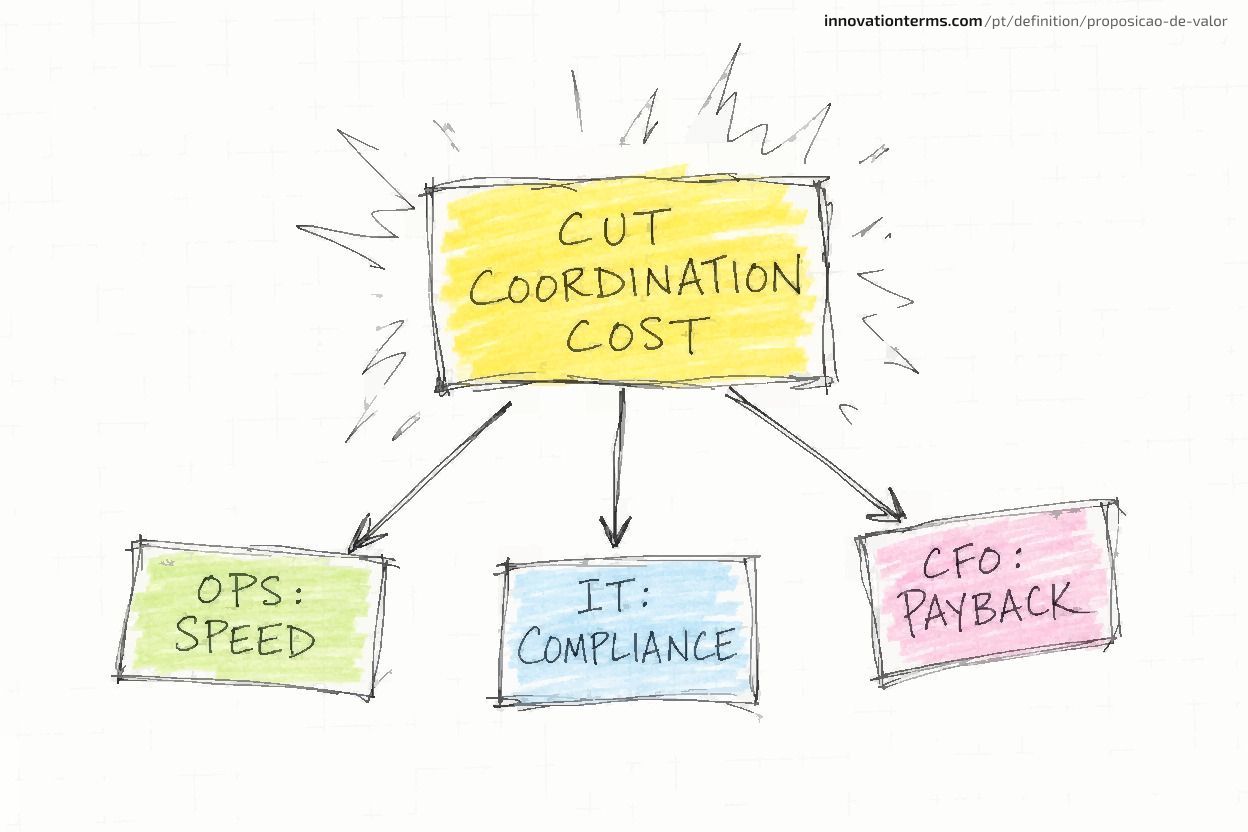
All three arguments serve the same underlying claim about coordination cost. What counts as credible evidence and format varies completely by audience.
Anderson, Narus and van Rossum call the gold standard a quantified resonating focus — their term for the B2B value proposition that isolates the one or two points of difference that matter most to this specific buyer, then proves the benefit in the customer's own numbers rather than listing a menu of possible advantages. Their Sonoco case is the template: a packaging redesign let a European consumer-goods customer move from a seven-day, three-shift schedule to a five-day, two-shift operation, at the same price as the old packaging. That sentence convinces a CFO. A vague benefit claim convinces no one, which Marc Benioff understood when Salesforce built role-based selling into its enterprise motion rather than pitching one message to the whole committee — a strategy detailed in Behind the Cloud.
How Do You Write a Value Proposition?
Two construction templates have become standard, and both force the specificity a vague draft hides. Neither produces a finished value proposition. Both produce a draft to test, which is the only honest output at this stage.
The popular "We help [X] do [Y] by doing [Z]" formula is widely attributed to Steve Blank's The Four Steps to the Epiphany, but it does not appear verbatim in the book. It is a useful scaffold regardless of who phrased it. Treat it as folk wisdom that works, not gospel.
The XYZ scaffold
"We help [X, a specific customer] do [Y, a specific job] by doing [Z, a specific mechanism]." The value of the format is exposure. Most first attempts produce a Y that does nothing specific ("improve productivity") and a Z that is a feature, not a mechanism. Forcing all three variables to be concrete surfaces the vagueness immediately. If X is "businesses," the draft is already broken.
Geoffrey Moore's positioning statement
Moore's template from Crossing the Chasm adds the two things the XYZ scaffold leaves implicit, the category and the alternative:
For [target customer] who [statement of need], [product name] is a [product category] that [key benefit]. Unlike [primary competitive alternative], our product [key differentiation].
The "Unlike" clause is the whole point, because it forces the next-best alternative onto the page, which is the component teams most reliably drop. Running the same product through both templates makes that visible: the XYZ version tests whether the job and mechanism are specific, and the Moore version tests whether the differentiation survives contact with a real competitor.
The sequencing mistake
Template sequence matters more than template selection. It is sequence. Writing the statement before doing the jobs-pains-gains research produces a confident sentence with no evidence underneath. The value proposition canvas exists to structure that research before the statement gets written, and zooms into the value-proposition block of the wider business model. The loop is draft, test, revise — the same innovation feedback loop that governs validated learning — not draft and ship. Reversing that sequence is the single most expensive mistake a product team can make, because the cost compounds with every week of unchecked work. §9 shows what the actual gates look like.
How Do You Test Whether a Value Proposition Is Real?
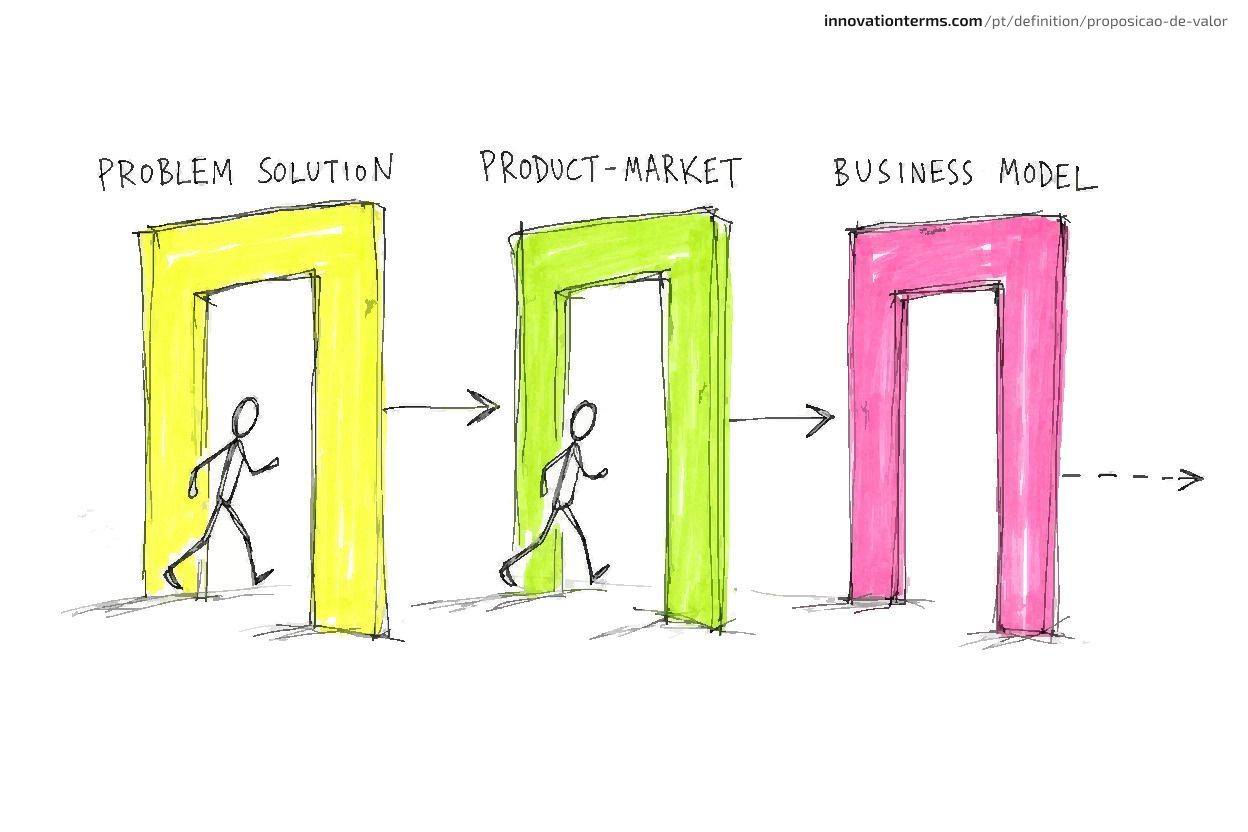
Testing a value proposition means checking whether the promise holds at three gates: problem-solution fit (the customer has the job or pain the value proposition addresses), product-market fit (the product reliably produces the benefit), and business-model fit (the company can deliver it profitably). Pass all three and it is validated. Pass one and it is an assumption with good lighting.
The components are crisp. The target customer is named. The differentiation clause is present. By every formal measure, it is a complete value proposition. But no one ever walked it past a real customer who had a real alternative. Juicero ran the paper-fit pattern to its logical end in 2017. The company had a specific target customer (health-conscious households), a named job, a clear benefit, and a differentiation clause built around a proprietary press it claimed was the only way to extract juice from its packs. Then reporters squeezed the packs by hand and got the same result. The press was the entire differentiation clause. And it was replicable with two human hands. The canvas had looked coherent. The promise had simply never been tested against what customers would actually do.
Strategyzer's three-fits framework formalizes the same logic Steve Blank put under "get out of the building." The same gate-criteria logic appears in the stage-gate model used by established product teams. The value proposition is a value hypothesis — Eric Ries's term for the testable assumption about what will make the product worth paying for. Customer interviews are the experiment. Eric Ries states the stakes:
They fail because nobody wants what they're trying to build.
— Eric Ries, Stanford ETL
Validation means a customer switches and pays at the stated price, not one who says the demo was nice. The signal is a customer who switches and pays at the stated price. Willingness to pay at the stated price, measured by an actual order or a signed letter of intent, not a survey. Retention past the first renewal. 72% of new product and service innovations fail to deliver on expectations — Strategyzer's figure for what skipping the validation gates looks like at scale. For the full validation toolkit, the market validation page goes deeper.
Where Does a Value Proposition Fit in the Business Model Canvas?
The value proposition sits at the center of the Business Model Canvas. Everything else serves it. The canvas as a whole exists to show how a company builds, delivers, and captures the value that single promise commits to, and each surrounding block is a different part of answering that question.
The block at the center
Osterwalder and Pigneur position the value proposition as the bridge between the customer-facing blocks (segments, channels, relationships) and the company-facing blocks (key activities, resources, partners). That placement is the argument of §2 drawn as a diagram. The activities exist to keep the promise. The revenue stream exists because the promise is worth paying for. If a block does not support the value proposition, the model has a coherence problem, and the canvas makes it visible. The full mechanics live on the business model canvas page.
The value proposition statement is the artifact: one sentence or a short paragraph naming the customer, job, benefit, and differentiation. The Value Proposition Canvas is Strategyzer's method for building and testing that artifact: a tool that zooms into the center block and maps products and services against customer jobs, pains, and gains. The canvas is the research instrument. The statement is what it produces. For the canvas method in full, the value proposition design page goes deeper.
What Do Teams Most Often Get Wrong About Value Propositions?
The common errors are specific, repeatable failure modes, each with a diagnostic tell.
"The value proposition is the tagline." Companies publish taglines in the value-proposition slot on their own websites, which is why the visual equivalence makes the swap feel credible. Falsifiability is the test. If your statement could not possibly be proven wrong by a customer, it is a tagline.
"Feature lists are value propositions." Understandable. Engineering teams describe capabilities because that is the vocabulary of their work, but "what it does" and "what the customer gets and why they would pay for it" are different questions — the core of Anderson, Narus and van Rossum's taxonomy — and the only reliable path from one to the other is laddering the so-what question until you reach something with a price attached.
"Once written, it is done." The statement enters the pitch deck and is never revisited. But a value proposition is a promise against a specific competitive alternative. When that alternative changes, the promise has to be re-tested. This is the bridge to §12.
"Benefit, not feature, is the whole game." Standard marketing advice, and it is necessary. The qualification it omits is the payment test: a benefit nobody will trade money or time for is structurally no better than a feature list. MediaPost's "Your Value Proposition Is BS" names what happens when that test is skipped: when every company promises the same thing, the buyer sees no value in any of them.
For the B2B multi-stakeholder failure mode (one org-wide line trying to serve a 6–10-person buying group), see §7.
Why Good Value Propositions Go Bad
A value proposition is a promise relative to the customer's next-best alternative. It expires. When a substitute enters the market and reshapes what the alternative actually is, the original claim may stop being true even though the product has not changed in any meaningful way, and no amount of better writing fixes that.
The mechanism is relativity. "Faster than the incumbent" stops working when the incumbent gets faster or a new entrant arrives faster than both. The differentiation clause, the testable part, is always measured against a moving baseline. BlackBerry's value proposition for enterprise email (secure, reliable, a real keyboard) was true against the 2007 alternative and false against the iPhone within a few years, without BlackBerry changing a thing. The alternative moved, so the promise broke.
Porter explains the slow version. A position rooted in a hard-to-copy activity system decays slowly because rivals struggle to match the whole system, while a position resting on a single feature decays fast — the central argument of What Is Strategy? (1996). Christensen explains the fast version. The basis of competition shifts over a product's life from functionality to reliability to convenience to price, and a low-end disruptor resets the reference point entirely. The incumbent's value proposition was calibrated against a baseline that no longer exists. The innovator's dilemma page covers that substitution in full.
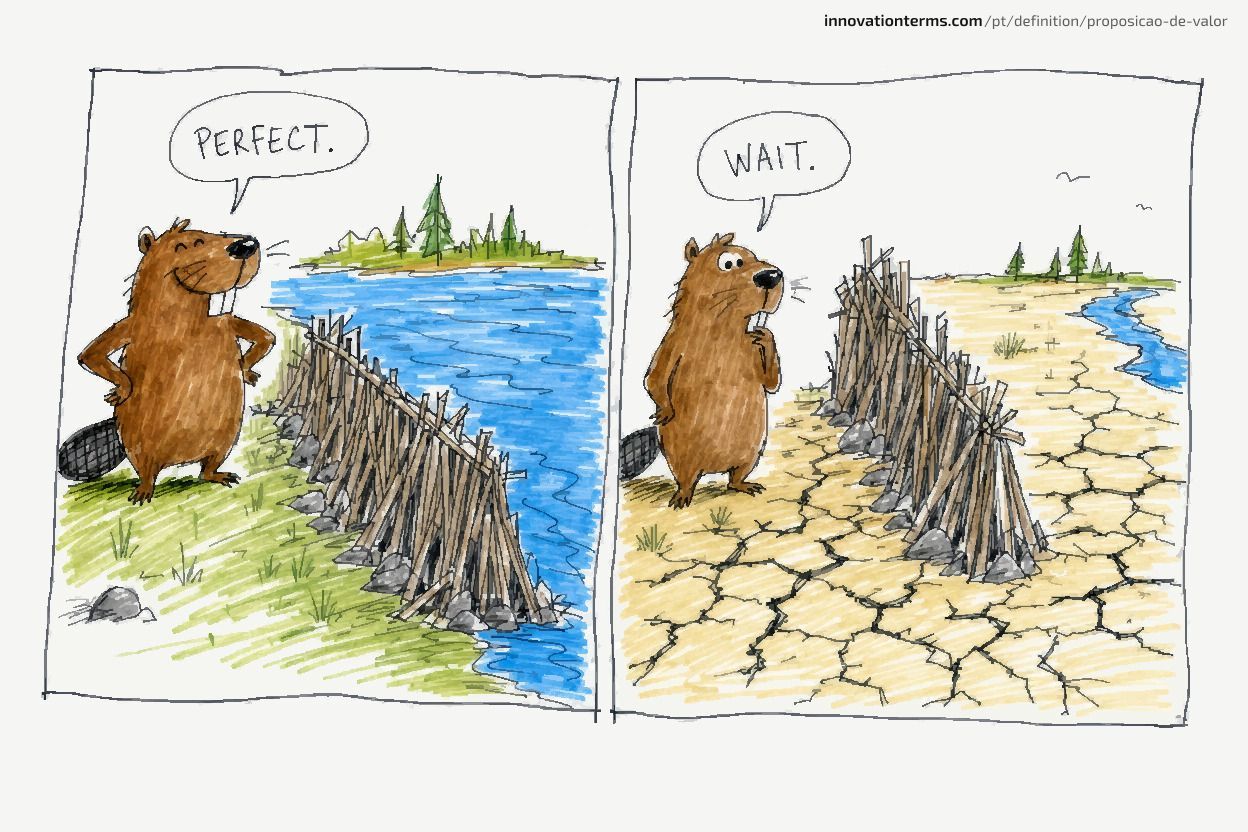
A two-sided marketplace needs two value propositions, one per side, because a single line that satisfies sellers says nothing to buyers, and the platform fails if either side leaves. And Skålén et al.'s 2014 Journal of the Academy of Marketing Science study frames the value proposition as an evolving practice bundle rather than a fixed statement, which is the academic way of saying the same thing operators learn the hard way: a value proposition has a refresh cadence, and treating it as a one-time artifact is how it quietly stops being true.
Value Proposition by the Numbers
Across time periods, market contexts, and methodologies, researchers converge on the same dominant failure mode. The largest single category of startup death is the precise failure a tested value proposition is built to prevent: building something nobody wanted.
| Statistic | What it implies | Source |
|---|---|---|
| 42% of failed startups cite "no market need" (2024 re-analysis reframes the top driver as poor product-market fit at 43%) | The most common way companies die is keeping an untested promise | CB Insights |
| 72% of new product and service innovations fail to deliver on expectations | Most value propositions are wrong about what customers care about | Strategyzer |
| 6–10 decision makers per complex B2B purchase | A single org-wide value proposition cannot satisfy the committee | Gartner |
| ~17% of the B2B buying journey spent with any vendor's reps | The value proposition does its work when you are not in the room | Gartner |
The 42% figure barely moved in a decade, from 42% in the 2014 cohort to 43% in the 2024 re-analysis from CB Insights. That stability is the real signal. This is not an era-specific problem to be solved by a better tool or a hotter market. It is structural, and it is what an unvalidated value proposition looks like counted at scale. For an innovation manager deciding whether to fund the next build increment, the number reframes the question. The risk is not that the value proposition is poorly written. The risk is that it has never been tested.
How Did Slack Build a Value Proposition for Multiple Buyers?
In 2013, software teams coordinated across email, IRC, and scattered message threads at the cost of constant context-switching and lost history, and Slack's value proposition named that specific failure rather than reaching for a generic claim about communication. That precision is why the case holds up as the clearest modern example of a value proposition built as architecture rather than copy, then re-tested as the buying group changed.
The public launch line, "Be less busy," was an aspiration, closer to a tagline than a falsifiable claim. The real value proposition lived in founder Stewart Butterfield's internal memo, "We Don't Sell Saddles Here," circulated two weeks before the preview release:
We're selling organizational transformation. The software just happens to be a necessary part of the larger sale.
— Stewart Butterfield, We Don't Sell Saddles Here (2013)
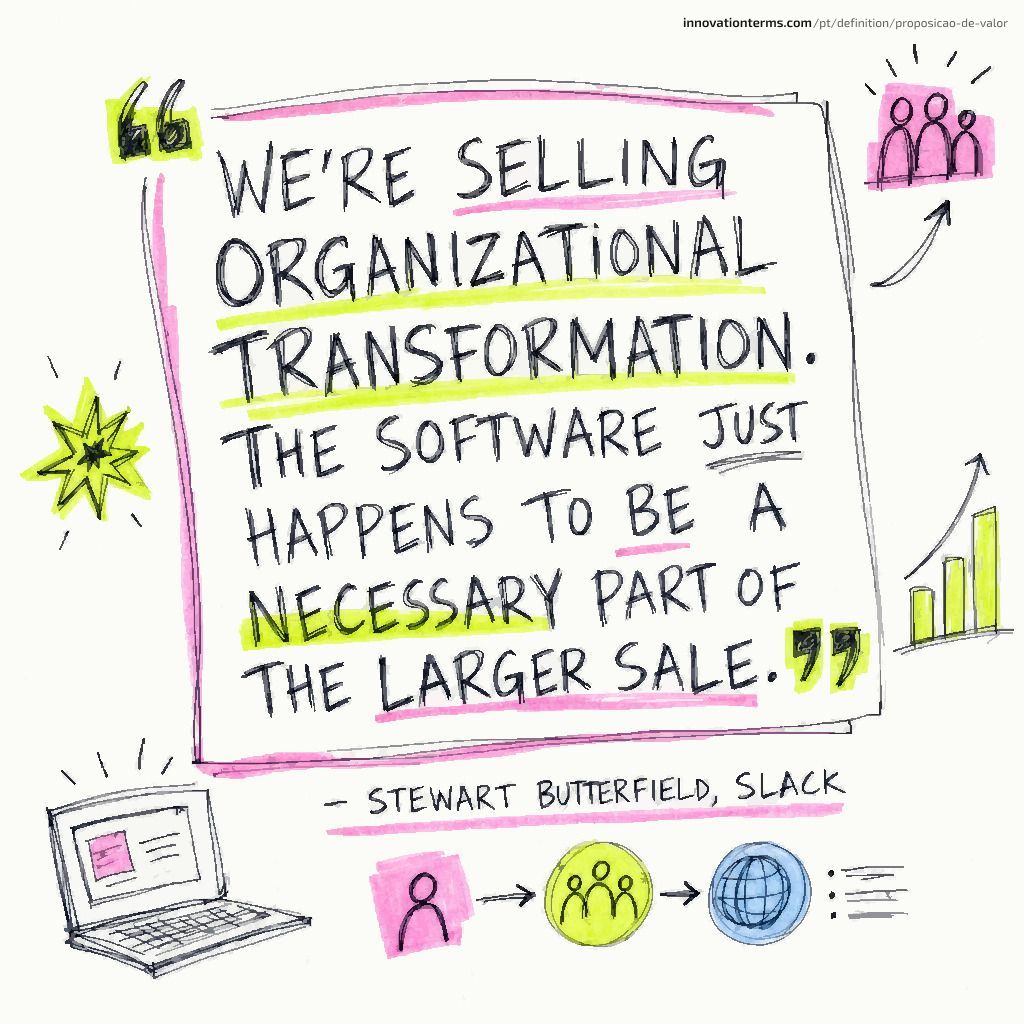
Butterfield's memo anchors the value proposition to a customer outcome (the transformation the customer experiences) rather than the features that produce it. It is Levitt's quarter-inch hole, stated by an operator with a product to ship.
Then the buying group changed. When Slack moved upmarket, the end-user promise (I am less buried in email) did not translate to the IT security buyer (does it meet our compliance bar, does it integrate with SSO) or the finance buyer (what is the return versus the alternative). One value proposition fractured into three role-specific claims sharing a single core: reduce coordination overhead. The benefit stayed constant. The evidence and format adapted per role, which is the multi-stakeholder structure §7 describes, observed in the wild.
TL;DR
- A value proposition names a customer, a job, a benefit, and why it beats the next-best alternative. Drop the fourth and you have a tagline.
- It is a falsifiable economic claim about how the business model creates and keeps value, one that precedes and constrains what marketing communicates. A tagline cannot be wrong. A value proposition can.
- A USP is one communications claim. A value proposition is the full case, with price and business-model fit attached.
- In B2B, 6 to 10 buyers each apply a different lens, so one org-wide line fails. Build a core claim with role-specific variants.
- Test it at three gates (problem-solution, product-market, business-model) before funding the build. 42% of startups die from skipping that.
A value proposition is the specific, testable promise a product makes to a defined customer, anchored to a job and a named alternative, with a benefit and a price attached. The competitor pages treat it as a sentence to polish. The frameworks that built the concept, from Lanning to Porter to Osterwalder, treat it as the claim the whole business model exists to keep. Writing it well is easy. Checking whether it is true is the work, and skipping that check is the most common reason value propositions, and the companies built on them, fail.
Frequently Asked Questions
What is a value proposition in simple terms? A value proposition is a falsifiable customer claim. It is the specific reason a customer would choose a product over the alternative, naming a defined customer, the job they are trying to do, the benefit they receive, and why that benefit beats whatever they would do instead. Any statement a real customer could not prove wrong is a tagline.
What are the four parts of a value proposition? The four parts are the target customer, the job they need to do, the benefit delivered, and the differentiation against the next-best alternative. Teams drop the differentiation clause more than any other. Without it, there is no way to verify whether the claim holds against any real evidence. Remove it and the statement describes a product without promising anything specific.
What is the difference between a value proposition and a USP? A unique selling proposition is a single competitive difference optimized for communication, originating in 1961 advertising practice. A value proposition is the full economic case: target customer, job, benefit, price, and the business-model claim that the company can deliver it. Every value proposition contains a USP. Not every USP is anchored to a full value proposition.
Is a value proposition the same as a tagline or slogan? No. A tagline communicates brand identity and cannot be falsified. A slogan promotes a campaign. A value proposition makes an economic claim that a defined customer gets a specific benefit at a specific price, and it can be proven wrong if the customer does not actually get it. The falsifiability is the whole difference.
How do you write a value proposition? Use a construction scaffold to force specificity, then test the draft. The XYZ format ("We help X do Y by doing Z") exposes vague jobs and mechanisms, and Geoffrey Moore's positioning template adds the product category and the competitive alternative. Both produce a draft to validate with customers, not a finished statement to ship.
What makes a good value proposition? Specificity on all four components, testability against real customer behavior, and alignment with a business model that can actually deliver the promise profitably. The gold standard, especially in B2B, proves the benefit in the customer's own numbers, the way Anderson and Narus quantified value rather than asserting it.
How do you test or validate a value proposition? Run it through three sequential gates: problem-solution fit (do customers have the job or pain it addresses), product-market fit (does the product reliably deliver the benefit), and business-model fit (can the company deliver it profitably). Validation means customers switching and paying at the stated price, not survey approval. A value proposition that passes all three is real.
Ravi @ravi_p
Escreve sobre ecossistemas de startups, experimentos de crescimento e estratégia de produto baseada em evidências.