
Innovator's Dilemma
Quick answer
The innovator's dilemma is the paradox where well-run incumbents fail by serving current customers too well. Learn the conditions, examples, and boundary test.
Innovator's Dilemma [2026]: Definition, Examples & Traps
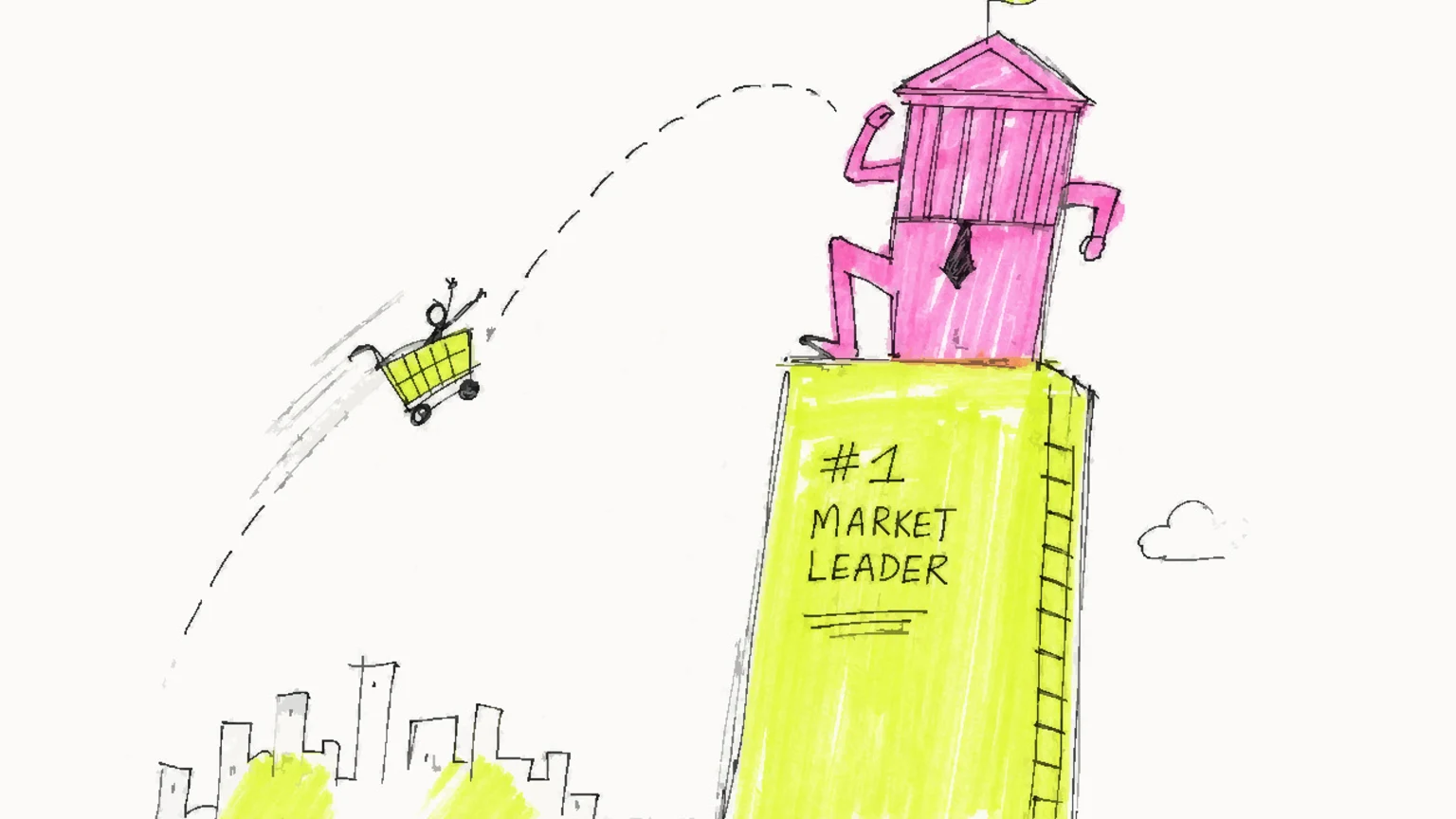
The innovator's dilemma is the paradox that a well-run company can make every rational decision its customers and investors ask for, listening closely, funding profitable lines, and optimizing the core, and still lose market leadership to an entrant that starts with an inferior product. The mechanism is structural: current customers control where capital flows, and they will never allocate budget toward products that underserve their needs. An entrant serving a different, overlooked segment faces no such constraint. It improves unimpeded until its product crosses the "good enough" threshold for mainstream customers. By then, the incumbent's resource allocation process has been doing its job flawlessly — for the wrong market.
That narrow definition matters. The innovator's dilemma applies only when an entrant starts below mainstream performance in an underserved segment and improves faster than the market's evolving needs. Most disruptions celebrated in the business press — Uber, the iPhone, many AI products — don't fit those conditions at all.
Clayton Christensen introduced the term in his 1995 HBR article with Joseph Bower and developed it fully in his 1997 book. The theory has since been applied to nearly every competitive shock in every industry, which has made it both famous and largely useless for prediction.
TL;DR
The innovator's dilemma is a structural trap: well-run incumbents lose leadership because their best customers and capital processes push them upmarket, away from entrants that start below mainstream performance and improve faster than market needs. Sustaining innovation serves existing customers; disruptive innovation climbs from overlooked segments.
- The innovator's dilemma is not a verdict on management competence. Incumbents fail because good customers and good capital processes push them upmarket, away from low-end threats.
- Sustaining innovation improves products for existing customers. Disruptive innovation starts below mainstream needs in an overlooked segment, then improves until it invades the core market.
- Uber, the iPhone, and most AI products do not fit Christensen's definition of disruption. Using the label loosely destroys its predictive value.
- Empirical research on the hard-disk industry confirms the core prediction: cannibalization fear explains at least 57% of the innovation gap between incumbents and entrants. Igami (2017)
- Incumbents can respond by creating autonomous business units with independent resource streams — not by asking the profitable core to cannibalize itself.
What is the Innovator's Dilemma?
The innovator's dilemma is the paradox that a well-managed company can make every rational decision its customers and investors demand and still lose market leadership to an entrant that starts with an inferior product. The trap only springs when the entrant targets an underserved segment and improves faster than mainstream needs grow. When a disruptive entrant improves faster than the market's needs, well-managed companies can fail because their investment process keeps steering resources toward the core. The firm is not asleep. Its processes are working exactly as designed — filtering investment toward products that earn the best margins from the best customers. The entrant exploits the gap that process leaves at the bottom.
Christensen's canonical formulation: doing the right thing is the wrong thing. Wikipedia The same decisions that drove past success, especially listening to customers and investing in profitable segments, systematically prevent the incumbent from responding to threats that look unattractive at first. MIT Sloan researchers confirmed the bind: good managers, following every sound principle, build a blind spot for disruptive rivals by design. King & Baatartogtokh (2015)
Three boundary conditions determine whether the innovator's dilemma actually applies to a given situation Christensen, Raynor & McDonald (2015):
- The entrant targets nonconsumers or customers who are overserved by the incumbent's current offering.
- The entrant's initial offering is measurably worse than the incumbent's on the dimensions mainstream customers care about.
- The entrant improves along a trajectory that outruns the market's ability to absorb the incumbent's performance — eventually becoming good enough for mainstream customers while the incumbent has moved further upmarket.
All three conditions must hold. When they do, the incumbent's rational response to its best customers produces a structural blind spot that cannot be fixed by better management. When they don't hold, a different theory of competitive threat applies.
Christensen himself stated this clearly in his Christensen Institute video: Christensen Institute video
"A disruptive innovation is not a breakthrough innovation that makes good products a lot better but it has a very specific definition and that is it transforms a product that historically was so expensive and complicated that only a few people with a lot of money and a lot of skill had access to it. A disruptive innovation makes it so much more affordable and accessible that a much larger population have access to it."
A disruptive innovation starts by serving people who previously had no access — not by attacking the incumbent's core customers directly.
For internal navigation: disruptive innovation, sustaining innovation, disruptive technologies.
Where did the idea come from?
Clayton Christensen developed the theory by studying the hard-disk drive industry between 1976 and 1993, where well-run incumbents repeatedly failed because they followed their best customers upmarket. The 1995 HBR article with Joseph Bower introduced the term 'disruptive technologies,' and the 1997 book expanded it into a general framework. Christensen developed the theory by studying an industry where competent management was not the variable: the hard-disk drive industry between 1976 and 1993. What he realized was that the companies that failed were not badly led. They were managed well — for the wrong market.
Bower and Christensen first introduced the term "disruptive technologies" in a 1995 HBR article. Their opening observation laid out the empirical puzzle that would become the book: Bower & Christensen (1995)
"One of the most consistent patterns in business is the failure of leading companies to stay at the top of their industries when technologies or markets change. Goodyear and Firestone entered the radial-tire market quite late. Xerox let Canon create the small-copier market. Bucyrus-Erie allowed Caterpillar and Deere to take over the mechanical excavator market. Sears gave way to Walmart."
The disk-drive dataset was unusual in its precision: a succession of drive form-factors — 14-inch to 8-inch to 5.25-inch to 3.5-inch — the script never changed story repeatedly in a single industry over roughly fifteen years, with panel data tracking each firm through multiple transitions. Wikipedia Each transition was led by new entrants. In each case, the incumbent could see the entrant technology. In each case, incumbent customers told them not to bother with it. Seagate dominated the 5.25-inch market, then missed 3.5-inch — not because it lacked engineering talent, but because its most profitable OEM customers had no use for the smaller drives when they first appeared. Desktop minicomputers and early laptops were a thin, marginal market. The entrant's product wasn't better; it was smaller, lighter, and cheaper — qualities the existing customer base explicitly didn't value yet.
Christensen published The Innovator's Dilemma in 1997. The book connected the disk-drive observations to a broader theory of resource allocation and customer influence, and introduced the term that would be applied — and misapplied — to nearly every industry disruption story in the decades that followed.
The research backdrop matters because it explains the theory's scope. Christensen did not build a general theory of competitive failure. He built a theory of what happens when an entrant enters below the mainstream market in an underserved segment and improves faster than the market's evolving performance demands. That scope is specific. The disk-drive industry provided 15 years of clean data for exactly that pattern.
What is the difference between sustaining and disruptive innovation?
Sustaining innovation improves products for a company's existing customers along dimensions they already value. Disruptive innovation starts by serving a different, lower-performance segment, then improves until it invades the incumbent's core market. The diagnostic question is whether the entrant's initial customers overlap with the incumbent's most profitable customers. Sustaining innovation serves the customers a company already has by improving the performance dimensions they already value. It makes a good product better for the people already paying for it. Disruptive innovation starts by serving a different, lower-performance segment, then improves until it invades the incumbent's core market.
The issue comes down to three questions: Who are the earliest customers? Is the initial product better or worse on mainstream metrics? And which trajectory is faster — the entrant's improvement, or the market's rising performance demands?
Dimension
Sustaining Innovation
Disruptive Innovation
Target customer
Existing, profitable mainstream customers
Nonconsumers or overserved low-end customers
Initial performance
Better than current offerings on existing metrics
Worse than incumbent on mainstream metrics
Improvement trajectory
Incremental; follows customer requests
Faster than market needs; eventually overshoots mainstream
Incumbent response
Effective; incumbents win most sustaining battles
Ineffective; rational response amplifies the threat
Example
Hard-disk drives with increasing capacity for servers
3.5-inch drives for early laptops and portables
Incumbent vulnerability
Low — incumbents are motivated to invest
High — entrant's early customers are not worth fighting for
Incumbents are very good at sustaining innovation. Christensen, Raynor & McDonald (2015) When a new generation of drive technology offered higher storage density for existing server buyers, the leading disk-drive companies led those transitions. The dilemma only emerges when the new offering starts below mainstream standards and serves a market the incumbent has no economic reason to enter.
Where incumbents do defend successfully — Intel held off AMD's desktop processor challenges through each Pentium and Core generation — the entrant came in at mainstream performance, not below it. AMD had to meet the same performance bar from day one, so Intel's standard sustaining R&D was sufficient to maintain its position. The key diagnostic is whether the entrant's initial customers overlap with the incumbent's most profitable customers. Christensen Institute
What are the two types of disruptive innovation?
Christensen identifies two paths: low-end disruption targets overserved low-end customers with a cheaper 'good enough' offer, and new-market disruption creates access for nonconsumers who previously had no option. Both share the same trajectory: initial underperformance on mainstream metrics, faster improvement than demand growth, and eventual mainstream invasion. The first path targets overserved low-end customers; the second creates a market among nonconsumers. Wikipedia
Type
Entry Point
Mechanism
Classic Example
Low-end disruption
Overserved low-end customers
Entrant offers "good enough" at lower cost; incumbent retreats upmarket
Steel mini-mills (Nucor vs. integrated mills)
New-market disruption
Nonconsumers; no existing market
Entrant creates access where none existed; incumbent has no market to defend
Personal computers (vs. mainframes/minicomputers)
Low-end disruption
Low-end disruption enters at the least profitable tier of an existing market. The incumbent's most profitable customers are at the high end; the low end generates thin margins and is often underserved through neglect. The entrant offers a product that mainstream customers would find inadequate, but that the low-end segment finds "good enough" at a price point the incumbent can't match without destroying its own margins.
Nucor's steel mini-mills in the 1970s are the canonical example. Wikipedia Mini-mills used electric arc furnaces to recycle scrap steel — cheaper to build, cheaper to operate, but producing lower-quality steel. Integrated mills (US Steel, Bethlehem) were happy to cede the rebar market to mini-mills; it was low-margin commodity business. Mini-mills improved over time and moved up the quality ladder into structural steel, then sheet steel. By the time they reached the integrated mills' core markets, they had a decade of cost-structure advantage.
New-market disruption
New-market disruption doesn't take customers from the incumbent — it creates them. The initial buyers are nonconsumers who previously lacked access due to cost, complexity, or geography. The incumbent literally has no customers to lose in this segment because the market didn't exist before. Christensen Institute
Personal computers disrupted mainframes and minicomputers along this axis. The first Apple II buyers were not migrating from an IBM mainframe. They were students, hobbyists, and small-business owners who had never had access to computing power. IBM and DEC initially had no reason to compete — their customers were enterprise IT departments that needed far more than a desktop machine could provide. By the time the desktop's performance curve reached enterprise capability, the PC makers had 15 years of manufacturing scale and channel distribution the minicomputer companies couldn't replicate.
The Christensen Institute's current six-question checklist operationalizes both types: the first three questions gate on nonconsumers or overserved customers, simpler-or-cheaper design, and an improvement trajectory that follows a different performance dimension than the incumbent's. Christensen Institute
Why do well-managed incumbents ignore disruptive threats?
Incumbents ignore disruptive entrants not because managers are blind, but because current customers control the resource-allocation process. Customers request better performance on existing dimensions, not worse products for unfamiliar segments. Capital-market metrics such as ROIC and RONA reinforce the bias by rewarding efficiency in the core over investment in uncertain new markets. Stop calling incumbents blind. The resource allocation process is doing its job: money moves upstream because the best customers never ask for worse products, and the entrant's market fails every financial screen. Bower & Christensen (1995)
Bower and Christensen named this the resource-dependence problem in 1995, rooted in what Christensen called the incumbent's value network — the interlocking set of customers, suppliers, and financial metrics that together define which investments look rational. The customer-facing teams translate customer feedback into resource requests. Customers tell them what they need: more performance and better reliability inside the systems they already run. They never ask for a worse product that costs less and serves a market the incumbent doesn't yet serve. Budget flows in the direction of customer demand, which is always upmarket.
Clayton Christensen stated the causal mechanism directly in his Oxford lecture: Oxford Saïd lecture
"The causal mechanism behind this phenomena that we call the innovator's dilemma is the pursuit of profit. If you think you can beat the giant by making better products that you could sell for better profits to the giant's best customers, they'll get you."
The logic is precise. An incumbent competing in the entrant's initial market would have to accept lower margins, compete in a smaller market, and produce a product its best customers don't want. That is not a description of managerial failure. It is a description of rational resource allocation doing exactly what it is supposed to do.
Christensen and van Bever added a capital-markets layer in 2014, calling it the capitalist's dilemma: the investment tools used to guide capital reward efficiency over deployment, making any disruptive bet look like a mistake under standard metrics. Christensen & van Bever (2014) Metrics like ROIC and RONA — which became the dominant performance measures through the 1980s and 1990s — reward capital efficiency over capital deployment. A disruptive bet requires deploying capital into a market that will earn below-average returns for years. Under those metrics, the decision to pass looks like discipline.
One named example of an incumbent that killed a promising project due to customer pressure: Seagate Technology. The company had engineers working on the 3.5-inch drive in the mid-1980s but could not get internal funding because its major OEM customers — desktop PC makers — wanted larger-capacity 5.25-inch drives. Wikipedia Christensen (1997) Seagate's marketers showed prototypes to existing desktop customers, found little interest, and senior managers shelved the program. The initiative later resurfaced through Conner Peripherals, a 1987 spin-off of Seagate and Miniscribe engineers that became one of the leading 3.5-inch suppliers. Seagate eventually acquired Conner, but paid a premium for what its own engineers had built.
How does the technology trajectory make the trap inevitable?
The trap becomes inevitable when an entrant's performance improvement trajectory outruns the market's rising demand. Once the entrant reaches 'good enough' for mainstream customers, additional performance from the incumbent earns little premium while the entrant's cost advantage compounds. Incumbents can see the threat but cannot economically pursue it. The S-curve trap isn't just about the incumbent's blindness. It's about the geometry of the threat.
Christensen's trajectory argument has two curves. The first tracks how fast a technology improves in performance over time — measured on whatever dimension the market cares about (storage capacity, processing speed, cost per unit). The second tracks how fast the market's performance demands rise over time. If the entrant's improvement trajectory runs above the market's demand curve, the entrant will eventually exceed what mainstream customers need, even without targeting them directly. Christensen, Raynor & McDonald (2015) Christensen (1997)
The "good enough" threshold crosses when the entrant's performance curve intersects the market's demand line. Before that crossing, the entrant's product is simply inferior. After it, the entrant can serve the mainstream at a cost structure the incumbent cannot match without dismantling its own business model.
The disk-drive industry gives the cleanest data. Between 1981 and 1998, areal density in hard drives surged by around 50% per year — comfortably ahead of the storage requirement increases for any given customer segment. Igami (2017) Each successive form-factor entrant didn't need to match the incumbent immediately; it needed to improve faster than the market's needs grew. The math did the rest.
Incumbents often had the technical capability to match the entrant. The constraint was not engineering; it was the economic logic governing incumbents. Launching the new product would slow demand for the existing high-margin product. The entrant did not face that constraint; it had nothing to cannibalize.
Cannibalization explains at least 57% of the gap between how fast incumbents and entrants innovate. That gap is not managerial complacency. It is the logical outcome of serving profitable customers well.
The "good enough" concept clarifies when the crossing becomes dangerous. Customers have a performance level they need, and performance above that level earns a diminishing premium. Once an entrant reaches "good enough" for the mainstream, additional performance from the incumbent earns almost nothing — but the entrant's cost advantage continues to compound. The incumbent is selling more product than the market needs, at margins the market will no longer support. Christensen, Raynor & McDonald (2015)
Mini-case: How Netflix escaped late fees and redefined video rental
Netflix entered below Blockbuster's mainstream offering on immediacy, served customers overserved by late fees, and improved along a trajectory of selection, convenience, and streaming that Blockbuster's store economics could not match. By 2005 Netflix had 4.2 million subscribers; Blockbuster's elimination of late fees in 2004 cost roughly $400 million in operating income. In 2000, Blockbuster generated roughly $800 million a year in late fees and extended viewing fees — close to 16% of total sales. By 2004, late fees were pulling in an estimated $400 million each year in operating income alone, about 40% of its ~$1 billion in total operating income on $6 billion in revenue. Phan (2025) Stratrix (2025)
What Blockbuster was actually doing — and how Netflix entered below it
Blockbuster's late fees were not an oversight or a customer-hostile choice. They were a structural feature of the in-store rental model: without them, inventory management became impossible. A store carrying 50 copies of a new release needed those copies back within 48 hours to serve the next wave of customers. The late fee was a demand-management tool. Customers hated it, but Blockbuster's best customers — frequent renters of new releases — had nowhere else to go.
Netflix launched its DVD-by-mail subscription service in late 1999. Netflix 2005 10-K The initial offering was strictly worse than Blockbuster on the dimension Blockbuster's core customers cared about most: immediacy. You couldn't watch a movie tonight if you decided you wanted one at 7 PM. Delivery took days.
Netflix targeted a different customer: the overserved late-fee payer. These customers didn't rent impulsively. They planned ahead, watched whatever arrived in the mail, and had been effectively penalized by Blockbuster's return-enforcement economics. Netflix's unlimited rental plan with no late fees was not better for Blockbuster's core customer. It was far better for the customer Blockbuster had decided was worth annoying.
The trajectory
Netflix improved along a different performance dimension than Blockbuster measured itself on. Its selection grew. Its recommendation engine improved. Its delivery time shortened as fulfillment centers expanded. By December 31, 2005, Netflix had grown from 2.6 million to 4.2 million subscribers. Netflix 2005 10-K
Blockbuster responded in 2004 by eliminating late fees — which cost it that $400 million in operating income, an act of financial self-harm required to compete with an entrant it had previously dismissed as serving a marginal market.
The causation point
Blockbuster's late fees were $400 million a year in operating income — 40% of the company's total. Netflix didn't beat them by hiring smarter managers. It served the customers Blockbuster had decided were worth alienating. It then improved along a trajectory Blockbuster's economic model couldn't follow. Streaming — which Netflix pivoted to in 2007 — was a separate transition, but by then Netflix had a subscriber base, a brand, and a cost structure built for content-as-service rather than content-as-inventory.
Christensen, Raynor, and McDonald confirmed the Netflix case fits the low-end disruption pattern in their 2015 HBR article: Netflix entered below mainstream performance on immediacy, served overserved late-fee customers, and improved along a trajectory — selection, convenience, then streaming quality — that Blockbuster's store economics couldn't replicate. Christensen, Raynor & McDonald (2015)
What are the classic examples and what do they show?
Disk drives, steel mini-mills, Kodak, and Netflix illustrate the mechanism where entrants enter below mainstream performance, improve faster than market needs, and displace incumbents. They also show the theory's limits: the model works best when performance is measurable and segments are distinct; it over-predicts when boundary conditions are absent. Three cases beyond Netflix illustrate different facets of the mechanism — and also show where the model's explanatory power is strong versus contested.
Hard-disk drives (1976–1993)
The disk-drive industry is still the cleanest empirical test of the theory because the same pattern repeated across multiple generations. Wikipedia Each transition — 14" to 8" to 5.25" to 3.5" — involved new entrants entering a segment the dominant supplier's customers didn't value, improving faster than those customers' needs, and ultimately displacing the dominant supplier.
Seagate led the 5.25-inch market. Conner Peripherals (founded by former Seagate engineers) led the 3.5-inch market. Seagate eventually acquired Conner — but at market rates, having ceded the laptop drive market entirely during the transition.
Kodak and digital photography
Kodak is often cited as the canonical Innovator's Dilemma failure. The more accurate account is more complicated. Kodak engineers invented the first digital camera in 1975. The company held significant digital camera patents and launched consumer digital products in the 1990s. What it couldn't escape was the economics: Kodak's Photography segment reported roughly $1.43 billion in operating profit in 2000, and film remained the high-margin core that digital would have to replace dollar-for-dollar. Every digital camera dollar earned that replaced film revenue was a lower-margin replacement. Gavetti (2003)
Kodak was trapped not by blindness but by the same capital-efficiency logic Christensen and van Bever described: the tools used to assess investment performance made the film-to-digital transition look like a value-destroying move for years before it became survival-critical.
The Kodak case is a partial fit for the Innovator's Dilemma model — digital photography eventually served the same mainstream customers, which doesn't perfectly match the "underserved segment first" condition. The strategic implication follows from that partial fit: Kodak's failure wasn't purely a resource-allocation problem. Part of the issue was architectural: a business model built around consumables no longer fit a digital world, so an autonomous unit alone could not solve it.
Nucor and steel mini-mills
Nucor's rise through the steel industry followed the low-end disruption path precisely. Wikipedia Christensen (1997) Mini-mills entered at the bottom with commodity-grade rebar — a product the integrated mills were happy to exit because the margins were thin. Nucor tightened up its process, then climbed into structural steel and later flat-rolled sheet steel. Each move invaded a low-margin market the integrated mills had assumed was safe.
The counter-case: US Steel and Nucor coexist today. Not every disruptive entrant eliminates the incumbent. Where incumbents serve customer segments the entrant can't profitably reach — ultra-high-specification steel for aerospace, for instance — they retain defensible positions. The Innovator's Dilemma predicts market-leadership transfer in the disrupted segment, not industry elimination.
What are the most common misconceptions about disruptive innovation?
The term has been stretched to cover Uber, the iPhone, AI chatbots, and every industry shock, but most of these do not fit Christensen's definition. True disruption requires an entrant to start below mainstream performance in an underserved segment and improve faster than market needs; otherwise the label misleads strategy. The term "disruptive innovation" has been applied to every competitive shock in the business press for 25 years. The result: a concept that once predicted something now predicts nothing. Naughton (2014) Here are the four most common misapplications.
Myth 1: Uber is a disruptive innovation. Reality: Christensen, Raynor, and McDonald stated explicitly in their 2015 HBR article that Uber is not a disruptive innovation under the theory's definition. Christensen, Raynor & McDonald (2015) Uber entered the premium segment of the taxi market with a superior product. Its first customers were people who could already afford taxis and wanted a better experience. It did not start below mainstream performance in an underserved segment and work its way up. It entered at the top and stayed there. By the logic of disruptive innovation theory, the right term for what Uber did to taxi companies is "sustaining attack from a better-capitalized competitor."
Myth 2: The iPhone disrupted Nokia. Reality: The iPhone launched at $499 — significantly more than a mainstream Nokia handset. It was better on nearly every dimension mainstream smartphone customers cared about from day one. Gans (2015) As Joshua Gans wrote in 2015: "There is no such thing as high-end disruption, only high-end entry." Gans (2015) What the iPhone did to Nokia is better explained by Henderson and Clark's architectural innovation model — a redesign of the product's architecture that made Nokia's existing capabilities (manufacturing scale, carrier relationships, feature-phone software) irrelevant — rather than a low-end entry that crept upmarket.
Myth 3: AI/LLMs represent the classic Innovator's Dilemma for Google. Reality: This is the most current version of the misapplication, and it's worth examining directly. Packy McCormick stated it clearly in 2023: McCormick (2023)
"What people are missing in the analysis is that LLMs, and the products like ChatGPT built on top of them, aren't a disruptive innovation – they don't underperform on things that matter to mainstream customers and make it up by serving a small new or low-end niche well – but a superior product across nearly all dimensions."
ChatGPT did not enter the market by serving people who couldn't use Google Search. It entered by offering a better experience for many mainstream queries from day one. Google's hesitation to deploy competing products at scale was partly real — ad revenue was 80% of its income — but that is the capitalist's dilemma, not the innovator's dilemma. The distinction matters because the strategic response is different.
Myth 4: Every industry disruption is an Innovator's Dilemma. Christensen, Raynor, and McDonald stated this directly in their 2015 HBR article: Christensen, Raynor & McDonald (2015)
"The problem with conflating a disruptive innovation with any breakthrough that changes an industry's competitive patterns is that different types of innovation require different strategic approaches."
The lessons that apply to a genuine disruptive challenge will not apply to a sustaining attack or an architectural redesign. Applying the Innovator's Dilemma label to every competitive shock leads to the wrong prescribed response.
Most 'disruptive' winners hailed today are not true Innovator's Dilemma cases; Uber, the iPhone, and most AI chatbots entered the market at the top, not the bottom, and the theory cannot explain them.
The Christensen Institute's six-question diagnostic is the cleanest available tool for boundary-testing a claimed disruption. Christensen Institute The first two questions — does it target nonconsumers or overserved customers, and is the initial offering worse on mainstream metrics — eliminate the vast majority of high-profile "disruptions" from consideration.
By the numbers: What does the evidence actually say?
Empirical work on hard-disk drives confirms the core prediction: Mitsuru Igami's 2017 structural analysis found cannibalization explains at least 57% of the incumbent-entrant innovation gap. Broader tests find the theory over-predicts incumbent failure when analysts apply it to cases where one or more boundary conditions are missing. The innovator's dilemma is one of the most cited theories in management, and one of the least empirically tested. The disk-drive industry provides the closest thing to a controlled experiment. Mitsuru Igami's 2017 paper in the Journal of Political Economy is the most rigorous structural analysis of that dataset. Igami (2017)
"The results suggest that despite strong preemptive motives and a substantial cost advantage over entrants, cannibalization makes incumbents reluctant to innovate, which can explain at least 57 percent of the incumbent-entrant innovation gap."
This finding is worth unpacking. Igami estimated a structural model of the disk-drive industry covering 1981–1998 — 17 years, multiple form-factor transitions, dozens of firms. The key result: incumbents wanted to preempt entrants (they had strong incentives to innovate first) and they could have out-competed on cost (they had manufacturing scale). The reason they didn't was cannibalization: introducing the new product would reduce demand for their existing high-margin products. That cost exceeded the benefit of preemption.
Key numbers from the evidence base: cannibalization accounts for ≥57% of the incumbent-entrant innovation gap (Igami 2017, JPE); the study covered 1981–1998, 17 years of form-factor transitions; areal density improved roughly 50% per year across that period; Blockbuster's late-fee operating income peaked at ~$400M/year; Kodak's film gross profit reached $1.3B in 2000 before the digital transition began consuming it. Igami (2017) Phan (2025) Naughton (2014)
King and Baatartogtokh, writing in MIT Sloan Management Review in 2015, tested Christensen's predictions against 77 cases. King & Baatartogtokh (2015) Their finding: Christensen's disruption narrative applied fully to fewer than 10% of cases, partially to about 25%, and did not apply at all to the majority. The cases where it failed were disproportionately ones where the "disruption" entered at the high end (like the iPhone) or where the incumbent successfully adapted (like Intel).
The empirical picture is not mixed in a way that discredits the theory; it is mixed in a way that confirms its boundaries. Igami's work confirms the core mechanism in the hard-disk industry where all three conditions hold cleanly. King and Baatartogtokh's broader test finds the theory over-predicts incumbent failure across industries precisely because analysts apply it to cases where one or more conditions are absent. The boundary-condition argument is the reconciliation: when all three conditions hold, the mechanism operates as predicted; when they don't, a different failure mode — architectural, business-model, or sustaining attack — is at work, and applying the Innovator's Dilemma playbook prescribes the wrong response.
What are the main criticisms and limitations?
Critics argue Christensen's evidence base was narrower than the book's confident tone implied, the term is overused, and the theory does not explain high-end entry or architectural innovation. The strongest critiques sharpen the boundary conditions rather than invalidate the mechanism: apply the model where the data hold and resist overextension. Christensen's theory has attracted serious critics, not just business-press skeptics. Three lines of criticism are worth engaging.
Jill Lepore's historical objection
Lepore's 2014 New Yorker essay, "The Disruption Machine," is the most visible critique. Her central argument is about evidentiary standards: Lepore (2014)
"Disruptive innovation as a theory of change is meant to serve both as a chronicle of the past (this has happened) and as a model for the future (it will keep happening). The strength of a prediction made from a model depends on the quality of the historical evidence and on the reliability of the methods used to gather and interpret it. Historical analysis proceeds from certain conditions regarding proof. None of these conditions have been met."
Lepore argued that Christensen's disk-drive cases were cherry-picked, that companies he cited as failures had not in fact failed, and that the theory's predictive record was essentially untested at the time of the book's publication. Her piece provoked a sharp response from Christensen and a sustained public debate about evidentiary standards in management theory.
Markides's definitional objection
Constantinos Markides argued in 2006 that Christensen's concept had been stretched beyond its explanatory power. Markides (2006) Markides distinguished three innovation types — disruptive product, business-model, and radical — arguing Christensen's mechanism was built for low-end and new-market product disruption specifically, and applies poorly to the other two. When a business observer sees a company wrestling with a "disruption challenge," the starting point has to be which type of innovation is actually involved. The strategic response differs significantly across the three.
King and Baatartogtokh's predictive-power test
The 2015 MIT Sloan study by King and Baatartogtokh represents the most systematic empirical challenge. King & Baatartogtokh (2015) Testing Christensen's 77 claimed disruptive-innovation examples, they found that a majority did not follow the predicted trajectory. Incumbents adapted more often than the theory predicts. Performance overshooting — Christensen's term for when an entrant's improvement curve outruns what the mainstream market actually needs — was less common than the model implies.
Don't throw the theory out; tighten its conditions instead. Apply it where the data hold, resist the urge to label every challenge disruptive, and let the right model guide the right response.
What are the edge cases and boundary conditions?
The Innovator's Dilemma is one incumbent-failure mechanism among several. Architectural innovation, business-model innovation, and sustaining attacks from better-capitalized competitors follow different logics. A four-question diagnostic — target segment, initial performance, improvement trajectory, and resource-allocation fit — distinguishes genuine disruptive threats from other competitive challenges. Don't diagnose every failure as the Innovator's Dilemma; match the threat to its true type and pick the playbook that fits the mechanism.
Architectural innovation (Henderson & Clark, 1990)
Henderson and Clark described a different failure mode: architectural innovation, where a new design reconfigures the relationships between existing components without changing the components themselves. Henderson & Clark (1990) The incumbent's capabilities are not obsolete — they're simply not assembled in the right way for the new design. The iPhone's disruption of Nokia fits this model better than Christensen's: Nokia's manufacturing, carrier relationships, and battery technology were individually strong, but the smartphone required a different system architecture (touchscreen OS, app ecosystem, direct-consumer relationship) that Nokia's modular organization couldn't recombine quickly.
Business-model innovation (Markides, 2006)
Southwest Airlines' disruption of legacy carriers was not a Christensen-style disruption. It didn't start by serving underserved low-end customers; it offered a better product (point-to-point routes, lower fares, faster turnaround) by restructuring the cost model. Markides (2006) The mechanism was business-model innovation, not low-end entry followed by upmarket improvement. Legacy carriers' challenge in responding was mimicry — hub-and-spoke economics made the low-cost structure very hard to adopt without cannibalizing core revenue.
Classifying threats: the four-question diagnostic
Rather than a static table, a direct decision sequence works better. Does the entrant target nonconsumers or overserved low-end customers? Is its initial product measurably worse on mainstream performance metrics? Is its improvement trajectory faster than market demand growth? Does the incumbent's resource-allocation process systematically filter out that market? Matching all four conditions points to a genuine Innovator's Dilemma — and the autonomous unit response. Anything short of all four suggests architectural or business-model innovation instead, each requiring a different strategic playbook.
The AI/LLM case
The boundary test applied to AI products in 2023–2026 produces a verdict that is clear for the high-profile cases and nuanced only at the margins. ChatGPT, Claude, and Gemini entered as superior products for mainstream use cases — they are not Innovator's Dilemma cases, and calling them one directs incumbents toward the wrong playbook. The genuinely disruptive edge is narrower: cheap, purpose-built models serving buyers who previously couldn't afford expert knowledge or analytical tools do fit the new-market disruption pattern. That distinction matters strategically. As McCormick noted, applying the Innovator's Dilemma label to the flagship LLMs misleads both incumbents and entrants about the nature of the threat and the appropriate response. McCormick (2023)
How can incumbents respond without abandoning their core business?
The prescribed response is an autonomous business unit with independent resources, customers, and metrics, free from the core's resource-allocation process. The unit must match the threat type: autonomous for genuine disruption, ring-fenced funding for early-stage threats, acquisition for cost-model advantages, and direct competition for sustaining attacks. The Innovator's Dilemma has a prescribed response, and it's not "be more agile" or "foster a culture of innovation." The theory points managers to a specific diagnosis: current customers control the resource allocation process. From there, leaders should give the disruptive bet a resource allocation process that current customers don't control.
Christensen and Raynor outlined the response architecture in The Innovator's Solution (2003). The key instrument is the autonomous business unit: a separate team with its own P&L and customer base. Christensen & Raynor (2003)
The logic:
- The core business unit cannot successfully pursue a disruptive market because its resource allocation process will always deprioritize it in favor of higher-margin sustaining work.
- An autonomous unit can be assigned a mission that would be irrational for the core — serving a small, low-margin market — because it isn't competing for resources against a profitable core.
- The autonomous unit can iterate on the disruptive product without the constraint of maintaining compatibility with the core's customers or revenue model.
The jobs-to-be-done connection
The Innovator's Solution also introduced a practical tool for identifying which disruptive market to target: the jobs-to-be-done framework. Christensen's formulation was that customers don't buy products; they hire them to do a job. An autonomous unit targeting a disruptive market needs to identify the job nonconsumers or overserved customers are trying to do — and that the incumbent's current offering does poorly. Christensen & Raynor (2003)
As one account of the framework's origin summarizes: Christensen declared that "understanding the customer really means understanding the underlying job they are trying to get done." Christensen & Raynor (2003) Netflix understood that overserved customers wanted to watch a movie without being penalized for returning it late. The job wasn't "watch a movie tonight"; it was "watch movies regularly without financial anxiety." DVD-by-mail served that job in a way Blockbuster's late-fee model structurally couldn't.
Named cases
IBM PC Division (1980): IBM launched the PC business unit in Boca Raton, Florida — geographically and organizationally separate from IBM's mainframe and minicomputer divisions. The unit had authority to source components from outside IBM and sell through its own channels, freedoms no IBM division had at the time. Christensen (1997) It shipped a product in August 1981 that IBM's own customers initially didn't ask for. The PC went on to cannibalize IBM's minicomputer revenue, but the autonomous structure allowed IBM to establish market presence before the trajectory crossed the mainstream threshold.
Xerox PARC failure: The counterexample is Xerox's Palo Alto Research Center, which invented the graphical user interface, the laser printer, and Ethernet in the 1970s, but lacked an autonomous unit structure to commercialize any of them. Innovations developed at PARC had to pass through Xerox's existing business units for commercialization — which meant they had to make sense to Xerox's copier sales force and large-enterprise customers. Most didn't, and the technologies were eventually commercialized by Apple, Adobe, and others. The diagnostic for PARC's failure is direct: a unit that must route its inventions through the core for commercialization is not autonomous. It is a funded R&D lab with no independent path to market.
For teams building internal ventures, the jobs-to-be-done framework and the disruptive strategy playbook provide the operational tools that The Innovator's Solution introduced.
FAQ
Why do successful companies fail if they do everything right?
Because "doing everything right" is defined by current customers, who direct capital toward higher performance on existing dimensions. When an entrant enters an underserved segment below mainstream performance, those customers never request a response. By the time the entrant's trajectory crosses into the mainstream, the incumbent has spent years optimizing for the wrong curve. The failure is the output of correct management. Wikipedia King & Baatartogtokh (2015)
What is the difference between sustaining and disruptive innovation?
Sustaining innovation improves a product for existing, profitable customers. Disruptive innovation starts below mainstream performance thresholds, serving nonconsumers or overserved customers, then improves faster than the market's needs until it reaches the mainstream. Incumbents typically win sustaining battles and lose disruptive ones, for structural reasons rooted in resource allocation. Christensen, Raynor & McDonald (2015)
Is Netflix an example of the Innovator's Dilemma?
Yes, among the clearest cases. Netflix entered below Blockbuster's mainstream offering on immediacy, served customers overserved by late fees, and improved along a trajectory — selection, convenience, streaming quality — that Blockbuster's store-economics model couldn't follow. Christensen, Raynor, and McDonald confirmed this classification explicitly in 2015. Christensen, Raynor & McDonald (2015)
Why is listening to customers sometimes bad advice?
Customers reliably guide sustaining innovation. For disruptive markets, they are a systematically misleading guide: they never request products that currently underperform on their needs. Listening only to existing customers guarantees resource allocation misses the disruptive segment — because that segment either doesn't yet exist (new-market) or is actively undervalued (low-end). Bower & Christensen (1995) Christensen & van Bever (2014)
What are the two types of disruptive innovation?
Low-end disruption enters at the least profitable tier of an existing market with a "good enough" offer. New-market disruption creates access for nonconsumers who previously had no option. Both follow the same trajectory: underperformance on mainstream metrics, faster improvement than demand growth, eventual mainstream invasion. Wikipedia Christensen Institute
How can incumbents avoid the Innovator's Dilemma?
By creating an autonomous business unit with independent resources, customers, and metrics — not by embedding the disruptive bet inside the core, which will always deprioritize it. The prior step is accurate diagnosis: distinguish whether the threat is genuinely disruptive (nonconsumer or overserved segment, worse initial performance, faster trajectory) from a sustaining attack or architectural innovation, each requiring a different response. Christensen & Raynor (2003)
Is Uber a disruptive innovation?
No. Christensen, Raynor, and McDonald stated this directly in 2015: Uber did not enter below mainstream performance standards in an underserved segment. It entered the premium tier of the taxi market with a superior product for existing taxi customers. The theory's boundary conditions are not met. Uber's challenge to taxi companies is better described as a business-model innovation (platform economics, dynamic pricing) or a sustaining attack from a better-capitalized competitor. Christensen, Raynor & McDonald (2015) Gans (2015)
Related InnovationTerms concepts
For the related mechanisms, see sustaining innovation, disruptive innovation, and disruptive technologies. The response playbook connects to jobs-to-be-done and disruptive strategy. Adjacent ideas already on the site include invention, market validation, mind mapping, federated innovation, and wisdom of the crowd.

Clara @cla_reinholt
Focuses on innovation communication, facilitation, and turning frameworks into team habits.