
Innovation Feedback Loops
Quick answer
An innovation feedback loop is a designed circuit, not a cultural practice. Learn the five links, positive vs. negative types, and how to close the loop.
Innovation Feedback Loops: Design the Circuit First
Your team runs retrospectives. Your product managers read user interviews. Your innovation managers track NPS quarterly. None of that guarantees you have an innovation feedback loop. A feedback loop is a closed circuit. The output of an innovation process (a prototype result, a market signal, a sprint outcome) feeds back into that same process as adjusted input for the next iteration. The loop is closed only when the return pathway is explicit and enforced; it is open when the signal is collected but never changes what happens next. Most organizations have the data. Far fewer have the circuit.
TL;DR
- A feedback loop is a closed circuit, not a survey.
- The return pathway (output back to input) is what closes it.
- Positive loops amplify, negative loops stabilize — match type to phase.
- Feedback lag breaks the loop when signals arrive after the decision window.
- You cannot culture your way to a functional loop. Design it first.
A feedback loop routes process output back as adjusted input to the next iteration. It works only when the return pathway is explicitly designed, not assumed. Positive loops amplify signals; negative loops stabilize toward targets; the wrong loop type applied to the wrong innovation phase suppresses what it should be amplifying.
§1 What is an innovation feedback loop?
An innovation feedback loop is a closed circuit in which the output of an innovation process feeds back into that same process as adjusted input for the next iteration. The loop exists only when the signal changes what the process does next; if the signal is only collected, the circuit is open.
Words drift.
That's not a complaint; it's a warning.
"Feedback loop" began in one place and ended up meaning "listening to customers" or "acting on data." in agile, lean, and product-management conversations.
Both are fine practices.
Neither is the structural condition.
A peer-reviewed literature review notes that the feedback-loop concept appears widely without a consistent mechanical definition.
When a term is used everywhere, it is often defined nowhere.
That gap is what this page tries to close.
This feedback loop definition is stricter than everyday usage because it requires the fifth link (adjusted input) to change. A useful definition separates five elements:
- Input. The hypothesis, goal, or starting conditions entering the process.
- Process. The experiment, sprint, build, or development stage that transforms input into output.
- Output. The measurable result: a prototype, a metric, a market response.
- Feedback signal. The information about the output that is routed back.
- Adjusted input. The next iteration's starting conditions, changed by the signal.
Remove any one of these and the loop is not a loop. The most commonly missing element is the last one. Teams often collect the signal without changing the input, which means they are monitoring a process rather than closing a circuit. Akbar & Baruch (2017) confirm that feedback loops are instrumental in organizational knowledge creation only when managers know how the loops unfold and can steer them toward planned and emergent outcomes.
The concept began as engineering, not management theory. Norbert Wiener coined the feedback loop in the 1940s while designing control systems for anti-aircraft artillery, work he published in Cybernetics (1948):
The anti-aircraft predictor adjusted the gun's aim in real time based on where the target had been. The return pathway wasn't a best practice — it was a design specification. Norbert Wiener, Cybernetics (1948)
That design specification is the missing ingredient in many so-called feedback loops. The signal must travel back and it must alter the input. Anything else is open-loop data collection.
§2 How does a feedback loop work in product development?
A feedback loop in product development has five links: defined input, the process itself, measurable output, a return pathway, and adjusted input. Each link must hold. Remove one — a missing hypothesis, a vanity metric, a report no one reads, or a plan that never changes — and the loop is open.
The five links can be summarized as a working taxonomy:
Link
Function
The loop breaks when...
Input
A hypothesis or goal enters the process
The team does not know what assumption it is testing
Process
Build, sprint, experiment, or development stage runs
The process is decoupled from the hypothesis
Output
A measurable signal is generated
No metric is defined or the metric is a vanity metric
Return pathway
The signal travels back to the decision point
The signal sits in a report and never reaches the next iteration
Adjusted input
The next iteration starts with changed conditions
The team repeats the same plan regardless of the signal
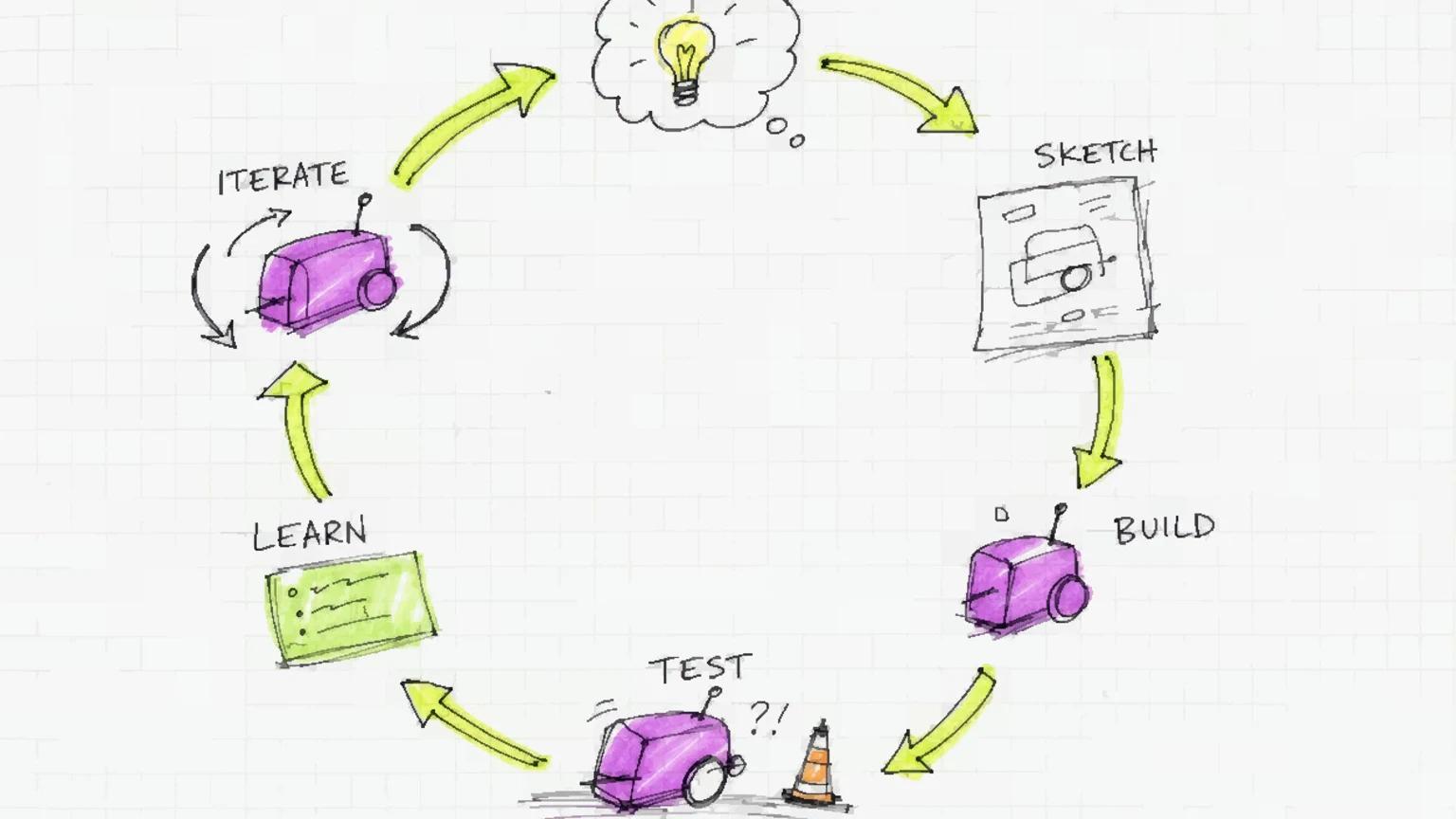
The Build-Measure-Learn loop from Lean Startup is the best-known product-development feedback loop. It is often written as a sequence. The sequence only works as a circuit if the "learn" step changes the next "build." That is the circuit test. Ben Hafele, CEO of Lean Startup Co., reframes the order as "learn first" — learning velocity, in his formulation, is simply the speed at which the circuit closes, per the EY Decoding Innovation podcast (2024).
That reordering matters. The hypothesis precedes the build, and the learning must return to the hypothesis. An iterative feedback loop shortens the lag between output and adjusted input; it is the operating principle behind short sprints and MVPs. The same structure appears in agile sprint retrospectives. A retrospective takes the sprint outcome as output, produces action items as a signal, and is supposed to adjust the next sprint's input during planning. The State of Agile Report 2025 found that 63% of Agile users follow Scrum, yet only 13% say Agile is deeply embedded across the business. The gap between ceremony and embedded practice is a broken fifth link: the retro output fails to change the next sprint.
§3 Where does the term feedback loop come from?
The term "feedback loop" is not a business metaphor. It is an engineering description that was later applied to organizations. It began in Norbert Wiener's wartime anti-aircraft predictors in the early 1940s and migrated into management through cybernetics and system dynamics. The engineering origin means the return pathway is the defining condition, not an enhancement.
The 1942 anti-aircraft predictor
Norbert Wiener developed the feedback loop while working on the problem of aiming anti-aircraft cannons targeting aircraft moving at speed. Any gunner who fired directly at a plane was going to miss it by aiming at its current position; he had to predict where the plane would be when the shell arrived. Wiener's 1942 report, "The Extrapolation, Interpolation, and Smoothing of Stationary Time Series," became the classified foundation for the anti-aircraft predictor. The device adjusted the gun's aim continuously based on the aircraft's past trajectory. Output (the observed path of the target) was fed back as input to the aiming mechanism. The return pathway was not optional. It was the design.
The Macy Conferences and the organizational migration
After the war, Wiener and others formalized these ideas in Cybernetics: Or Control and Communication in the Animal and the Machine (1948). The Macy Conferences (1946–1953) pushed the framework outward — into biology, psychology, and how societies organize themselves. From there the circuit metaphor moved into management theory, most directly into system dynamics and organizational learning. The feedback loop was no longer only about machines; it became a way to describe any system whose output influenced its own input.
Why the origin matters for practitioners
Origins are not trivia.
They tell you what a thing is.
In engineering, the return pathway is not a nice-to-have.
It is the defining condition.
When a product team calls "collecting customer feedback" a feedback loop, it is filing an optional management activity under the same label as a control-engineering circuit.
The two are not interchangeable.
One is a data-collection practice.
The other is a structural mechanism for continuous adjustment.
The 63% Scrum adoption rate reported by the State of Agile Report 2025 shows how widely the language of feedback loops has spread, while the 13% deep-embedding figure shows how rarely the circuit is complete.
Adopting the language is easy.
Completing the circuit is not.
§4 What is the difference between positive and negative feedback loops?
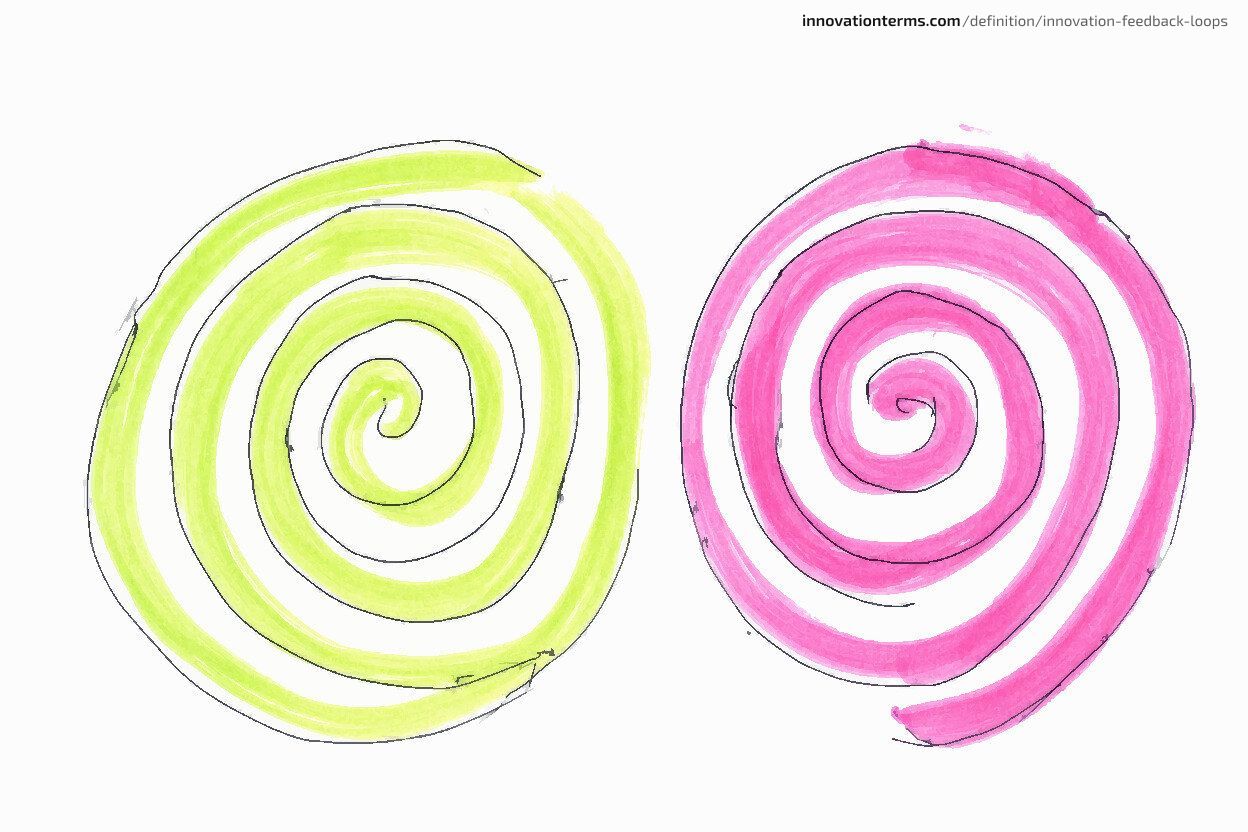
Positive feedback loops amplify: they push output further in the direction it is already heading. Negative feedback loops stabilize: they measure deviation from a target and push back toward it. In innovation, the critical question is not which loop is "better" — it is which loop is matched to the current phase.
Positive feedback loops in innovation
A positive, or reinforcing, loop magnifies change. Donella Meadows (2008) calls it "what happens when a change in one area of the system magnifies itself in another." The best-known positive feedback loop innovation is the viral growth engine: a small group of early adopters loves a feature, tells others, and the team sees usage spike and doubles down on the same direction. A platform product observes a network effect: more users attract more developers, which attract more users. In each case the loop reinforces the deviation from the baseline.
The danger is that amplification does not discriminate between good signals and bad ones. A confusing onboarding flow can produce high engagement metrics when users click around searching for what they need. Teams see the engagement spike, double down on the confusing design, and the problem compounds—creating a state of path dependency (where early design choices lock the team into a trajectory that becomes increasingly expensive to reverse) until someone questions the metric itself.
Negative feedback loops in innovation
A negative, or balancing, loop keeps a system near a target. Meadows uses the thermostat as the canonical example:
A thermostat loop keeps room temperature fairly constant at a desired level. Any negative feedback loop needs a goal (the thermostat setting), a monitoring and signaling device to detect excursions from the goal (the thermostat), and a response mechanism. Donella Meadows, Thinking in Systems (2008)
In product development, Stage-Gate is the canonical negative feedback loop innovation managers use to govern a portfolio of projects. Each review gate is a designed negative feedback loop. The project produces a stage deliverable; the gate compares it against predefined criteria; outputs that deviate from the target trigger a modify-pause-kill decision. Stage-Gate International reports that organizations using gated innovation processes average 130% more new-product revenue than companies with informal processes, and that Stage-Gate success rates run 63–78% against a roughly 10% baseline for unstructured approaches. The correlation partly reflects that organizations disciplined enough to install gates tend to be disciplined in other ways. The loop works because it stabilizes the portfolio toward a known standard.
Phase matching: the loop type you choose is a strategy choice
James March's exploration-exploitation framework is the central caution. Exploration phases need positive loops because the goal is to amplify variance and discover what might work. Exploitation phases need negative loops because the goal is to converge on a known target. Applying a negative loop too early in exploration filters out the very variance that makes innovation possible. Applying a positive loop too late in exploitation turns a stable process into a runaway experiment.
Dimension
Positive (reinforcing) loop
Negative (balancing) loop
Behavior
Amplifies deviation from baseline
Returns system to a target
Innovation phase match
Exploration: discovery, ideation, validation
Exploitation: scaling, operations, gatekeeping
What breaks it
Bad signal amplified unchecked
Target becomes wrong or phase changes
Named example
Network-effect growth in platform products
Stage-Gate review killing off-target projects
§5 How do you know if a feedback loop is actually closed?
A feedback loop is closed when, and only when, the output signal has an explicit, enforced path back to the input of the same process. The closure test is binary: either the return pathway exists and alters the next input, or it does not.
The most common failure is the pseudo-loop.
Data is collected, analyzed, and reported.
The input stays the same.
Many popular definitions describe exactly this.
A four-step "collect → analyze → implement → monitor" cycle treats the loop as a data-to-action pipeline without naming the return-pathway condition.
That framing describes customer research or continuous improvement.
Not a closed feedback loop.
A literature review devoted to clarifying the feedback-loop concept exists precisely because the term is used so loosely.
Once a concept needs its own clarification industry, it has already lost its edge.
The circuit closure test: four yes/no questions
- Is the input to the next iteration changed by the signal from the last iteration?
- Is the person or team receiving the signal also empowered to act on it?
- Is the signal type specified before the loop runs, or chosen after the fact?
- Does the loop have a named cadence that matches the decision window?
Four "yes" answers mean the loop is closed. A single "no" means it is open, regardless of how much data the team collects.
Closed loops, pseudo-loops, and broken loops
A closed loop passes the test. In the Lean Startup Build-Measure-Learn cycle, the pivot-or-persevere decision is the closure mechanism: the experiment's output must change strategy. Steve Blank (2005) makes the return pathway explicit in his Customer Development model by sending teams back from Customer Validation to Customer Discovery when assumptions are invalidated.
A pseudo-loop looks like a loop but lacks the return pathway. Quarterly NPS surveys that generate a PowerPoint deck are pseudo-loops. Retrospectives that produce action items no one assigns are pseudo-loops. The State of Agile Report 2025 data suggests many organizations live here: 63% use Scrum, but only 13% report deep Agile embedding. The ceremonies scale faster than the circuits.
A broken loop has a designed return pathway that is blocked. The signal exists, the channel exists, but someone stops it. Argyris & Schön's work on defensive routines explains why: the actions teams take to promote productive learning can actually inhibit deeper learning when surfacing a negative signal feels unsafe. The pathway is structurally present and behaviorally closed.
Feedback loops versus PDCA and continuous improvement
Plan-Do-Check-Act is related but not identical. Closed loop innovation only happens when the Act step explicitly changes the next Plan. It is a checklist when Act means "document what we did." The same four letters can describe a closed circuit or an open ritual. The difference is not the acronym; it is whether output feeds back as adjusted input.
§6 Why does feedback timing break so many loops?
Feedback lag is the time between process output and the adjusted input that starts the next iteration. When lag fits inside the decision window, the signal can still change what the team does next. When it does not, the next iteration launches on old assumptions — the signal arrives after the decision has already been made.
Feedback that arrives after the decision window closes is decorative data.
The State of Agile Report 2025 suggests a structural lag problem in many organizations: only 13% say Agile is deeply embedded, while 42% describe their culture as "better than nothing but could be more effective." The gap between adopting iterative language and embedding iterative practice is often a lag gap. Teams collect signals in ceremonies but the signals do not reach the next planning cycle in time to change it.
The lag spectrum
Different cadences create different decision windows. A two-week sprint keeps the planning meeting days away, which means retro signals can still change the upcoming backlog. A quarterly Stage-Gate produces a signal, but the next planning window may be months out — the signal must survive until then. An annual strategy review is almost always too late: by the time the signal returns, the product has shipped and the team has moved on.
The shorter the cadence, the more likely the signal arrives inside the decision window. That is why Lean Startup practice emphasizes "learning velocity" — the goal is not to move fast for its own sake, but to make sure the learning returns while the team can still act on it, per the EY Decoding Innovation podcast (2024).
Lag versus signal quality
Shorter lag is not always better. Donella Meadows (2008) identifies delay as a system variable: loops with very short delay can become unstable and oscillate rather than converge. If a team shortens its feedback cadence below the time needed for a meaningful signal to accumulate, it starts reacting to noise and can trap the product in a limit cycle (a self-sustaining, repetitive oscillation that never converges on a target). The loop is closed technically, but the signal is garbage.
The design challenge is matching cadence to the signal's natural accumulation time. User behavior trends usually need weeks. Manufacturing defects need minutes. Strategic market shifts need quarters. A loop is well designed when its lag fits the decision window of the process it feeds.
§7 What is double-loop learning, and why does it matter?
Single-loop feedback corrects actions against a fixed target; double-loop feedback questions whether the target itself is correct. Most innovation feedback loops are single-loop, which is how teams become very good at building the wrong thing. Double-loop learning is the mechanism that prevents local optimization within a broken frame.
Argyris and Schön define the distinction precisely in Organizational Learning (1978). Single-loop learning occurs when error is detected and corrected in ways that permit the organization to carry on its present policies — the action changes, but the governing variable, what Argyris and Schön call the dimension the organization is trying to keep within acceptable limits, does not. Double-loop learning goes further:
Double-loop learning occurs when error is detected and corrected in ways that involve the modification of an organization's underlying norms, policies and objectives. Chris Argyris and Donald Schön, Organizational Learning (1978)
The first loop fixes the action. The second loop fixes the governing variable.
When single-loop learning is not enough
A product team might run a tightly closed Build-Measure-Learn cycle around a feature no one needs. The loop is technically closed: each experiment changes the next experiment. But the governing variable — "we should build this feature" — is never questioned. The team optimizes within the wrong frame. That is single-loop feedback run on a double-loop problem.
Single-loop feedback changes actions and tactics within execution phases — A/B testing button copy to improve conversion is the canonical example. Double-loop feedback modifies the governing variable itself, with the most important case being the discovery that an entire product category is wrong.
Stafford Beer's viable system model
Stafford Beer's Viable System Model offers an organizational map of the same distinction. System 3 (operational control) runs single-loop feedback: it keeps operations within the governing variable. System 4 (intelligence and strategy) runs double-loop feedback: it monitors the environment and questions whether the governing variable is still correct. Organizations that run only System 3 loops optimize operations while their strategy decays. They close the loop on the wrong level.
Steve Blank's customer development loop
Steve Blank's Customer Development model makes the distinction practical. Customer Discovery asks whether the problem is real. Customer Validation asks whether the solution works. Conflating the two is a named startup failure mode: teams run tight solution-iteration loops on unvalidated problems. They close the product feedback loop while the market feedback loop remains open.
The implication for practitioners is diagnostic. If your loop is closed but your outcomes are not improving, the failure is rarely mechanical. You are optimizing the wrong governing variable.
§8 By the Numbers: feedback velocity and innovation outcomes
The empirical case for feedback-loop design is not anecdotal. Iteration cadence, loop closure rate, and signal-to-noise ratio are all measurable, and they correlate with commercial innovation outcomes when the return pathway is explicitly designed. The table below collects the strongest available signals from the source pack.
Statistic
Source
Year
What it means
63% of Agile users follow Scrum
State of Agile Report
2025
Iterative methods are widespread, but adoption does not imply closed loops.
Only 13% say Agile is deeply rooted
State of Agile Report
2025
The gap between ceremony and circuit is large.
80%+ North American companies use Stage-Gate
Stage-Gate International
2024
Negative feedback loops are standard in portfolio management; figure is vendor-reported.
130% more new-product revenue with gated processes
Stage-Gate International
2024
Vendor-reported correlation; likely confounded by organizational discipline.
63–78% Stage-Gate success rate vs. ~10% unstructured
Stage-Gate International
2024
Vendor-reported benchmark; treat as directional.
85% of andon activations resolved within 60 seconds
Toyota production data via lean literature
1999
Designed physical return pathways can close loops almost instantly.
$1 to fix a defect at source vs. $100 after final assembly
Toyota production data (widely cited)
1999
Fast negative loops reduce cost by orders of magnitude.
78% experimenting with AI; 9% measurable productivity gains
TechJuice AI analysis
2025
Technically closed AI loops can be epistemically unreliable.
Organizations that design the return pathway — whether through Stage-Gate gates, Toyota's andon cord, or Lean Startup decision rules — outperform organizations that treat feedback as an activity rather than a circuit.
What the numbers do not say
These statistics are directional, not causal. Stage-Gate correlates with higher revenue because organizations disciplined enough to install gates are usually disciplined in other ways. Toyota's andon cord works inside a production system built around it, not as an isolated tool. The State of Agile numbers show adoption, not competence. The correct reading is not "install these mechanisms and results follow." The correct reading is that closed loops are associated with better outcomes. Closure forces decisions that open loops avoid. That is the design argument in a sentence.
§9 Toyota's andon cord: the designed negative feedback loop that stops the line
Toyota's andon cord is the most-cited example of a designed feedback circuit in industrial history. Any worker on the production line who detects a defect pulls the cord. The line stops. The signal routes immediately to the team leader. The defect is addressed before the next unit is produced. The cord is the return pathway — physical, immediate, and non-negotiable.
The setup: quality as a design problem
Taiichi Ohno, the architect of the Toyota Production System, did not treat quality problems as cultural failures. He treated them as signal-routing failures. A machine that cannot show abnormalities is not under control. The andon cord was designed because relying on workers to report problems voluntarily was not reliable at scale.
The circuit design
The cord maps directly to the five-link model. The input is the production target and standard work for the station. The process is the assembly operation, and the output is the unit being produced. The feedback signal is the cord pull itself, triggered by any detected abnormality. The adjusted input is the line halt — the corrected process before the next unit begins.
The return pathway is not a suggestion box. It is a physical cord with a defined protocol. Spear & Bowen (1999) document how Toyota's production system encodes feedback loops; about 85% of andon activations are resolved within 60 seconds without stopping the line, and when the line does stop the average resolution time is 4.2 minutes. These figures are widely cited in the lean literature rather than directly reported by Spear & Bowen. The loop is fast because it is designed to be fast.
The outcomes
Catching a defect at its source costs roughly $1 to fix; addressing the same defect after final assembly can cost $100 or more, according to Toyota production data reported by Spear & Bowen (1999). The economic argument for the andon cord is not abstract. Every minute of delay multiplies the cost of the defect. The negative feedback loop pays for itself by shrinking that delay.
The lesson: design before culture
Taiichi Ohno captured the design principle:
Stopping the machine when there is trouble forces awareness on everyone. When the problem is clearly understood, improvement is possible. Taiichi Ohno
Toyota workers pull the cord not because they are uniquely virtuous, but because the cord is there, the protocol is defined, and the decision authority is granted. Culture sustains the cord's effectiveness. The cord makes the decision structurally possible in the first place.
Spotify's squad model applies the same structural logic to software: squads own their metrics and route validated learning back through an explicit "Think It, Build It, Ship It, Tweak It" circuit — the same return-pathway architecture, a different domain, as Kniberg & Ivarsson (2012) describe.
§10 When do negative feedback loops suppress innovation?
Negative feedback loops stabilize processes toward a target. In product operations, that is the goal. In early-stage innovation, it is destructive. When an organization applies stabilizing feedback to an exploration process, it filters out exactly the signal variance that might indicate something genuinely new.
James March made the structural argument in Organization Science (1991):
Adaptive processes, by refining exploitation more rapidly than exploration, are likely to become effective in the short run but self-destructive in the long run. James G. March, Organization Science (1991)
The mechanism is straightforward. Negative loops reward signals that return the system to its target. In exploration, the most valuable signals are the ones that deviate from the target — the unexpected customer behavior, the weird prototype result, the idea that does not fit the current strategy. A negative loop treats those signals as errors and suppresses them.
Stage-Gate as a portfolio-level negative loop
Stage-Gate is a correctly designed negative loop when applied to exploitation. It kills projects that deviate from the portfolio's target profile. The Stage-Gate data is impressive: 80%+ adoption in North America, 130% more new-product revenue, and 63–78% success rates, according to Stage-Gate International. The loop is doing what it is supposed to do.
The problem appears when Stage-Gate is applied too early. A gate that evaluates an idea against current strategy before the idea has been validated will kill the ideas that matter most for future growth. The negative loop becomes a suppression mechanism. Incumbent firms run excellent negative loops for their existing market. That strength makes them structurally unable to respond to disruptions that do not fit the current target.
The phase-mismatch problem
In exploitation, a negative loop filters deviations from the known target — the result is higher efficiency, lower variance, and predictable outcomes. Applied to exploration, the same mechanism filters the deviations that contain novelty, producing premature convergence and strategic blind spots. The loop is not broken. It is being asked to do the wrong job.
How to spot a phase mismatch in your portfolio
Three symptoms appear when a negative loop is applied too early. First, idea mortality is high at the first gate but post-launch success is flat or declining — the loop is filtering out variance before it can be tested. Second, breakthrough ideas are repeatedly reframed to fit current strategy rather than being allowed to challenge it. Third, the metrics at each gate measure fit with the existing business model rather than evidence of a new one. These are not signs of a broken process. They are signs of a correctly designed negative loop running in the wrong phase.
§11 What do practitioners get wrong about feedback loops?
The three most consequential misconceptions about feedback loops are simple to state and expensive to hold: that collecting feedback is running a loop, that a retrospective ceremony closes the loop, and that faster feedback is always better. Each has a structural consequence, not a cultural one, because the belief designs the system.
Misconception 1: "Collecting feedback" is a feedback loop
Many glossaries define a feedback loop as a four- or five-step process: collect, analyze, implement, monitor. That describes a data-to-action pipeline, not a closed circuit. The missing condition is the return pathway. If the analyzed feedback does not change the next input, the loop is open. A literature review devoted to clarifying the feedback-loop concept exists because the term is used so loosely in innovation writing.
Enterpret (2024) describes a real-world instance: when users discover a workaround for a broken feature and share it, the workaround can become "the way" and the underlying problem never gets fixed. The signal reached the team, but the return pathway routed it to the wrong input. The loop closed around the workaround instead of the root cause.
Misconception 2: The retrospective is the feedback loop
A retrospective is a ceremony. A feedback loop is a circuit. The State of Agile Report 2025 data shows the gap: 63% use Scrum, but only 13% report deep Agile embedding. Many of those teams run retros. Fewer of them use the retro output to change the next sprint's input.
Argyris and Schön explain why the ceremony can mask an open loop. Teams develop defensive routines that protect them from the anxiety of questioning their own assumptions. The loop appears closed because the ritual exists, but the governing variable remains unchanged. The retro produces signal; the organization resists the adjusted input.
Misconception 3: Faster feedback is always better
Speed helps only when the signal has had time to accumulate. Donella Meadows (2008) identifies delay as a named system variable: loops with very short delays can oscillate rather than converge. A daily standup that asks "what did we learn yesterday?" can produce noise if the build has not generated a meaningful signal. Faster is better only when cadence matches signal accumulation time.
Misconception 4: A feedback loop is a cultural practice
This is the misconception the contested take in §13 addresses. Culture can sustain a working loop, but it cannot substitute for the loop's design. Toyota did not install the andon cord because workers already felt safe pulling it. Workers pulled it because the cord, the protocol, and the decision authority were designed into the system.
§12 What are the boundary conditions and edge cases?
Feedback loops do not behave the same way in every context. Three conditions change their behavior enough to require design adjustments: loop cadence faster than signal accumulation, organizational transformation, and AI-generated signals. The closure test still applies, but the signal itself may be unreliable.
Loop cadence and instability
A loop can run too fast. Meadows notes that delays are a high-impact intervention point in systems: shortening the delay below the time needed for a meaningful signal can make the loop oscillate. In product teams, this appears as excessive pivoting: every micro-signal triggers a strategy change, and the team never stays with an experiment long enough to learn. The loop is closed, but the signal is noise.
Transformation periods and the breakdown of single-loop feedback
During periods of strategic transformation, the governing variables are changing faster than single-loop feedback can track. Argyris and Schön's framework implies that this is when double-loop learning becomes mandatory: the organization must question its norms, policies, and objectives, not just its tactics. A loop that optimizes against a governing variable that is itself changing will produce increasingly wrong outputs.
AI-generated signals
AI-mediated feedback loops are a special edge case. They can satisfy the technical circuit-closure condition (output influences input via an ML model) without satisfying the epistemic condition. A 2025 synthesis of AI adoption reports suggests that 78% of organizations are experimenting with AI, but only 9% have achieved measurable productivity gains (TechJuice, 2025). The gap suggests that many AI feedback loops are technically closed but running on unreliable signals. Two distinct failure modes apply: model drift, where the training distribution has moved away from current conditions, and model misspecification, where the input data is valid but the model was built for a different question. Practitioners designing AI-mediated loops need to distinguish which failure mode is active before adjusting the loop.
PDCA and the definition boundary
Plan-Do-Check-Act is a feedback loop when Act changes Plan. It is a checklist when Act means filing the results. The boundary is not the framework; it is whether output feeds back as adjusted input. The same distinction applies to agile retrospectives, innovation reviews, and customer advisory boards.
§13 Designing the circuit: prerequisites for a functional innovation feedback loop
You cannot culture your way to a functional feedback loop. The return pathway must be designed before culture can sustain it. Three structural prerequisites separate a loop that closes from one that appears to close: a named owner with decision authority, an explicit return pathway with a defined signal type, and a cadence matched to the decision window.
The loop is not a cultural practice. The culture sustains the loop only after the loop has been designed.
The five-question design checklist
- Is there a named owner who is empowered to act on the signal?
- Is the signal type defined before the loop runs?
- Does the return pathway physically or procedurally exist?
- Is the cadence shorter than the decision window?
- Does the next iteration's input change when the signal says it should?
A "yes" to all five means the loop is structurally sound. A "no" to any one means the loop is open, regardless of how often the team meets or how many surveys it sends.
Named owner and decision authority
The person who receives the signal must also have the authority and the obligation to act on it. In Toyota's system, the team leader responds to the andon cord and can halt the line. In Spotify's model, squads own their metrics and decide whether to pivot. Without named ownership, the signal becomes a committee agenda item.
Signal type and return pathway design
Not all feedback is signal. The team must decide what kind of output will count before the loop runs. A learning velocity metric is not the same as a revenue metric. A customer complaint is not the same as a usage pattern. If the signal type is chosen after the fact, the team will optimize for what is easy to measure rather than what matters.
Cadence matched to the decision window
The loop must return signal while the decision is still open. A two-week sprint can close a tactical loop. A quarterly gate can close a portfolio loop. An annual strategy review cannot close a product loop.
FAQ: Frequently asked questions about innovation feedback loops
What is the difference between a positive and a negative feedback loop in innovation?
A positive feedback loop amplifies deviation from a baseline; a negative feedback loop stabilizes a system toward a target. In innovation, exploration phases need positive loops to amplify novel signals, while exploitation phases need negative loops to converge on a known standard. Applying the wrong type to the wrong phase is a structural failure.
How does a feedback loop work in product development?
It works through five links: defined input, process, measurable output, return pathway, and adjusted input. The Build-Measure-Learn cycle and the sprint retrospective are both attempts at this circuit. They become real feedback loops only when the learning changes the next build or the retro output changes the next sprint.
What is the Build-Measure-Learn loop, and is it a feedback loop?
Build-Measure-Learn is a feedback loop when the "learn" step changes the next "build" through a pivot-or-persevere decision. If the team builds, measures, and then builds the same thing again, the loop is open. The circuit closes only when output returns as adjusted input.
Why do feedback loops fail even when teams collect lots of data?
Data collection is one link. A loop fails when the signal has no return pathway, the return pathway is blocked by defensive routines, the signal arrives after the decision window, or the loop type does not match the innovation phase. Most failures are structural, not motivational.
How do you know if a feedback loop is actually closed?
Use the closure test: the next iteration's input must be altered by what the last iteration's output revealed. If the signal is collected, analyzed, and reported but the plan stays the same, the loop is open. Named ownership and a defined cadence are supporting evidence of closure.
Can a feedback loop run too fast?
Yes. If the cadence is shorter than the time needed for a meaningful signal to accumulate, the loop reacts to noise and oscillates rather than converging. Speed helps only when it matches the signal's natural accumulation time. A loop that is fast but noisy is technically closed and practically useless.

Clara @cla_reinholt
Focuses on innovation communication, facilitation, and turning frameworks into team habits.