
Capacidad Absortiva

Respuesta rápida
La capacidad de absorción es la capacidad de una empresa para reconocer, absorber y aplicar el conocimiento externo, siendo la mayoría de las organizaciones deficientes en la parte realizada que convierte las entradas en salidas.
Absorptive capacity
A company funds an open innovation portal, a corporate scouting team, and a bigger R&D headcount. The external ideas arrive. The commercialized products do not. That gap has a name, and it is not a sourcing problem.
Absorptive capacity is a firm's ability to recognize the value of new external knowledge, assimilate it, and apply it to commercial ends — the definition from Cohen and Levinthal's landmark 1990 paper. Wesley Cohen and Daniel Levinthal coined the term that year. That paper now carries more than 34,000 academic citations, and most pages that rank for it stop at a four-box model without taking a position.
Most firms fail on the realized half of absorptive capacity, not the sourcing half. Organizations build the visible, budgetable half first: scouting, licensing, R&D spend. They starve the half that turns an absorbed insight into a shipped product. The two halves are not equivalent. This page explains what makes the second one the deciding factor and why throwing money at the gap does not close it.
TL;DR
- Absorptive capacity is a firm's ability to recognize, absorb, and commercialize external knowledge — Cohen and Levinthal's foundational construct.
- Zahra and George (2002) split it into potential (acquire, assimilate) and realized (transform, exploit) capacity.
- Most firms fail on the realized half, so sourcing more knowledge does not fix the problem.
- It compounds from prior knowledge, so you cannot buy or hire it fast — the load-bearing claim in Absorptive Capacity (1990).
- Lane, Koka and Pathak (2006) found measuring it by R&D spend alone to be the field's most expensive and most persistent error.
Whether external knowledge becomes commercial output depends on a firm's conversion routines. The binding constraint for most firms is the realized half (the conversion routines that turn an absorbed insight into a product) rather than the sourcing half that budgets fund first. Build the conversion machinery before you scale the scouting.
What is absorptive capacity?
Absorptive capacity is a firm's ability to recognize the value of new external information, assimilate it, and apply it to commercial ends. Cohen and Levinthal introduced the term in 1990. It is a learned capability built from prior related knowledge, not a budget line and not a stated willingness to learn.
Every later refinement orbits the original formulation:
the ability of a firm to recognize the value of new, external information, assimilate it, and apply it to commercial ends.
— Cohen and Levinthal, Absorptive Capacity: A New Perspective on Learning and Innovation (1990)
That sentence carries three distinct verbs, and they are sequential. A firm has to recognize that an outside signal matters before it can do anything with it. It has to assimilate the signal into how it already understands the domain. Then it has to apply the result to something a customer pays for. Skip any step and the knowledge stalls.
- Recognize: spotting which external development is relevant before competitors do.
- Assimilate: connecting the new input to existing technical understanding.
- Apply: converting the understanding into a product, process, or decision.
Abundant information punishes firms whose absorption routines cannot keep pace with what is available. Levinthal's Wharton colleague Adam Grant put the tension plainly on the Modern Wisdom podcast:
My colleague Dan Levinthal writes a lot about absorptive capacity, which is a person or an organization's capability to take in new information. And I think we're all now drowning in information.
— Adam Grant, Modern Wisdom, episode 885
With more than 34,000 citations, Cohen and Levinthal's 1990 ASQ paper is one of the most-referenced constructs in management science.
Where did absorptive capacity come from?
Cohen and Levinthal were solving a specific puzzle: why does R&D spending sharpen a firm's capacity to absorb knowledge developed elsewhere? Their answer treated R&D as training for absorption, not as a factory of inventions. The investment taught the firm to read what others were discovering. That single flip made absorptive capacity non-obvious.
The argument started a year before the famous paper. In 1989, Cohen and Levinthal published "Innovation and Learning: The Two Faces of R&D," which set up the load-bearing claim:
We suggest that R&D not only generates new information, but also enhances the firm's ability to assimilate and exploit existing information.
— Cohen and Levinthal, Innovation and Learning: The Two Faces of R&D (1989)
When a pharmaceutical company runs an internal research program, the program produces some discoveries directly. It also teaches the company's scientists enough of the relevant science to understand discoveries made elsewhere. The 1989 paper has since accumulated more than 7,500 citations of its own, a sign of how much later work was built on that single distinction.
The empirical observation behind the concept
The motivating fact was that firms differed sharply in how much they got out of the same external knowledge pool. Spillovers were supposed to be free. In practice, only some companies converted them into anything. Cohen and Levinthal argued the difference was internal: the firms that benefited had already invested in understanding the field, so they could read the signal. The reframing inverted the usual economics. Investing in research stopped looking like a pure cost of producing inventions and started looking like the price of admission to everyone else's inventions. A firm that stopped investing did not just stop generating ideas. It lost the ability to recognize the ideas arriving for free from outside.
How does absorptive capacity work? The four-component model
The 1990 triad held until 2002, when Shaker Zahra and Gerard George split absorptive capacity into four components grouped into two halves. Potential absorptive capacity covers acquisition and assimilation. Realized absorptive capacity covers transformation and exploitation. The gap between the two halves is where most firms lose their innovation returns.
The reconceptualization — published in the Academy of Management Review and now cited more than 7,800 times — is the model most strategy decks use today, and Zahra and George's 2002 paper remains the go-to reference for operationalizing the construct. The value of the four-part view is that it locates failure. A firm can be strong at one component and weak at the next, and the model tells you which.
| Component | What it does | What failure looks like | Half |
|---|---|---|---|
| Acquisition | Locating and obtaining relevant external knowledge | Scouting that never finds the right signal | Potential |
| Assimilation | Interpreting and absorbing the knowledge internally | Not-invented-here rejection of outside ideas | Potential |
| Transformation | Recombining new knowledge with existing knowledge | Insights that stay trapped in one team | Realized |
| Exploitation | Converting transformed knowledge into commercial output | A prototype that clears the stage-gate review but never ships | Realized |
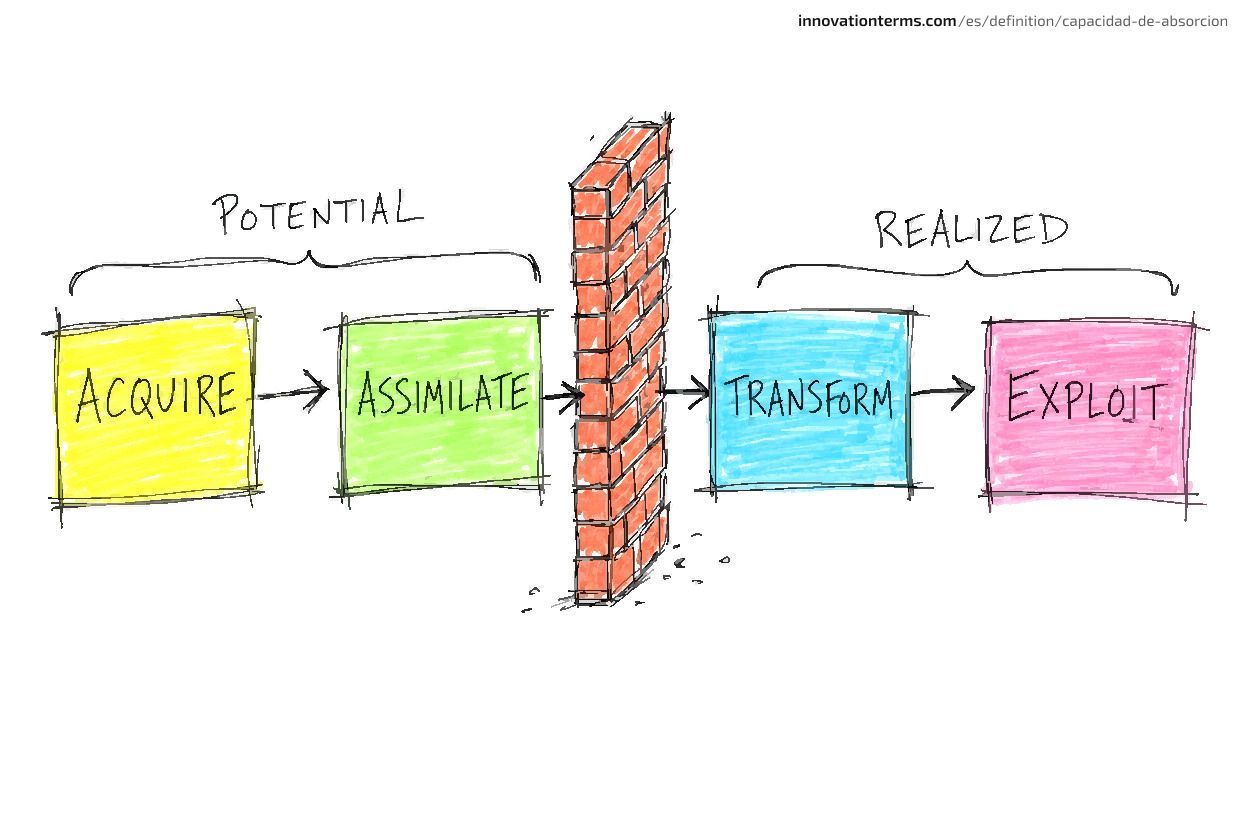
Potential versus realized
Potential absorptive capacity is the half you can budget for. You can hire scouts, buy database access, and fund a corporate venture arm. Realized absorptive capacity is organizational plumbing: the cross-functional routines and shared language that move an absorbed insight toward a product. Zahra and George (2002) argued that the two halves can move independently. Only the realized half touches competitive advantage directly.
In 2007, Gabriel Todorova and Boris Durisin offered the most substantive challenge to the four-component sequence. Their core argument: transformation is not a stage that follows assimilation but an alternative path through it, and the process can loop rather than proceed in one direction — the case Todorova and Durisin (2007) make in the Academy of Management Review. That distinction matters in practice. Firms that stall after assimilation are not simply running behind on a schedule; they may be routed onto a branch that never reaches exploitation. The four-component model survived the critique, which is part of why it remains the working framework.
Why the split matters
The question is no longer "are we sourcing enough external knowledge?" It is "where in the chain does our knowledge stop moving?" A firm with strong acquisition and weak exploitation does not need more scouting. It needs to fix the conversion machinery. That distinction is the spine of everything that follows on this page, and it is the part competitor definitions leave out.
Where knowledge stops moving
Most firms get stuck in potential. They acquire. They assimilate. The knowledge arrives, is read, is understood. Then somewhere between understanding and use, the machinery goes quiet. The conversion is not automatic — Zahra and George were clear on this — and without social integration mechanisms, the connective tissue that moves insight from one team to another, potential capacity never becomes realized output. It stays recognized and inert.
The two halves do not convert at a fixed rate. Zahra and George (2002) modeled the relationship as an efficiency factor: the ratio of realized to potential capacity. A firm can score high on acquisition and assimilation while its efficiency factor stays low, which means knowledge enters and then sits. The evidence that both halves matter independently is direct. Albort-Morant et al. (2018) studied 112 Spanish automotive-components firms and found that potential and realized capacity were each separately related to green product and process innovation performance. Neither half substitutes for the other.
Social integration mechanisms
Social integration mechanisms are the routines that distribute absorbed knowledge across the organization: cross-functional teams, job rotation, shared problem-solving forums, and the informal connectors who carry context between units. They lower the cost of turning a private insight into a shared capability. Without them, a brilliant absorbed idea stays in the head of the person who absorbed it.
Not-invented-here as the human barrier
The most common concrete failure at the assimilation step is not-invented-here syndrome, first named by Katz and Allen in 1982. It is the reflex to reject outside ideas because they came from outside. The Oxford Handbook of Open Innovation puts the mechanism plainly:
Organizations with strong technical histories often feature R&D personnel who are convinced that if they didn't invent it themselves, it must not be important.
— Oxford Handbook of Open Innovation
The barrier is human rather than structural, and it threatens the professional identity of the R&D staff expected to do the assimilating (Oxford Handbook of Open Innovation; Unpacking Open Innovation). One practitioner framing calls this rejection reflex the organizational "antibody," the immune response a company mounts against ideas it did not generate (a16z Podcast). The reflex is changeable, though. Some firms deliberately swap "not invented here" for an "invented anywhere" stance that treats outside origin as no mark against an idea (Witzeman et al. 2006, Unpacking Open Innovation). NIH syndrome is a reliable warning sign on any innovation culture health assessment. Realized capacity fails for reasons no org chart captures, which is why buying more potential capacity rarely fixes it.
Why does absorptive capacity compound?
Absorptive capacity grows from prior related knowledge, so it compounds. Each unit of prior knowledge reduces the cost of acquiring the next. A firm already fluent in a domain absorbs its next development cheaply (vocabulary in place, scaffold ready) while a firm starting cold pays full price for every signal and falls a little further behind with each one. Cohen and Levinthal made this the engine of the whole construct: what you can learn depends on what you already know.
The compounding claim in the 1990 paper does more structural work than any other part of it. Cohen and Levinthal (1990) argued that absorptive capacity is largely a function of the firm's level of prior related knowledge. That single dependency creates path dependence and operates as one of management's clearest positive feedback loops: each domain-relevant hire, paper, or patent makes the next one easier to absorb, and the advantage accumulates. The meta-analytic evidence supports the dynamic at scale: Stettler and Moosauer et al. (2024) found that knowledge-rich environments create more opportunities to reap innovation benefits from absorptive capacity, which means the rich get richer.
The Pascal-and-Fortran illustration
Cohen and Levinthal's own example is about programmers. Those who already knew a structured language like Pascal absorbed new software-engineering principles faster than those without that background — an illustration embedded in Absorptive Capacity (1990). The prior knowledge was not the new skill. It was the scaffolding that made the new skill cheap to acquire. The same logic scales to firms: a company fluent in a technical field reads its frontier almost for free, while a newcomer pays full price for every signal.
The late-mover trap
The compounding mechanism produces a trap. A firm entering a new technical domain cold is penalized twice. It lacks the products. More critically, it lacks the prior knowledge to recognize what it should even be acquiring. Cohen and Levinthal (1990) call this lockout. The door does not slam shut; it just, gradually, becomes unreadable. A company that ignored a field long enough can no longer tell which external developments matter. This is one mechanism behind why incumbents miss disruptive innovation: the threat arrives written in a technical language they stopped learning before it was ever a threat. Lockout is quiet. It arrives after a long run of success in an adjacent area, exactly when a firm feels no pressure to invest in absorbing anything new.
The time to build absorptive capacity in a field is before you need it. That is precisely when the investment case is hardest to make.

How does absorptive capacity gate open innovation returns?
Open innovation programs pay off in proportion to the absorptive capacity a firm brings to them. Two buyers of the same licensed discovery can reach opposite outcomes based entirely on whether each one can adapt and apply what it acquired.
Henry Chesbrough's open innovation model made external sourcing a strategic priority, but it assumes the absorption side is handled. Studies consistently find the absorption side is not handled. Research on knowledge spillovers finds they are more effective in organizations with high absorptive capacity, so the same spillover lands differently depending on who receives it. The 112-firm green-innovation study makes the same point from the inside: firms needed both halves of the capability, not just the sourcing half, to convert external knowledge into innovation performance — as Albort-Morant et al. (2018) showed across Spanish automotive suppliers.
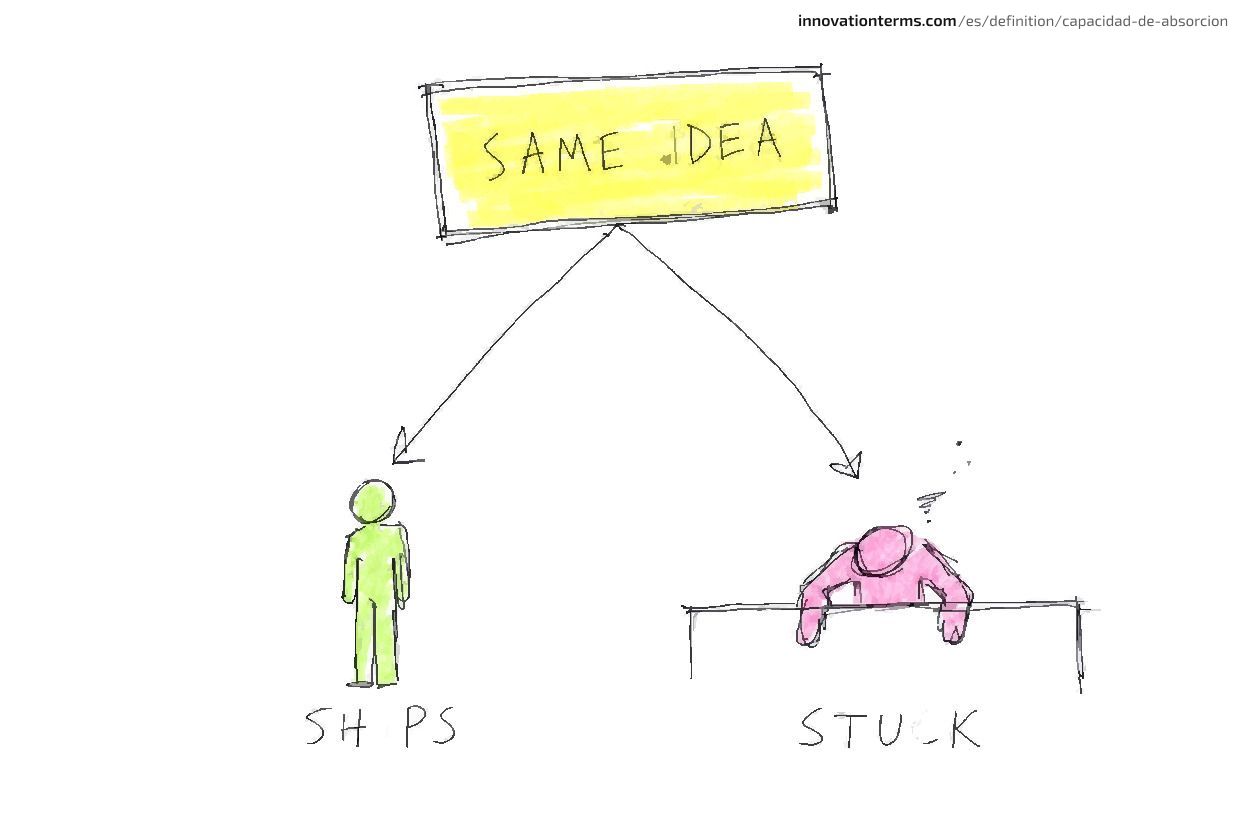
Two firms, one idea, opposite results
The clearest way to see the gate is to hold the external idea constant. Give two firms the same licensed molecule, the same published method, or the same startup partnership. The firm with deep prior knowledge in the field reads the idea quickly, connects it to work already underway, and ships. The firm without that base struggles to see what it has. The knowledge spillover was identical. The return was not, because absorptive capacity decided what each firm could do with it. The Journal of Technology Transfer (2025) documents the same mechanism in AI-era spillovers: the recipient's capacity, not the signal's quality, determines the return. This is the mechanism behind a frustration every innovation leader recognizes: a competitor extracts more from the same conference, the same vendor, the same acquisition.
The small-firm question
Firm size is a weak predictor of open innovation outcomes. Huang and Rice (2009) studied Australian manufacturing SMEs and found that open innovation outcomes depended on the firm's absorptive capacity, which means even resource-constrained firms can win from external sourcing if their conversion routines are strong. The practical reading: before scaling an external-knowledge program, measure whether the organization can use what it already sources. The sequencing matters, and running open innovation well starts with the absorption audit before the scouting budget. This is also why federated innovation and continuous foresight programs underdeliver when the conversion layer is missing: they widen the inflow without widening the firm's ability to act on it.
What actually builds absorptive capacity?
Four levers build absorptive capacity: R&D investment that deepens prior knowledge, HR practices that grow domain expertise, organizational structures that move knowledge across units, and boundary spanners who translate external signals into internal language. None of them works overnight, and their timelines differ.
R&D drives absorptive capacity through a mechanism most competitors do not measure. Cohen and Levinthal (1990) showed that the investment builds prior knowledge, and that prior knowledge is what scales absorptive capacity beyond whatever inventions the R&D produces directly. The meta-analytic evidence across 145 studies confirms that these inputs reliably raise innovation performance through absorptive capacity — as Stettler and Moosauer et al. (2024) demonstrate at scale. The catch is that the field has spent most of its attention on the outcomes of absorptive capacity and far less on the organizational design and individual-level inputs that create it — a gap Volberda, Foss and Lyles (2010) document across the literature — making it easy for idea management programs to invest in intake pipelines without first building the conversion routines that determine what happens next.
| Determinant | Mechanism | Timeline | Evidence strength |
|---|---|---|---|
| R&D investment | Builds prior related knowledge, not just outputs | Years | Strong (foundational) |
| Cross-unit structure | Moves knowledge between teams that hold different pieces | Quarters to years | Strong |
| HR practices and rotation | Deepens and broadens domain expertise across people | Years | Moderate |
| Boundary spanners | Translate external signals into terms internal teams act on | Months to years | Moderate |
How do firms measure absorptive capacity, and why do most proxies mislead?
If your innovation dashboard measures R&D spend and nothing else, you are measuring the wrong thing. R&D spending builds some of the prior knowledge absorptive capacity requires, but the conversion routines that turn absorbed knowledge into products are a separate capability that spending cannot proxy. Treating the two as identical produces measurement error that has shaped two decades of findings.
Lane, Koka and Pathak (2006) reviewed 289 absorptive-capacity papers across 14 journals and found the field had collapsed the construct into its most convenient proxy. When researchers control for confounds, the proxy gets shakier. Azagra-Caro et al. (Technology Transfer in a Global Economy) found that the effect of R&D intensity on a young firm's outcomes was not relevant once founder characteristics were taken into account, which suggests R&D intensity was capturing something else. A practitioner version of the critique is direct: in much of corporate America, R&D is "much more D than R," meaning most of the spend funds incremental development, not the exploratory learning that builds absorptive capacity (Radio Atlantic, Derek Thompson).
The field reaches for four proxies, ranked by accuracy. R&D intensity is the most common and the weakest alone; it measures input spending but cannot distinguish spend that builds learning from spend that funds routine development output. Patent counts add codified inventive output but say nothing about tacit knowledge (the domain know-how that lives in practice and cannot be written down, as distinct from the codified output a patent captures) or assimilative capability. Staff education and R&D headcount share that blind spot: they measure human capital available to absorb without capturing whether the organization routes absorbed knowledge to where it can be used. The strongest proxy is the multidimensional survey instrument, scoring acquisition, assimilation, transformation, and exploitation as distinct capabilities — the approach Zahra and George (2002) formalized. That is the only measurement that tells a leader which component is failing.
What better measurement requires
The fix is to measure the four components separately rather than inferring all of them from one budget number. A firm that measures only R&D intensity cannot locate where its knowledge stops moving. A firm that measures all four components learns whether its problem is potential or realized, which is the only measurement that changes what a leader should do next.
By the numbers: what the evidence shows
The evidence base is large and consistent: absorptive capacity reliably predicts innovation performance across industries, and the construct anchors one of management research's most-cited streams.
Cohen and Levinthal's 1990 paper carries 34,542 citations, among the tallest stacks in management science. The citation count reflects influence, but the meta-analytic record tests the underlying claims. Stettler and Moosauer et al. (2024) synthesized 145 studies covering 434,985 firms and 798,650 firm-year observations, confirming that absorptive capacity reliably predicts innovation performance, with the relationship strengthening in knowledge-rich environments. Lane, Koka and Pathak's (2006) review of 289 papers across 14 journals found the proxy collapse was systematic. Albort-Morant et al. (2018) confirmed with 112 Spanish automotive-components firms that potential and realized capacity matter independently in a sector far from high-tech.
When external knowledge becomes more abundant, the value of absorptive capacity rises rather than falls. AI raises the volume of accessible knowledge, yet a 2025 study of Chinese manufacturing firms found it strengthens the innovation payoff mainly where absorptive capacity is high, and chiefly for the harder, tacit knowledge that tooling alone cannot convert. A 2026 AI-AC study confirms that AI helps most at the acquisition and matching stages, which leaves transformation and exploitation as the human bottleneck. The knowledge glut does not retire absorptive capacity. When external ideas are everywhere, the ability to convert them becomes the entire game. The practical takeaway for anyone planning how to use AI for innovation: the glut raises the premium on conversion.
Common misconceptions about absorptive capacity
You cannot buy absorptive capacity with an R&D budget. You cannot hire it by adding PhDs. You cannot build it quickly in a domain you have long ignored. The field's own measurement habits kept the first of these mistakes alive for two decades.
The reification critique is the empirical anchor. When most of 289 reviewed papers used R&D spending as a stand-in for the construct, they taught a generation of managers that the budget was the capability.
research in this area is fundamentally driven by five critical assumptions that we conclude have led to its reification.
— Lane, Koka and Pathak, The Reification of Absorptive Capacity (2006)
"More R&D spend buys more absorptive capacity." It does not, at least not directly. You cannot buy absorptive capacity with an R&D budget, because the capability compounds from prior related knowledge that no purchase order can backdate — the compounding claim at the heart of Cohen and Levinthal (1990). The claim is not that R&D spending is useless. It is that no single budget cycle can substitute for the years of prior knowledge the capability compounds from. Spending raises the input. Whether the input becomes a capability depends on the conversion routines the budget does not buy. Firms that ramped R&D while neglecting the realized half saw the spend leak out.
"Hiring PhDs imports the capability." Hiring domain experts helps potential capacity. It does nothing for transformation and exploitation unless the organization can route what those experts know to the teams that build products. Xiong and Li (2024) confirm that the firm-level capability requires integration mechanisms that connect those individual members. A roomful of experts who never talk to product teams is potential capacity with a very low efficiency factor.
"We can build it fast when we need it." The compounding mechanism rules this out. A firm cold in a domain lacks the prior knowledge to recognize what it should acquire, so it cannot shortcut the years of accumulation that fluent competitors already banked — the lockout argument from Absorptive Capacity (1990). Most firms do not lack external knowledge. They lack the realized capacity to convert it, so their scouting and R&D spend leaks out before it reaches a product.
Where absorptive capacity has limits
Absorptive capacity reliably predicts innovation outcomes but leaves individual-firm divergence, construct overlap, and non-knowledge constraints unexplained. It behaves differently at the individual and organizational levels, it overlaps with neighboring constructs without being identical to them, and there are situations where it is not the binding constraint at all. Treating it as a master variable overclaims.
Individual versus organizational
A firm's absorptive capacity rests on the absorptive capacity of its people, yet the two can diverge. An organization can be full of capable individuals and still fail to absorb, because the firm-level capability depends on how individual knowledge is combined and shared — the micro-foundation argument Xiong and Li (2024) surface in a literature review across 47 studies. The reverse also holds: strong combinative capabilities — Van den Bosch, Volberda and de Boer's (1999) term for the cross-unit routines that recombine knowledge pieces held in different silos — can extract more from a modest talent pool. Diagnosing a problem at the wrong level leads to the wrong fix.
Neighboring constructs
Absorptive capacity is one of several knowledge capabilities. Lichtenthaler and Lichtenthaler (2009) distinguish absorptive capacity (taking knowledge in) from connective capacity (maintaining external networks for privileged access) and desorptive capacity (exploiting knowledge outward). A firm can be strong at absorption and weak at the other two. The construct is also closely related to dynamic capabilities, and Volberda, Foss and Lyles (2010) document that much of the field treats absorptive capacity as one specific dynamic capability rather than a separate thing.
When it is not the bottleneck
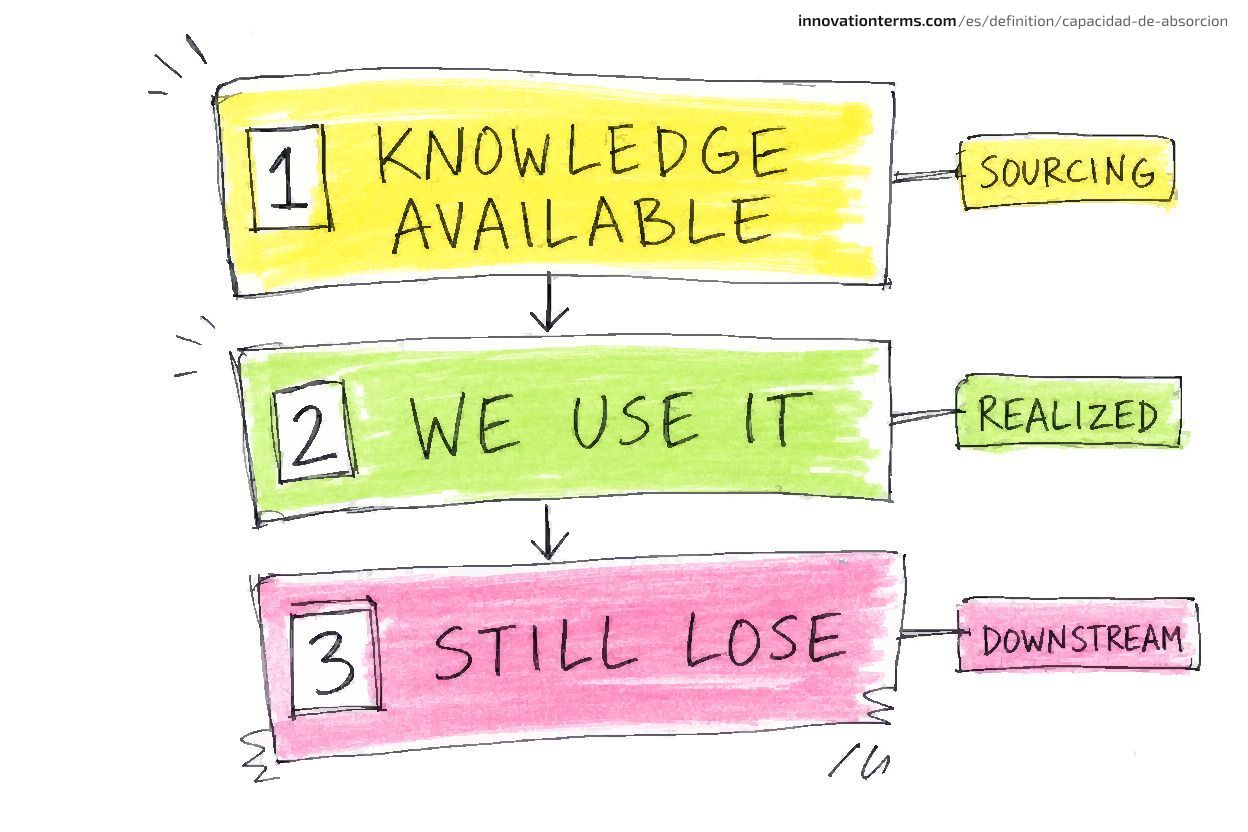
Raising absorptive capacity is the wrong intervention when something else is the real constraint. At the regional and national level, technology transfer succeeds or fails on the recipient's absorptive capacity. In some settings capital or market access, or the technological level of the host economy, becomes the binding limit instead (Reddy and Zhao 1990, via Technology Transfer in a Global Economy). Criscuolo and Narula (2008) reach the same conclusion studying national technological accumulation: a country's ability to benefit from foreign technology tracks its own absorptive capacity. A useful diagnostic before investing:
- Is relevant external knowledge actually available to us? If no, the problem is sourcing, not absorption.
- Do we acquire it but fail to use it? If yes, the problem is realized capacity.
- Do we convert knowledge well but still lose? If yes, the constraint is downstream: capital, distribution, or regulation, not absorptive capacity.
Absorptive capacity in practice: what pharma shows
Pharmaceutical firms with greater internal research capacity extract more from licensed-in external discoveries. Internal conversion capability sets the yield on what any licensed discovery can return, which is why two firms acquiring the same discovery can produce different commercial results.
Cockburn and Henderson (1998) studied how pharmaceutical firms access upstream basic research. The companies that benefited most maintained their own internal basic research and used pro-publication incentives that kept their scientists connected to public science. Their measure of "connectedness" — coauthorship between company scientists and public researchers — correlated with drug-discovery performance. The internal research was not just producing drugs. It was the absorptive capacity that let the firm read and use discoveries made elsewhere, which is the two-faces argument from Cohen and Levinthal (1989) observed in the wild.
The cautionary half of the case comes from Procter and Gamble. In the early 2000s, P&G built one of the most-cited open innovation programs, Connect and Develop, after CEO A.G. Lafley set a public target that half of the company's innovations would come from outside (HBR IdeaCast, "How to Capture All the Advantages of Open Innovation"). The program worked, for a while. Then it faded. An HBR account is direct about why:
instead of P&G continuing to grow from its mastery of open innovation, they seemed to lose the formula. The key people that were doing the program retired.
— HBR IdeaCast
Chesbrough, the open innovation framework's own architect, asks why Connect and Develop never sustained the company's revenue growth (Oxford Handbook of Open Innovation). P&G's realized capacity lived in people and routines rather than in a buyable asset, so it walked out the door when those people did.
Frequently asked questions
What is absorptive capacity in simple terms? Absorptive capacity is how well a company recognizes valuable new external knowledge, takes it in, and turns it into commercial output. Cohen and Levinthal (1990) showed that it depends on what the firm already knows: two companies with the same access to an idea get different results because their absorptive capacity differs.
Who came up with absorptive capacity? Wesley Cohen and Daniel Levinthal introduced the concept in a 1990 paper in Administrative Science Quarterly, building on their 1989 argument about the "two faces" of R&D. The 1990 paper is now cited more than 34,000 times and remains the field's anchor.
What is the difference between potential and realized absorptive capacity? Potential absorptive capacity is acquiring and assimilating external knowledge. Realized absorptive capacity is transforming and exploiting it into commercial output. Zahra and George (2002) introduced the split, and the gap between the two halves is where most firms lose innovation returns.
Can a company increase its absorptive capacity? Yes, but slowly. The levers are R&D that deepens prior knowledge, cross-unit structures, HR practices like rotation, and boundary spanners — all confirmed across 145 studies. Because the capability compounds from prior knowledge, building it takes years, which is why firms should invest before they need it.
Is R&D spending a reliable proxy for absorptive capacity? It is a weak proxy when used alone. R&D spending is an input that helps build absorptive capacity, not the capability itself. Lane, Koka and Pathak (2006) found the field routinely confused the two across 289 papers, producing measurement error. Multi-component survey measures are more accurate.
How does absorptive capacity differ from dynamic capabilities? Dynamic capabilities are the broad ability to reconfigure a firm's resources. Absorptive capacity is the narrower ability to absorb external knowledge. Volberda, Foss and Lyles (2010) show much of the field treats it as one specific dynamic capability. Related constructs include connective and desorptive capacity (Lichtenthaler and Lichtenthaler 2009).
Why do open innovation programs underperform when absorptive capacity is low? Because external ideas generate value only once the firm has adapted and applied them. Knowledge spillovers are more effective in firms with high absorptive capacity, so a low-capacity firm gets little from the same sourcing. Audit conversion before scaling open innovation.

Clara @cla_reinholt
Se centra en la comunicación de innovación, la facilitación y en convertir los marcos en hábitos de equipo.