
How to Use AI for Innovation: Where It Pays Off Most
AI's ROI in innovation is uneven: evaluation benefits most, raw ideation least. A practical guide to where AI shifts the effort/quality tradeoff in your program.
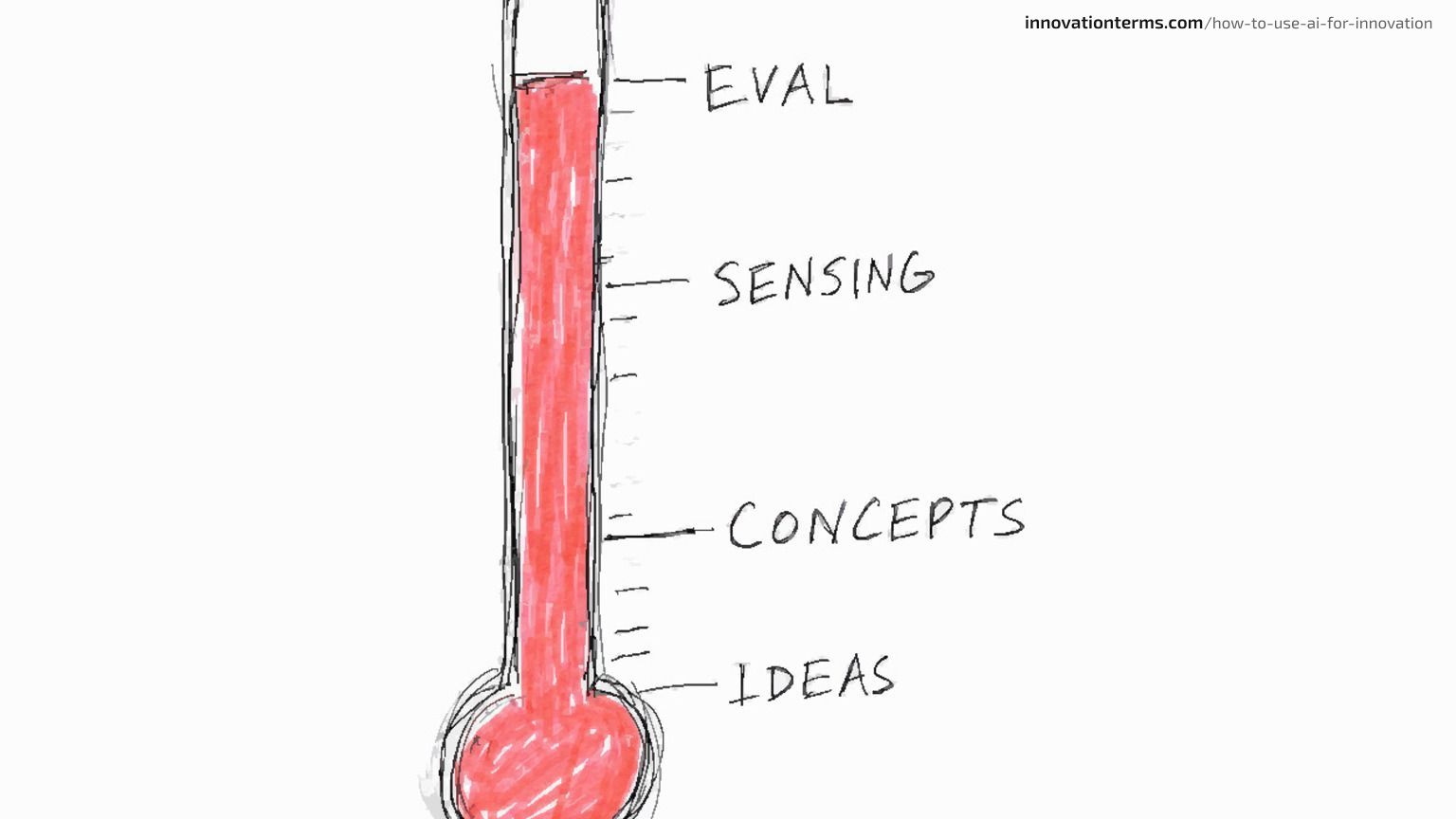
AI's ROI across the innovation lifecycle is uneven enough that the sequencing decision matters more than the tool selection.
The pattern that emerges from academic research and practitioner experience is clear. AI operates within defined functional boundaries. It is a precision tool, and precision tools work best on problems that have already been framed. Evaluation and screening are such problems: the inputs are fixed, the outputs are measurable, and the organizational context required is low. Raw ideation is the opposite. To know whether an idea is any good, you need to know things the model cannot know, your portfolio history, your tolerance for risk, the political capital required to move something forward. The technology is the same in both cases. The difference is the shape of the problem.
The primary self-selection signal: if your team receives more ideas per month than reviewers can assess in one week, you have an evaluation bottleneck, and that is where AI investment pays off first. If your team has no structured idea pipeline and no review process, start with market sensing. this guide assumes you already have both.
TL;DR
- Start with evaluation AI, not ideation AI. Evaluation has the highest ROI because the task has clear inputs, measurable outputs, and low organizational-context requirements.
- AI generates more ideas, not necessarily better ones. A June 2025 study found LLM-generated research ideas score higher on novelty at the proposal stage but decline significantly on all metrics after execution, compared to expert-generated ideas.
- The failure point in most innovation programs is not the supply of ideas. It is the capacity to evaluate and advance the ideas already in the pipeline.
- 74% of organizations struggle to achieve value from AI because they lack the governance and readiness infrastructure, not because they chose the wrong tools.
- The Digital Second Brain concept (building AI-queryable organizational memory) is how teams gradually close the gap between what AI can offer and what their innovation program can use.
The core argument: AI's value in innovation is stage-dependent. Evaluation and screening tasks have the highest ROI because they have clear inputs, measurable outputs, and low organizational-context requirements. Start there, build the infrastructure, and you create the conditions where AI-assisted ideation becomes tractable.
What does "using AI for innovation" mean in practice?
AI for innovation means applying machine-learning tools to specific tasks in the innovation management lifecycle. the process still runs its course. The ROI depends entirely on which task you apply it to.
In augmentation, AI extends what a human analyst or reviewer can do in a given time window. In automation, AI replaces the human step entirely. Most current AI applications in innovation work are augmentation: faster synthesis, more consistent scoring, pattern detection across volumes too large for human teams. Full automation of judgment-intensive steps (strategy decisions, portfolio bets, project kills) is not where the technology is.
AI as augmentation, not automation
A team that expects AI to automate idea selection will be disappointed. A team that expects AI to help analysts evaluate twice as many ideas per week at consistent quality will find the expectation achievable, per Gama & Magistretti's 2025 systematic review in JPIM.
The four innovation stages this guide covers
These are ordered by descending AI ROI, not by chronological lifecycle position.
Who this guide is for
Innovation teams at organizations that already have a structured idea pipeline. The primary self-selection signal: if your team receives more ideas per month than reviewers can assess in one week, you have an evaluation bottleneck and that is where AI pays off first. If your team has no structured idea pipeline and no review process, start with market sensing rather than evaluation.
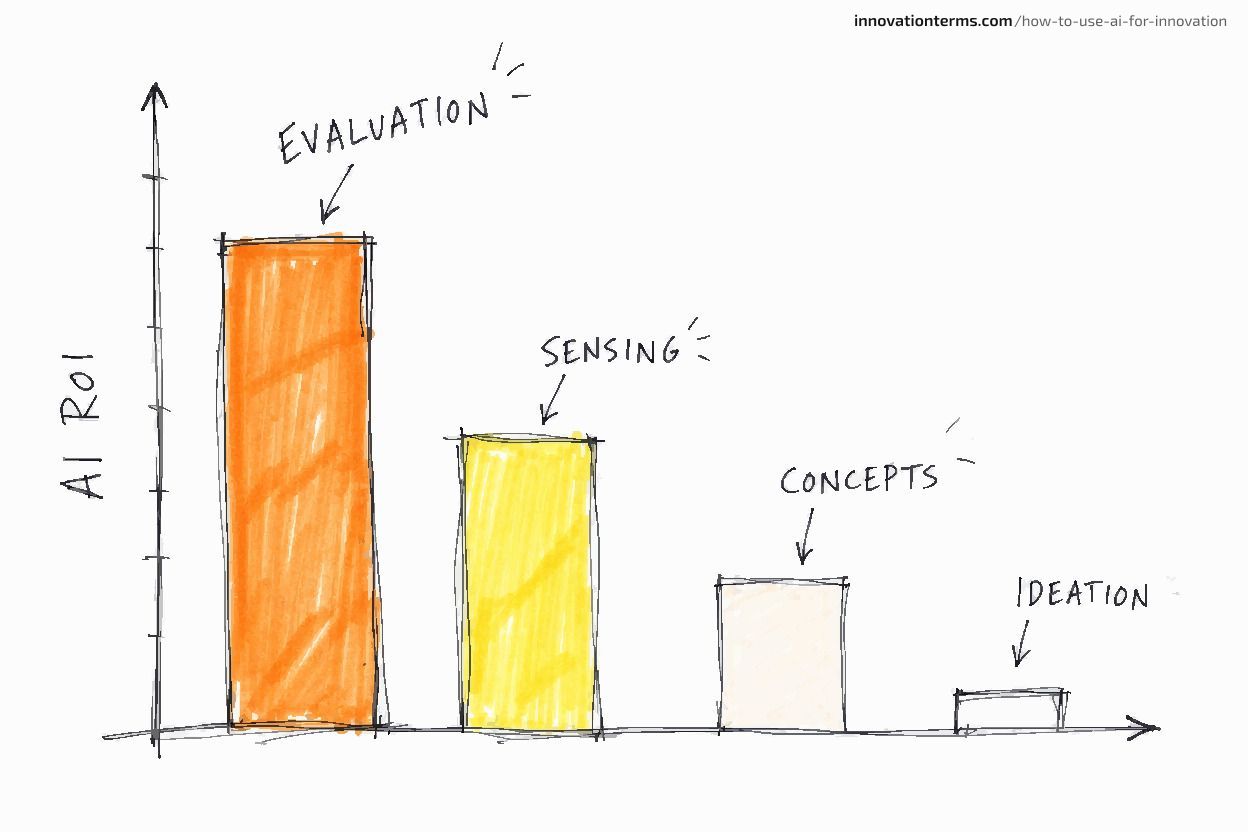
The ROI gradient — why does AI help more at some stages than others?
Evaluation and screening produce the highest AI ROI. Raw ideation produces the lowest. The reason is structural: evaluation tasks have defined inputs and measurable outputs. open-domain ideation requires organizational context no AI model can access.
A 2025 systematic review of 62 empirical articles on AI in innovation management found that AI adoption in practice concentrates in development and screening stages, not in ideation, despite virtually all the marketing discourse centering on brainstorming tools. Gama & Magistretti (2025) explain why: "replace" and "reinforce" applications are most tractable where task structure is high. Ideation remains the hardest domain because it requires context-dependent judgment.
The organizational context problem is the structural constraint. As ITONICS puts it:
"Generic AI cannot see your innovation initiatives. It does not know your strategic priorities. It has zero context on the employee ideas your people submitted last quarter."
The political capital behind a proposal, the portfolio gap a concept fills, the cultural readiness of a business unit to absorb a disruption: none of these are in any training dataset.
| Stage | What AI does well here | AI ROI level | Organizational context required |
|---|---|---|---|
| Evaluation and screening | Pattern-matching against criteria, feasibility scoring at scale, clustering similar submissions | Highest | Low |
| Market sensing | Signal processing from large corpora, trend detection, interview theme extraction | High | Low–Medium |
| Concept development | Variant generation, iteration on existing concepts, structured drafting | Medium | Medium |
| Raw ideation | Recombination of patterns from training data | Lowest | High |
By the Numbers — what does AI adoption in innovation programs actually look like?
The data on where organizations deploy AI in innovation differs sharply from where vendors focus their marketing. Most measurable investment is in evaluation, screening, and development. Not brainstorming.
Key statistics:
74% of companies struggle to achieve and scale value from AI, and 60% generate no material value despite AI investments, per BCG's September 2025 Widening AI Value Gap analysis. High-performing companies pursue half as many AI use cases as peers, focusing intensely on three to five core applications. Winners invest 70% of their resources in people and processes, not technology.
34% of organizations are deeply transforming with AI. Just 20% report having achieved innovation improvement as a measurable outcome, according to Deloitte's 2026 State of AI in the Enterprise survey. The majority are optimizing existing processes, not reinventing innovation programs.
95% of organizations report zero ROI on their AI investments, per CapTech's 2025 C-suite research. The finding is attributed to a "tech first" approach: deploying tools before defining the business problem they solve. This failure pattern applies to evaluation AI as much as brainstorming AI, without scoring criteria and a structured idea pipeline in place before deployment, evaluation tools produce rankings that reflect training data rather than organizational priorities.
Only 1% of organizations describe themselves as AI-mature, with fully integrated workflows and measurable ROI.
| What vendors emphasize | What the data shows |
|---|---|
| AI brainstorming and ideation tools | AI adoption concentrates in development and screening stages — JPIM systematic review |
| "AI transforms innovation across all stages" | 34% deeply transforming; 37% remain at surface-level implementation — Deloitte 2026 |
| Tool selection as the primary success factor | 70% of winners' AI investment goes to people and processes, not tools — BCG (2025) |
Step 1 — How do you use AI to evaluate and screen ideas at scale?
AI can score, cluster, and rank idea submissions against defined criteria, faster and more consistently than human reviewers can at high volume. This is where most innovation programs see the clearest measurable improvement. The reason is almost mechanical. At scale, human judgment degrades in predictable ways: reviewers get tired, they start pattern-matching unconsciously, they disagree with one another about what the criteria mean. AI does not solve the problem of what the criteria should be. It solves the problem of applying them without variance. The bottleneck is not deciding what counts as a good idea. The bottleneck is getting every idea reviewed before the submitter stops caring.
The academic evidence supports this concentration of value. Gama & Magistretti's 2025 systematic review found that AI deployment in innovation programs concentrates in development and screening stages (the stages where teams report measurable throughput gains) while ideation-stage deployment remains rare in practice despite vendor marketing emphasis. Pescher & Tellis (2025, JPIM) confirm the pattern from an experimental angle: AI assists well in idea screening while underperforming on idea selection, the distinction between applying defined criteria versus exercising organizational judgment.
What AI evaluation actually does
Practical AI evaluation in idea management covers three distinct tasks: clustering submissions to surface similar ideas and reduce review duplication. scoring against predefined feasibility and strategic criteria to produce a ranked shortlist. and identifying submissions that closely match past rejected or funded ideas, a function that, when the historical record is structured and queryable, effectively extends reviewer institutional memory.
Purely tactical. Each of these tasks requires AI to apply criteria you have already defined rather than derive them from organizational context it cannot access, which is the distinction that keeps evaluation tractable given where the technology currently stands.
When the bottleneck builds
When idea volume grows faster than review capacity, programs slow down. Submissions age unreviewed. Employees stop contributing when they observe that ideas disappear without feedback. As a HYPE Innovation practitioner webinar framed the structural problem: "You have a lot of disorganized data that leads to slow processes.. it really impacts your decision making and probably worst of all it results in little return on Innovation investment."
AI evaluation stabilizes the program against the governance failure that comes when volume outpaces review capacity.
Criteria come first
Define your criteria before deploying AI scoring. Strategic fit, feasibility, and novelty relative to your current portfolio are the most common. The AI needs these criteria as explicit input. Without them, it's pattern-matching against the wrong target.
Step 2 — How do you use AI for market sensing and external signal detection?
AI for market sensing addresses the scale problem human analyst teams cannot solve: volume. A typical analyst team can track dozens of sources consistently; AI systems process thousands of patent filings, publications, and competitor signals at scale, surfacing patterns before they become obvious to any human-managed monitoring process. This is where continuous foresight practices gain the most from AI augmentation. The constraint is deciding which signals matter for your specific strategy.
The signal volume problem
A team of three analysts cannot monitor thousands of patent filings per week, track commentary across hundreds of industry publications, or synthesize customer interview corpora at scale. AI systems can, consistently and without the attention gaps that compress what human teams can actually cover. McKinsey's research on AI in R&D estimates 20-80% acceleration potential across R&D and development processes, with signal processing among the earliest stages to show measurable gains. The constraint is not how many signals AI can process. It is that AI detects patterns without knowing which signals are strategically relevant to your organization's specific ambitions.
How the scale advantage plays out in practice
Procter and Gamble's AI-assisted product development demonstrates how this works at enterprise scale. P&G's AI Factory has accelerated fragrance R&D by a factor of five, with AI analyzing millions of ingredient combinations and consumer data points to identify development directions worth pursuing. AI synthesis of large qualitative corpora (customer interviews, support transcripts, community discussions) compresses what would be weeks of thematic analysis into hours, expanding the volume of evidence analysts can engage with before forming conclusions, not replacing the conclusions themselves.
Where the analyst still owns the work
A signal about competitor patent filings or a market shift is only useful when someone knows whether your organization is positioned to act on it. That judgment is what AI cannot make. AI surfaces that a signal exists and quantifies its frequency, but interpreting whether a specific finding matters against your actual strategy is the analyst's job. The open innovation signal detection use case applies the same logic, scanning external sources at scale to identify partnership opportunities beyond the organization's own R&D footprint.
Step 3 — How does AI accelerate concept development and iteration?
AI shortens the concept development cycle by accelerating iteration: from rough concept to submission-ready document. The time savings are concentrated in the documentation-intensive stages, not in generating the core concept from scratch.
AI functions as a fast first-draft tool for development-stage work: drafting concept documents, generating variant proposals, structuring feasibility arguments, and producing alternative framings of an existing concept. McKinsey's research on AI in R&D indicates 20–80% acceleration potential for development-stage processes, with the variation driven by how documentation-heavy the current process is.
What iteration acceleration looks like
The practical workflow: a human team generates the core concept, then AI generates variants, drafts, and structured critiques. The AI handles documentation overhead that currently consumes the most time in development stages, not the judgment about which concept is worth pursuing. Combining AI iteration support with systematic market validation at each concept stage keeps the development cycle moving without losing sight of whether the concept solves a real problem.
Dell'Acqua et al. (2023) at BCG and Harvard Business School provide the mechanism. Consultants using AI on well-defined tasks with clear inputs and outputs completed work 25% faster and at 40%+ higher quality than peers working without AI. Junior team members saw a 43% performance improvement. For concept documentation (a well-defined task with clear structure) this improvement is directly applicable.
Where AI development assistance breaks down
Concepts requiring deep organizational-context alignment are where AI iteration support fails. A concept whose viability rests on a privately signaled strategic bet or an undocumented internal capability sits outside what AI variants can assess. They will miss those constraints. Human review remains the quality gate.
Step 4 — How do you use AI for portfolio modeling and resource allocation?
AI portfolio modeling is effective for scenario simulation: "What does the portfolio look like if we shift 20% of resources to this category?" It requires structured portfolio data as input and cannot substitute for the strategic judgment about which bets are worth making.
AI answers the "what if" questions faster and across more variables than a human team with a spreadsheet. It does not answer "which assumption is strategically right for us." The threshold is lower than in raw ideation, because portfolio scenarios work with structured, AI-queryable data rather than tacit organizational judgment.
What AI portfolio modeling does
Resource scenario simulation, expected-value modeling across the innovation portfolio, and portfolio balance analysis across risk/horizon/category dimensions are all tractable AI applications in portfolio management. The output is faster, more comprehensive scenario analysis for human decision-makers, not an autonomous portfolio recommendation.
The prerequisite: structured portfolio data
AI portfolio modeling cannot run on unstructured decisions. Teams without a functioning idea management system and a defined evaluation history cannot run AI scenario analysis on their portfolio. The data layer comes first. As BCG's research on enterprise AI value notes, organizations that build governance and data infrastructure before deploying AI tools are the ones that generate measurable returns.
Decision framework for portfolio modeling AI readiness: The data question comes first. Do you have structured portfolio data covering idea submissions, stage-gate history, and funding decisions? If not, build that layer before anything else. Defined evaluation criteria are the next precondition, because AI has nothing meaningful to score scenarios against without them, and deploying before criteria exist produces outputs that cannot connect to actual organizational priorities. A question about strategic direction requires organizational judgment, not a modeling tool.
How did AI-enabled experimentation change what Amazon ships?
Amazon's experimentation infrastructure illustrates what becomes possible when algorithmic prioritization handles thousands of simultaneous A/B tests — a pace no human review process could sustain at consistent quality. The case also reveals what AI still cannot replace: the strategic reasoning behind each experiment's hypothesis and the decisions about what findings mean for the product direction.
The scale problem
Amazon runs thousands of A/B tests per year across its product and service portfolio. Bezos stated publicly across multiple investor letters that Amazon's competitive advantage depends on experiment volume: "If you double the number of experiments you do per year, you're going to double your inventiveness." Conversion Rate Experts' Amazon analysis documents the broader experimentation culture. Ambition is not what stands out here. It is the organizational humility embedded in it. Fewer than half of Amazon's experiments improve the metrics they target. The company has made a bet that the learning from those failures is worth the cost. Volume is what makes it work: without enough failures to aggregate, individual losses never become a portfolio signal.
At thousands of simultaneous experiments, prioritization is the bottleneck. Which experiments get resources? Which results trigger a deeper investigation versus a quick conclusion? Which findings should inform other active experiments? These questions cannot be answered by human review at that volume.
The AI mechanism
Statistical models handle prioritization at this volume: flagging which experiments are producing significant results fast enough to warrant early resource reallocation, which are stuck in noise, and which findings pattern-match to prior experiments in ways worth surfacing for human review. Amazon's product managers set the strategic hypotheses. The algorithmic layer handles resource allocation and result interpretation at scale, raising the volume ceiling at which human judgment can operate without degrading in quality.
The result is an innovation feedback loop that operates faster than any manually managed experimentation process could sustain.
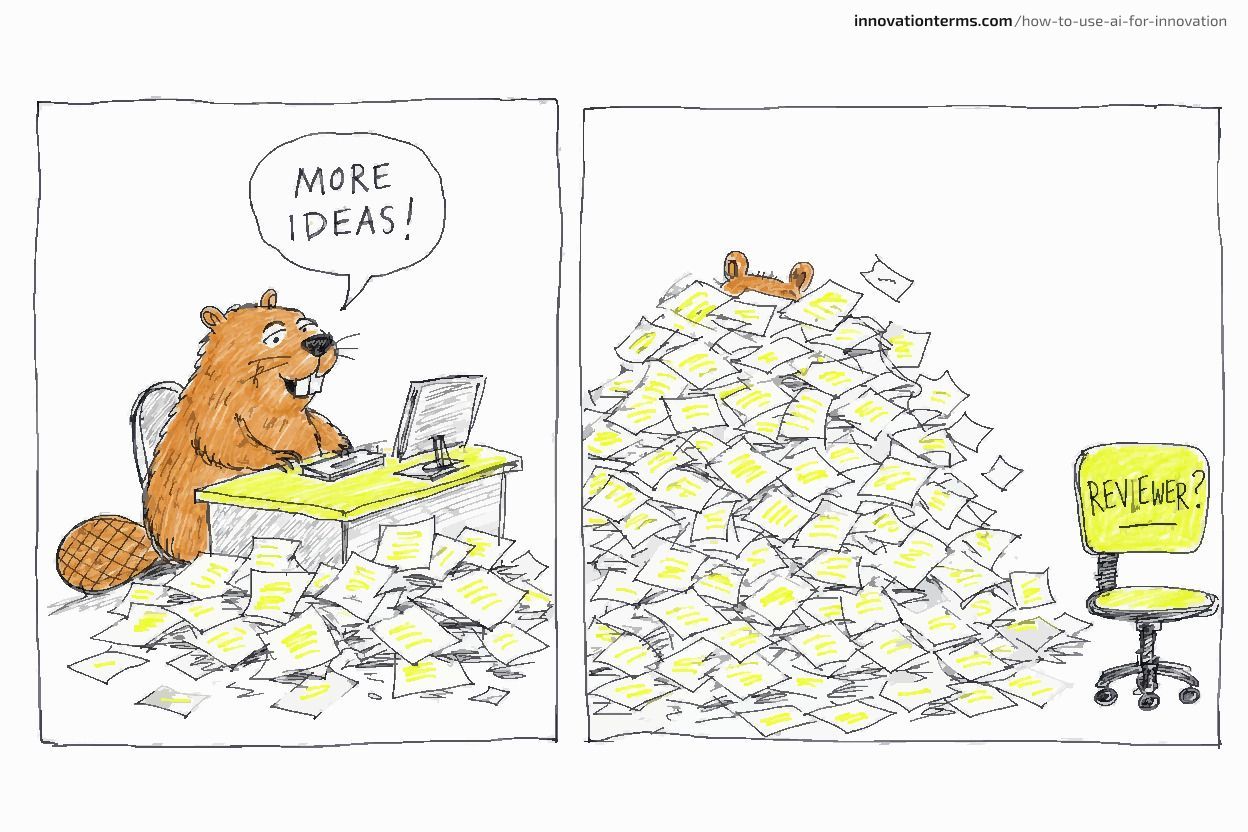
Why does AI help least with raw ideation — and what to do instead?
Adding AI to your ideation process generates more ideas with nowhere to go. The real ROI is in evaluation infrastructure that makes good ideas findable in the volume you already produce. This is the claim that vendor marketing most wants you to misunderstand. The pitch is seductive: more ideas, faster creativity, an innovation engine. But the engine needs a filter. Most organizations haven't. The evidence supports it. The problem inside most companies is not that people have stopped having ideas. It is that the ideas they already have are stuck in queues.
Vendor marketing targets this claim more aggressively than any other in this guide, and the empirical record on it remains unsettled. The evidence supports it.
The novelty-feasibility gap
A June 2025 study by researchers at Stanford and Carnegie Mellon assigned 43 expert researchers to implement either LLM-generated or human expert-written research ideas. Each researcher spent more than 100 hours implementing the concept and produced a four-page paper. Blind peer review by NLP experts assessed novelty, excitement, effectiveness, and overall quality.
The finding, from Si, Hashimoto & Yang (2025) at arXiv:
"scores of the LLM-generated ideas decrease significantly more than expert-written ideas on all evaluation metrics (novelty, excitement, effectiveness, and overall; p < 0.05)."
LLM-generated ideas look more novel at the proposal stage. When someone actually builds on them, the advantage disappears across every metric. AI-generated ideas require more evaluation work to find the ones that can survive execution, not less, which means deploying ideation AI without evaluation infrastructure makes the bottleneck worse.
The organizational context problem
The structural reason AI ideation underperforms is not a technical limitation that better models will soon fix. It is an information problem. AI models cannot access your organization's portfolio history, cultural readiness for a particular type of disruption, political capital behind a business unit, or past bets that constrain what the next bet should look like. These are the actual inputs to a good innovation decision.
"Generic AI cannot see your innovation initiatives. It does not know your strategic priorities. It has zero context on the employee ideas your people submitted last quarter." — ITONICS
This is why structured ideation (where AI generates concepts within a defined evaluation framework) performs well (Dell'Acqua et al. (2023) found 40%+ quality improvement on well-defined tasks), while open-domain strategic ideation performs poorly. The evaluation framework is doing the organizational context work. Remove it, and AI is recombining training-data patterns without any signal about which combinations matter for your organization.
The volume-without-governance failure mode
"And that is starting from understanding that the failure point in most innovation and nurturing new ideas is rarely in the supply of new ideas. It's almost never in the supply of new ideas."
— Safi Bahcall, MIT physicist, biotech CEO, and author of Loonshots
Daniel Casanova, who led BASF's ideation platform for 15 years, observed the same pattern firsthand: "my impression was always that it doesn't really do much more right now than humans would brainstorm is just faster right and you can do more of it and then you have more work to filter it out again." — HYPE Innovation webinar
When AI is used in early ideation across an organization, it draws on the same training distribution for every team. Research from the Wharton Human-AI Research Lab found that:
"When humans generate initial ideas and AI supports evaluation or refinement, diversity is preserved. But when AI is used in early ideation, outputs converge."
Wharton research found that AI ideation outputs converge toward a homogenous distribution even as idea volume increases. More ideas get generated. An enterprise that runs this at scale gradually shrinks the range of strategic options it genuinely considers.
What to do instead
If your team's AI ambition is to get more from your ideation program, route investment toward evaluation infrastructure first. AI evaluation makes good ideas findable in the volume you already have. Scouting for Growth frames the underlying logic cleanly: "Innovation is not an event. It is a capacity system. The goal is not to generate more ideas. It is to increase the flow of ideas to scaled outcomes." Solving the evaluation bottleneck strengthens the case for AI-assisted ideation, because the organizational criteria that make ideation AI tractable (what a good idea looks like for your specific program) have by then been made explicit. This is also why AI ideation tools work better after the fuzzy front end (the pre-project phase where strategic requirements are still undefined) has been resolved, once criteria exist, AI can be constrained by them.
What are the most expensive misconceptions about AI in innovation?
The three misconceptions that cost the most money in AI-for-innovation programs are connected: they all start from the assumption that the bottleneck is ideation volume, and proceed to add AI tools without building the evaluation infrastructure those tools require.
Misconception 1: "AI generates better ideas than human brainstorming."
The evidence says AI generates more novel-looking ideas, not better-executed ones. Pescher & Tellis (2025, JPIM) find that "AI increases the average creativity of generated ideas. however, the effect of AI on the generation of top ideas is conflicting." The ideas that get funded and built are top ideas, not average ones. And as the arXiv 2506.20803 study shows, LLM ideas underperform on every execution metric once someone actually tries to build on them.
Misconception 2: "AI can decide what to build next."
AI can model resource allocation scenarios. It cannot decide which bet is right for your organization. that requires the dominant logic (the cognitive framework through which your leadership interprets which opportunities align with the organization's strategic identity) that no AI model can access. When organizations take AI portfolio recommendations as settled decisions rather than raw material, they hand off the judgment that only human accountability can anchor.
Misconception 3: "AI tools are the bottleneck, once we have the right tools, we'll innovate faster."
BCG's 2025 research found that 74% of companies struggle to achieve value from AI and 60% generate no material value despite investments. The bottleneck is almost never the tools. BCG found that the organizations generating substantial AI value invest 70% of their resources in people and processes, not technology. CapTech's 2025 C-suite research puts the failure pattern precisely: "I think that comes from this tech first approach as opposed to the business first approach." BCG/HBS research on AI mandate pressure found that many organizations are deploying AI tools in response to mandate pressure rather than demonstrated business need — a pattern that consistently produces tech-first failures.
Misconception 4: "More AI-generated ideas means better innovation outcomes."
Between 50 and 70 percent of novel ideas in organizations already "self-silence" or are ignored before reaching review, per research cited in HBR IdeaCast, which means adding AI-generated ideas into that same system compounds the governance bottleneck rather than addressing it. Tracking "ideas generated" as a success metric masks a falling idea-to-pilot conversion rate.
When does the standard ROI gradient not apply?
The evaluation-first ROI gradient applies when two conditions are met: your team receives more ideas than it can evaluate, and good decisions require organizational context that an LLM cannot access. When either condition is absent, the gradient flattens.
Early-stage startups
An early-stage founder without an established product portfolio has no evaluation bottleneck to solve. There is no backlog of ideas waiting to be screened. In this context, AI brainstorming has higher relative value: the organizational context constraint is lower (fewer past bets to account for, clearer feasibility signals), and the goal is expanding the option space rather than narrowing it.
Scientific R&D with computationally checkable feasibility
AlphaFold 3 (DeepMind, 2024) improved protein-molecule interaction prediction accuracy by 50%, and Isomorphic Labs followed by signing deals worth approximately $3 billion with Novartis and Lilly for AI-discovered therapeutic candidates, per AI drug discovery research. Drug discovery is where AI ideation has its clearest track record. Phase I success rates for AI-designed candidates reach approximately 90%, against a 40–65% industry baseline.
Why does AI ideation work here and not in business innovation? Because feasibility in drug discovery is computationally checkable. The protein structure constrains what molecules can bind. That constraint is structurable and AI-queryable in a way that "will this business concept fit our organization's cultural readiness for disruption" is not. This is the same mechanism the Jagged Frontier research captures: AI performs well on tasks with clear constraints, and poorly when contextual judgment is the actual input, as BCG's 2024 GenAI productivity research confirms — consultants using AI performed 19% worse on tasks outside the frontier, where contextual judgment was required.
Small innovation teams
Not every team has an evaluation bottleneck. A team that receives ten well-considered proposals each quarter can work through all of them. There's no backlog. For that team, AI market sensing or concept iteration tooling yields more than evaluation AI does. The evaluation-first rule applies when there is an actual bottleneck to solve, not as a universal default.
How do you build the organizational memory AI needs to work well?
The reason AI helps least in raw ideation is that it lacks organizational context. A Digital Second Brain built around your innovation program gradually closes that gap by making your organization's knowledge AI-queryable.
What organizational context means in practice
The types of knowledge that, when made AI-accessible, most change AI's usefulness in innovation decisions are: portfolio history (which ideas were funded, which were rejected, and why). evaluation criteria (what your organization defines as strategic fit and feasibility). past bets and their outcomes (what has been tried, what worked, what failed at which stage). and cultural readiness signals (which business units have capacity to absorb a new initiative).
This is exactly the information that absorptive capacity theory predicts organizations need to use external knowledge effectively. The absorptive capacity framework, first described by Cohen & Levinthal (1990), predicts that organizations without structured prior knowledge in a domain cannot effectively apply new information about that domain. Applied to AI, the implication is almost obvious once you state it: a model trained on the open internet can hand you patterns from everywhere, but it cannot hand you patterns from your own history unless you have made that history readable. The organization that has documented which ideas failed and why is the organization that can ask AI a useful question.
What a Digital Second Brain for innovation looks like
A Digital Second Brain for innovation is a structured knowledge layer built on top of the idea management system. It makes the organization's historical decisions AI-queryable. When an employee submits a new idea, AI can cross-reference it against past submissions, flag duplicates, and surface the evaluation history relevant to that idea's category. Teams that have built this layer report a different class of AI output: instead of generic recombinations from training data, they get pattern-matching against their own organizational history, the closest available proxy for organizational judgment.
AI absorptive capacity
BCG found the gap between AI leaders and laggards traces to infrastructure differences rather than which tools each side chose. That observation scales. The absorptive capacity framework maps onto Cohen and Levinthal's foundational point: an organization's capacity to recognize and apply external knowledge determines what any input is worth to it. Research consistently finds that organizational readiness predicts AI ROI more reliably than tool selection, per both BCG (2025) and Cohen & Levinthal's foundational framework.
The Digital Second Brain addresses the convergence problem identified by Wharton research (that AI-assisted early ideation produces homogenous outputs) by making AI support contextually specific to your organization's option space.
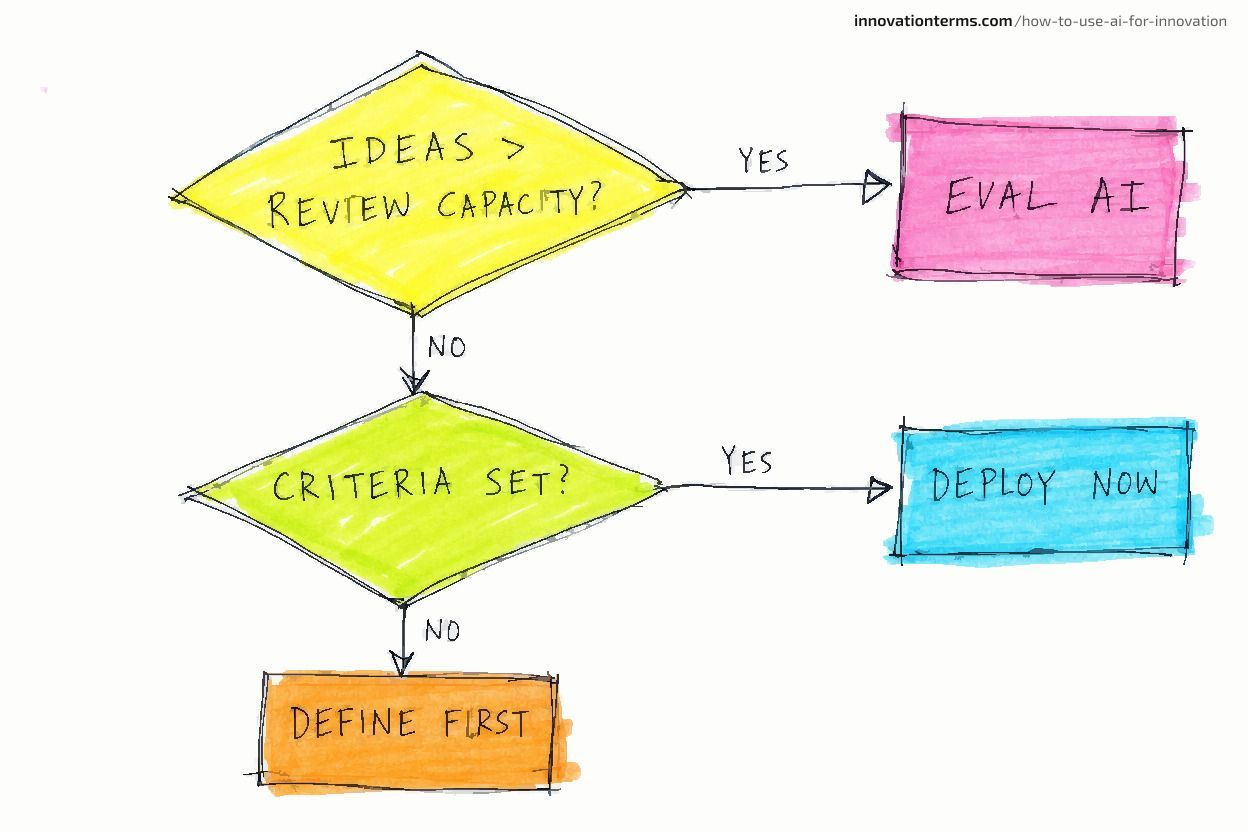
Where should your team start? Recommended entry points by maturity
Most teams start with AI brainstorming because it requires no infrastructure. Start with evaluation. Teams that do see better outcomes faster, provided they arrive with an existing idea pipeline and criteria defined in advance rather than expecting AI to supply those inputs.
Decision framework:
- Does your team receive more ideas per month than reviewers can assess in one week? Yes → Start with evaluation AI. No → Start with AI market sensing.
- Do you have defined scoring criteria? Yes → Deploy evaluation AI now. No → Define criteria first, then deploy.
- Do you have structured portfolio data? Yes → Add AI portfolio modeling. No → Build the data layer first.
Market sensing requires a research brief and a tool to process incoming signals. Teams at Level 1 have no structured pipeline and track ideas without formal process, which is why this is their entry point: infrastructure requirements stay low enough that the output is useful immediately, wherever the program currently stands.
Level 2 teams (some idea backlog building. manual review slowing) are where AI evaluation should be introduced. The prerequisite is non-negotiable: without defined scoring criteria, AI evaluation is pattern-matching against the wrong target, per Pescher & Tellis (2025).
Level 3 teams (evaluation bottleneck confirmed. portfolio data exists) are ready to add AI portfolio modeling alongside concept development acceleration. BCG's data on AI maturity is consistent with this sequencing: organizations that generate substantial value from AI pursue "3–5 core use cases" and build deep capability in those before expanding. Resist the pressure to deploy AI across every innovation stage simultaneously.
How do you measure whether AI is actually improving your innovation outcomes?
The most common measurement mistake in AI-for-innovation programs is tracking activity — ideas generated, AI sessions run — rather than outcomes: conversion rate, evaluation throughput, screening precision. What you measure shapes what you optimize for, and programs that default to activity metrics after deploying AI consistently report rising volume alongside falling conversion rates.
The right metrics
If you deployed AI evaluation, track whether evaluation throughput improved and whether the idea-to-pilot conversion rate is trending upward. If you deployed AI market sensing, track whether the quality of the signal-to-strategy pipeline improved. The four metrics that matter: idea-to-pilot conversion rate (whether screening improves quality, not just volume), time from submission to screening decision (evaluation throughput), false-positive rate in AI screening (how often AI advances ideas that reviewers later reject), and idea-to-market cycle time (end-to-end program velocity). "Ideas generated by AI" is not a meaningful metric for any stage.
Common mistakes to avoid
Measuring volume as a proxy for quality. Programs that shifted to volume metrics after deploying AI brainstorming tools typically saw conversion rates decline while activity numbers climbed. Counting ideas generated or sessions run measures whether the technology is being used. It does not measure whether outcomes are improving.
Skipping the baseline. Before deploying any AI in your innovation process, document the current state: how many ideas are reviewed per week, how long the average idea takes to receive a screening decision, and what percentage of screened ideas advance to concept development. Without a baseline, you cannot measure whether AI improved anything.
What a healthy AI-augmented innovation program looks like at six months: Evaluation throughput has measurably improved (more ideas reviewed per reviewer per week). The false-positive rate in AI screening is tracked and declining as the criteria improve. At least one idea that was surfaced by AI pattern-matching has advanced to concept development. Leaders are measuring outcomes, not activity.
For a full framework on measuring innovation ROI, including pre-AI baselines and stage-gate conversion benchmarks, see the dedicated guide.
Frequently Asked Questions
What is the best way to start using AI for innovation?
Start with AI-assisted evaluation and screening, not with ideation tools. Evaluation is where most programs have a measurable bottleneck (too many ideas, too little review capacity) and where AI delivers the most consistent improvement. Set up scoring criteria first, then deploy AI against them. Teams without scoring criteria should define those before adding any AI to their evaluation process.
Does AI actually generate good ideas, or just more ideas?
Both, but in a way that usually creates more work rather than less. Academic research published in June 2025 found that LLM-generated ideas are rated as more novel at the proposal stage but decline significantly on all execution metrics when someone actually tries to build on them. AI raises the average quality of ideas generated, but the effect on top ideas (the ones worth funding) is conflicting. Volume without a stronger evaluation process produces a larger pile to sort through, not a better shortlist.
What can AI not do in innovation — where does it fall short?
Organization context is absent. Portfolio history, cultural tolerance for disruption, political capital, and past strategic bets sit beyond what AI can access, a blind spot that limits its value in ideation and strategic decision-making far more sharply than in evaluation or signal processing, where organizational memory carries less weight. Which evaluation criteria are right for your organization is a strategy question. Pattern matching cannot answer it.
How does AI change the role of an innovation manager?
It shifts the work toward evaluation design and criteria definition (the human judgment that AI needs as input) and away from manual screening and research synthesis. As AI absorbs more of the process overhead, the work that remains is harder to delegate: which bets deserve funding, when a project has run its course, how the portfolio stays balanced. This is augmentation, not replacement.
How do you evaluate AI-generated ideas against real criteria?
Apply the same evaluation criteria you use for human-generated ideas: strategic fit, feasibility relative to current organizational capabilities, and impact potential against your portfolio goals. The criteria must be defined before deployment. AI scoring without defined criteria produces rankings that reflect the training data, not your organization's priorities.
What are concrete examples of AI in innovation management?
Amazon's algorithmic prioritization of thousands of simultaneous A/B tests. P&G's AI factory accelerating fragrance R&D by a factor of five. and AI-assisted feasibility scoring in drug discovery, where AI-designed candidates are achieving Phase I clinical trial success rates roughly double the industry average.
How do you build organizational readiness for AI in innovation?
Organizational memory first. Structured idea history, defined evaluation criteria, and documented portfolio decisions with their outcomes create the substrate that makes AI-queryable systems worth building, and research consistently shows that this kind of readiness predicts AI ROI more reliably than tool selection. The Digital Second Brain framing, building AI-queryable knowledge systems around your innovation program, is the most practical path there.