
Innovation Culture: How to Improve Your Health Score
Innovation culture is the shared set of behaviors that decides whether
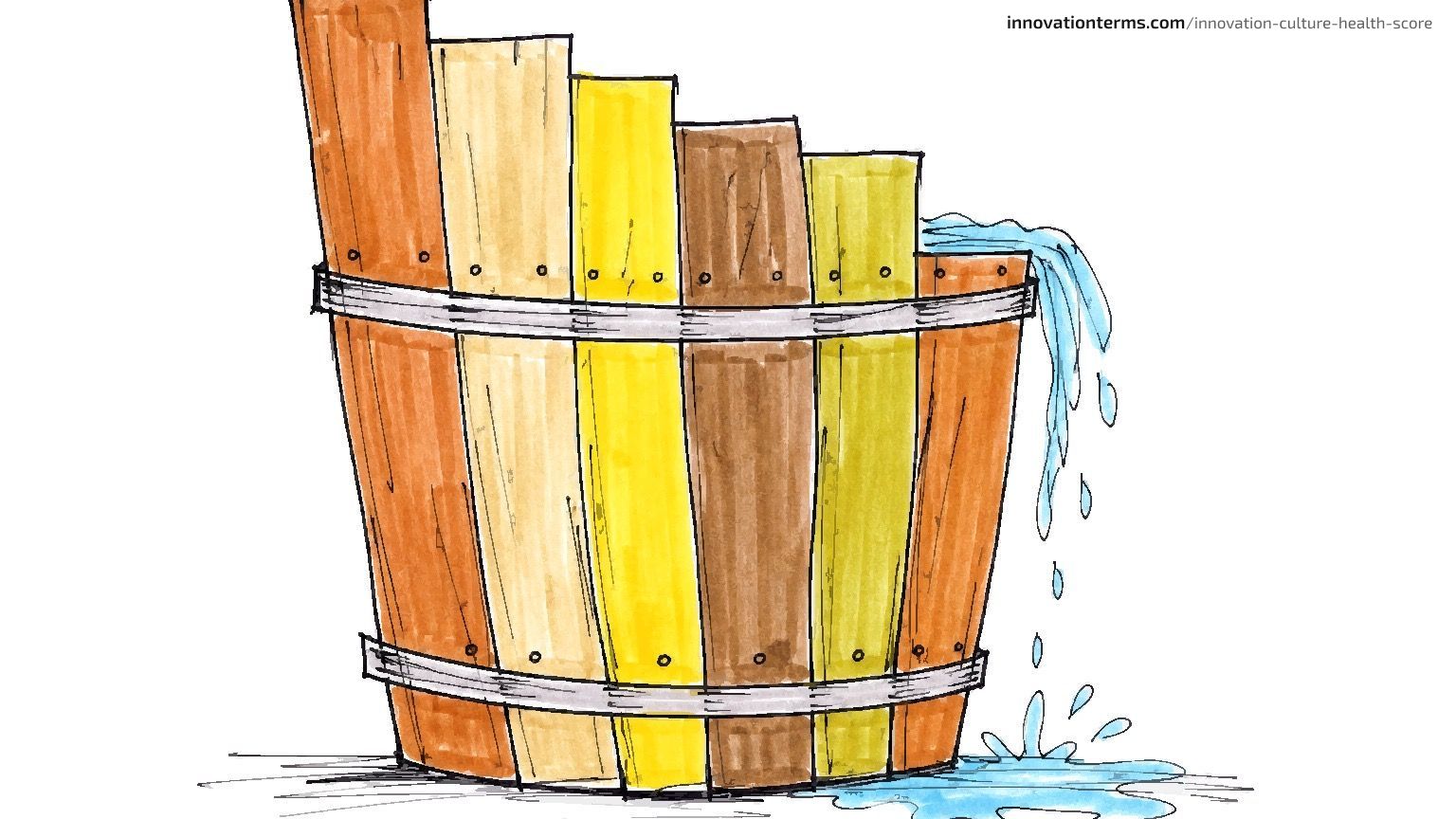
Innovation culture is the set of everyday behaviors that decides whether ideas get airtime, get tested, and get a real path to rollout. The Innovation Culture Assessment becomes useful when teams read the score as a diagnostic, not applause. A low total signals fragile conditions; a high total with one weak dimension signals where progress will stall. Fix the weakest condition first, reassess in a quarter, and watch dimension movement before celebrating the total.
TL;DR
- Fix the weakest dimension first.
- Read stars as behaviors, not sentiment.
- Make leadership visible in cadence.
- Protect time before asking for ideas.
- Lower experiment cost every week.
- Reassess quarterly by dimension.
§1 What is culture for innovation, and what can this assessment actually measure?
Innovation culture is the repeatable pattern of behaviors that decides whether ideas survive contact with daily work. The assessment turns that pattern into six observable dimensions — Leadership and Vision, Psychological Safety, Time and Resources, Experimentation, Collaboration, and Learning and Momentum — so teams can act on what they see rather than guess at what they feel.
Innovation strategy picks direction and bets. Culture decides whether people can surface weak signals, test assumptions, and keep promising work alive. A polished strategy deck can still kill ideas through slow approvals or a calendar with no room for learning.
Start with behavior, not slogans
Innovation culture gets fuzzy the moment teams use it as a mood word. The rubric cuts through that. It does not ask whether innovation feels inspiring. It asks whether leaders make it a priority, whether people can challenge the status quo safely, whether protected time exists, whether experiments are defined before they start, and whether cross-functional work plus retrospectives actually move work forward.
The six dimensions map to observable operating conditions
- Reference base: academic measures from Dobni (2008) and Tian et al. (2018), plus healthcare frameworks from the NHS seven-dimension guide and Ayaad's 2025 healthcare scale
- What this model does differently: it reduces each idea to observable statements Close enough to the literature to be credible. simple enough to use in one sitting.
| Dimension in the tool | Behavior the reader can see | Closest external frame |
|---|---|---|
| Leadership & Vision | Priority, written direction, visible budget | Dobni's leadership and Ayaad's leadership behaviors |
| Psychological Safety | Candid challenge, blame-free learning, junior voices heard | Edmondson's interpersonal risk taking |
| Time & Resources | Protected exploration time and light funding paths | NHS resources and tools |
| Experimentation | Small tests, defined success, evidence-led decisions | Dobni's measurable innovation behaviors |
| Collaboration | Cross-functional work, user involvement, open knowledge flow | Song et al. on cross-functional collaboration |
| Learning & Momentum | Retrospectives, visible wins, path to rollout | Progress Principle and AAR routines |
It also lines up with design thinking, market validation, culture of experimentation, and innovation feedback loops. Ideas only move when the surrounding culture lets those practices happen consistently. The page is practical by design: teams need a clean answer to what behaviors a stronger culture would make normal next month.
§2 How should you read the Health Score?
The Health Score averages 18 one-to-five-star statements into a 0–100 number, but the number matters less than the lowest-scoring dimension. That weak point acts as a bottleneck: improving it first usually moves the total faster than spreading effort evenly across all six dimensions.
First, understand what the gauge is actually showing
The tool converts each 1 to 5 star response into a 0 to 100 scale, averages the results across 18 statements, then assigns a label and short band summary. The article below should match the interface above.
| Score band | Tool label | What the band should trigger |
|---|---|---|
| 0-19 | At Risk | Fix a foundation immediately. Pick one dimension and one team ritual. |
| 20-39 | Fragile | Stop spreading effort. Repair the weakest condition before adding programs. |
| 40-59 | Developing | Build on strengths, but prioritize the lowest dimension next. |
| 60-79 | Healthy | Tighten the remaining gaps so one weak area does not slow the rest. |
| 80-90 | Excellent | Keep pressure on weak spots and codify what is working. |
| 91-100 | Thriving | Protect the habits that produced the score and teach them across teams. |
Averages flatter systems that are still brittle
The bottleneck logic matters because systems rarely fail at their strongest point. Goldratt's core rule is still the cleanest version of the idea:
An hour lost at the bottleneck is an hour lost for the entire system.
— Eliyahu Goldratt, The Goal (1984)
A team can show strong leadership and decent collaboration, then still post a weak psychological safety score. That is not a respectable average. It is a sign that the next good idea will probably stall in the same place. Low safety makes candor feel costly, experiments happen less often, wins thin out, and leadership backing gets harder to secure.
Treat a low dimension score as the best place to test first, not as a prompt for a long root-cause debate. Run one small, cheap experiment that should only succeed if the weak dimension is the real constraint. If the experiment still stalls, the bottleneck sits one dimension upstream.
Use the PNG report as a change log
Save the PNG report. It turns a passing reaction into a record. The file captures the gauge, the label, and every statement-level rating, so the only comparison that matters is the same team, against the same rubric, after a quarter of behavior change.
Start smaller. When the total score is low, the first move needs to survive a busy month, and when the total score is high but one dimension lags, the better move is to leave polished areas alone because the biggest gain usually comes from the part of the system that is dragging the rest.
§3 How do you strengthen Leadership and Vision?
Leadership and Vision improves when innovation becomes visible in priorities, budget, and review cadence. Teams need a written direction, a light funding path, and a standing forum where bets get reviewed — not more slogans or one-off speeches. Without those signals, culture work collapses into announcements that nobody believes.
What a strong score looks like
The live assessment asks whether leaders talk about innovation as a priority, whether a shared written vision exists, and whether senior leaders back promising ideas with budget and time. Those statements are good because each is observable. A healthy score means the team can repeat the innovation strategy in plain English, knows where early-stage funding comes from, and has seen leaders review experiments in the same forums where delivery work gets reviewed.
Leaders have a disproportionately large effect on the cultures of organisations and systems.
— NHS Institute, Creating the Culture for Innovation (2010)
That matches the perception gap reported in the market literature. Crowdworx cites the familiar split where 78% of senior leaders believe they already have a creative culture and only 28% of employees agree. The exact number comes through a secondary source. The smarter lesson is the pattern: leaders regularly overestimate how visible their commitment looks from the middle of the organization.
First moves that change behavior quickly
Start with a one-page innovation direction, not a grand manifesto. Name the problem spaces that matter, the customer signals worth watching, and the money or time that can be spent without a fresh approval. Then put innovation on the agenda of meetings that already allocate resources, including innovation portfolio management. A quarterly offsite is too far away; a monthly operating review is close enough.
Add a visible review cadence for early bets. Teams that already use continuous foresight or federated innovation know the pattern. Weak signals need an owner, a review date, and a next decision. A leader decision log helps: for every rejected or paused idea, one sentence naming the reason and revisit date proves attention is real. Without these mechanisms, the culture reads leadership enthusiasm as theater.
Why this dimension often breaks first
Many teams are asking managers to coach innovation without training them to do it.
60% of first-time managers do not receive any sort of leadership development training — leading 40% of them to fail within the first 18 months.
— Center for Creative Leadership (2022)
That is a culture problem because managers mediate priority, feedback, and permission every day.
If a Leadership and Vision score is low, do not start with slogans. Start with visible decisions. Publish the direction. Ring-fence a small budget. Review experiments in public. Then see whether the stars move.
§4 How do you rebuild psychological safety before asking for riskier ideas?
Psychological Safety rises when people can challenge the status quo, report failed tests, and speak before the loudest voice dominates. Fix this dimension before asking for bigger experiments, because low safety raises the cost of every other improvement. Once people can speak up, experiments get cheaper and learning accelerates.
What good looks like in practice
Team psychological safety—a shared belief held by members of a team that the team is safe for interpersonal risk taking—and models the effects of team psychological safety and team efficacy together on learning and performance in organizational work teams.
— Amy Edmondson, Psychological Safety and Learning Behavior in Work Teams (1999)
The tool translates that definition well. A stronger score means people can challenge the status quo without career risk. Failed experiments are treated as learning rather than blame. Quiet voices are heard before the room settles around the loudest opinion.
Google's Project Aristotle is well known for examining what made teams effective. The researchers expected the winning teams to be defined by the mix of talent on the roster. The published takeaway went the other way:
What really mattered was less about who is on the team, and more about how the team worked together.
— Google Project Aristotle
First moves that lower the cost of candor
Start with meeting design. Ask the most senior person to speak last in idea reviews. Run one round where every participant names a risk, a question, or a weak assumption before solutioning starts. In retrospectives, separate the failed test from the person who ran it. The sentence "the experiment failed" should be normal. The sentence "you failed" should be unacceptable.
Add a pre-mortem ritual: before committing to an idea, the team spends ten minutes writing down why it could fail. Criticism becomes the assignment, so the social risk of speaking first disappears.
The most useful counter-intuitive signal from Edmondson's work is that better teams may appear to make more mistakes because they are more willing to report them. That matters for assessment results. If the Psychological Safety score rises and the team starts surfacing more problems, the culture may be getting stronger rather than weaker.
Safety still needs standards
Psychological safety is not comfort or consensus. It lowers the social cost of truth telling without removing the need for evidence, deadlines, or quality thresholds. In innovation settings, "be safe" can degrade into "be agreeable." The better move is to make disagreement routine, structured, and fast.
If this dimension scores low, fix it before asking the team for bigger experiments. Low safety makes every other improvement slower because people hide the very information that would make ideas better.
§5 How do you protect time and resources so exploration survives a normal calendar?
Time and Resources improves when exploration has a defendable slot in the calendar and a light approval path. Protected time signals that exploration is part of the job, not a favor or a side task that delivery work can cancel. Even a small, recurring block sends a stronger message than a large one-time hack day.
What a strong score looks like
The tool asks whether teams have protected time beyond the roadmap, whether there is a light-touch way to request a small test budget, and whether delivery work is prevented from swallowing every experiment. Those questions are concrete because most teams fail here in scheduling, not in ideology.
Protected time is not a perk. Protected time is proof that the roadmap does not own every hour. 3M institutionalized that proof through its well-known 15% rule:
The beauty of 3M's 15 percent rule is that it's not a rule at all: it's permission.
— 3M, A Century of Innovation (2002)
Most big businesses treat exploration as an exception; 3M treats it as part of the job.
Atlassian solved the same problem differently by creating a bounded, public event in ShipIt, which began in 2005 as a dedicated 24-hour period for side projects and later scaled to thousands of participants across multiple countries.
Why autonomy matters here
Dan Pink's TED synthesis offers a simple warning: creative work degrades when every experiment gets framed as extra work done after the real work. That is why autonomy, mastery, and purpose matter. They shift exploration from a side task into work the person owns. If the assessment score is low here, people are probably signaling a resource design problem, not a motivation defect.
First moves for teams with tight budgets
Not every team can copy 3M or Atlassian in full. Most teams can still defend a 90-minute weekly test block, a monthly half-day sprint for opportunity framing, or a tiny experiment fund that managers can approve without a business case. Teams already doing market validation or early design thinking work need exactly that kind of low-friction permission structure.
Start with a calendar audit: cancel or shorten one recurring hour-long meeting and redirect that hour to a protected test block. The move costs nothing and proves exploration is a priority. The ambidextrous organization frame is a useful next read for balancing exploration and execution.
If this dimension scores low, do not ask for more ideas. Ask where the next cheap test lives on the calendar, who can approve it in a day, and what work stops so the answer is yes.
§6 How do you make experimentation cheap enough to happen weekly?
Experimentation improves when teams define success before a test starts, keep the cost low, and feed every result into the next decision. Cheap, frequent tests beat occasional big pilots because they produce evidence faster and fail with less damage. The goal is evidence, not motion.
Separate experiments from pilots
Many teams call a pilot what is really an experiment. The distinction matters because pilots are heavier, slower, and tied to implementation, while experiments answer a narrow question cheaply. A prototype makes an idea concrete enough to inspect at low cost; the threshold to scale is a visible user reaction. An experiment tests one assumption with a defined success rule; the threshold is a clear accept, reject, or revise signal. A pilot proves operational viability in a real setting; the threshold is cross-functional readiness and a rollout path.
The live tool uses the operating rule of defining what success looks like before the test starts, then letting evidence inform the next decision. That is validated learning, the practice of running fast, low-cost tests to gather evidence before making major commitments to an idea.
Lower the cost per learning cycle
Original ideas rarely arrive on the first attempt. Grant's synthesis suggests that moderate delay can produce ideas that are both different and better — not because waiting itself helps, but because incubation plus repeated small attempts beats a single polished launch. The practical move is not to delay work; it is to run several cheap, low-ego experiments instead of betting on one big reveal.
Give every test a return path
Cheap experiments only matter when they feed the next decision. That is where innovation feedback loops and innovation portfolio management become useful. Every test needs a question, a date, a success threshold, plus a named person to decide what happens next. Without that, experiment volume becomes theater.
Create an assumption log: one page with the open question, the cheapest test that could answer it, and the decision that changes if the answer is yes or no. The log turns ideation into a queue of small bets.
If this score is low, shorten the path from idea to test. Cut deck-writing. Cut approvals. Force every proposed experiment to answer one assumption first.
§7 How do you build collaboration without drowning people in meetings?
Collaboration improves when ideas cross functions early and knowledge flows to the person who needs it next. The goal is not more meetings; it is one clear owner plus the right voices, early evidence, and reusable learning. When ownership is unclear, collaboration becomes meeting debt instead of knowledge flow.
What good looks like
The assessment asks whether different teams work on ideas together, whether customers or end users are involved early, and whether knowledge is shared openly. Those are the right signals because weak collaboration rarely looks like open hostility. It usually looks like sequential work, late user input, and duplicated learning across silos.
Song, Dyer, and Thieme found that market knowledge and cross-functional collaboration enhance product innovation performance, while also qualifying that benefit. Collaboration pays off when the organization has mechanisms to integrate what different functions know.
Why more collaboration is not automatically better
There is a counterweight. Cross, Rebele, and Grant warn that time spent by managers and employees in collaborative activities has ballooned by 50% or more. "Break silos" is easy advice to give and expensive to apply badly. More meetings, channels, and optional reviewers do not create stronger collaboration. They create drag unless the team knows who owns the decision and what each function contributes.
Healthy collaboration means one owner plus the right functions, early evidence, integrated knowledge that produces a decision, and learning stored where another team can reuse it. That is the backbone of a transactive memory system. Drag means every interested party joins by default, functions show up late at the approval gate, meetings multiply without a decision, and learning stays trapped in one silo.
Moves that work in hybrid teams
The practical fix is a narrow cross-functional path. Pick one problem owner, one customer-facing voice, and one operator or technical voice. Review evidence together early, not at the approval stage, then store the learning where another team can find it. Pages like federated innovation, wisdom of the crowd, ambidextrous organization, and continuous foresight are useful because they solve the same problem: variety helps only when the signal can travel.
For hybrid teams, run the review asynchronously. Before the live meeting, each function posts one piece of evidence and one risk, then names the decision it needs. The live meeting then owns integration, not status updates.
If the Collaboration score is low, simplify the path. Fewer people, earlier evidence, clearer ownership.
§8 How do you turn learning into momentum instead of idea pileup?
Learning and Momentum improves when teams convert experiments into visible progress, shared routines, and a path to rollout. Retrospectives and decision logs matter more than idea counts because they close the loop between testing and action. Momentum is evidence that learning changed what happens next.
Make progress visible
Amabile and Kramer point to a progress blind spot, not just a morale finding. Across 12,000 diary entries from 26 project teams, the biggest day-to-day lift came from making progress in meaningful work, yet 95% of managers failed to rank progress as the top motivator. In practice, that leaves many organizations rewarding launch theater while overlooking the evidence that a team is learning faster.
Use a repeatable learning routine
The After Action Review is useful because it is plain. Morrison and Meliza define it as an interactive discussion in which unit members decide what happened, why it happened, and how to improve or sustain collective performance. That routine beats vague calls to "share learnings." A strong score means teams can answer four questions quickly after a test: what did we expect, what happened, what did we learn, and what changes next. That closes the loop between experimentation and momentum.
Build capability, not just excitement
This is also where the manager-skill gap comes back. Momentum stalls when first-line leaders do not know how to run retrospectives, coach evidence-based reviews, or move ideas into a simple innovation portfolio management path. The fix is a decision log: for every experiment, record the expectation, the result, and what the team decided to do differently. The log needs only a shared page and a five-minute review at the start of the next meeting.
Capability building is also often the first budget cut. One secondary roundup cites U.S. corporate training spend falling from $101.8B in 2023 to $98B in 2024. treat it cautiously as an aggregation page.
Start with one learning ritual. Then add one visible scoreboard that tracks completed experiments, decisions changed by evidence, and the small wins that actually reached users or operators. Submitted idea counts can wait unless they lead somewhere.
§9 What do the numbers say about healthy teams?
The numbers do not set a universal passing grade; they calibrate whether the conditions for innovation are present. Healthy teams pair the score with operating evidence such as experiments completed, decisions changed, and learning reused. The score finds the constraint; the operating data shows whether the constraint is loosening.
A practical calibration set
- 78% vs. 28%, Crowdworx's leader-employee perception gap shows leadership optimism often outruns frontline reality.
- 60% and 40%, Center for Creative Leadership's manager-training gap and failure rate shows weak manager capability slows every dimension.
- 12,000 diary entries across 26 teams, Amabile and Kramer's Progress Principle evidence shows small wins and visible progress are not fluff.
Other numbers in the source pack add useful color. They do not change the action plan. The score is there to find the dimension most likely to stall the next good idea, not to collect impressive figures.
What low and high scores should mean operationally
A low score points to a missing survival condition for good ideas. The missing piece may sit in authority and trust, or in execution support such as time, experiment design, collaboration paths, or learning discipline. A high score means the culture has more of those conditions in place, but it does not guarantee even maturity across dimensions or a reason to stop checking for the weakest point.
Resist fake thresholds. There is no academically blessed number above which every team is healthy. The useful question is whether the score lines up with observable behavior and whether the next quarter's change plan attacks the real constraint, not whether the average looks flattering.
§10 What can Atlassian ShipIt and 3M's 15% rule teach you?
Atlassian ShipIt and 3M's 15 percent rule both protect time for exploration, but one uses a bounded event and the other uses standing permission. The transferable lesson is to make exploration hard to cancel, not to copy a famous ritual whole.
Why ShipIt travels better than folklore
Atlassian's own history is concrete enough to copy. ShipIt began in 2005 as a 24-hour side-project sprint: pause normal work, build something that matters, then show it. The useful parts are the bounded time box, the public demo, and the expectation that experiments produce evidence or a next step. If demos never lead to decisions, the ritual flatters the culture and teaches people that extra effort disappears after applause.
What 3M proves that hackathons do not
3M's example lands in a different place. The 15% rule is standing permission, not an event. In 3M's telling, that room for individual initiative is how ideas like the Post-it note survived long enough to become commercial realities. It also shows that time protection becomes culture only when it is institutional. If exploration depends on one unusually tolerant manager, the practice disappears in the next reorg.
Copy the mechanism, not the mythology
The transferable pattern is simple: protect a block of time, keep the entry cost low, ask for a defined question and a demo, and give promising work a real next step. That structure can support a formal hack day, a weekly test window, or a rotating exploration sprint inside a regulated environment. Teams building a culture of experimentation can use this pattern as the first concrete ritual. The mechanism matters more than the brand-name case study.
§11 Which edge cases change how you should interpret the score?
Regulated settings, hybrid work, reorganizations, and small teams all change how the six dimensions show up. The score stays useful when teams read it in context and compare like with like, treating major structural shifts as new baselines. Ignore context and the score becomes noise instead of signal.
Regulated or safety-critical teams
High-stakes settings are different. A healthcare team still needs the same underlying conditions, yet experimentation shows up under tighter limits than on a consumer app team. Ayaad's 2025 validation study supports that continuity by grounding a 30-item healthcare instrument in six constructs adapted from Dobni and Tian, suggesting the framework survives context shifts when practice is paired with stronger controls and closer coordination.
The NHS guide helps here because its seven-dimension model was written for a public-sector setting where risk, resources, and relationships all have to be handled explicitly. A low Experimentation score in a hospital or utility does not mean "move faster and break things." It means lowering the cost of learning inside the safety boundary.
Hybrid teams and collaboration drag
Remote and hybrid teams often produce uneven scores. Collaboration can look healthy in meeting count and weak in actual idea flow. Psychological safety can look fine in one-on-ones and poor in large groups. Pair the survey with operational evidence such as experiment cycle time, participation breadth, or how often learning gets reused across locations.
When comparisons become misleading
Layoffs change the frame. So do reorganizations or major scope shifts, because once the team, manager set, or problem space moves in a material way, the tool is no longer tracking the same system and the new run belongs in the record as a baseline PNG for the next stable quarter.
For organizations navigating major structural change, the horizon planning framework can help separate short-term operating rhythm from longer-term culture work.
Edge cases do not weaken the bottleneck idea. They make it more important because teams under stress need sharper sequencing, not broader ambition.
§12 Which myths keep culture work stuck?
Culture work stalls when teams mistake activity for conditions. More ideas, celebrated failure, prizes, and a flattering total score can all hide the real bottleneck, which is usually a weak dimension that nobody is fixing. The antidote is to count decisions moved and learning reused.
Myth 1: More ideas means better culture
A big backlog proves very little. Teams can generate plenty of ideas and still score poorly on Time and Resources or Learning and Momentum if those ideas do not move into tests, decisions, or learning loops, because the assessment is asking how a concept reaches rollout rather than whether people keep producing suggestions.
Myth 2: Teams should celebrate failure
Isenberg argues that well-intentioned attempts to celebrate failure are misguided. Failure is sometimes the by-product of serious experimentation. It is not the target. The better norm is to reduce the shame around honest tests while still expecting teams to learn quickly and avoid repeating preventable mistakes.
Myth 3: Leaderboards and prizes create innovative behavior
Kohn warns that the more we use artificial inducements to motivate people, the more they lose interest in what we're bribing them to do. If the score becomes a leaderboard, teams will improve for optics. If the score becomes a diagnostic, teams will improve for conditions. That is the difference between a healthy culture review and a survey game.
Myth 4: One big score means the culture is fixed
Start with the weak point, not the label. The total score does matter because it summarizes the environment, but it stops helping once readers forget that one weak dimension can still choke the system. The average of 18 statements cannot cover for a deep local failure.
§13 How often should you rerun the assessment, and what should you track between runs?
Rerun the assessment quarterly, after a period of deliberate changes, and compare dimension-level movement rather than the total alone. Save each PNG report so the same team can compare itself against the same rubric over time. That rhythm keeps the bottleneck visible without gamifying the number.
Why quarterly is the right default
The live page recommends a quarterly rhythm. Monthly reruns are usually too fast for the team to rate real change in leadership habits or budget behavior honestly. Annual reruns are too slow. They let the score drift away from the operating changes that caused it.
Quarterly is also short enough to keep the bottleneck visible. If the weakest dimension was Psychological Safety in April, the July conversation should focus on whether candor rituals changed, whether experiment quality improved, and whether other dimensions moved as a consequence. That is a sharper review than asking whether the team "feels more innovative."Edmondson (1999)
Track more than the gauge
Use the score together with a small operating dashboard:
- Number of experiments completed and reviewed.
- Percentage of tests that changed a decision.
- Participation breadth across functions.
- Retrospective actions completed.
- Good ideas that moved from concept to rollout.
Those measures keep the assessment grounded in behavior. Teams already using innovation feedback loops, market validation, innovation portfolio management, or federated innovation will recognize the logic. The survey tells you where conditions feel weak. The operating data tells you whether the conditions are changing.
How to talk about score movement with leadership
Do not present the score as proof of virtue. Present it as a decision tool. Show the old PNG, the new PNG, the lowest dimension then and now, and the operating changes that moved with it. That keeps the conversation on resource allocation and makes the score harder to game.
FAQ
How do you measure innovation culture?
The Innovation Culture Assessment measures it through 18 observable statements grouped into six dimensions: Leadership and Vision, Psychological Safety, Time and Resources, Experimentation, Collaboration, and Learning and Momentum. Each statement is rated one to five stars, and the results are averaged into a 0–100 Health Score. The score is most useful when teams compare dimension-level results rather than chase the total.
What does a low score on one dimension actually mean?
It means that dimension is the most likely bottleneck for the next good idea. A weak Psychological Safety score raises the cost of candor; a weak Time and Resources score starves experiments; a weak Learning and Momentum score keeps the team from compounding wins. Fix the lowest dimension first, then reassess.
What is a good Health Score?
A good Health Score shows up in the weakest dimension first. That dimension should be improving, and the operating evidence should move with it. Even a total in the Healthy or Excellent band can hide a local bottleneck. The real test is whether the team can run better experiments, surface harder truths, and move more ideas into decisions than it could last quarter.
Which dimension should teams fix first?
Teams should usually fix the lowest-scoring dimension first because that condition is the most likely to slow the rest. A weak Psychological Safety score raises the cost of candor. A weak Time and Resources score starves experiments. A weak Learning and Momentum score keeps the team from compounding wins even after tests happen.
How often should teams rerun the assessment?
Quarterly is the best default for most teams because behavior change needs time and frequent reruns create noise. Teams should save the PNG report, make one quarter of targeted changes, then compare the next run by dimension instead of treating the total as a stand-alone grade.
What is the difference between culture for innovation and innovation strategy?
Innovation strategy decides where the organization wants to place bets and what outcomes matter. Culture for innovation decides whether people can raise ideas, test assumptions, collaborate across functions, and learn fast enough for the strategy to work. Strategy picks direction. Culture determines whether the system can execute under real conditions.
Can a team improve the score without adding budget?
Yes. Many first moves cost time and attention more than money: making the senior voice speak last, protecting a weekly test block, defining experiment success before work starts, and running short retrospectives that produce real follow-through. Budget helps, but several weak scores improve first through meeting design and operating cadence.
What should teams use besides a survey?
Teams should pair the survey with operating evidence. Start with completed experiments and decisions changed by evidence, then add broader signs that work is spreading and reaching rollout. The survey captures perceived conditions. The operating evidence shows whether those conditions are producing better innovation behavior over time.