
How to Run Open Innovation: Model, Strategy & Program
Choose between inbound, outbound, or coupled open innovation — but answer three questions first: what you offer partners, what you can absorb, and how IP is structured.
If you are a startup looking for corporate partners, this is the wrong article.
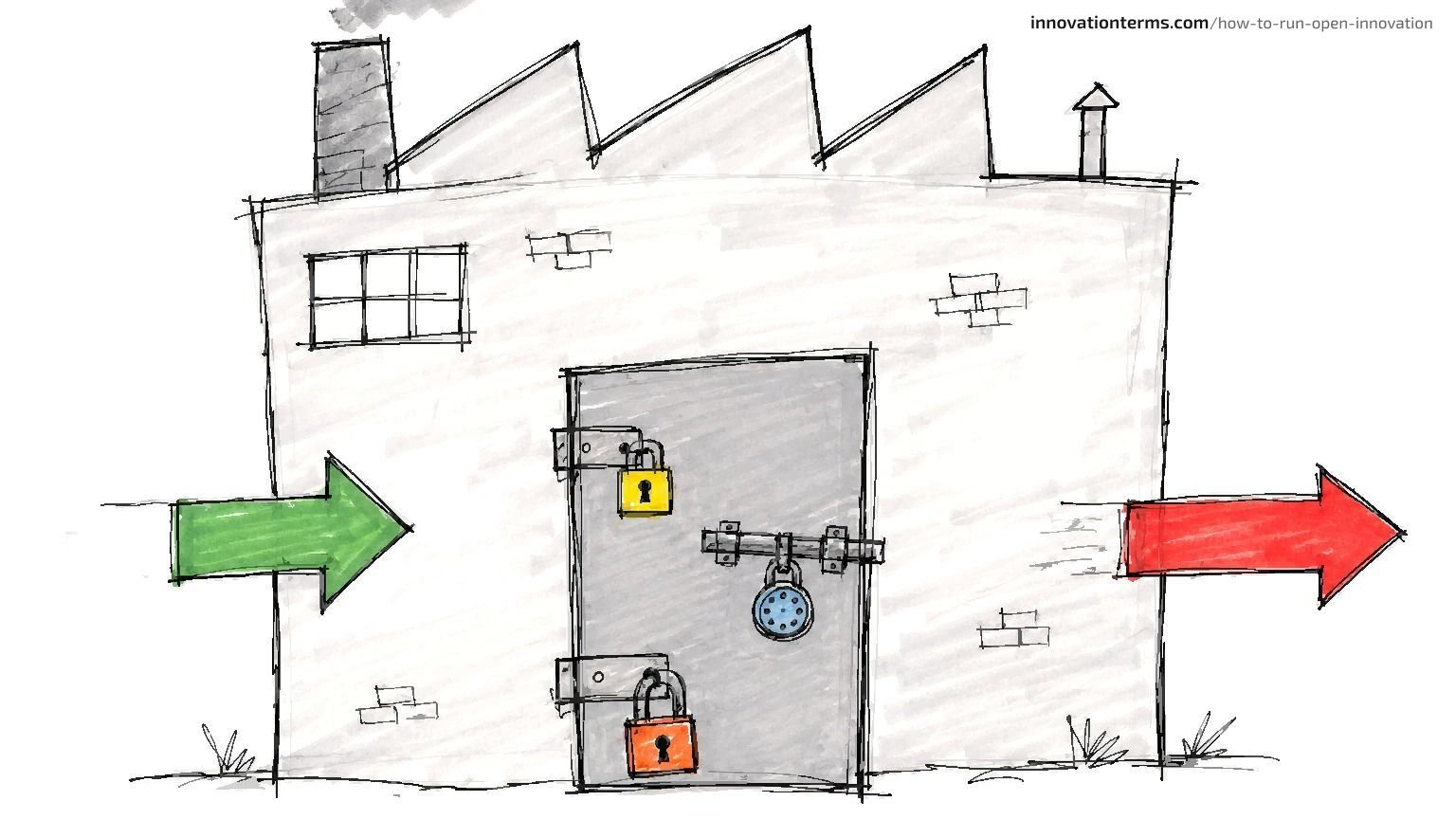
Open innovation is the use of purposive inflows and outflows of knowledge to accelerate internal innovation and expand the markets for external use of innovation, as Henry Chesbrough defined it in 2003. The core idea: valuable knowledge exists outside your organization's boundaries. You can bring it in. You can also send internal knowledge outward when external commercialization creates more value than internal development would.
Most guides begin with model selection. That is the fourth question. The prior three determine which models are even available to you, with IP structure being the factor most likely to eliminate options you might otherwise pursue.
TL;DR
- Absorption failures explain most program disappointments, not partner quality
- Answer three questions before you pick a model
- Define what you offer partners, not just what you want from them
- IP terms determine which partners show up, or don't
- Winning ideas die inside without a named owner
- Model choice follows readiness — it doesn't precede it
Most open innovation programs fail not because they attract bad partners but because the organization lacks the internal machinery to act on what partners bring. Before choosing a model, answer three questions: what you genuinely offer external partners, whether your absorptive capacity can handle what comes in, and whether your IP structure makes partner participation rational. Model selection follows those answers automatically.
§1 — What Open Innovation Actually Requires — and What It Isn't
Open innovation requires a system — not just an intake mechanism. A hackathon, API program, or idea competition is one gate in that system. Without the absorptive infrastructure to evaluate, fund, and integrate what comes through that gate, any single event produces activity metrics, not commercial results. Most programs fail at this junction, not at the ideation stage.
"The use of purposive inflows and outflows of knowledge to accelerate internal innovation, and expand the markets for external use of innovation, respectively." — Henry Chesbrough, Open Innovation (2003)
Misconception 1: A hackathon is open innovation
A hackathon is an ideation event. It generates outputs. Open innovation is the system for absorbing those outputs, evaluating them, funding them, integrating them, and converting them into commercial products or capabilities. Running a hackathon without that system produces a well-attended event and a folder of slide decks nobody ever acts on.
The error is treating the intake mechanism as the complete system. Intake is one gate. What happens after intake is the open innovation problem.
Misconception 2: Open innovation is crowdsourcing
Crowdsourcing aggregates distributed micro-contributions from large, often anonymous crowds — fitting problem shapes like prediction markets, wisdom of the crowd aggregation, consumer polling, and work that decomposes into discrete micro-tasks. Open innovation involves bilateral knowledge exchange with named partners who invest substantial resources, time, IP, and organizational attention, as Gassmann & Enkel (2004) established across 144 companies. A startup co-developing a product with your engineering team is not doing crowdsourcing. Different governance structures entirely.
Misconception 3: Running an API program is running open innovation
Letting outside developers build on your platform is what platform strategy looks like. It becomes open innovation only when your organization changes in response to what external developers build, when their innovations reshape your internal roadmap, your technology choices, or your product direction. Outbound platform is the more accurate label for most API programs. The distinction matters for governance design.
§2 — Do You Even Belong in the Kitchen?
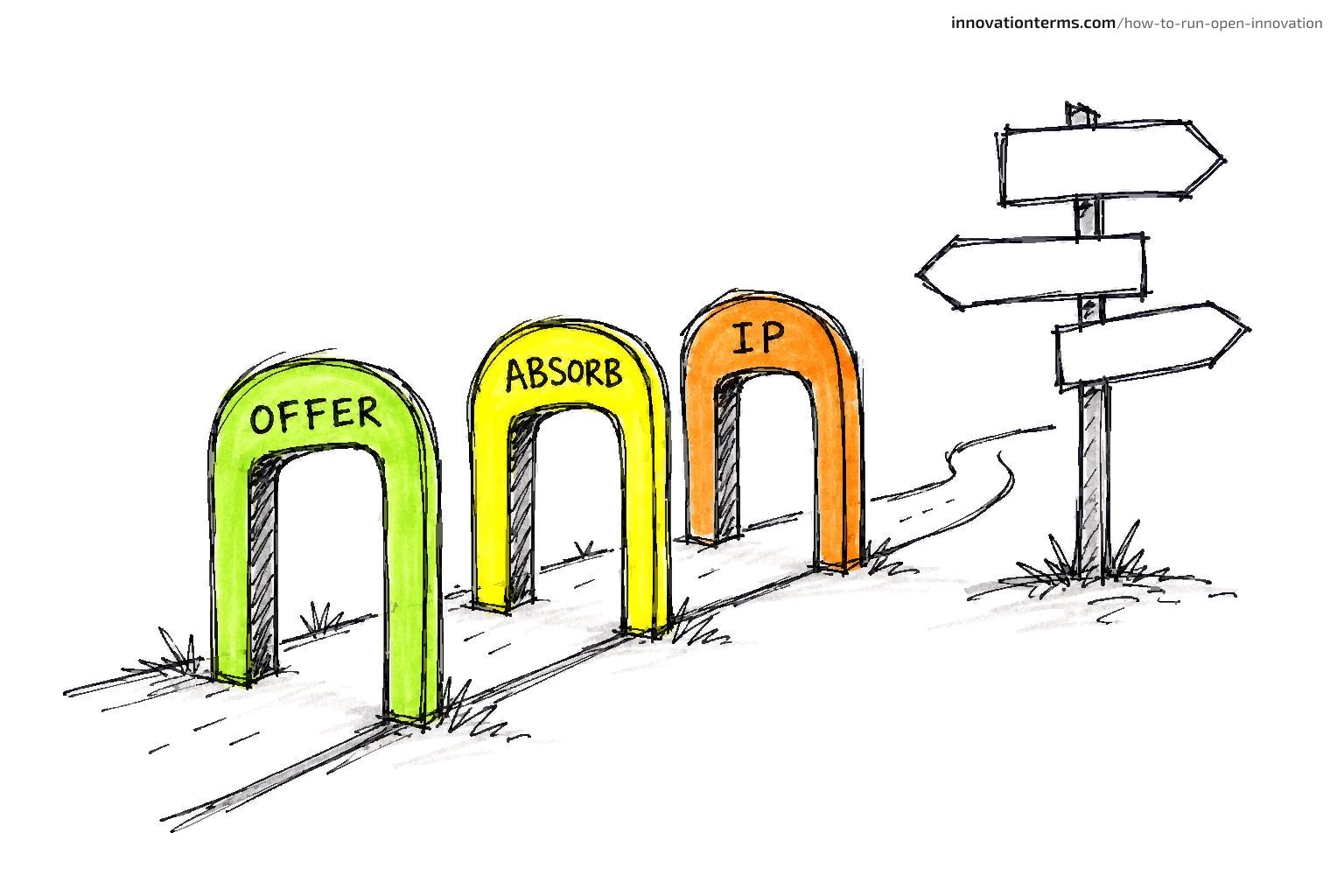
Three prior questions determine which models are even available to your organization: what you genuinely offer external partners, whether you have absorptive capacity to act on external knowledge, and whether your IP structure makes participation rational. Answer all three before touching a model taxonomy.
Question 1 — What does your organization genuinely offer external partners?
External partners are not free. A startup or university joining a corporate open innovation program exposes IP that may be difficult to recover and commits organizational attention that leadership has to specifically authorize. They choose better opportunities when the corporate offer is concrete.
Six offering currencies matter: access to distribution, proprietary data, first-customer validation, IP licensing rights, co-investment capital, and equity. You do not need all six. Name only the ones you actually own and can back up. The program design follows from the honest answer.
Question 2 — Does your organization have absorptive capacity to act on what comes in?
Cohen & Levinthal (1990) defined absorptive capacity as "the ability of a firm to recognize the value of new, external information, assimilate it, and apply it to commercial ends." This capacity is not automatic. It requires investment.
Three observable signals indicate functional absorptive capacity: dedicated technology scouts or an equivalent external intelligence function; a defined integration process with budget authority at the business unit level; at least one internal champion with P&L responsibility willing to own an external idea. Without these, external sourcing produces inputs you cannot convert — and deferring the build long enough turns the gap into innovation debt that compounds with every cohort.
Question 3 — Is your IP structure designed to make partner participation rational?
Three IP categories must be defined before any partner engages: background IP (each party's pre-existing IP, retained by originator), jointly developed IP (new IP created through the collaboration, with ownership and licensing agreed upfront), and licensed output IP (the right for one party to use jointly developed IP for defined commercial purposes).
Programs that arrive at IP terms after collaborative work has started negotiate under the worst possible conditions, when the value of what's been created is visible and the incentives to dispute it are highest.
Decision tree outputs: Pass all three questions, proceed to §7. Fail Q1, see §4. Fail Q2, see §3. Fail Q3, see §5. Pass all three and still getting shelfware? See §10 and §12.
§3 — Why Absorptive Capacity Predicts ROI More Than Partner Quality
Absorptive capacity — the organizational ability to recognize, evaluate, and act on external knowledge — predicts open innovation ROI more reliably than partner quality. Organizations with the highest returns from external collaboration invest in internal integration capability first. The question is not which partners to find, but whether the organization can convert what partners bring into commercial output.
The conventional framing treats sourcing quality as the central challenge, oriented around whether a given startup or university merits attention. Cohen & Levinthal (1990) and Zahra & George (2002) point to a different variable as dominant: internal absorptive capacity, the organizational ability to recognize, evaluate, and act on external knowledge. The organizations with the highest external collaboration ROI are not the ones with the best partners. They are the ones with the strongest internal integration capability.
Finding better partners sits downstream of your open innovation problem. Your open innovation problem is almost certainly internal, and it is the part you have least incentive to fix because it requires budget, headcount, and admitting that your organization cannot currently act on what external partners bring.
The PACAP/RACAP distinction
Zahra and George (2002) split absorptive capacity into two components: potential absorptive capacity (PACAP: identifying and evaluating external knowledge) and realized absorptive capacity (RACAP: integrating and exploiting it). Most open innovation programs invest heavily in PACAP. Challenge programs, scouting platforms, and accelerator funnels are all PACAP-investment. They get better at finding. They do not automatically improve at using.
That gap is where open innovation programs go to collapse. I've watched it happen in kitchens from Lisbon to Hanoi: a beautiful piece of fish comes through the door, the line cook knows what to do with it, but the expediter is on break, the pans are cold, and the sous chef is already thinking about his next job. PACAP gets you the fish. RACAP gets it cooked. Without both, you don't have dinner. You have a corpse on ice and a room full of hungry people pretending everything's fine.
"The constraint on successfully bringing this kind of innovation to the marketplace where it will make a real difference to the economy, the constraint becomes the absorptive capacity of the acquiring companies. And the big companies typically have lost much of the capacity for innovation, and they have to learn how to acquire innovation from the outside and not kill it. Efficiency is the enemy of innovation." — a16z Show
"The problem is that in order to do that, you need to have sufficient what in the economics literature, we call sufficient absorptive capacities. It's a capacity to understand, to make sense of what you're listening or reading. You can only do it if you have all the pieces of the puzzle disclosed." — Cecilia Rikap, City University of London
Three observable signals of strong absorptive capacity
Named technology scouts or an external intelligence function are the first indicator. P&G deployed more than 70 technology entrepreneurs globally by 2006, per Huston & Sakkab (HBR 2006).
70+ technology entrepreneurs deployed globally by P&G by 2006 — Huston & Sakkab, HBR 2006
These were not event attendees. They were embedded external intelligence, each assigned to match specific internal problems to external solutions with commercial potential.
The second signal is a path to market with budget checkpoints baked in. That means named decision-makers with actual budget authority, not a committee that convenes to review ideas and then routes them elsewhere for approval.
The third is business-unit P&L ownership of at least one externally sourced initiative at any given time. If every externally sourced idea sits with the central innovation team and never transfers to a business unit owner, the absorption infrastructure does not exist.
"And then my colleague here, Dan Leventhal, put this idea of absorptive capacity on the map. That organizations differ in their ability to learn and in turn to grow their people." — Adam Grant, Wharton School
§4 — What Does Your Organization Actually Offer External Partners?
External partners invest time, IP, and organizational attention. They choose the better-offer program when multiple options compete for their participation. The 38% organizational asymmetry rate in collaborative projects traces in large part to corporations that design programs as passive inboxes, not as genuine exchanges, per the EU 2021 study cited by GreyB.
Chesbrough & Bogers (2014) frame open innovation explicitly as bilateral: "a distributed innovation process based on purposively managed knowledge flows across organizational boundaries." The organization's business model must specify what it gives, not just what it intends to extract. A business model canvas exercise done from the partner's perspective — what do they receive from us? — often reveals how thin the actual offer is.
The offering gap
Reading a challenge program brief usually tells you whether you qualify. Corporations describe the technology domain they want and the startup stage they will consider, often naming a specific problem too. Few specify what the corporation offers in return beyond a prize. That asymmetry is the offering gap, and it is why challenge programs attract participants who primarily need prize capital rather than partners with the specific knowledge and technology the program genuinely needs.
Six offering currencies
| Offering currency | What it means concretely |
|---|---|
| Distribution access | First-market validation or channel to millions of end users |
| Proprietary data | Operational data unavailable to external developers |
| First-customer proof | Venture client structure: purchase revenue before product is fully launched |
| IP licensing rights | Rights to use existing corporate IP in building something new |
| Co-investment capital | Equity or milestone payments alongside the collaboration |
| Regulatory access | Navigating compliance for a partner entering a regulated market |
Programs that offer only prize capital attract participants who need prize capital. Programs that offer data, distribution, and first-customer proof attract partners who could raise capital elsewhere.
Writing a partner return statement before launch
Before launching, write one sentence per offering currency you control. Make it specific enough that a startup could evaluate it and decide whether participation is worth their time. If you cannot write this statement, the program is not ready to launch. The inability to write it is diagnostic — it means the offering has not been agreed internally, which means a partner who says yes will eventually encounter a corporate counterpart who has not agreed to any of it.
§5 — How IP Structure Determines Who Actually Participates
IP terms are a participant filter. According to the 2025 State of Corporate Innovation Report, only 16% of organizations have IP management aligned to their innovation strategy, per HYPE Innovation's 2025 failure analysis.
16% of organizations have strategy-aligned IP management at program launch — 2025 State of Corporate Innovation Report via HYPE Innovation
The other 84% either default to full-assignment terms that capable partners refuse, or improvise terms after collaboration has started, when IP dispute risk is highest and bargaining position is most asymmetric.
Three IP categories every program must define in advance:
- Background IP, each party's pre-existing IP — retained by originator, explicitly excluded from the collaboration's ownership scope
- Jointly developed IP, new IP created through the collaboration — ownership percentages and licensing scope require agreement before work starts, and commercialization rights especially need to be settled upfront because renegotiating after results appear is rarely successful
- Licensed output IP, the right for one party to use jointly developed IP for defined commercial purposes, under defined terms, for a defined duration
Pisano & Teece (2007) identified the core paradox: creating value requires opening organizational boundaries and enabling knowledge exchange, but capturing that value requires governance that prevents unintended knowledge leakage. IP structure is the governance mechanism that resolves this, because without it partners either refuse to engage (value creation fails) or engage and extract the value before you can capture it.
Tesla's June 2014 patent pledge is the most-cited outbound IP case. Elon Musk's stated logic was not altruism, it was competitive positioning. The competitor set for Tesla was not other EV makers. It was gasoline cars. Patent exclusivity over EV technology served no purpose if EV adoption as a category remained small. Opening IP to accelerate the ecosystem was the rational competitive move — a lesson from the innovator's dilemma applied to IP strategy.
The lesson for corporate programs is not "release your patents." It is that IP strategy must serve competitive goals, not default to maximum restriction. As one practitioner noted on the GeekWire Global Innovation Exchange podcast: "what you really need is upfront discussion of IP because no one fights about IP when there's no IP."
§6 — What Do the Numbers Say About Open Innovation ROI?
Adoption of open innovation is high. Results rarely satisfy. The gap between them is consistent across large-firm surveys and traces to the same structural causes: insufficient IP governance, weak absorptive capacity, and an offering gap that attracts participants who cannot become genuine commercial partners.
~38% of collaborative projects face organizational asymmetry breakdowns, with strategic misalignment, IP culture gaps, and contract formality differences as leading causes — EU 2021 study via GreyB
| Stat | Source | What it means |
|---|---|---|
| 78% of large firms (>$250M revenue) practice open innovation | Chesbrough & Brunswicker 2014 | Adoption is not the bottleneck |
| 36% of organizations actively engage in open innovation as of 2025 | HYPE Innovation 2025 | Active program rate is lower than claimed OI participation |
| 16% have strategy-aligned IP management | 2025 State of Corporate Innovation Report | Most programs launch with improvised IP terms |
| ~38% of collaborative projects face organizational asymmetry breakdown | EU 2021 study via GreyB | Offering gap and partner misalignment are structural, not exceptional |
| >35% of P&G innovations had significant external components by 2006 | Huston & Sakkab, HBR 2006 | Absorptive capacity builds slowly; this result took five-plus years |
The 78% adoption figure reflects organizations that report running some form of open innovation. The 36% active engagement figure and the 16% IP management alignment figure reveal the gap: most programs run without the governance infrastructure that converts external ideas into commercial output. The intake is easy to start. The conversion is not.
§7 — Which Open Innovation Model Fits Your Situation?
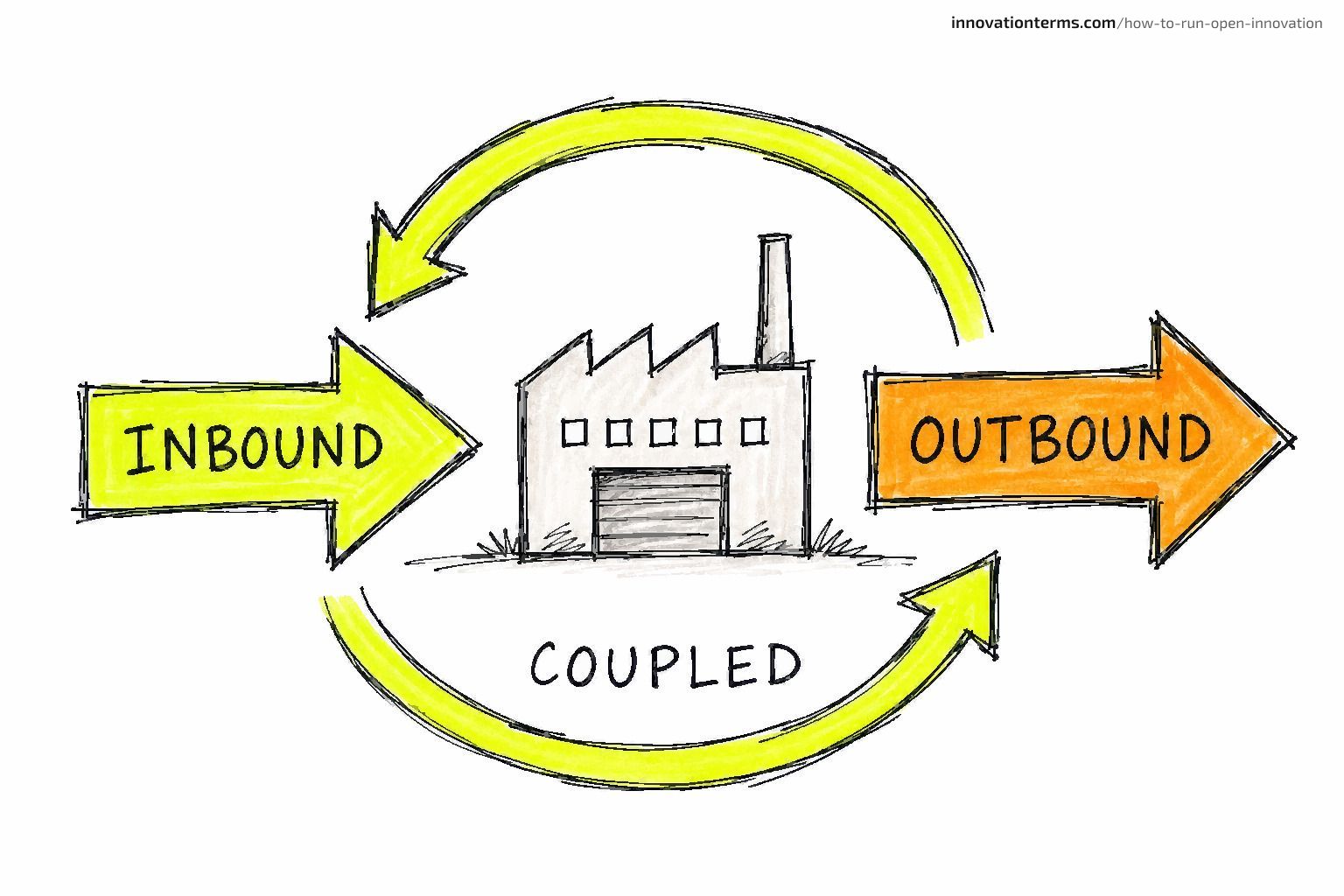
The three open innovation models — inbound (external knowledge in), outbound (internal knowledge out), and coupled (bidirectional with named partners) — differ in what they require from the organization, not just in which direction knowledge flows. Model selection follows from absorptive capacity, IP structure, and what the organization can genuinely offer, not from which label sounds most ambitious.
Inbound, outbound, coupled — these are just words on a menu. They tell you whether the kitchen is facing the street or the alley. The omelet-making ability of anyone inside goes completely unmentioned. I've seen too many organizations stand in front of the whiteboard like tourists pointing at pictures of pho, deciding whether they want north, south, or central style, while their own stoves don't light. Pick the taxonomy after you've checked the gas, the knives, and whether anyone on the line has the scars to prove they've done this before. The gas is your absorptive capacity (§3). The knives are what you actually offer (§4). The scars are your IP structure (§5).
Inbound (outside-in) brings external knowledge into internal innovation. Challenge programs, co-development partnerships, and accelerators are all inbound mechanisms, and they work when the organization has strong absorptive capacity and a defined integration process, as Zahra & George (2002) describe. Where RACAP is weak or no internal champion exists to carry externally sourced ideas through to a business unit, this model fails.
Outbound (inside-out) externalizes knowledge the organization created but cannot commercially exploit internally, licensing patents, spinning out technologies, or releasing IP (as Tesla did in 2014) to accelerate ecosystem adoption. It fits organizations with surplus IP and no internal commercialization path. It fails where strategic differentiation depends on IP secrecy, per Teece's (1986) appropriability framework.
Coupled runs both directions simultaneously with named strategic partners. It requires high IP maturity, pre-agreed jointly developed IP terms, and a long-term co-development goal. It fails when launched prematurely, before IP structure is agreed or before both parties understand the bilateral commitment required, per Chesbrough & Bogers (2014).
Gassmann & Enkel (2004) classified these archetypes across 144 companies, finding outside-in (inbound) most commonly practiced and the coupled process as demanding the highest organizational maturity. Organizations with weak absorptive capacity should not start with coupled models. Those with surplus IP and no internal commercialization path belong in outbound.
Innovation ecosystem vs. open innovation program
The distinction between an ecosystem and a program is structural, not scalar.
A program is bounded: named partners, defined problem, defined time window, defined IP terms. An ecosystem is a governance architecture where third parties build on your platform under rules you set, and where your competitive success is partly determined by their success.
Apple's App Store operates as a gated distribution channel under Apple's control. It is an ecosystem. Apple sets the rules. Developers build within them. Apple captures value from the ecosystem's aggregate productivity. Salesforce's AppExchange operates the same way. Conflating the two produces programs that cannot scale — because program relationships are too shallow and too short-term to generate the mutual dependency an ecosystem requires — or ecosystems governed like programs, where everything requires bilateral negotiation that fails at volume.
§8 — Which Program Type Should You Run?
Once the model direction is clear, the implementation structure follows from what the organization can offer and how quickly it needs measurable results. Five program types differ in their offering requirements, absorptive capacity demands, IP complexity, and timelines to first commercial outcome.
| Program type | What the org offers | AC requirement | IP complexity | Time to results |
|---|---|---|---|---|
| Challenge program | Prize capital, visibility, access | Low–medium | Low (winner owns; corp licenses) | 3–6 months |
| Partnership / co-development | Co-investment, data, IP sharing | High | High (jointly developed IP pre-agreed) | 12–36 months |
| Platform ecosystem | Developer access, distribution | High (developer relations team) | Medium (license terms, revenue share) | 24–60 months |
| Accelerator | Equity, space, network, mentorship | Medium (corporate sponsor per cohort) | Medium (equity stake, co-development options) | 18–48 months |
| Venture client | First-customer revenue, proof-of-market | Low | Low–medium (product procurement, no equity) | 3–12 months |
Most open innovation guides skip past the venture client model entirely. BMW pioneered it in 2015 with the BMW Startup Garage. Gregor Gimmy, co-founder, defines the distinction precisely:
"We are not an accelerator, we are a venture client. That means we become a startup's client at a point in time that still makes it a 'venture,' for example, because the startup product is not ready to launch yet." — Gregor Gimmy, BMW Startup Garage (Munich Startup, 2017)
If the organization's primary offering is purchase revenue (not equity, not mentorship, not network) the venture client structure delivers market validation faster and without the cap table complexity an accelerator requires. It also aligns incentives differently: the startup ships something that works for a paying customer, not something that wins a pitch competition. One precondition: the corporate side needs a functioning procurement process for non-standard vendors. Teams without a defined procurement pathway will fail to execute even when the intent and the startup relationship are right.
For challenge programs, using an innovation campaign canvas before launch forces the structural decisions — designated sponsors, budget authority, integration pathway — that determine whether winning ideas actually ship.
§9 — P&G Connect+Develop: What Absorptive Capacity Looks Like at Scale
P&G's Connect+Develop program, launched in 2001 under CEO A.G. Lafley, moved from a negligible external innovation fraction to more than 35% by 2006 while R&D headcount stayed flat. The result came not from the program itself but from the internal absorptive capacity P&G built alongside it: technology scouts, an external intelligence function supporting continuous foresight on technology trends, and cross-functional integration with business-unit budget authority.
Everybody loves to name-check P&G like it's some temple you can pilgrimage to and come back enlightened. The kitchen runs dirtier than the dining room, always. What P&G built wasn't a program, it was a back-of-house operation. Seventy scouts roaming the planet like hungry junkies, business units with actual money and permission to spend it, people inside whose necks were on the block if an external idea failed. The 'program' was just the door. The real machinery was the line. It ran hot and dangerous, and nobody there stood around looking pretty.
The problem before Connect+Develop
P&G had external partnerships before 2001. They produced little because no internal integration system existed. When A.G. Lafley became CEO in 2001 with an explicit target of sourcing 50% of innovations externally, P&G did not simply launch a partner program. It rebuilt its absorptive capacity while running the program.
What P&G built internally
By 2006, P&G had constructed three things that did not exist at program launch: more than 70 technology entrepreneurs functioning as knowledge gatekeepers (boundary-spanning roles that translate external discoveries into internal problem-solution matches) deployed globally with specific internal-problem assignments; a dedicated external technology intelligence function; and a cross-functional integration process with business-unit-level budget authority for externally sourced ideas, per Huston & Sakkab (HBR 2006).
None of these were program features. They were internal infrastructure investments. The program was the intake mechanism. These were the RACAP infrastructure.
The numbers
By 2006, more than 35% of P&G's innovations had significant external components, up from a negligible fraction at the program's 2001 launch, per Huston & Sakkab (HBR 2006). R&D headcount remained flat during this period. The productivity gain came not from hiring more researchers but from building the capability to find, evaluate, and absorb what external partners brought.
What the timeline means for your program
Seven years. That is the absorptive capacity build timeline for a company with P&G's resources and strategic clarity. Organizations that run an open innovation challenge and evaluate ROI at 12 months are measuring the intake mechanism. The commercial result comes years later.
§10 — Why Winning Ideas Still Become Shelfware — and How to Prevent It
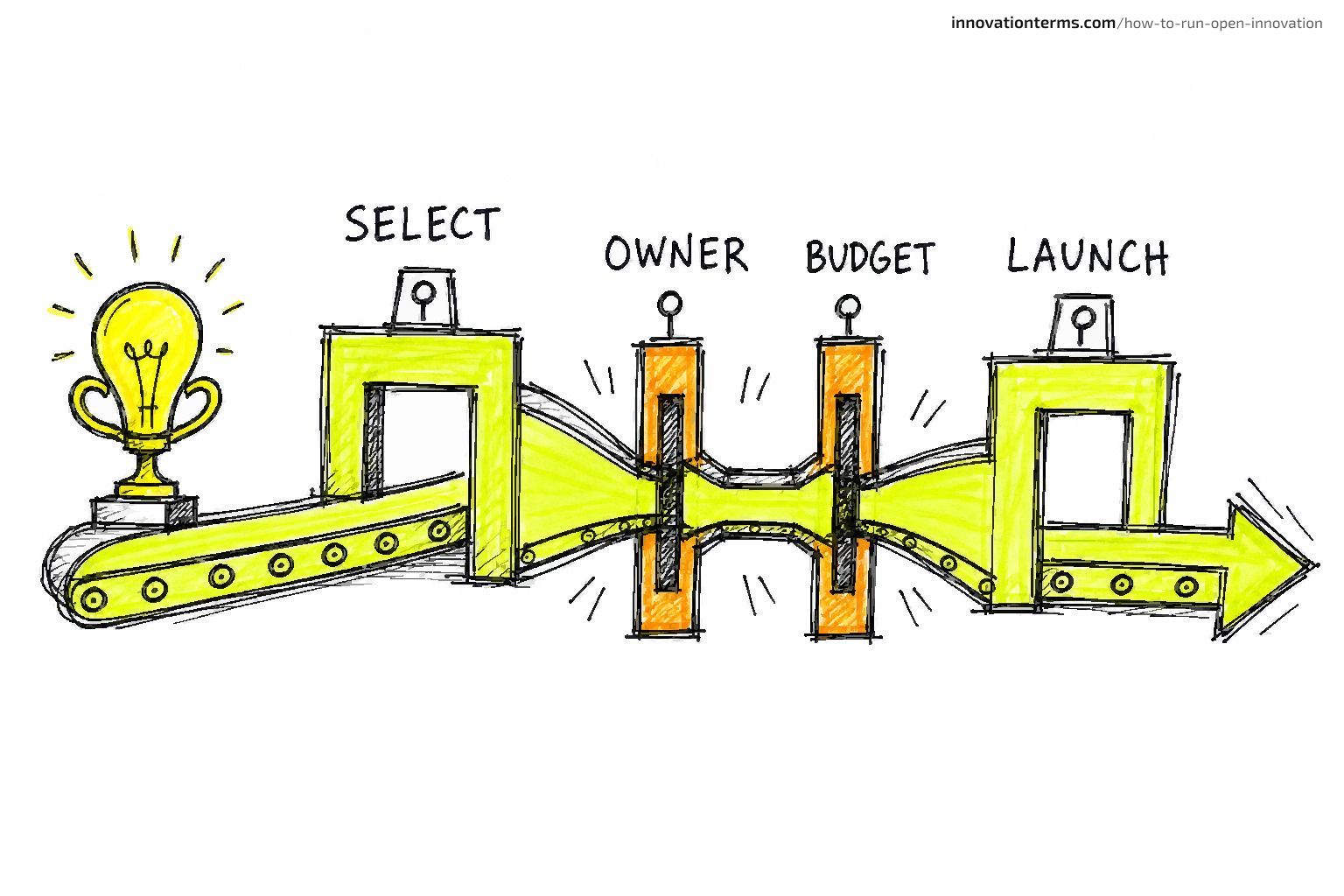
Ideas that survive a challenge program, complete an accelerator cohort, or clear a partnership evaluation still fail at a predictable rate inside corporate organizations. The bottleneck is not ideation quality. It is the absence of three structural elements: a named internal owner at selection, a pre-committed budget pathway, and a business unit with P&L authority willing to own the outcome.
Sourcing the idea is easy. Any asshole with a plane ticket and a notebook can find something delicious. The hard part is walking it through the door of a corporate kitchen where nobody asked for it, nobody's pan is hot, and the chef de cuisine would rather keep serving the same overcooked chicken. He knows exactly how the chicken committee likes it. An idea doesn't die because it was bad. It dies because nobody inside grabs it by the throat and says, 'This one is mine.'
The three conditions that produce shelfware
No named internal owner designated at selection. The challenge program picks a winner. Nobody has been assigned to champion that winner's integration into a business unit before the selection event happens. The program team celebrates; the winner waits for a call that never comes. This is NIH syndrome (the organizational bias where internal teams unconsciously devalue or resist ideas that did not originate inside) operating at the structural level — not as individual resistance but as a design default that ensures no one is obligated to care.
No pre-committed budget pathway. The winning idea must compete for capital after selection. It enters a standard capital allocation process with no head start, no executive advocate with budget authority, and no urgency signal.
No P&L authority willing to own the outcome. The program team can evangelize. It cannot commit. The business unit that would benefit from the external innovation has no obligation to adopt it and often has internal alternatives it prefers.
These three conditions are design failures. They are fixable before the program launches, but only if you address them before you run the program, not after the first cohort produces shelfware. Building innovation feedback loops from program selection into business unit integration makes the follow-through visible and accountable.
The Liberty Global case
Liberty Global's Spark program launched in 2011 as an idea submission platform. The first two years produced little: ideas submitted on the platform did not respond to specific challenges or fall within a set timeframe. They were often not aligned with company strategy or business needs. Nor did they have clear owners, per the HYPE Innovation Liberty Global case study.
The 2013 redesign introduced idea campaigns with designated sponsors (business unit executives with budget authority) pre-assigned before each campaign launched. The structural variable that changed was ownership design. Idea quality was never the problem.
"Once implemented globally, it has a promise of a 30 million euro ROI per year! Spark is the only system in the company that offers this collaborative opportunity of taking ideas from anyone, anywhere, and sharing them across the different operations." — Sarah Kelly, Innovation Program Manager, Liberty Global (HYPE Innovation)
The €30M figure reflects one idea scaled globally. Across 30,000 employees in 14 countries, the program generated 15,000+ ideas and implemented 1,100+, per HYPE Innovation's Liberty Global case — but only after the governance redesign.
What designing for follow-through looks like
Before launching any challenge or partnership program: name the executive sponsor for each problem area and confirm their budget authority. Build the integration process into the program design, not the post-selection phase. If no business unit is willing to pre-commit to owning a winning idea in a given problem area, do not run a challenge in that area.
Scott Gunther on the Scouting for Growth podcast, a corporate VC practitioner, puts the principle directly: his team will not take anything forward until an executive sponsor is in place, because post-investment execution is where most corporate-startup relationships either accelerate or die slowly in meetings.
§11 — How Do You Select External Partners Without Wasting 18 Months?
Most vetting frameworks stop at two of the three dimensions that actually matter. The EU 2021 study via GreyB found organizational asymmetry in 38% of collaborative projects — with breakdown criteria (strategic misalignment, IP culture differences, contract formality gaps, risk tolerance mismatch) that reverse-engineer the selection criteria preventing breakdown. Capability fit is necessary. It is not sufficient.
Capability fit (necessary condition)
- Does the partner have specific knowledge or technology the program's problem statement requires?
- Is this knowledge genuinely external, not reproducible internally within the required timeframe?
- Can the partner demonstrate prior application of this capability at a comparable scale?
Operational compatibility (the dimension most vetting frameworks miss)
- Does the partner's decision-making speed match the program timeline?
- Does the partner have legal and compliance sophistication to execute the IP terms the program requires?
- Can the partner commit resources at the level the program requires, not just at the proposal level?
Startups frequently pass capability vetting and fail operational vetting. A team with genuine technical capability often lacks the legal infrastructure to execute a co-development agreement. A startup managing three active customer relationships cannot commit engineering resources at the level the program requires — not at proposal time, and not at execution time.
Cultural alignment (the dimension that produces asymmetry)
- Does the partner's IP culture match the program's IP framework?
- Does the partner's risk tolerance align with the program's timeline-to-results expectations?
- Is the partner's participation motive aligned with what the program offers?
A startup that joins a challenge primarily for PR exposure treats it as a marketing exercise. Delivery commitment is absent from day one. Misaligned motives produce asymmetric investment — the corporate side commits resources while the partner side protects its optionality.
§12 — Who Should Own the Program — and What Happens When Nobody Does
Who owns the open innovation program determines what happens to winning ideas. A central innovation team with no budget authority can source and evaluate but cannot commit business units to implementation. A business unit sponsor with P&L authority has a direct use case and the authority to act. This is not an organizational politics question — it is a program design question with predictable outcome patterns.
The corner office and the slide deck attribution are distractions from the real question. This is about who gets their hands dirty. A central innovation team without budget is a travel writer without a knife — they can describe the meal, they can't cook it. What you need is the bastard who owns the burners, who gets screamed at if the plates come back, who will steal equipment, lie to purchasing, and personally walk an external partner past security because the idea is worth it. Curators belong in museums. Owners belong in kitchens.
Three governance models
Organizations typically assign open innovation programs to one of three homes.
Central innovation team offers highest visibility and the lowest follow-through rate. The team can source and evaluate. It cannot commit business unit resources. Winning ideas sit with the innovation team until they find a business unit that is interested, and interest without authority is not adoption.
Business unit sponsor delivers the highest follow-through rate. The BU has P&L authority and a direct use case for what partners provide. Risk: the program scope is limited to the BU's own problem space, which may not reflect the organization's most valuable open innovation opportunities. For multi-BU programs, a federated innovation governance model — where each business unit runs its own instance under shared IP and selection standards — distributes ownership without centralizing the follow-through failure point.
Corporate ventures / CVC team produces moderate follow-through. Can fund. Often lacks the integration process for non-equity-stage ideas, meaning ideas that are not investment targets fall outside the team's mandate.
The governance model that consistently fails is the central innovation team with no authority to commit other business units. Well-run challenge programs emerge from this structure. Nothing commercial comes out of them, and organizational support tends not to survive that fact.
The budget authority requirement
Owning the program operationally means three specific things: the ability to allocate budget to implement a winning idea without an additional approval cycle; the ability to assign internal headcount to a partner integration project; and the P&L authority to accept commercial responsibility for an externally sourced innovation.
Without all three, the program champion is a curator. A curator can identify value. Only an owner with budget authority and P&L responsibility can extract it, per HYPE Innovation's Liberty Global case.
§13 — When Open Innovation Is the Wrong Choice
Open innovation is not universally appropriate. Three conditions make it a poor strategic choice: tight appropriability, where IP secrecy is the primary competitive advantage; strategic sensitivity, where the problem space reveals competitive intent to external partners; and structural mismatch, where the organization actually needs an ecosystem governance architecture rather than a bounded collaboration program.
When closed innovation is more rational
Teece (1986) established the appropriability regime framework: when IP secrecy is the primary source of competitive advantage, and when imitators can rapidly commercialize what you disclose, knowledge-sharing is strategically irrational. Tight appropriability is the default condition for pharmaceutical firms protecting pre-filing compounds, and the same constraint applies to defense contractors with classified processes or semiconductor firms with trade-secret fabrication methods. Open innovation in those contexts gives away competitive advantage before it can be captured.
The test: if external disclosure of the knowledge required for collaboration would materially reduce your competitive position, open innovation in that domain is the wrong choice. This is the structure underlying the innovator's dilemma for incumbents — when protecting existing IP serves near-term performance at the cost of long-run adaptability.
When the right structure is an ecosystem, not a program
Some organizations attempt to run an open innovation program when what they actually need is an ecosystem governance architecture. The distinction is structural, and confusing the two is expensive.
An ecosystem requires: a platform others build on, rules governing third-party participation, a revenue-sharing or value-exchange mechanism that creates mutual dependency, and governance infrastructure to manage conflicts at scale. Apple's App Store, Salesforce's AppExchange, and Android are ecosystems. None of them are open innovation programs. They are platforms with governance rules, revenue mechanisms, and enforcement infrastructure.
An organization that needs an ecosystem but launches a challenge program will find that program partner relationships are too shallow and too short-term to produce the mutual investment an ecosystem requires. An organization that needs a program but builds an ecosystem governance architecture wastes years on infrastructure for a problem that a bounded collaboration would have solved.
When crowdsourcing is the right tool instead
Crowdsourcing is one tool inside the broader open innovation system, fitting specific problem shapes: aggregating distributed micro-contributions, running prediction markets, collecting consumer feedback at scale (Brabham, 2008). Not everything. Problems requiring deep bilateral knowledge exchange or co-development of jointly owned IP lie outside what crowdsourcing can deliver.
Most corporate settings treat the terms as equivalent. They are not synonymous. Running a crowdsourcing contest does not require a bilateral exchange framework, IP governance, or absorptive capacity at scale. Running a co-development partnership requires all three. Treating them as equivalent causes organizations to underprepare for co-development and overengineer crowdsourcing platforms.
FAQ
What is the difference between inbound and outbound open innovation?
Outbound open innovation externalizes knowledge the organization created but cannot commercially exploit internally — licensing patents, spinning out technologies, or (as Tesla did in 2014) releasing patents to accelerate ecosystem adoption. Inbound brings external knowledge in through challenge programs, co-development, and accelerators. The coupled model runs both directions simultaneously with named strategic partners, per Gassmann & Enkel (2004).
How do you protect IP in an open innovation program?
Define three IP categories before any partner engages: background IP (each party retains pre-existing IP), jointly developed IP (co-created during the collaboration, ownership and licensing agreed upfront), and licensed output IP (the right to use jointly developed IP for defined commercial purposes). Only 16% of organizations have strategy-aligned IP management at program launch, per HYPE Innovation (2025), meaning the other 84% negotiate terms reactively, after collaborative work has already created valuable IP and after both parties have invested enough that dispute risk is high.
What does open innovation actually require internally before you start?
Three things. First, a clear offering — what your organization provides to external partners in return for their knowledge or technology. Second, absorptive capacity — an internal integration process with budget authority and designated champions who can pull external ideas through to commercialization, as Cohen & Levinthal (1990) established. Third, a defined IP structure that makes partner participation rational. Most programs launch with only one of the three in place and then attribute failure to partner quality.
What is the difference between open innovation and crowdsourcing?
A challenge program that uses crowdsourcing for ideation still needs bilateral IP agreements and integration infrastructure to ship. That gap is the distinction. Crowdsourcing aggregates distributed, micro-scale contributions from large crowds — prediction markets, consumer voting, micro-tasks, wisdom of the crowd mechanisms — whereas open innovation is the broader system of sustained bilateral knowledge exchange with named partners who commit substantial resources to the relationship.
Who should own an open innovation program internally?
The best governance structure is a named business unit with P&L authority, not a central innovation team. Central innovation teams can source and evaluate but cannot commit business unit resources. Business unit sponsors have a direct use case for what partners provide and the authority to implement winning ideas. If no business unit is willing to own the program, that is a signal the program is solving a problem nobody inside has the authority (or the incentive) to fix, per HYPE Innovation (2025).
How long does it take to see results from open innovation?
Challenge programs can produce vetted external ideas in 3–6 months. Converting those ideas into commercial products typically takes 12–36 months for a co-development partnership and considerably more for ecosystem-scale programs. P&G's Connect+Develop reached more than 35% external innovation contribution after seven years of sustained investment in absorptive capacity alongside the external program, per Huston & Sakkab (HBR 2006). Organizations that evaluate open innovation ROI at 12 months are measuring the intake mechanism. The commercial result comes years later.
What is the difference between open innovation and an innovation ecosystem?
An innovation ecosystem is a governance architecture where third parties build on your platform under rules you set, and where your competitive success is partly determined by their success. Apple's App Store, Salesforce's AppExchange, and Android are ecosystems. They are not open innovation programs. Managing an ecosystem as if it were a program produces a partner network you can neither scale nor control.