
How to Manage Ideas: Process, Gates and Evaluation [2026]
Most idea programs fail at the same point: no structured criteria for advancing or killing ideas. The full management process, from intake to decision.
TL;DR
- Most idea management programs fail because no structured decision-making layer exists between intake and implementation.
- Adding better submission channels to a broken evaluation process does not fix the problem, it makes it worse.
- Structured, time-boxed idea challenges consistently produce better decision ratios than always-open suggestion boxes.
- Evaluation criteria need to be defined before any ideas arrive, not assembled after the submission list grows unmanageable.
- The feedback loop is not optional. Organizations that solicit ideas without responding see participation collapse after the first cycle, a collapse harder to reverse than if they had never run the program.
- Advancement gates convert evaluation into decisions by creating mandatory review points where ideas either advance, pause, or stop with a stated reason.
- Measuring idea management success by participation rate is the wrong metric. Measure implementation rate, time-to-decision, and idea-to-ROI ratio.
In two sentences: How to manage ideas is a question about decision architecture, not submission volume. Organizations that fix the evaluation layer first (criteria, gates, feedback) implement more ideas from fewer submissions than those that invest in better collection before building the governance to act on what arrives.
Most organizations do not have an idea problem. They have a decision problem.
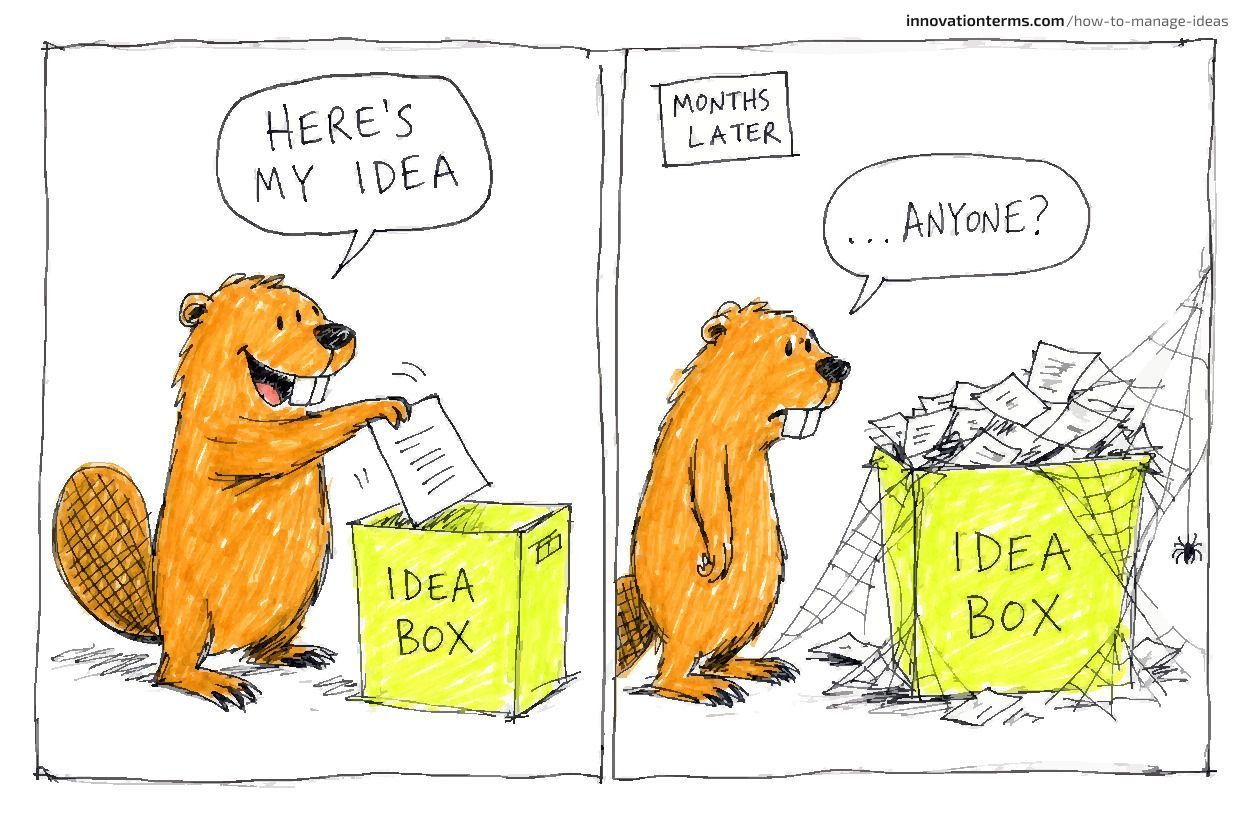
The pattern is consistent enough to have its own name among innovation managers: the 400-ideas-zero-implemented cycle. A campaign launches, participation surges, hundreds of submissions arrive, and then the program quietly stalls. No criteria exist for evaluating 400 ideas with a team of two. No committee has authority to advance anything. Contributors hear nothing. Six months later, someone proposes opening another suggestion box.
The primary keyword in this domain, "how to manage ideas," almost always belongs to someone who has already run at least one intake that worked too well. They collected ideas. They couldn't act on them. They're trying to do it differently.
Decision architecture is best understood by examining where it breaks. Every section answers one named breakdown point. If your organization already has ideas coming in, start at §3. If you're designing a system from scratch, start at §2.
What Happens When You Collect 400 Ideas and Implement Zero?
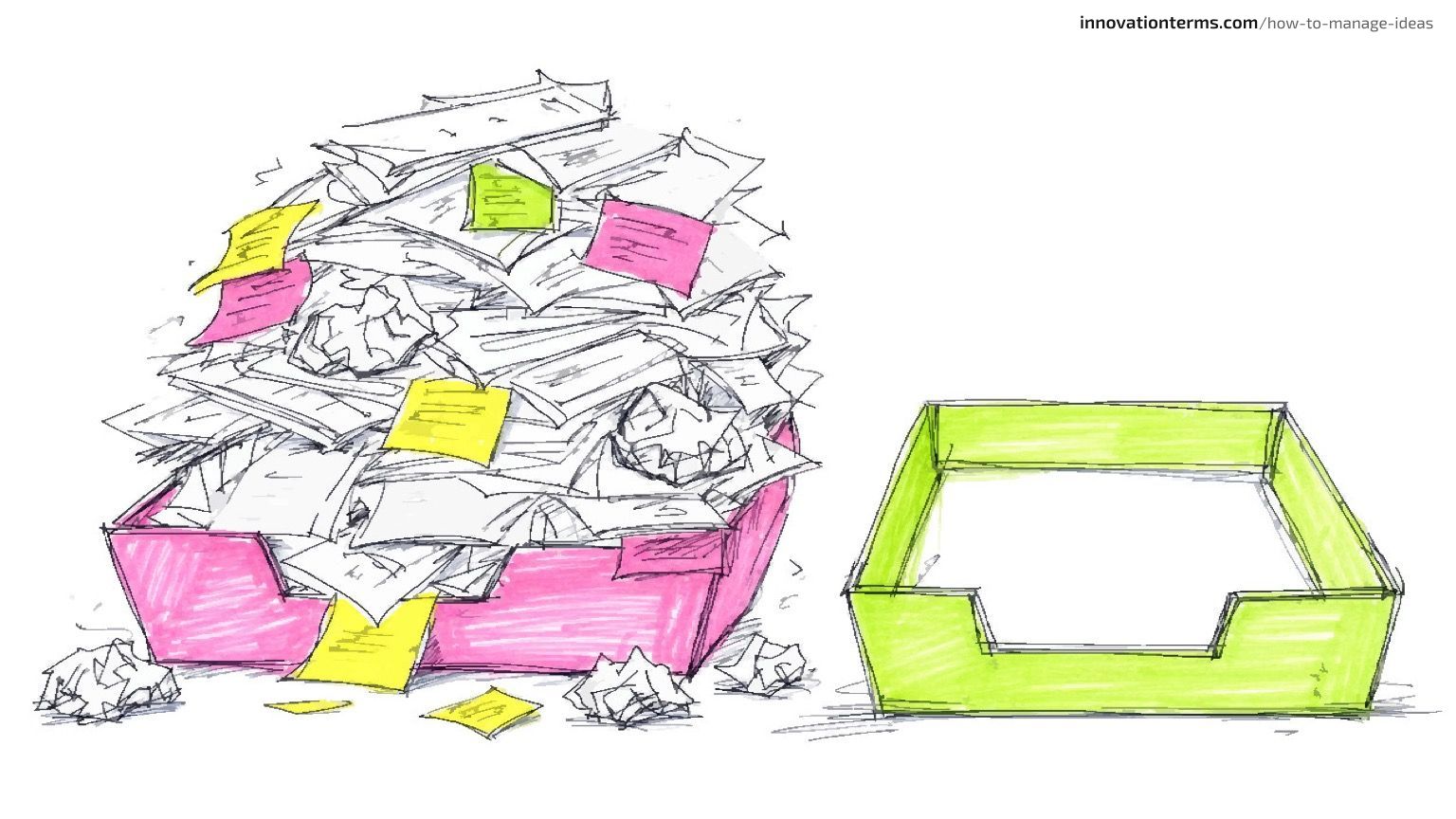
Most idea management programs fail not because of poor submission design but because nothing exists to evaluate what arrives. The collection step almost always works. What fails is the governance layer between intake and decision — the criteria, the review authority, and the feedback loop that tells contributors what happened.
Every organization that has run a large-scale idea campaign has lived through a version of this, and the scene has the stillness of a laboratory after everyone has gone home: the submission numbers look good, the participation rate exceeds expectations, and then nothing happens. The ideas sit in a spreadsheet. (I have stared at one of these spreadsheets. Four hundred rows, color-coded by status, every status meaning the same thing: not yet.) The committee that was going to review them never convenes. A year passes. Someone mentions running the campaign again, and the people who submitted last time say nothing, which is, acoustically, the loudest feedback you will ever receive.
This is not a creativity failure. It is a governance failure. The collection step worked. What failed was everything downstream of it.
The data on how common this outcome is tends to come from vendors with obvious incentive to make the problem look large. Even accounting for that, the numbers are striking. According to Kainexus, which tracks outcome data from its continuous improvement platform customers, only 2–3% of ideas submitted through a typical suggestion box system are ever implemented. Across organizations using structured software-assisted workflows, that figure exceeds 80%. The structural difference between the 2–3% implementation rate and the 80%+ rate is not the submission interface. It is the evaluation workflow, the advancement criteria, and the feedback loop.
The academic literature confirms the dysfunction predates the digital era. A 2001 study published in Creativity and Innovation Management found that:
"motivating employees to participate is a common weakness of suggestion systems. Motivating employees involves more than simply offering rewards to submitters if their suggestions are put to use."
— Axtell et al. (2001), Creativity and Innovation Management
The participation collapse is predictable once you understand the mechanism. Contributors who submit ideas are making a bet: that the organization has the capacity and intent to evaluate what they send. (The house, in this case, is a committee that meets quarterly and has not yet finished the agenda from the last meeting.) When nothing happens, the bet resolves against them, not with a formal rejection, but with the soft, collective decision of several hundred people to keep their next idea to themselves. The second campaign attracts fewer submissions, not because the ideas dried up, but because the prior experience already answered the question participants most wanted answered: does anyone read these?
What This Failure Mode Is Actually Costing You
The cost of the 400-ideas-zero-implemented failure mode is not just the unimplemented ideas themselves. Reversing the impression that submissions are theater takes longer than it took to create it. What practitioners describe — "where do good ideas go to die," "we collected 400 ideas and acted on zero," "employees stopped submitting because nothing happened" — is a structural failure, not a cultural one. The organizations experiencing it did not have a shortage of innovative employees or a leadership team that didn't care about ideas. They had an evaluation layer that could not handle the volume they created.
The governance gap (the space between intake and decision) is where idea programs go to die. The following sections explain why the governance gap forms and what closes it.
What Does Idea Management Actually Mean?
Idea management is the organizational system that evaluates promising ideas against consistent criteria and advances the most valuable ones into funded work. Brainstorming facilitation is a different practice. It is not a suggestion box. It is the governance layer that sits between the moment an idea is submitted and the moment someone decides what to do with it.
Organizations conflate these two practices constantly. Brainstorming facilitation (workshops, design thinking sprints, ideation sessions) generates ideas. Idea management is the harder discipline that follows, deciding which generated ideas to pursue and why, something many teams that excel at facilitation have never built a real process for.
The field's internal vocabulary draws a further distinction between idea management and innovation management. Idea management is the intake and selection phase: the front end of the process that captures individual ideas and evaluates them before advancing or rejecting them. Innovation management covers the full organizational practice, from strategy through commercialization. Idea management feeds innovation management. It does not replace it.
The "tangible outcomes" qualifier throughout practitioner literature is doing real work. A system that accumulates submissions and acts on none of them is an archive, and the entire point of that qualifier is to draw a line between systems measured on intake and those measured on implementation.
What Idea Management Is Not
A suggestion box is a passive collection mechanism with no evaluation process attached. Idea management is the full workflow from collection through decision, covering every operational element in between. A hackathon or innovation tournament is an event. Idea management is the ongoing infrastructure that ensures the best outputs from one-off events don't disappear between sessions. And idea management is not just a software category: organizations run functional programs with shared documents and scheduled review meetings, and dysfunctional programs with expensive platforms and no evaluation criteria. Platforms such as Ideanote and HYPE Innovation can support enterprise-ready, AI-enabled idea management, but the tool determines workflow efficiency while the governance model determines outcomes.
Why Is the Bottleneck Always Downstream of Intake?
The collection step in most idea programs almost always works. The real constraint is evaluation capacity: the organizational bandwidth to assess ideas and reach decisions within a window that preserves contributor trust.
This structural point explains more program failures than any other. Most organizations ignore it when their programs produce disappointing results. The typical response to low implementation rates is to open more submission channels, run a bigger campaign, or buy a better suggestion tool. Each of these interventions increases intake volume without increasing evaluation capacity. The bottleneck widens.
KSB, a global pump and valve manufacturer with approximately 16,000 employees, provides one of the cleaner documented examples of what fixing the evaluation layer actually looks like. After implementing a structured innovation platform, KSB reduced its idea processing time by 60%. Frank Udo Kimm, KSB's Head of Idea Management, described the original challenge as a failure of connection and integration in the evaluation process, not a shortage of ideas. The 60% reduction did not come from submitting more ideas or running better campaigns. It came from creating a more integrated evaluation workflow, the precise layer that was missing.
Stat: KSB reduced idea processing time by 60% after implementing a structured innovation platform, with 7,043 active users across 16 locations. (ITONICS, 2023)
The Idea Funnel Drop-Off Map
Most idea programs produce a drop-off pattern that looks roughly like this:
| Funnel Stage | Typical Outcome (Suggestion Box) | Structured Program |
|---|---|---|
| Submission | 100% of submitted ideas | 100% of submitted ideas |
| Screened and reviewed | 30–50% (rest lost or ignored) | 85–95% (systematic review) |
| Evaluated against criteria | 10–20% | 60–80% |
| Advanced to development | 2–5% | 15–25% |
| Implemented | 2–3% | 80%+ (of advanced ideas) |
The drop-off in unstructured programs happens at the review stage, not the submission stage. When ideas are submitted but never reviewed, they cannot be evaluated or advanced to implementation. The review gap traces to absent decision architecture.
Research on multi-criteria decision-making in public transit innovation confirms the structural problem: "A simple list of innovations would not be very useful for Public Transport Operators, as they cannot implement all of them at once." What applies to transit applies equally to corporate idea programs. Volume without selection architecture is just a backlog.
The Governance Gap Defined
The governance gap is the space between intake and decision. It appears when an organization has no pre-agreed criteria for evaluating submitted ideas, no named authority with decision power over the queue, no defined review cadence, and no feedback mechanism telling contributors what happened to their submission.
Tal Atzmon, who has studied innovation funnel design in large organizations, identifies the deeper organizational force that sustains the governance gap:
"organizations are killing innovation by definition... when one of them in organization says let's do something else the entire organization start working against that employee against that idea — not because they mean harm — but because in large organizations employees are measured on resource efficiency"
— Tal Atzmon, How to Build an Innovation Funnel in Large Organizations
The governance gap is not merely structural negligence. It is the predictable outcome of organizations where cross-current ideas threaten the efficiency metrics everyone is measured on. Absent governance is how large organizations protect their current resource allocations, not through malice, but through incentive.
The Stage-Gate model research on project-level gate design provides the mechanism for closing this gap. Robert Cooper's framework offers a forcing-function logic that translates directly to the idea level: defined deliverables, predetermined criteria, mandatory decisions. The forcing function does not guarantee the right ideas advance. It guarantees that ideas do not linger in limbo.
Why Does Adding Better Intake Channels to a Broken Evaluation Layer Make Things Worse?
When an organization's evaluation capacity is already overloaded, adding more submission channels increases the unresolved backlog, accelerates the participation collapse when nothing happens, and entrenches the belief among contributors that submissions are performative. It does not improve outcomes. It makes outcomes worse.
Better idea collection tools are the worst investment an organization with a broken idea management process can make. (IdeaWake, 2026)
The mechanism is visible in any organization that has added intake capacity without fixing evaluation. Consider what happens when a company that already cannot process 400 ideas launches a redesigned submission portal, adds mobile access, introduces gamification, and promotes the new system to every employee. Submissions increase, because of course they do. You have just installed a faster conveyor belt at a factory whose assembly line is already broken. The evaluation team (whose capacity has not changed) now has 700 ideas it cannot act on. The backlog is larger. The feedback loop is slower. The time to first response grows. Contributors who submitted in the new system wait longer than contributors who submitted in the old one. Participation collapses faster. The only thing the new portal has improved is the velocity at which hope becomes cynicism.
Millard (KaiNexus) names this failure mode explicitly among the nine reasons suggestion boxes fail: "you thought making it digital would solve your problems." The problem was never the submission interface. The problem was the absence of any structured process for acting on what the interface collected.
Psychological safety is a real variable. It explains the wrong gap, though. Low psychological safety suppresses submission rates but does not explain why submitted ideas go unevaluated and unimplemented. Governance architecture is what determines post-submission outcomes. An organization with high psychological safety and no evaluation criteria will still produce the 2–3% implementation rate. Axtell et al. (2001) confirm that the structural dysfunction predates any cultural variable.
The Decision to Fix Before You Scale
Before launching a new campaign or upgrading submission infrastructure, assess current evaluation capacity. Specifically:
- How many ideas can the review team evaluate per month?
- What criteria will they apply?
- When will contributors receive a response?
- Who has authority to advance an idea?
If any of these questions do not have clear answers, adding more intake capacity produces a larger, faster-growing backlog, not more implemented ideas. The order matters. Fix the evaluation layer first. Then consider whether intake improvements are warranted.
How Should You Design Your Intake: Structured Challenges vs. Open Suggestion Boxes?
Structured, time-boxed idea challenges consistently produce higher submission quality and better evaluation ratios than always-open suggestion boxes. The reason is design, not channel. A focused challenge defines the problem. It also sets a deadline and gives the evaluation team a concrete review window to plan around. An open box does none of these things.
The research on this point is consistent. A 2009 academic study of IT-based idea competitions found that "many information technology (IT)-based ideas competitions fail to meet requirements upon which active participation is established" — Blohm et al. (2009) — but notably, the failure mode in that research was poor design of the competition, not the structured format itself. The structured challenge format, properly designed, outperforms passive collection on the metrics that matter.
Adam Grant, organizational psychologist at Wharton, describes how Warby Parker approached this:
"And instead of a suggestion box, they run problem boxes where at Warby, it's just a Google Doc. When you want to get more innovative solutions and higher quality solutions, I think one of the best things you can do in a big organization is run an innovation tournament, a contest for ideas."
— Adam Grant, How I Built This with Guy Raz
The "problem box" framing captures something important: structured idea challenges define the problem before asking for solutions. An open suggestion box invites any idea about anything. A structured challenge says: "We are working on X. What would you do?" The specificity of the problem statement raises submission quality, reduces irrelevant ideas, and gives the evaluation team a coherent scoring context.
Structured Challenge vs. Open Suggestion Box: A Comparison
| Dimension | Structured Challenge | Open Suggestion Box |
|---|---|---|
| Problem scope | Defined before intake opens | Undefined; contributor decides |
| Submission window | Fixed (2–6 weeks typical) | Permanent / always-on |
| Evaluation planning | Review window predictable | Review triggered ad hoc |
| Evaluator-to-idea ratio | Manageable (volume controlled) | Unconstrained |
| Submission quality | Higher (problem-specific) | Mixed |
| Participation pattern | High during window; fades after | Low and declining |
| Best for | Focused innovation topics, executive-sponsored problems | Ongoing incremental improvements |
| Risk | Innovation fatigue if over-used | Participation collapse if unresponsive |
Cisco's Innovate Everywhere Challenge demonstrates what structured challenge design produces at scale. Over five years, the program generated 2,800+ ideas. Five ventures were adopted. Those five generated $2B+ in cumulative business impact. The ratio (5 from 2,800+) looks like a failure of selection unless you understand that the program's structure was built around evaluation discipline, not intake volume.
Stat: Cisco's Innovate Everywhere Challenge produced $2B+ in cumulative business impact from 5 ventures selected from 2,800+ submissions over five years — a ratio made possible by evaluation discipline, not submission volume. (Cisco, 2015)
When to Run a Challenge vs. Maintain an Always-On Box
The choice is not either/or. Most mature idea management programs use both: a permanent submission channel for incremental improvements and ongoing operational ideas, plus periodic structured idea challenges for strategic innovation topics where leadership has a defined problem and budget to act on the best submissions.
The decision rule: run a structured idea challenge when leadership has a named problem, a review team with capacity to evaluate submissions within four to six weeks, and genuine authority to fund the best ideas. Maintain an always-on channel for ideas that don't fit any active challenge. Publish its review cadence and response timelines in advance so contributors know when to expect a decision.
Hackathons and Time-Boxed Events
Hackathons occupy a distinct category: they produce prototypes rather than submissions, and they compress evaluation into the event itself. Their failure mode is idea orphanhood, not idea death. The prototype built in a weekend needs a home to continue. Tal Atzmon describes the gap: organizations run innovation events, but without a downstream platform to help ideas grow, there is no place in the company for them to go after demo day. Hackathons without a downstream intake and evaluation process are an event without a pipeline.
How Do You Build Evaluation Criteria That Actually Drive Decisions?
Evaluation criteria are the pre-agreed standards against which all submitted ideas are scored. They must exist before any ideas arrive. Criteria developed after the submissions land are reverse-engineered to justify decisions that were already made on other grounds, which is exactly what "innovation quickly turns political or arbitrary" looks like in practice.
"Without a clear evaluation process, innovation quickly turns political or arbitrary."
— IdeaWake
The fix is simple. Establish your evaluation criteria with agreed-upon weights and document how the process works before the campaign opens. Every evaluator applies the same rubric. Disagreements are surfaced in the rubric, not in the room.
The Evaluation Dimensions That Matter
IdeaWake's evaluation framework, among the most specific in the practitioner literature, identifies nine dimensions:
- Strategic Alignment, Does this idea address a stated organizational priority?
- Customer/Stakeholder Value, Who benefits, and how significantly?
- Reach, How many people or processes does this affect?
- Confidence, How strong is the evidence that this will work?
- Effort/Cost, What does implementation actually require?
- Feasibility, Does the organization have the capability to execute this within a reasonable timeframe?
- Risk and Dependencies, What could prevent implementation, and what does this depend on?
- Time-to-Value, How long from approval to measurable outcome?
- Market and Competitive Edge, How does this affect the organization's competitive position?
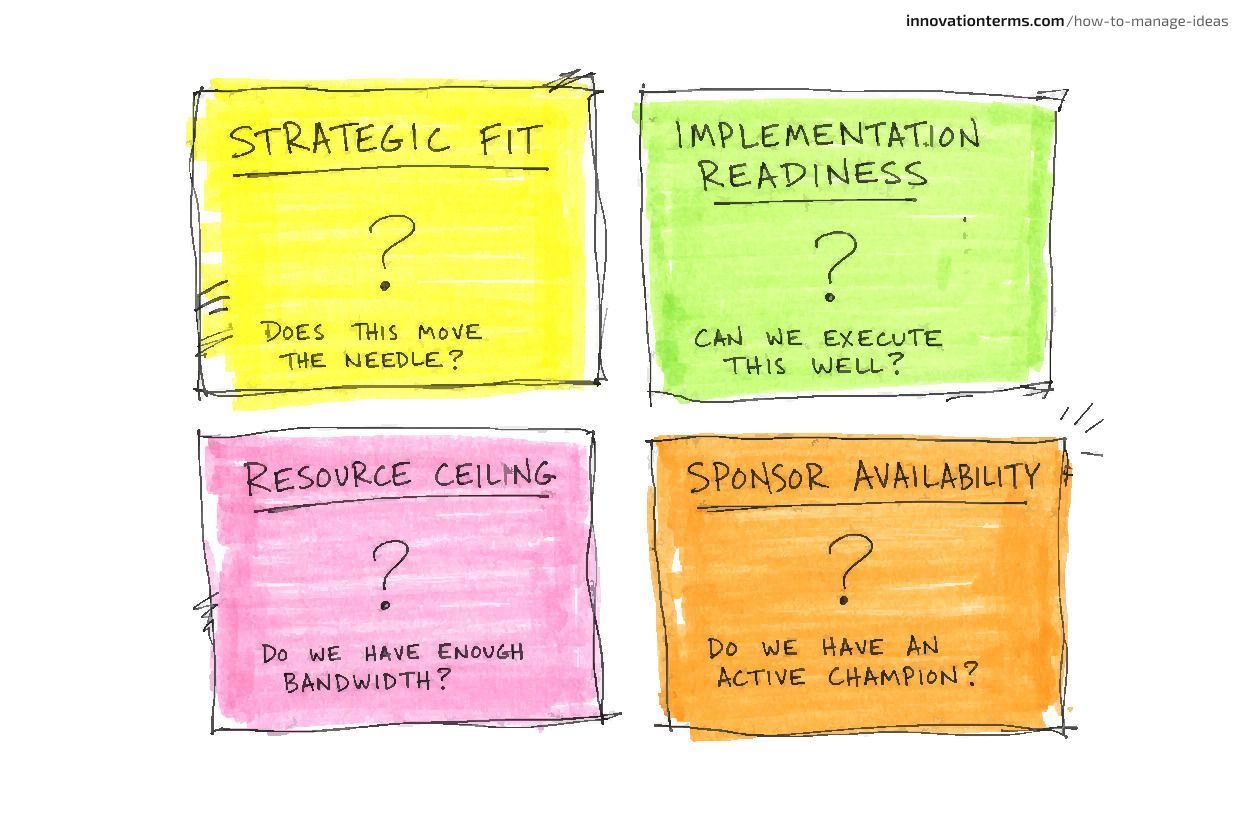
Robert Cooper's Stage-Gate model covers similar terrain at the project level. Applied at the idea stage, the criteria compress to four practical dimensions most organizations can score reliably before committing development resources:
- Strategic Fit, Does this address a stated priority? Disqualifier: no stated organizational priority exists that this addresses.
- Implementation Readiness, Can this be tested within 60–90 days with available resources? Disqualifier: requires resources not currently available or allocatable.
- Resource Ceiling, What is the maximum cost of a first test? Disqualifier: exceeds the budget authority of anyone in the evaluation process.
- Sponsor Availability, Is there a named person willing to own this through implementation? Disqualifier: no sponsor exists or can be identified.
Sponsor availability is missing from most evaluation frameworks. It is also the single most reliable predictor of implementation, because ideas without a named sponsor who owns them from evaluation to implementation rarely survive the organizational friction between departments. The academic literature on multi-criteria innovation selection confirms that "a simple list" with no ownership assignment cannot drive action.
How to Weight the Criteria
Weighting depends on organizational context. An early-stage program with limited evaluation bandwidth should weight Implementation Readiness and Resource Ceiling heavily at the first gate, disqualifying ideas that cannot be tested cheaply narrows the field to what the team can actually act on. A program running at higher maturity with dedicated innovation budget can weight Strategic Fit and Sponsor Availability more heavily.
The critical rule: weights must be set before evaluation begins, agreed in writing by the evaluation team, and applied consistently across all submissions in a given campaign. Post-hoc weighting adjustments destroy the consistency that makes structured evaluation credible.
Who Should Be Evaluating
Committee composition determines which criteria get scored reliably. Expert-only panels (senior leaders and domain specialists) score Strategic Fit and Market Attractiveness well but systematically underestimate Feasibility and miss Implementation Readiness signals because they are distant from execution.
Viima's Category Manager model offers a structural fix. In this approach, domain experts hold evaluation authority within their category. They know their area's constraints, resource ceilings, and sponsor candidates. They make faster, better-calibrated decisions than a central committee that evaluates across all domains. For organizations with 200–500 employees, the Category Manager model with cross-functional expert panels outperforms both centralized expert review and fully decentralized self-evaluation.
Erin Meyer's research on management culture at INSEAD describes the same principle from a different angle: giving evaluators enough strategic context to make good decisions close to where the knowledge lives, rather than routing all decisions through a central committee that lacks operational context.
What Are Advancement Gates and Why Do They Matter?
Advancement gates are mandatory decision points at which an idea either advances to the next stage, returns for refinement with a stated reason, or stops with a stated reason. Their function is to force decisions: without named gates, ideas accumulate in every stage simultaneously and no one has the authority or obligation to act on any of them.
Without gates, the capacity limit of the evaluation layer is invisible until the system locks up, similar to what happens when traffic volume exceeds a road's designed capacity. The smallest delay causes the entire system to shut down. Queueing theory (the mathematical study of how wait times behave when arrival rates exceed processing capacity) predicts exactly this: once a queue's service rate falls below its arrival rate, backlog grows without bound. Adam Ward applies this logic explicitly to portfolio and idea management contexts. Gates make the capacity limit explicit at each stage, before the shutdown.
Stage-Gate Logic Applied to Ideas
Robert Cooper's Stage-Gate model was designed for product development projects. Its gate logic, however, applies directly to the idea stage, before any project commitment is made:
"At each Gate, senior managers...decide whether the project merits further funding and people for the next Stage."
— Robert Cooper, Stage-Gate International
The Stage-Gate approach specifies deliverables ahead of time, so expectations are transparent and teams know what they must produce to advance. The principle at the idea level works identically: define what an idea must demonstrate at each gate. At the first gate, the question is typically "Does this pass the basic criteria screen?" At the second gate: "Has this been validated against the evaluation rubric by the designated reviewer?" At the third gate: "Is there a named sponsor and a budget allocation for a first test?"
A Practical Three-Gate Design for Idea-Level Advancement
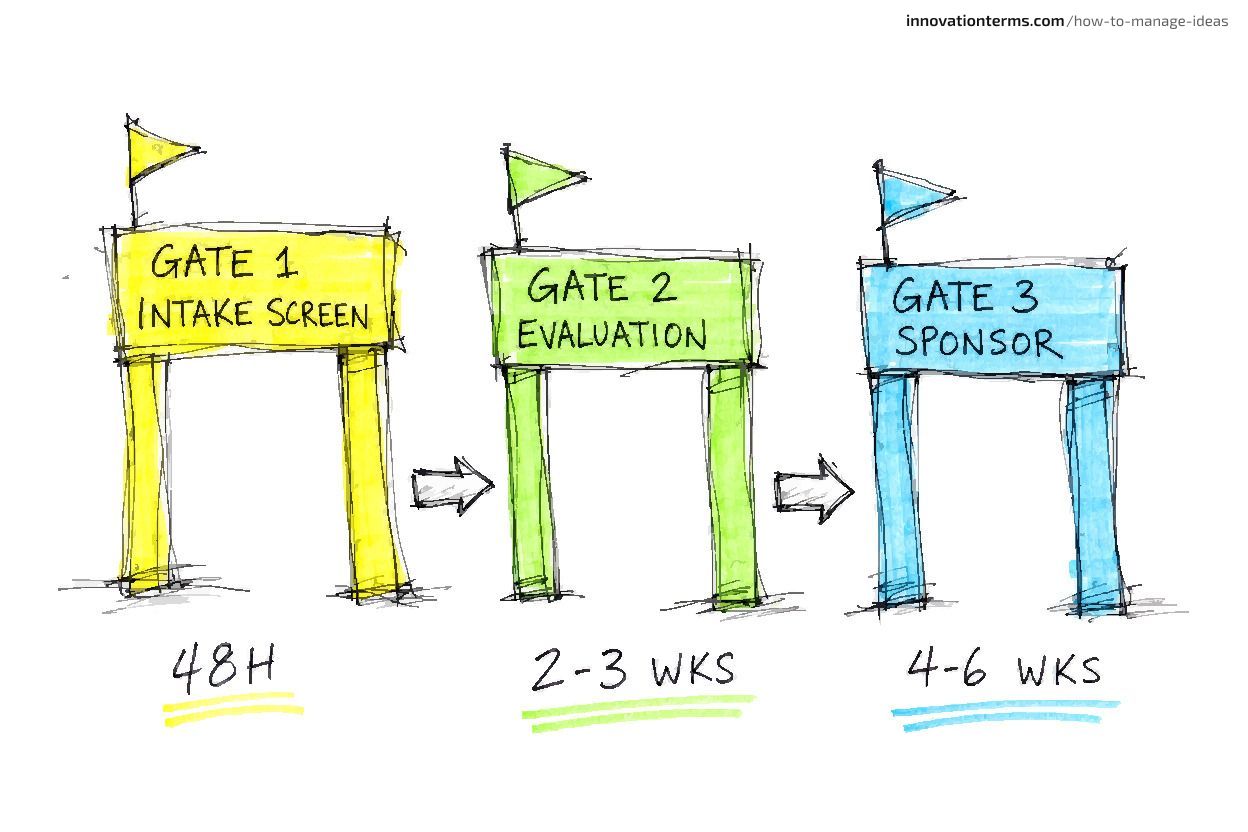
Most idea programs can operate with three gates before the idea becomes a project:
Gate 1, Intake Screen (48 hours) Criteria: Does the submission include a problem statement, a proposed approach, and a rough effort estimate? Is it within scope for the active campaign? If no to either: return with a template and a resubmission invitation.
Gate 2, Evaluation Committee Review (2–3 weeks from submission) Criteria: Scored against the pre-agreed rubric (Strategic Fit, Implementation Readiness, Resource Ceiling, Sponsor Availability). Score below threshold: reject with written rationale. Score above threshold: advance to Gate 3.
Gate 3, Sponsor Commitment (4–6 weeks from submission) Criteria: A named sponsor accepts ownership. A first-test budget is allocated or requested. A timeline for a first experiment is stated. If no sponsor commits within the window: the idea returns to the portfolio with an open "sponsor needed" flag rather than a rejection.
The three-gate design gives contributors a response at each stage, prevents limbo, and forces decisions at predictable intervals. Tal Atzmon's lean experimentation funnel follows a similar four-stage logic (Ideation, Incubation, Seed, Growth) where each stage defines concrete success criteria rather than leaving ideas to be judged on enthusiasm alone. In the Incubation stage, the explicit gate criterion is problem-solution fit (confirmation from real customer interviews that the problem the idea addresses is genuine and worth solving), not viability or technical feasibility, which come later.
AI-Assisted Screening at Gate 1
For organizations receiving high submission volumes, AI-assisted screening at Gate 1 can reduce the manual review load on the evaluation team. Research published in Organization Science in 2024 examined generative AI's role in crowdsourcing challenges and found that AI-human collaboration on idea evaluation changes the evaluator-to-idea ratio meaningfully, producing higher throughput without proportional reviewer cost. The limitation: AI screening works well for format compliance and basic criteria matching. It performs poorly on sponsor availability and organizational feasibility, which require human context.
How Do You Keep Contributors Coming Back After Rejection?
The feedback loop is not a courtesy feature. It is the mechanism that determines whether contributors submit again. Programs with no structured response to rejected ideas see participation decline sharply after the first cycle. Programs with structured rejection messaging (reason given, timeline stated, reconsideration path offered) maintain contributor engagement across multiple campaigns.
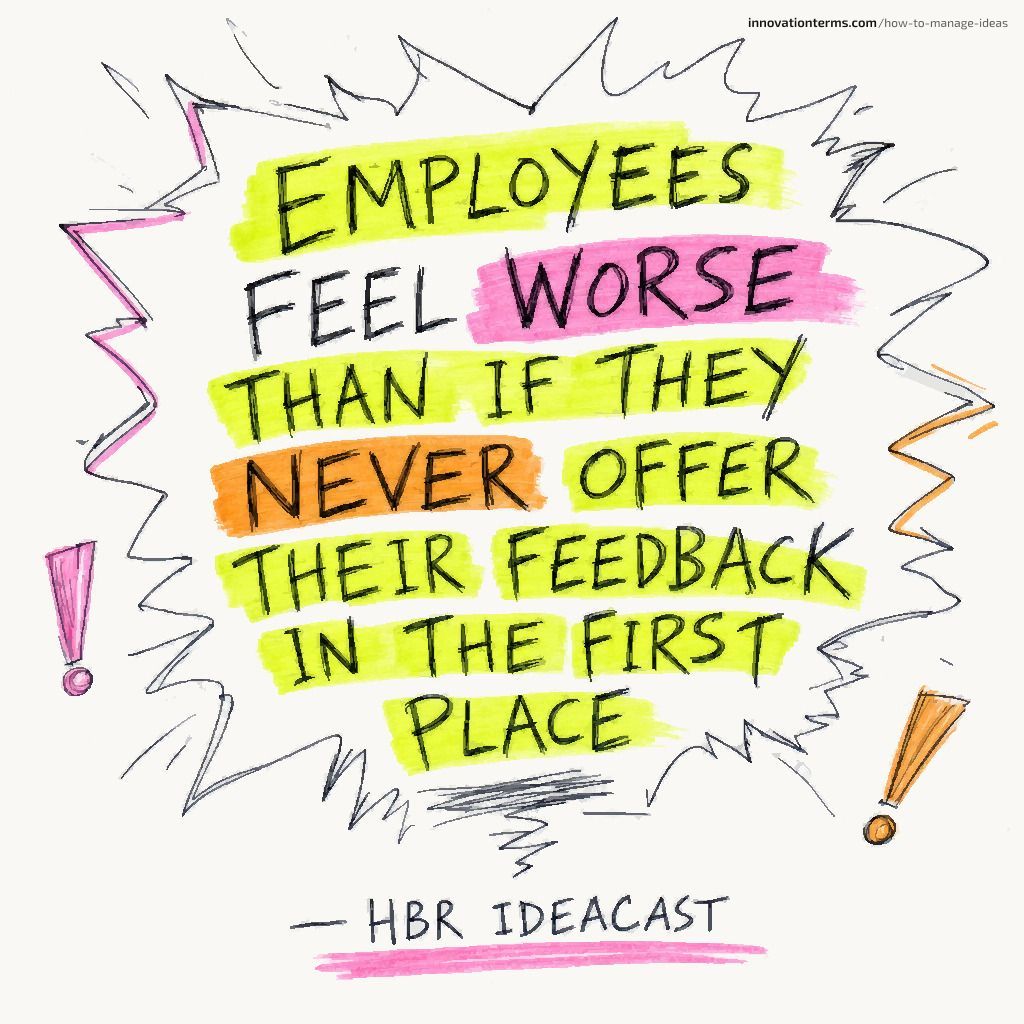
Asking for ideas without a mechanism to decide on them is not neutral. It is actively harmful. Employees who submit ideas into silence feel worse than employees who were never asked.
The research is unambiguous on the cost of silence. HBR IdeaCast put it precisely:
"if employees speak up a lot and managers don't respond to their feedback. It's not that things just stay the same. Employees feel worse than if they never offer their feedback in the first place."
The mechanism is expectation creation, which turns out to be one of the more dangerous things you can do in an office without meaning to. When an organization asks for ideas, it creates the expectation of a response. When no response arrives, the expectation is violated. That violation registers as rejection, not of the idea, but of the contributor. The contributor's rational response is to stop submitting. The organization, meanwhile, is left wondering where all the enthusiasm went, unaware that it has just run a small, perfectly controlled experiment in learned helplessness.
Adam Alfia, writing on real-time feedback systems, makes the structural implication explicit: if you're asking for feedback and not responding accordingly, it is better not to have the feedback loop at all, because the silence makes the organization look worse than silence would have before anyone was asked.
What a Functional Feedback Loop Contains
A feedback loop is not just a notification. For rejected ideas, it includes what criteria the idea was evaluated against, where the idea scored well and where it did not meet the threshold, whether the idea is permanently closed or could be reconsidered if conditions change, and a specific timeline ("We revisit submissions flagged for reconsideration in Q2"). For advanced ideas, it tells the contributor which gate the idea advanced to, who is sponsoring it, and an estimated timeline to a first decision or test. For all submissions, it includes a public program-level update: "From this campaign, 312 ideas were submitted. 14 advanced to evaluation. 2 have been assigned sponsors and are moving to a first test."
The public program-level update serves a different function than individual feedback. It demonstrates that the evaluation process operated, which addresses the most common perception among non-submitters: that nothing happens. Millard (KaiNexus) identifies the absence of any follow-up as the primary reason suggestion boxes fail. The specific failure mode is the absence of any visible evidence that evaluation occurred, which is distinct from the absence of a response to a specific idea. The public update closes that gap.
How Do You Plan a Campaign Before You Open Intake?
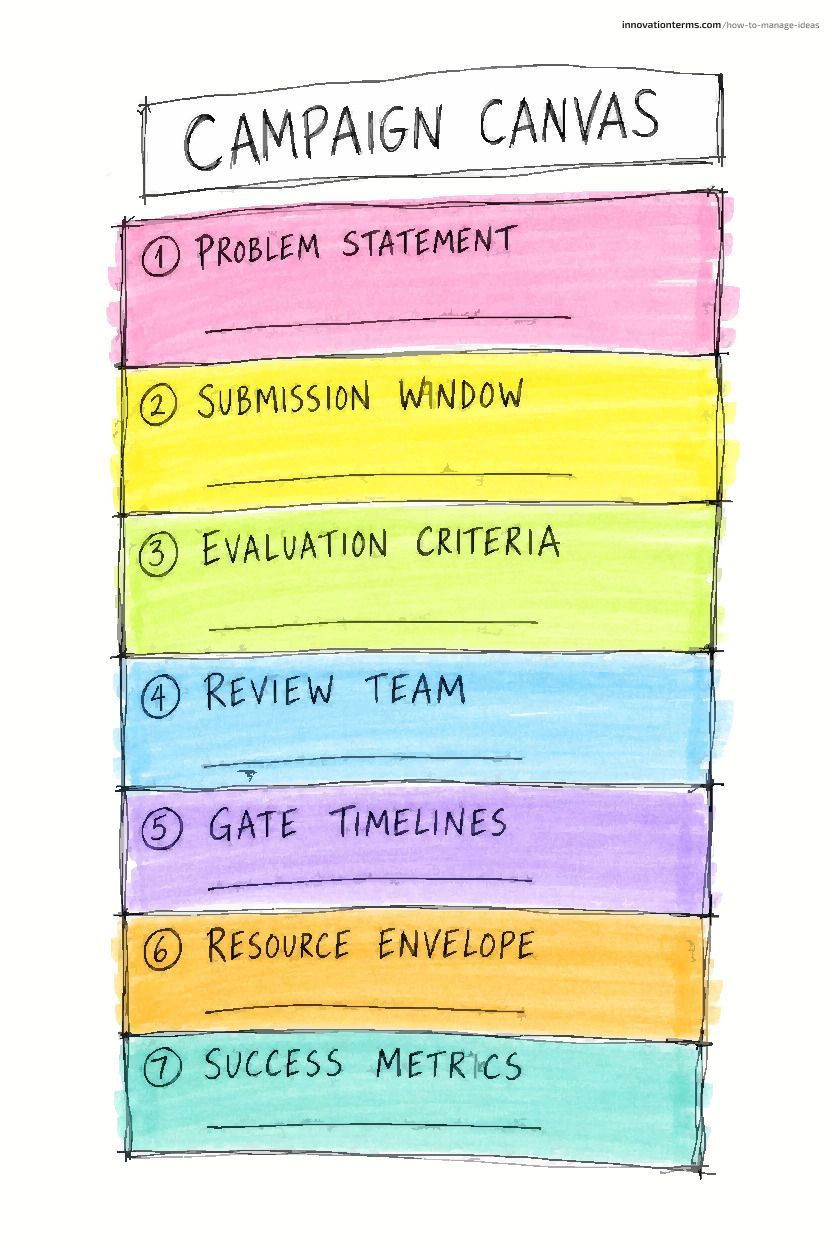
The campaign canvas is the pre-launch document that determines whether intake can be evaluated. It captures every structural decision that must exist before the first submission arrives, from the problem statement and evaluation criteria to the resource envelope. Without it, the campaign has no decision infrastructure and intake becomes a collection exercise.
The Campaign Canvas
The canvas should document:
- Problem statement: What specific challenge is this campaign addressing?
- Submission window: When does intake open and close?
- Evaluation criteria: Which dimensions will be scored, and how?
- Review team: Who evaluates submissions, and what is their time allocation?
- Gate timelines: By what date will contributors receive a response at each gate?
- Resource envelope: What budget exists to fund a first test for ideas that advance?
- Success metrics: How will the campaign be assessed? (Not participation rate, implementation rate, time-to-decision, ROI from advanced ideas.)
The campaign canvas is completed before the campaign opens, reviewed by the evaluation team to confirm capacity, and shared with contributors as a public statement of how the program operates. Its existence converts the campaign from a suggestion collection exercise into a structured intake with a visible decision process.
What the Portfolio View Enables
Once intake opens, the portfolio view is the operational complement to the campaign canvas. Idea portfolio management is the practice of tracking all active ideas across funnel stages simultaneously, so the organization can see where ideas are, who owns them, what stage they're in, and what resources they require. Without this view, innovation programs produce individual decisions but no system, ideas are evaluated one at a time with no visibility into the aggregate.
The distinction between a submission list and an idea portfolio is the difference between a backlog and a managed pipeline. A submission list shows what arrived. An idea portfolio shows what is happening to each item and why. The value becomes visible when you try to answer questions like: how many ideas are currently in evaluation across active campaigns? Which ideas have been sitting in the "advanced" state without a sponsor for more than 30 days? What is the average time from submission to first decision? None of these questions can be answered from a submission list. Left unmanaged, this kind of invisible backlog creates innovation debt — a compounding cost that grows with every cycle where ideas advance but don't close.
Viima's three-model framework (centralized, decentralized, hybrid) maps portfolio ownership to organizational size. In centralized programs (up to 200 employees), the steering group holds the full portfolio view, while decentralized programs (200–500 employees) distribute that view across Category Managers within each domain, with a central aggregation layer above. In hybrid programs (500+ employees), dedicated process owners maintain the cross-domain view.
Metrics Beyond Participation Rate
Participation rate is the metric most organizations track and the one least correlated with program success. A campaign with 40% participation and 1% implementation is worse than a campaign with 15% participation and 12% implementation.
The metrics that predict program health are: implementation rate (target above 10% of submitted ideas, and above 80% of formally advanced ideas). Time-to-decision (target 21 days or fewer to Gate 2 response). Sponsor acquisition rate (target above 60% of Gate-2 advanced ideas finding a named sponsor within 30 days). And resubmission rate from the previous campaign (above 50% indicates a functional feedback loop). Establish baselines for idea-to-ROI ratio in year one before setting targets.
By the Numbers: What Idea Management Programs Actually Produce
The performance gap between unstructured suggestion boxes and structured idea management programs is not incremental. It is roughly 40:1 on implementation rate. Evaluation architecture explains the gap, not idea quality, employee engagement, or organizational culture.
The Core Benchmark
Stat: In a typical suggestion box system, just 2–3% of ideas are ever implemented. In organizations using structured, software-assisted workflows, that figure exceeds 80%. (Kainexus, 2024)
Kainexus customer data shows only 2–3% of ideas in a typical suggestion box system are implemented, against 80%+ for organizations using purpose-built improvement software with structured workflows. This data carries inherent selection bias. Organizations that adopt structured continuous improvement software tend to be more operationally disciplined than average, which means the 80%+ figure covers only ideas that were formally advanced through the pipeline rather than all submitted ideas. The selection bias does not close a 40:1 gap between the 2–3% and 80%+ rates. Evaluation architecture is the mechanism, the only variable that consistently explains the difference. Independent research corroborates the direction: a 2023 Frontiers in Psychology study found that evaluation architecture is a necessary complement to psychological safety in producing implemented innovation outcomes.
Program Performance Benchmarks
KSB reduced idea processing time by 60% after implementing a structured innovation platform. High-performing organizations in AcceptMission's data implement 44% of submitted ideas through structured evaluation criteria. Cisco's Innovate Everywhere Challenge produced $2B+ in cumulative business impact from five ventures across more than 2,800 submissions, a 5-from-2,800 selection ratio that the program's evaluation discipline made possible. Bosch's Open Innovation Gateway selects approximately 20 technology partner projects from roughly 1,000 applications annually, generating approximately €8M in annual net present value from a 50:1 selection ratio (ITONICS vendor data, not independently corroborated).
What the data do not show is a case where better submission infrastructure, without evaluation architecture, improved implementation rates. The Kainexus analysis is explicit: the variable that explains the gap is evaluation workflow, not submission design.
The Bosch Case: What Evaluation Discipline Looks Like at Scale
Bosch's Open Innovation Gateway applies a roughly 50:1 selection ratio to approximately 1,000 annual partner applications, producing around 20 funded projects and approximately €8M in net present value per year. The ratio is evidence of evaluation discipline: structured criteria applied consistently are what make that selection ratio generate economic value rather than arbitrary exclusion.
Bosch's open innovation program provides one of the most documented examples of what structured evaluation discipline produces at the organizational level. The program is designed for external technology partners rather than internal employees, its intake is partner applications, its evaluation is project selection, and its output is funded collaborative projects. The structural logic is identical to internal idea management.
Program Structure
The Bosch Open Innovation Gateway attracts approximately 1,000 technology partner applications annually. Of those, roughly 20 projects are selected for full collaboration. The selection ratio is approximately 50:1, an aggressive filter that makes the program's evaluation discipline visible in its numbers.
Stat: The Bosch Open Innovation Gateway generates approximately €8M in annual net present value from ~20 selected projects out of ~1,000 applications — a 50:1 selection ratio enabled by staged evaluation criteria. (ITONICS, 2024 — vendor data, not independently corroborated)
The ~20 selected projects generate approximately €8M in annual net present value. The NPV figure comes from ITONICS, which is a vendor with a commercial relationship with Bosch, and has not been independently corroborated as of the research for this guide. It is cited with that qualification. What it demonstrates directionally (subject to the vendor disclosure) is that a 50:1 selection ratio, maintained consistently with defined criteria, generates material economic value from a small number of highly qualified selections.
What Selection at This Ratio Requires
Selecting 20 from 1,000 without explicit evaluation criteria would produce either analysis paralysis or political decision-making. At 50:1, there is no practical way for evaluators to "just know" which 20 applications to select. The evaluation process must be structured enough to eliminate 980 applications systematically, without requiring senior leadership review of all 1,000.
Bosch's approach (consistent with what ITONICS documents for similar programs) involves staged elimination: first a format and eligibility screen, then a strategic fit assessment, then a deeper technical and commercial evaluation for the survivors. Each gate eliminates a substantial fraction of remaining applications.
Stage-Gate International's research on project-level gate criteria provides the framework this kind of staged elimination runs on: Strategic Fit, Product and Competitive Advantage, Market Attractiveness, Technical Feasibility, Synergies, and Financial Reward/Risk. Applied at the partnership application stage, these six criteria give evaluators a structured basis for eliminating applications that are clearly misaligned before any detailed review.
An internal idea program that runs once a year and collects 300 submissions needs a structurally similar process at smaller scale. Staged screens, pre-agreed criteria, named evaluators with allocated time, and a target selection ratio aggressive enough to produce a shortlist the organization can actually act on. The same principles apply regardless of scale.
What Do Most Organizations Get Wrong About Idea Management?
Idea management programs fail at evaluation, not collection. Submission volume, contributor diversity, and tool quality are not the limiting variables. The evidence consistently points elsewhere. Barriers sit on the evaluation and decision side of the process, where most common interventions worsen the problem by flooding an already strained review process with more input.
Misconception 1: More Submission Channels Produce Better Outcomes
"We just need more people submitting", adding channels without increasing evaluation capacity produces a larger backlog and faster participation collapse.
More channels, more contributors, more ideas, but without evaluation capacity that scales with volume, more ideas produce more unreviewed ideas. The problem is in the chain between "more ideas" and "finding a good one." Without evaluation capacity that scales with submission volume, more ideas produce more unreviewed ideas. Axtell et al. (2001) found that participation problems in suggestion systems are structural, not motivational — employees who don't submit again after a failed first attempt are not unmotivated, they're responding rationally to evidence that submissions don't lead to decisions. Adding channels addresses the symptom while worsening the structural cause.
Misconception 2: Software Is the Primary Intervention
"We just need better idea management software", software only makes the failure mode run faster if evaluation architecture is absent.
Millard (KaiNexus) names this explicitly: "you thought making it digital would solve your problems" is reason 8 in its list of why suggestion boxes fail. Software provides workflow infrastructure. It does not provide governance. An organization with poorly defined evaluation criteria that switches from spreadsheets to a purpose-built idea management platform now has a faster-moving spreadsheet. The speed of the submission channel is irrelevant when no structured evaluation process exists downstream. Software that connects idea submitters with evaluators who lack criteria, decision authority, or time allocation does not solve the governance gap. It makes the gap more visible. (IdeaWake, 2026)
Misconception 3: Rewards and Gamification Drive Sustainable Participation
"If we add points, badges, and prizes, participation will stay high", extrinsic rewards maintain participation only until the first cycle where submitted ideas go unactioned, at which point reward structures collapse along with trust.
Points without outcomes kill participation. Contributors who submit for points but receive no response about what happened to their ideas stop playing the game well before they stop caring about the outcome. The research is consistent: "motivating employees to participate is a common weakness of suggestion systems. Motivating employees involves more than simply offering rewards to submitters if their suggestions are put to use." Gamification addresses the front-end action. It cannot compensate for an absent feedback loop.
Gamification addresses the submission action. What it cannot address is implementation outcome, and when contributors perceive the game as disconnected from actual decision-making, the credibility of the whole system erodes. The most effective "reward" for continued participation is visibility: public updates showing which ideas advanced and what the program produced. That visibility is a function of the feedback loop, not the rewards system.
Where Does Idea Management Get Complicated?
Idea management processes that work well in medium-sized, co-located organizations run into predictable structural problems in regulated industries, distributed teams, and contexts where anonymous submission is required. The core architecture doesn't change, but each context requires specific adaptations.
Regulated Industries: Healthcare, Financial Services, Defense
Regulated industries face two compounding constraints. First, idea evaluation in some areas (clinical protocols, financial products, defense procurement) is subject to compliance review requirements that prevent rapid advancement regardless of internal gate design. Passing all four internal gates does not guarantee a clear path to implementation. External legal or ethics review may still be required, introducing a delay the evaluation team cannot control.
Second, submission itself may create documentation obligations. In pharmaceutical environments, for example, an idea about a clinical protocol that was evaluated and rejected may create a record with regulatory implications. Organizations in these sectors need evaluation processes with explicit documentation chains, reviewer role definitions that match compliance requirements, and a clear boundary between "ideas under internal evaluation" and "proposals under regulatory review."
The practical adaptation: run a more aggressive intake screen at Gate 1 that flags ideas requiring compliance review before they enter the main evaluation track. Create a parallel compliance review lane with defined timelines rather than routing all submissions through the standard process.
Distributed and Remote Teams
Distributed teams change two variables in the evaluation equation: submission patterns and evaluation quality.
On submission patterns: distributed contributors in high-timezone-offset locations tend to submit ideas asynchronously, at times when no one is available to ask clarifying questions. This increases the frequency of incomplete submissions that require back-and-forth before evaluation can proceed, adding days to the Gate 1 screen.
On evaluation quality: evaluators who are remote from the operational context where an idea would be implemented make systematically worse Implementation Readiness and Resource Ceiling assessments. They cannot quickly check whether resources are actually available or whether the proposed approach is operationally realistic. The Category Manager model (evaluation authority held by domain experts who are close to implementation) is a structural fix, but it requires distributed Category Managers who have operational visibility in their region or function.
Erin Meyer's research on cross-cultural management at INSEAD adds a relevant dimension: the norms around surfacing disagreement, criticizing existing processes, and proposing changes vary significantly across national cultures. An idea management program designed with Northern European norms around directness may produce systematically lower submission rates from contributors in cultures where challenging the status quo is more contextually sensitive.
Anonymous Submission
Some organizations allow anonymous idea submissions to reduce the social risk of proposing unpopular changes or surfacing problems that imply criticism of current leadership. The governance implication is significant.
Anonymous submissions cannot be evaluated on Sponsor Availability (no submitter to recruit as sponsor) or Implementation Readiness signals that depend on knowing the submitter's role and operational context. They also complicate the feedback loop — how do you return a decision to an anonymous contributor?
Anonymous at Gate 1. Contact required at Gate 2. This staged disclosure structure preserves the psychological safety of submitting without requiring attribution upfront, while still enabling the evaluation and feedback processes that Gate 2 requires for an idea to advance. Contributors rejected at Gate 1 carry no attribution risk. Those who advance become visible to the review team only at the point where evaluation requires it. Anonymous intake at Gate 1 is a structural mechanism for approximating the goal of evaluating ideas on their merits.
Cross-Functional Idea Ownership
Ideas that cross departmental boundaries are the most common orphans in idea management programs. When an idea touches multiple functions (say, a process change that involves both operations and finance) no single Category Manager has full ownership authority. The idea either gets assigned to one function (which underweights the other function's constraints) or it goes to a central committee (which is slower and less context-rich).
The structural fix is a "co-sponsor" model: two named sponsors from different functions are both required to advance a cross-functional idea. Both must commit at Gate 3. The model forces the ownership conversation to happen explicitly, prevents cross-functional ideas from sitting in the "advanced but unowned" state, and gives both functions a stake in implementation success. Viima's hybrid model, designed for organizations with 500+ employees, includes a mechanism for this: a central process owner facilitates cross-domain idea routing and co-sponsor identification, while domain Category Managers retain evaluation authority within their areas. For organizations with distributed divisions across geographies, the federated innovation model offers a related governance pattern worth exploring.
Frequently Asked Questions
What is the idea management process?
The idea management process is the end-to-end workflow for capturing, evaluating, and advancing ideas through a structured decision pipeline. It includes intake design (who submits, to what channel, in what format), evaluation criteria (what standards ideas are scored against), advancement gates (decision points at which ideas advance or stop), and feedback loops (structured responses that tell contributors what happened). The process is managed. It does not run automatically.
How do you evaluate ideas from employees?
Evaluate against pre-agreed criteria set before any submissions arrive. Common dimensions include Strategic Alignment (does this address a stated priority?), Implementation Readiness (can this be tested within available resources?), Resource Ceiling (what would a first test cost?), and Sponsor Availability (is there a named person willing to own this?). Apply a scoring rubric consistently across all submissions in a campaign cycle. Decisions should be made by evaluators with domain context, not by a central committee that lacks operational visibility.
What happens after ideas are collected — who decides?
This is the most important question in idea management. Most programs never answer it before launching intake. A named evaluation team — not "leadership," not "the committee," but specific individuals with named responsibilities and time allocation — decides. The evaluation team applies the pre-agreed criteria at each advancement gate. Their decision authority needs to be explicit: they advance or reject. They do not recommend to someone else who then recommends to someone else. The governance gap appears precisely where decision authority is undefined.
How do you stop ideas from dying in the suggestion box?
Build the evaluation infrastructure before opening the submission channel. Set your evaluation criteria first. Then build the rest of the process infrastructure around them before intake opens. Then run a structured idea challenge with a fixed submission window rather than an always-open box, the time limit creates a review window the evaluation team can plan around. After each cycle, publish what the program produced: how many ideas were submitted, how many advanced, what happened to them.
What criteria should I use to evaluate innovation ideas?
Start with four: Strategic Fit, Implementation Readiness, Resource Ceiling, and Sponsor Availability. These four eliminate the ideas the organization cannot act on (regardless of quality) and advance the ideas that match both strategic priorities and operational capacity. For programs at higher maturity, add Customer/Stakeholder Value and Time-to-Value from IdeaWake's nine-dimension framework. Weight the criteria before evaluation begins. Don't adjust weights based on specific ideas in the queue.
How do you measure the success of an idea management program?
Not by participation rate. Measure implementation rate (what percentage of advanced ideas reach implementation), time-to-decision (how many days from submission to first gate response), sponsor acquisition rate (what percentage of Gate-2 advanced ideas find a named sponsor within 30 days), and resubmission rate (what percentage of contributors from the previous campaign submit again in the next). Submission count is a distraction. A program hitting 15% resubmission, 20% advancement, and 80% implementation of advanced ideas is working well, and the total number of submissions tells you essentially nothing about whether that is the case.
What is the difference between an idea challenge and a suggestion box?
An idea challenge is a structured, time-boxed campaign with a defined problem, a fixed submission window, a named evaluation team, and a public commitment to respond to all submissions by a stated date. A suggestion box is a passive, always-open collection channel with none of those elements. Structured challenges produce higher submission quality (because contributors understand the problem they're solving), better evaluator-to-idea ratios (because volume is controlled), and higher implementation rates (because the evaluation infrastructure is designed around the challenge scope). Always-on boxes are appropriate for ongoing incremental improvement programs, not for strategic innovation initiatives.