An innovation quiz is a structured assessment that tests how well someone understands innovation terms, frameworks, and decision patterns. A useful quiz teaches as it tests, so wrong answers point to concepts worth reviewing.
Which quiz should I take first?
Each quiz has its own page. Start with the knowledge quiz if you want to test concept recall. Start with the innovator type quiz if you want a quick reflection on how you approach innovation work.
What kinds of questions are included?
The quizzes cover innovation types, design thinking, MVPs, open innovation, experimentation, business model design, adoption, portfolio choices, and innovation metrics.
Is this useful for team workshops?
Yes. The page works well as pre-work because it gives participants a common vocabulary before they discuss strategy, customer problems, experiments, or portfolios.
Do the quizzes include explanations?
Yes. The knowledge quiz gives immediate feedback, and the question bank includes explanations with links to glossary pages so people can learn the concept behind each answer.
What is the difference between the two quizzes?
The knowledge quiz is a scored multiple-choice test of innovation terms and frameworks. The innovator type quiz maps your work habits to a practical archetype with strengths and next actions.
Can I use the questions for studying?
Yes. The static question bank is designed for study, facilitation, and revision. It keeps the questions, answer keys, explanations, and related terms visible in crawlable HTML.
Innovation Quizzes and Self-Assessments
The quiz area is a set of practical self-assessment tools built around
the same vocabulary used across the InnovationTerms glossary. Instead of
treating innovation as abstract theory, each quiz helps you map concepts
to your behavior, decisions, and team context. This makes the section
useful for practitioners, students, and teams that want shared language
they can use in real projects.
Our quiz formats align with widely used innovation framing in sources
like the
OECD Oslo Manual, while also encouraging applied reflection similar to resources
curated by
Wharton’s innovation coverage.
Why Take an Innovation Quiz?
Reflection accelerates learning. A quiz gives you a concrete way to test
what you currently understand and where your assumptions need work,
which helps move innovation concepts from passive reading into active
use.
For individuals, quiz results clarify strengths and learning priorities.
For teams, they create a shared baseline for discussion before strategy
sessions, retrospectives, and capability planning.
The result is faster alignment: people can discuss opportunity,
experimentation, and implementation with clearer definitions and fewer
misunderstandings. That shared understanding is often the difference
between ideas that stall and ideas that scale.
TL;DR
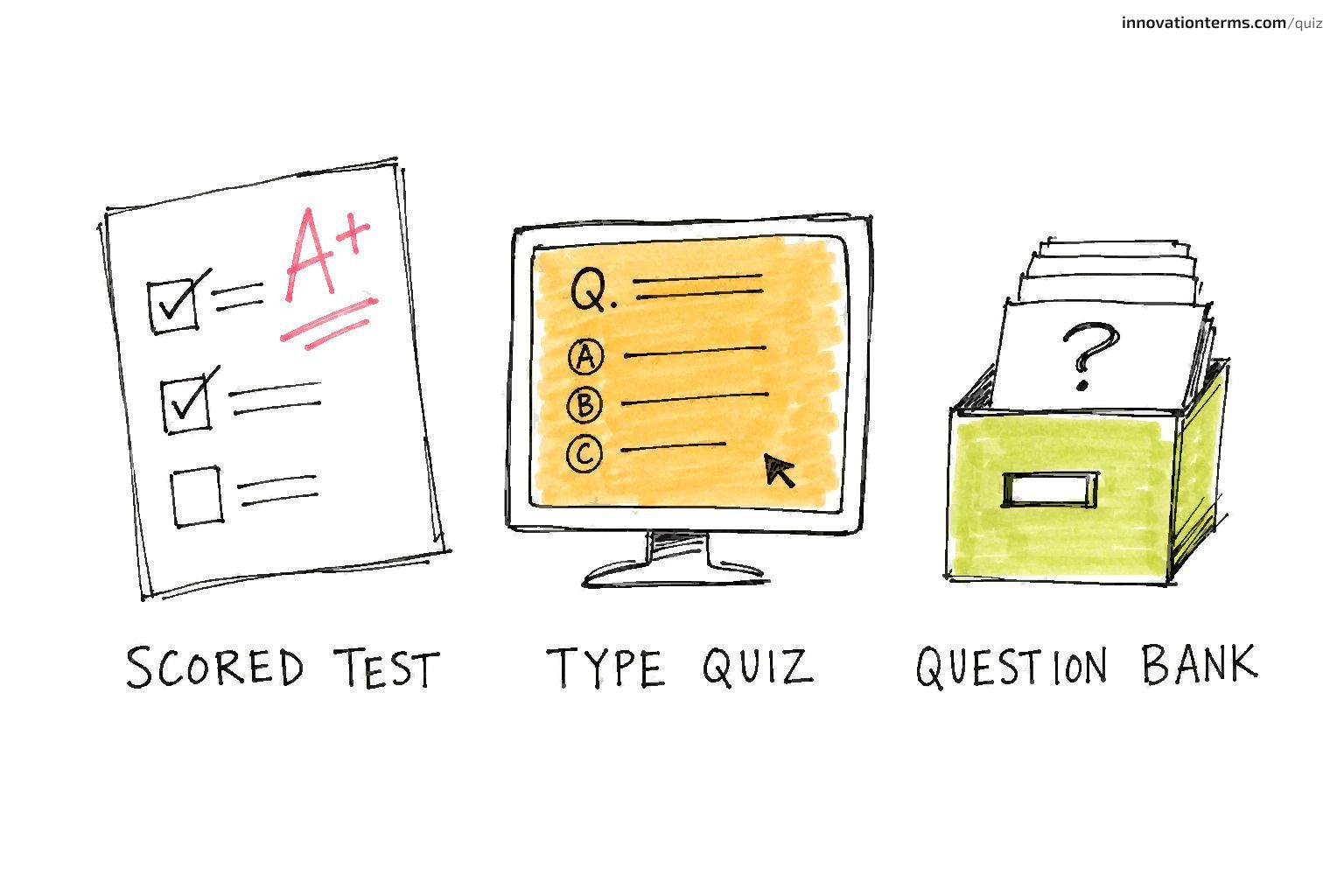
The hub contains three routes: a 20-question scored knowledge quiz, a 12-question innovator type quiz, and a 50+ question bank.
Choose the scored quiz to test concept recall and get instant feedback with glossary links.
Choose the archetype quiz for a quick reflection on your innovation work style and one concrete growth action.
Choose the question bank for workshop prep, study groups, or reusable discussion prompts.
All three are free. There is no sign-up, and each one is meant for learning rather than entertainment (the live quiz hub).
Common goals include checking what you know, thinking through how you work, or getting a team ready before a strategy session. Most pages that rank for "innovation quiz" narrow that choice to one format, often an archetype quiz or a trivia directory, sometimes a course quiz. The InnovationTerms quiz hub does not force that compression. It offers a 20-question scored knowledge test, a 12-question innovator-type reflection, and a 50+ question study bank (the InnovationTerms quiz hub).
What is the innovation quiz hub, and who is it for?
The InnovationTerms quiz hub is a free, no-sign-up chooser page that routes serious learners to one of three assessment formats: a 20-question scored knowledge test, a 12-question innovator-type reflection, and a 50+ question study bank. The focus is practical innovation fluency for people using it (this page).
The hub is a routing layer, not a single test. The scored knowledge quiz and innovator type quiz are interactive and return results, while the question bank stays static for study and facilitation. The two quizzes measure different things. The bank is browseable material you can use at any pace. Every route links back to glossary definitions, so a wrong answer becomes a study prompt instead of a dead end.
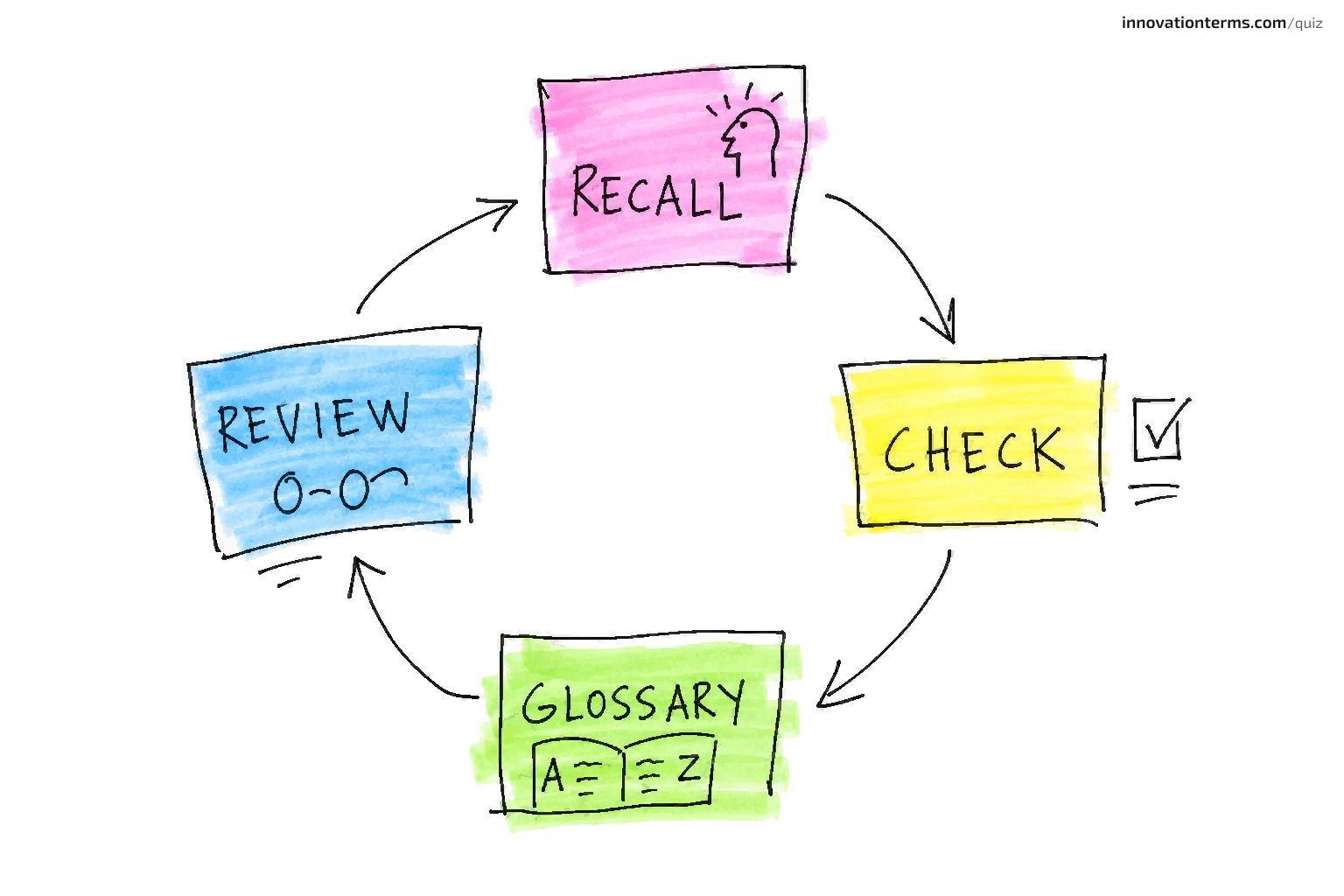
Retrieval practice, or answering from memory and then checking, is what turns a quiz into a learning event. Karpicke and Roediger (2008) found that repeated testing produced a large positive effect on delayed recall, while repeated studying after learning had none.
Repeated studying after learning had no effect on delayed recall, but repeated testing produced a large positive effect… The results demonstrate the critical role of retrieval practice in consolidating learning and show that even university students seem unaware of this fact.
Karpicke and Blunt (2011) later showed that 'practicing retrieval produces greater gains in meaningful learning than elaborative studying with concept mapping… Retrieval practice is an effective tool to promote conceptual learning about science.' Mike Taylor (2025) notes in his review of the testing-effect literature that 'The students who took practice tests remembered 50% more than students who studied repeatedly... Testing once produced better retention than studying four times.' The quizzes here are built to expose gaps and route you to the next concept, not to reward a quick guess. That is the difference between a serious learning resource and entertainment trivia. There is no sign-up wall, no leaderboard, and no data capture. The goal is to send you back to the glossary and guides with a clearer picture of what you still need to learn.
Which innovation quiz should you choose first?
Broad 'innovation quiz' searches usually indicate that the visitor needs help choosing a format. The hub ranks by routing each visitor to the right format before they click a child page.
Start by identifying your job. If you need a baseline of what you know, take the scored test. If you want a quick reflection on your role in innovation work, take the archetype quiz. If you need reusable questions for a group, open the bank. The decision can be made in one glance.
Start with the scored quiz if the goal is real knowledge. Retrieval practice beats elaborative studying for conceptual learning, as Karpicke and Blunt (2011) showed, which makes that route the strongest first stop. The archetype quiz stays in the hub, though only as reflection because the evidence behind most workplace personality-style tools is weak. The question bank fits a different job. Use it when you need reusable study material, not a one-time result (Chief Learning Officer, 2023).
This selector layout keeps each child page focused. You click to a narrower promise, not a repeat of the same pitch. If you are preparing a workshop, send the scored quiz for an individual baseline and the question bank for group discussion prompts. The hub owns the broad query by resolving selection intent before a visitor clicks anywhere.
When should you take the scored knowledge quiz?
Take the scored knowledge quiz when you want to test recall of innovation terms and frameworks and get immediate feedback on where to review. It is the right first stop for most serious learners and a focused innovation knowledge quiz because retrieval practice strengthens memory more than re-reading or concept mapping, as Karpicke and Blunt (2011) showed.
The quiz has 20 scored multiple-choice questions built from glossary definitions. You answer from memory. After each response you see whether you were correct, along with an explanation and a link to the relevant glossary term. That feedback loop is the point. Roediger, Putnam, and Smith (2011) list ten benefits of testing, including enhanced retention, flexible transfer, and better metacognitive monitoring for both learners and teachers.
Retrieval practice occurring during tests can greatly enhance retention of the retrieved information (relative to no testing or even to restudying)… Quizzes also permit students to discover gaps in their knowledge and focus study efforts on difficult material.
Immediate feedback also prevents misconceptions from hardening. The Learning Scientists describe retrieval practice as closing the book and writing what you know. The difficulty is part of the mechanism, because well-built quizzes create desirable difficulties, the manageable struggle that makes memory stick. Expect to spend about five to seven minutes. The score is not the destination. It is a signal for what to study next. A low score on questions about business model innovation or open innovation points you back to those glossary entries. A strong score suggests you are ready for deeper cluster guides.
When does the innovator type quiz help more than the scored test?
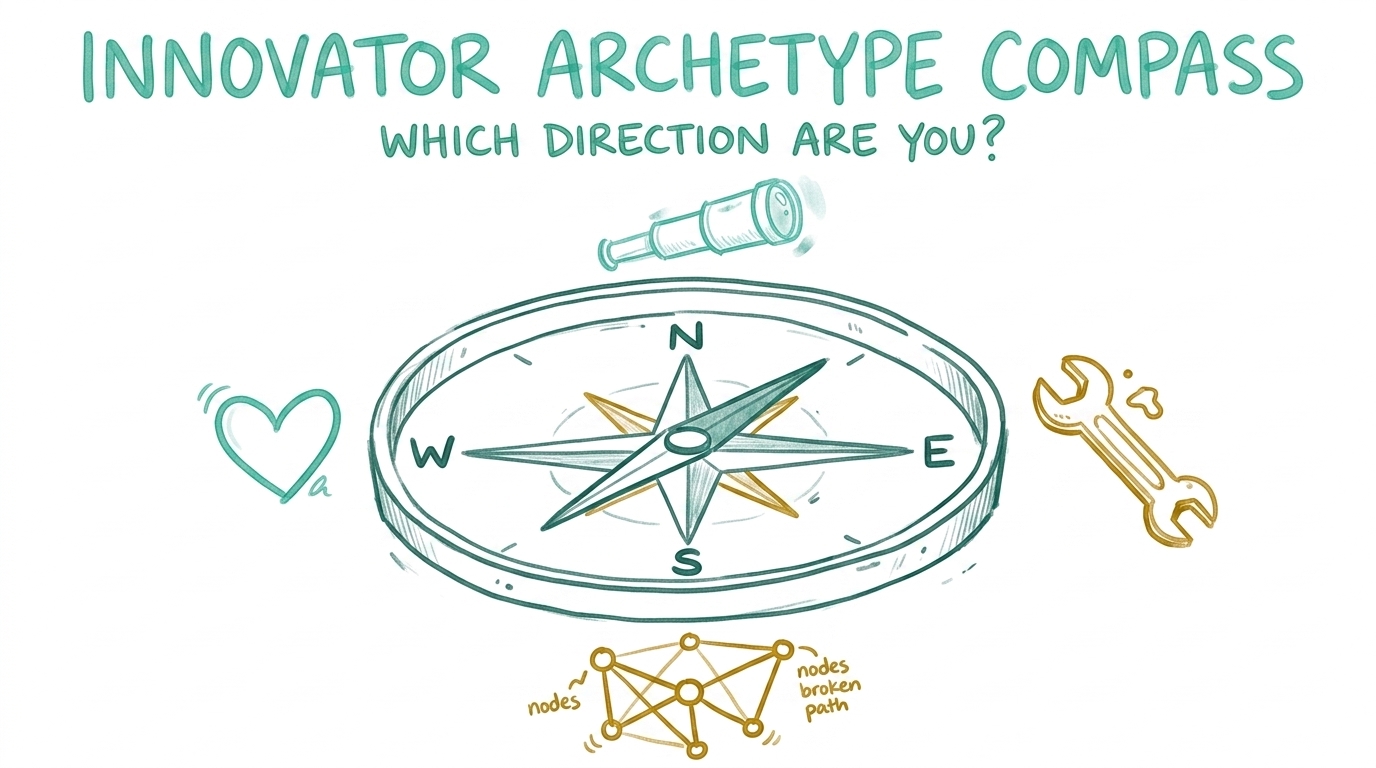
Choose the innovator type quiz when you want a fast reflection on how you currently work in innovation settings, not a verdict on what you know. It is useful for surfacing strengths and choosing one concrete growth action.
The quiz has 12 quick questions, requires no sign-up, and returns an archetype result with core strengths and a single growth action. It is designed as a work-style reflection, not a personality label. That distinction matters because the evidence behind most workplace archetype tools is weak. Treating the result as fixed produces false assumptions about people.
Personality, strength, or psychometric models such as Myers-Briggs, DISC, Belbin, Predictive Index, Tilt and the myriad others available, attempt to codify people and their preferences, personalities, behaviours and values into archetypes, using fixed (usually proprietary and opaque) algorithms… There is very little evidential basis behind personality profiling, and significant evidence against it.
The MBTI assessment isn't designed to predict success in a given occupation… Personality type doesn't indicate skills, abilities, job performance, or future success.
Use this route for a three-minute check-in before a team conversation. It also fits moments when one growth action helps more than a score. For example, a result centered on experimentation might lead to the design thinking sprint and minimum viable product guides. A result centered on collaboration might lead to open innovation and jobs-to-be-done.
When should you use the question bank instead of a quiz?
Use the question bank when you need reusable innovation quiz questions and answers rather than a single-pass interactive result. It is built for study, facilitation, and revision.
The bank contains 50+ factual questions with answer keys and plain-English explanations. Each entry links to a related glossary term. That makes it a study path, not a worksheet. You can scan it quickly. If you need more, review a category or pull individual questions into a workshop deck. For a facilitator, the strongest use is selecting items that match the workshop topic so the group has discussion prompts with answer keys ready.
Because the bank is crawlable HTML with visible answers, it also works as a reference facilitators can share without asking participants to create accounts or complete a timed flow. That matters for teams that need a low-friction pre-work resource. The low-anxiety framing helps too: quizzing that corrects overconfidence without high stakes helps learners lock in material (Tapesearch summary of Learning How to Learn).
The bank covers the same conceptual ground as the scored quiz, so study groups can use it as either an innovation terms quiz or an innovation vocabulary quiz. It works for focused drills on one topic, like business model design, and it also scales to a full review across the cluster, including areas such as open innovation or experimentation. Each question carries its own answer plus the related glossary term. That removes the need for a separate answer sheet.
How should teams and facilitators use these resources before a workshop?
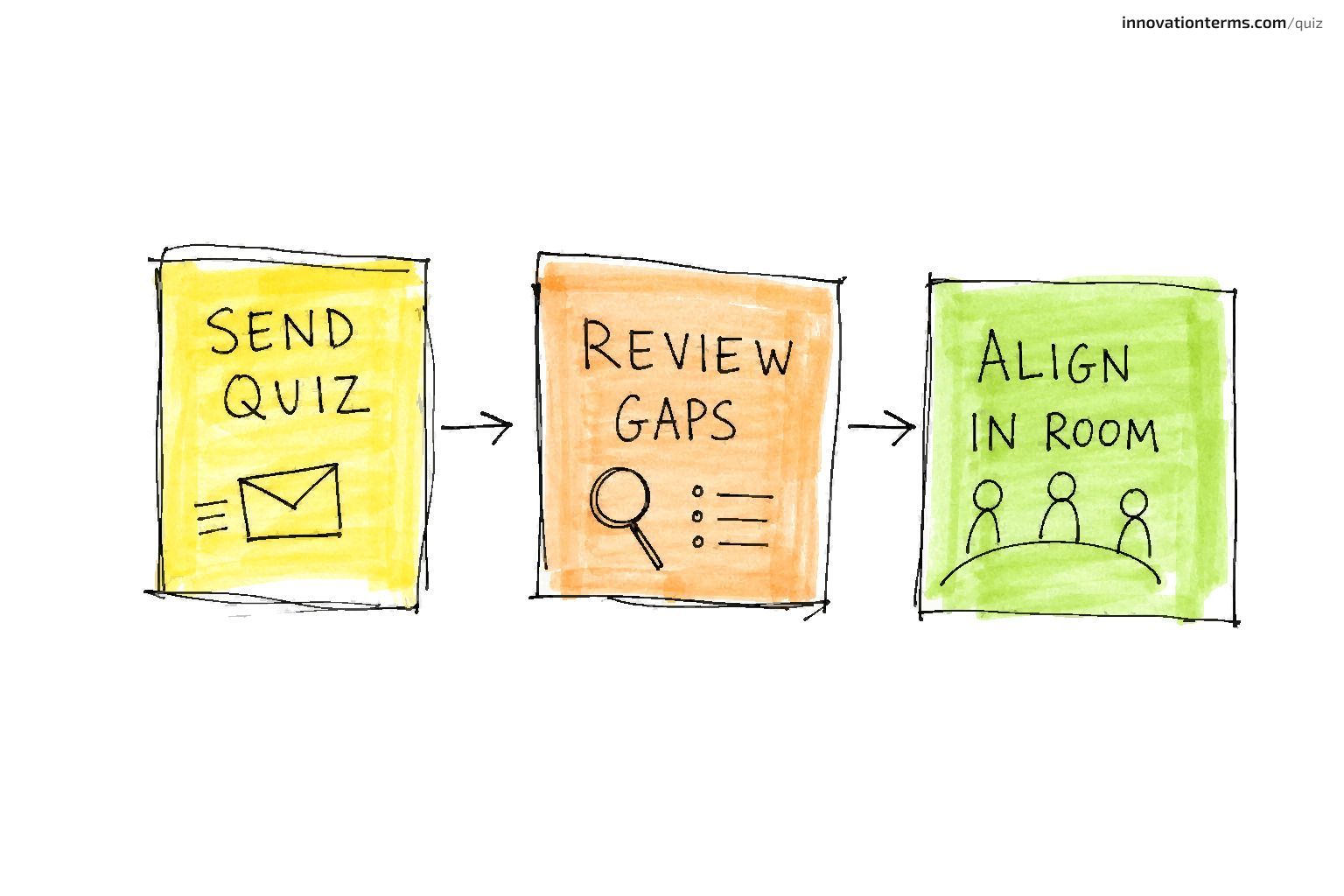
Teams and facilitators should treat the hub as a pre-session learning layer. Send the scored knowledge quiz to individuals for a private baseline. Use the question bank for shared discussion prompts. Keep the innovator type quiz as optional reflection.
The goal is shared mental models, not shared scores. Van den Bossche et al. (2011) found that co-construction and constructive conflict help teams build shared mental models. A shared mental model of the task environment improves team performance.
Particularly the team learning behaviors identified as co-construction and constructive conflict are related to the development of shared mental models. In addition, a shared mental model of the task environment in a team leads to improved performance.
Salas et al. (2008) recommend refining shared mental models by pre-planning and providing learning opportunities that expose members to feedback before the session. A short quiz does exactly that. It gives participants feedback on vocabulary gaps before the workshop starts, so the room can spend less time defining terms and more time solving problems.
Mini-case: a product strategy offsite. Use the 20-question scored quiz as pre-work one week before the offsite. Participants review wrong answers and the linked glossary terms. In the room, the facilitator uses selected question-bank items to probe contested concepts, from MVP testing to broader questions about disruptive innovation and innovation metrics. That prep shortens the move from vocabulary alignment to decision-making.
A short pre-work quiz accomplishes that. It is not a maturity assessment or a gated corporate benchmark. It is a lightweight quiz for innovation teams that need shared language before the real work starts.
What should you review after each quiz result?
Each quiz route should end in a specific next-step study path. The knowledge quiz points to glossary foundations. The innovator type quiz points to role and collaboration guides. The question bank points to related terms by topic.
Route
Result signal
Suggested next step
Scored knowledge quiz
Low or uneven score
Review glossary definitions for missed concepts, then read the relevant cluster guide
Read the guide that matches your growth action and the glossary terms tied to your strengths
Question bank
Questions answered incorrectly
Click the related term for each missed question and review its definition and connected guides
That follow-through keeps the hub focused on learning and review. Mike Taylor (2025) notes in his review of spaced retrieval quizzes that they reset the forgetting curve and guide learners back to weak spots. For example, a low score on the scored knowledge quiz might send you to definitions for disruptive innovation, jobs-to-be-done, or innovation metrics. Each route turns one session into a study plan.
FAQ
Is this for individuals, teams, or both?
Both. Individuals usually start with the scored quiz for self-assessment, then move to the question bank for study. Team leads and facilitators use the bank and the scored quiz differently, setting them up as pre-work when the goal is shared vocabulary before a session. The innovator type quiz fits either private reflection or a lighter team conversation starter.
Can I use these questions in a workshop or training session?
Yes. The question bank is designed for study and team-training use. It keeps questions, answer keys, explanations, and related terms visible in crawlable HTML, so you can share links or pull individual items into a session. You do not need permission or a login to share the page (the live quiz hub).
What is the difference between the two quizzes?
The scored knowledge quiz is a 20-question multiple-choice test of innovation terms and frameworks. It gives a score, instant feedback, and glossary links. The innovator type quiz is a 12-question reflection that maps your current work habits to an archetype, strengths, and one growth action (the live quiz hub).
How long does each option take?
The scored quiz takes about five to seven minutes. The innovator type quiz takes about three minutes. The question bank is open-ended. A focused review of one category takes roughly 15 to 30 minutes, and you can stop and resume as needed.
Are the quizzes scored, and do they explain the answers?
The knowledge quiz is scored and gives immediate feedback with an explanation and a glossary link for each question. The innovator type quiz is not scored. It gives a descriptive archetype result with a growth action. The question bank includes answer keys and explanations for every question (the live quiz hub).
Is this a serious learning resource or just a personality test?
This is a learning resource. The knowledge quiz uses retrieval practice, which Karpicke and Roediger (2008) show strengthens long-term memory more than re-reading. The innovator type quiz is framed as reflection, not a fixed personality label, as the MBTI publisher itself notes. The question bank is maintained as study and facilitation material (the live quiz hub).