Share
Share  Reddit
  X.com
X.com  Facebook
  Pinterest
  Threads
  Bluesky
  WhatsApp
  Telegram
  Messenger
  Email
Email Building a Disruption Radar for Your Category

Learn how to build a disruption radar that combines innovation radar, technology radar, and trend radar so your team can detect change early and act with confidence.
A disruption radar is not a slide. It is a decision system.
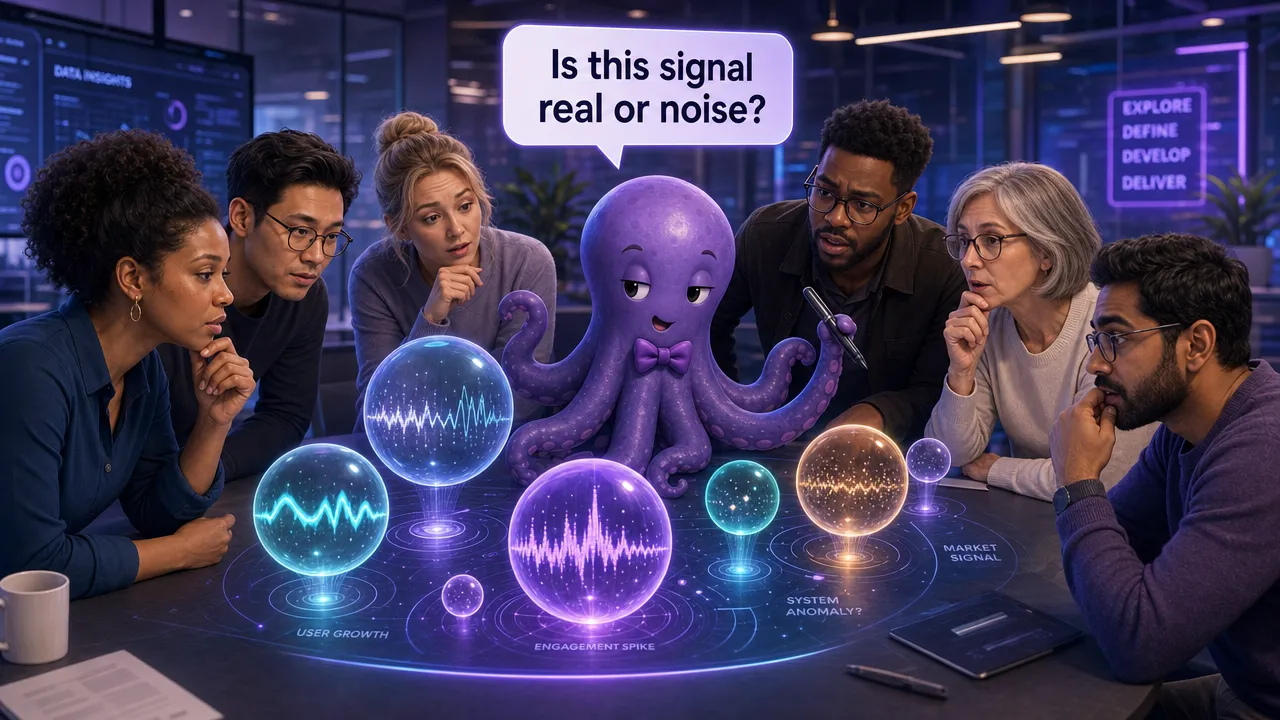
Most organizations can describe change. Fewer can detect weak signals early, debate them productively, and turn insight into portfolio action. That execution gap is exactly where a disruption radar helps. It gives leadership teams a shared language to answer practical questions:
- Which technologies are mature enough to adopt now?
- Which market shifts are real versus noisy?
- Which innovation bets deserve funding, partnerships, or fast experiments?
In this guide, you will learn how to combine three radar lenses — innovation radar, technology radar, and trend radar — into one operating rhythm.
1) the Three Radar Types: What Each One Does
A strong disruption radar program uses three complementary views:
Innovation Radar
An innovation radar maps where your business can innovate, not just what technology exists. It helps teams diversify bets beyond feature upgrades by tracking changes across offerings, customer experience, internal processes, and market presence.
Use this lens when you need to:
- Avoid product-only innovation bias.
- Redesign value delivery, channel strategy, or business model elements.
- Build a balanced innovation portfolio across incremental and transformational bets.
Technology Radar
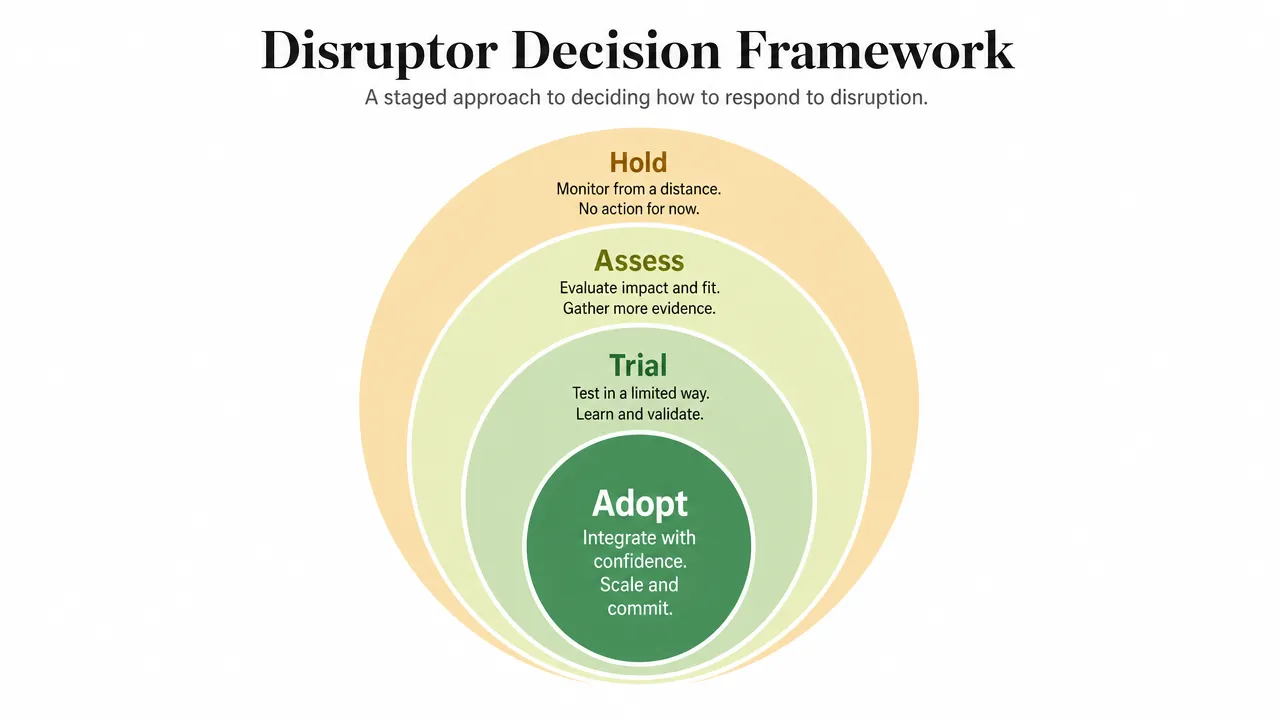
A technology radar maps which practices and tools to adopt, trial, assess, or hold. It is highly operational and often used by engineering, architecture, platform, and product teams.
Use this lens when you need to:
- Reduce architectural drift across teams.
- Align experimentation with platform standards.
- Make faster, transparent adoption decisions.
Trend Radar
A trend radar maps external change vectors (social, technological, economic, environmental, political) and converts them into strategic scenarios.
Use this lens when you need to:
- Improve horizon scanning.
- Translate macro shifts into concrete strategic implications.
- Avoid reacting too late to regulatory, societal, or ecosystem change.
Bottom line: Innovation Radar tells you where to innovate, Technology Radar tells you how to build, and Trend Radar tells you what external forces are coming next.
2) Anatomy of a Radar Diagram: Rings, Quadrants, and Blips
Most radar models share three building blocks:
Rings (Action Posture)
A practical ring model is:
- Adopt: proven and recommended for broad use now.
- Trial: promising and ready for controlled implementation.
- Assess: worth researching, prototyping, or monitoring.
- Hold: avoid or de-prioritize due to risk, poor fit, or immaturity.
These rings should represent recommended action, not hype level.
Quadrants (Classification Lens)
Quadrants segment the landscape so discussions stay structured. In technology contexts, this is often techniques, tools, platforms, and languages/frameworks. In enterprise strategy contexts, your quadrants might be market, customer behavior, operating model, and enabling technology.
Blips (Specific Signals)
A blip is one concrete item: a technology, startup pattern, policy shift, customer behavior, business model, or operating practice. Every blip should have:
- clear definition,
- evidence source(s),
- owner,
- decision recommendation,
- next review date.
If a blip lacks an owner or action, it is cataloging — not radar.
3) Technology Radar in Depth (and How to Use It Operationally)
The best-known model is the Thoughtworks-style radar: four quadrants (Techniques, Tools, Platforms, Languages & Frameworks) and four rings (Adopt, Trial, Assess, Hold).
What makes this model useful is not the chart itself. It is the operating discipline around it:
- Timeboxed curation of candidate blips.
- Cross-functional debate to stress-test assumptions.
- Explicit movement (inward/outward ring changes) between editions.
- Narrative rationale for each recommendation.
To run it inside your organization:
- Create a recurring forum (monthly signal triage, quarterly publish).
- Require short evidence notes for each proposed blip.
- Track ring movement history so teams can see learning over time.
- Tie Adopt/Trial decisions to architecture guardrails, procurement choices, and enablement plans.
A common anti-pattern is using a technology radar as a trendy shopping list. A good radar should reduce randomness, not increase it.
4) Innovation Radar: the Four-Dimension Model
Innovation radar models are often associated with work from Kellogg scholars and practitioners who frame innovation beyond product novelty. For practical execution, a four-dimension view works well:
- Offerings: what you sell (products, services, bundles).
- Customers: for whom and how you deliver value.
- Processes: how you operate and create value efficiently.
- Presence: where and through which channels/ecosystems you compete.
This helps teams avoid a classic failure mode: investing in tech upgrades while leaving business model and route-to-market unchanged.
Practical scoring tip: classify each initiative by primary dimension and expected impact horizon:
- H1 (0–12 months): core optimization and near-term growth.
- H2 (1–3 years): adjacencies and capability expansion.
- H3 (3+ years): options and future business models.
If most of your innovation portfolio is H1 + Offerings, your radar is under-diversified.
5) Trend Radar: STEEP, Macro vs Micro Signals, and Horizon Scanning
Trend radar work starts with environmental scanning. A common frame is STEEP:
- Social
- Technological
- Economic
- Environmental
- Political
Macro vs Micro Signals
- Macro trends are structural shifts (demographics, regulation, labor patterns, energy transitions).
- Micro signals are early indicators (niche user behaviors, startup activity spikes, unusual procurement patterns, pilot policy changes).
You need both. Macro signals provide direction; micro signals provide timing clues.
Horizon Scanning Cadence
Use a simple three-horizon cadence:
- H1 / Act now: trends already affecting current decisions.
- H2 / Prepare: trends likely to become material within planning cycles.
- H3 / Explore: weak signals that may shape future options.
Trend radar becomes strategic when each signal maps to a decision: monitor, experiment, hedge, invest, or exit.
6) How to Build Your Own Disruption Radar (7 Steps)
Here is a practical process you can run in 6–10 weeks for the first edition.
Step 1: Define Scope
Choose one decision domain first (e.g., digital channels, AI-enabled operations, new growth bets). Define owners, users, and cadence.
Step 2: Define Quadrants
Select four lenses aligned with your decisions. Keep them stable long enough to compare editions.
Step 3: Define Rings
Document ring criteria in plain language. What evidence moves a blip from Assess to Trial? What risks move it to Hold?
Step 4: Gather Blips
Build a signal pipeline from customer interviews, market intelligence, architecture reviews, startup tracking, regulatory watch, and frontline observations.
Step 5: Debate and Calibrate
Run structured calibration sessions. Encourage dissent and require evidence. Log unresolved assumptions.
Step 6: Publish
Share the radar with narrative context: top movements, top uncertainties, and explicit implications by business function.
Step 7: Act
Convert radar outputs into backlog, portfolio, budget, partnership, and capability decisions. If no decisions change, the radar failed.
7) Real-World Radar Programs: What to Learn
Thoughtworks Technology Radar
A mature, recurring publication model showing how disciplined curation and explicit ring recommendations can influence engineering behavior at scale.
Gartner Hype Cycle
Useful for understanding maturity narratives and expectation dynamics. Use it as a context lens, but avoid outsourcing your decisions to generic category curves.
EIT / EU Innovation Radar Initiatives
Helpful examples of public-sector signal aggregation and innovation discovery pipelines. They are especially useful for ecosystem scanning and venture opportunity mapping.
8) Common Failure Modes (and How to Prevent Them)
1) the Museum Piece
Radar gets published once and never updated.
Fix: set a non-negotiable publication cadence and assign permanent ownership.
2) the Consensus Trap
Only “safe” blips survive because conflict is avoided.
Fix: require documented dissent and confidence scoring.
3) Technology Bias
Everything becomes a tools discussion, ignoring customer, channel, regulation, and business model shifts.
Fix: use multi-radar design (innovation + technology + trend) and balanced participation.
4) No Action Bridge
Radar insights do not change budget, roadmap, or governance decisions.
Fix: add an “action ledger” that tracks decisions linked to each high-priority blip.
5) Signal Overload
Too many blips with weak evidence dilute focus.
Fix: set evidence thresholds and a strict cap per quadrant.
9) Getting Started This Quarter
If you are building your first disruption radar, do this:
- Pick one strategic domain and one executive sponsor.
- Launch with 20–40 blips max (not 200).
- Use a quarterly publish cycle with monthly triage.
- Define ring movement rules before your first workshop.
- Track two KPIs:
- Lead time from signal to decision
- % of radar-prioritized decisions executed
After two editions, review whether the radar improved decision speed, portfolio quality, and cross-functional alignment. If yes, scale to more domains. If not, simplify and tighten action linkage.
FAQ
What Is a Disruption Radar in Simple Terms?
A disruption radar is a structured way to detect, classify, and prioritize external and internal change signals so leadership teams can make earlier, better strategic decisions.
What Is the Difference Between Innovation Radar and Technology Radar?
Innovation radar focuses on where value can be created across business dimensions. Technology radar focuses on which technologies and engineering practices to adopt, trial, assess, or hold.
How Often Should a Disruption Radar Be Updated?
A practical cadence is monthly signal triage and quarterly publication. High-velocity domains may need shorter cycles.
How Many Blips Should We Start With?
Most teams should start with 20–40 high-quality blips and strong evidence rather than a large inventory with unclear actionability.
Is Trend Radar Only for Strategy Teams?
No. Trend radar is most effective when strategy, product, engineering, operations, compliance, and commercial teams co-own implications.

Clara @cla_reinholt
Focuses on innovation communication, facilitation, and turning frameworks into team habits.