
Choose the correct definition
Loading…
Read more: Glossary term
20 scored questions built from glossary definitions. Instant feedback with links to learn more.
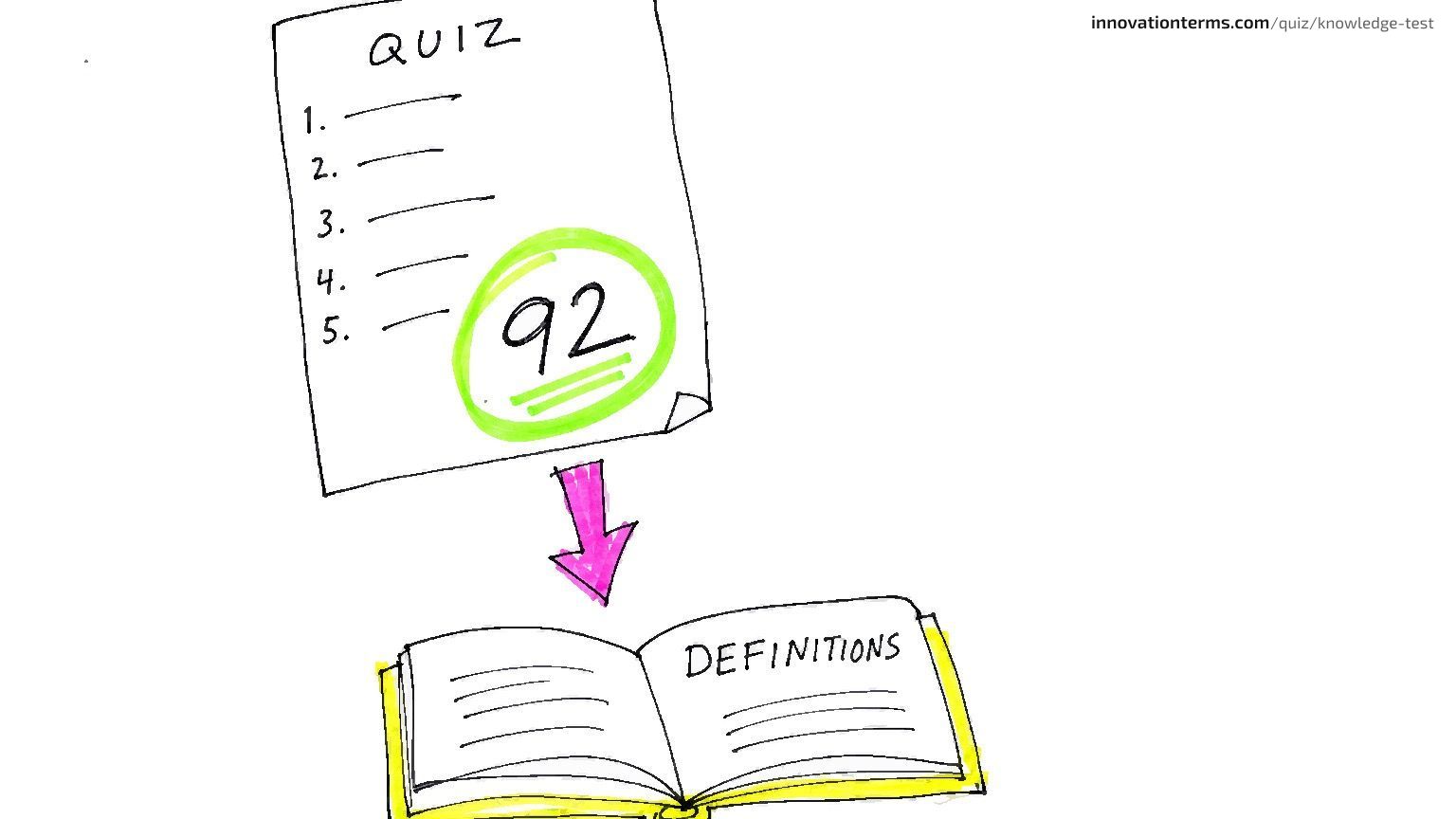
Every wrong answer links straight to the definition that would have made it right, so a fuzzy term becomes a five-minute fix instead of a lingering blind spot.
This innovation knowledge test is a vocabulary quiz for people who already use these words at work. Twenty questions, instant feedback, a score at the end.
Retrieval testing works because of what learning scientists call the testing effect — the finding, established by Karpicke & Roediger (2008), that actively retrieving information from memory improves long-term retention far more than re-reading the same material. Andrew Huberman makes the practical point the same way: use testing to reveal knowledge gaps, then study the gaps.
So read your result as a map. The score is a to-do list, not a grade.
The test draws 20 questions at random from the glossary: foundational terms, named frameworks like design thinking, and the decision patterns innovation teams argue about in real meetings. Each question shows a term and asks you to pick its correct definition from four options.
It leans hardest on the words people use loosely. A word without a fixed definition is a tool anyone can misuse. Disruption is the clearest example. Clayton Christensen watched his own term get stretched past the point of meaning, then spent years clarifying that disruptive innovation has a specific definition, not just "breakthrough product."
Pivot is another term practitioners get wrong. That's definitional drift — the slow erosion of a term's specific meaning through repeated casual misuse — and it's what makes a vocabulary check worth doing. In Lean Startup terms it means a structured change in strategy backed by market validation. Not a synonym for "we changed our mind." Two more the test covers:
The value is in catching the terms you half-remember before a board update does it for you.
Each question is scored the moment you answer. Correct answers add 10 points. Wrong answers subtract 5, so guessing is a losing strategy — the page is built to push you toward reading. Over 20 questions the score runs from −100 to a maximum of 200.
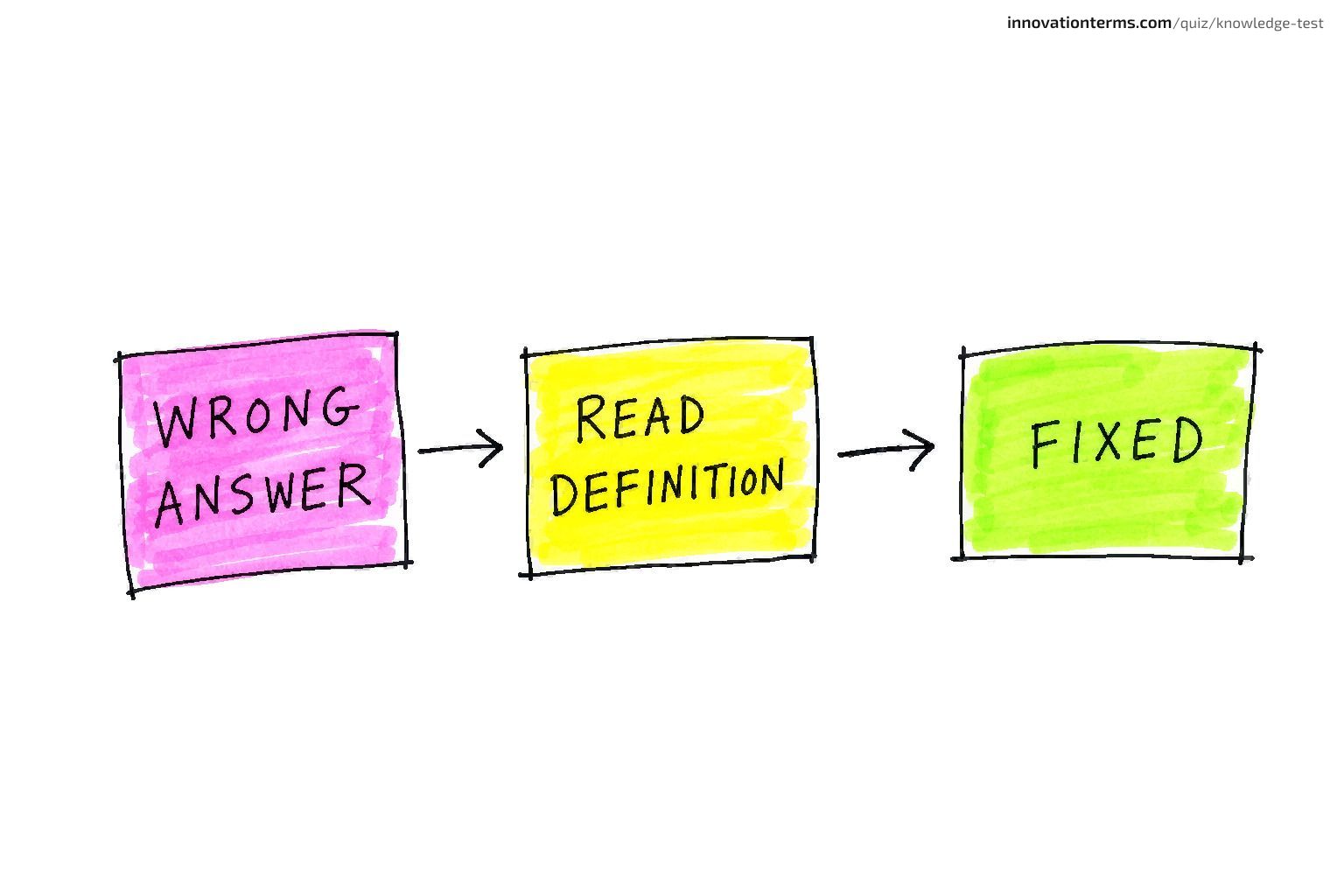
The feedback is immediate, and it's the part that matters. When you miss a question, the answer exposes a Read more link straight to the glossary definition behind it. That's the loop the whole page is built around: wrong answer, linked definition, five-minute fix.
Retake it as often as you like. Each run pulls a fresh question set, making it a natural before-and-after check around a learning sprint. Take it Monday, read what you missed, take it Friday.
Treat the first run as a baseline you can beat.
A low score flags the specific terms you've been using loosely. The number is not a verdict. Here's how to read it instead of just feeling it.
| Score | Roughly | What it usually means | What to do next |
|---|---|---|---|
| Below 50 | Under half right | You're guessing on core terms, or you've absorbed the popular misuse of words like disruption and pivot. | Read the linked definition after every miss before you leave the page. |
| 50–125 | ~10–15 right | Solid on the basics, fuzzy on the contested ones. The terms you missed are likely the ones people argue about. | Browse the full question bank and focus on the categories you slipped in. |
| 140+ | 16+ right | Your usage matches how the field actually defines these terms. You can run a meeting without quietly redefining words. | Use the test to spot-check your team rather than yourself. |
Thresholds based on the +10/−5 per-question scoring system across 20 questions.
It's a check on whether you use innovation terms the way this glossary defines them.
Most online innovation quizzes are trivia theater. The only score worth having is the one that tells you which definitions to go read next. Search for an innovation management quiz or a way to test your innovation knowledge online, and you'll mostly find IQ-style novelty rounds. InnoLead's quiz asks about famous failures and Silicon Valley lore: whether you know who invented something, not whether you can define disruption correctly. That's entertainment dressed as diagnosis. Entertainment is not the work. The work starts when the fun ends. Three things this test is often mistaken for:
Shared vocabulary is a real constraint on teams. The cost is quiet.
When half the room means three different things by "pivot," decisions get made on a misunderstanding. That is why the test is for learning, not evaluation.
Pair the test with the innovation quiz questions bank and you have a full study loop. The bank holds 56 questions across six domain categories, ungated, each with a plain-English explanation and a glossary link. The test finds the gap. The bank closes it. Two ways to use it:
Study first. Skim the bank before you test if you want to prime your vocabulary, or if a specific topic is coming up at work. Then take the test cold to see what stuck.
Remediate after. When the test surfaces a gap, read the linked definition, then find the related questions in the bank to confirm it landed. The wrong-answer link closes the immediate gap. The bank closes the ones next to it.
For teams, the question bank doubles as a facilitation kit. Run a 10-question round as a workshop warm-up, or open a planning session by surfacing where the group disagrees on a term. The disagreement is usually the useful part.
If you want a different kind of self-assessment, the innovator-type quiz maps how you behave at work to an archetype rather than checking definitions. All three live under the quiz index. Use the knowledge test for vocabulary gaps, the innovator-type quiz when the question is about behavior.
Start with the gap the test just handed you. Read one definition before you close the tab.
How well do I actually know innovation terms? The test tells you in about five minutes. You'll see which terms you match to the right definition and which you don't, with a score that maps to a plain-English read of where you stand.
What counts as a good score? No passing threshold. A higher score means your usage matches how the field defines the terms, and a lower one just flags which definitions to re-read.
Is this test hard or academic? No. It's a practical vocabulary check with no academic framing. If you use innovation terms at work, the questions won't surprise you.
What do I do with a question I get wrong? Click the Read more link under the answer. It goes straight to the glossary definition, which takes about five minutes to read. That's the whole point of the test.
How long does it take? Twenty questions, usually under ten minutes. You can retake it with a fresh set of questions whenever you want.
Can I study before I take it, or quiz my team? Yes. The question bank has 56 questions with explanations for studying solo, and the same innovation terms quiz works as a warm-up round for a workshop or team session.