Share
Share  Reddit
  X.com
X.com  Facebook
  Pinterest
  Threads
  Bluesky
  WhatsApp
  Telegram
  Messenger
  Email
Email How to Run a Five-Day Design Sprint

Learn how to run a five-day design sprint with clear roles, day-by-day structure, decision rules, and corporate failure-proofing tips.
You can spend three months debating a product direction and still leave with weak evidence. A well-run design sprint gives you a different path: one week, one concrete challenge, one realistic prototype, and direct user feedback before you commit major budget.
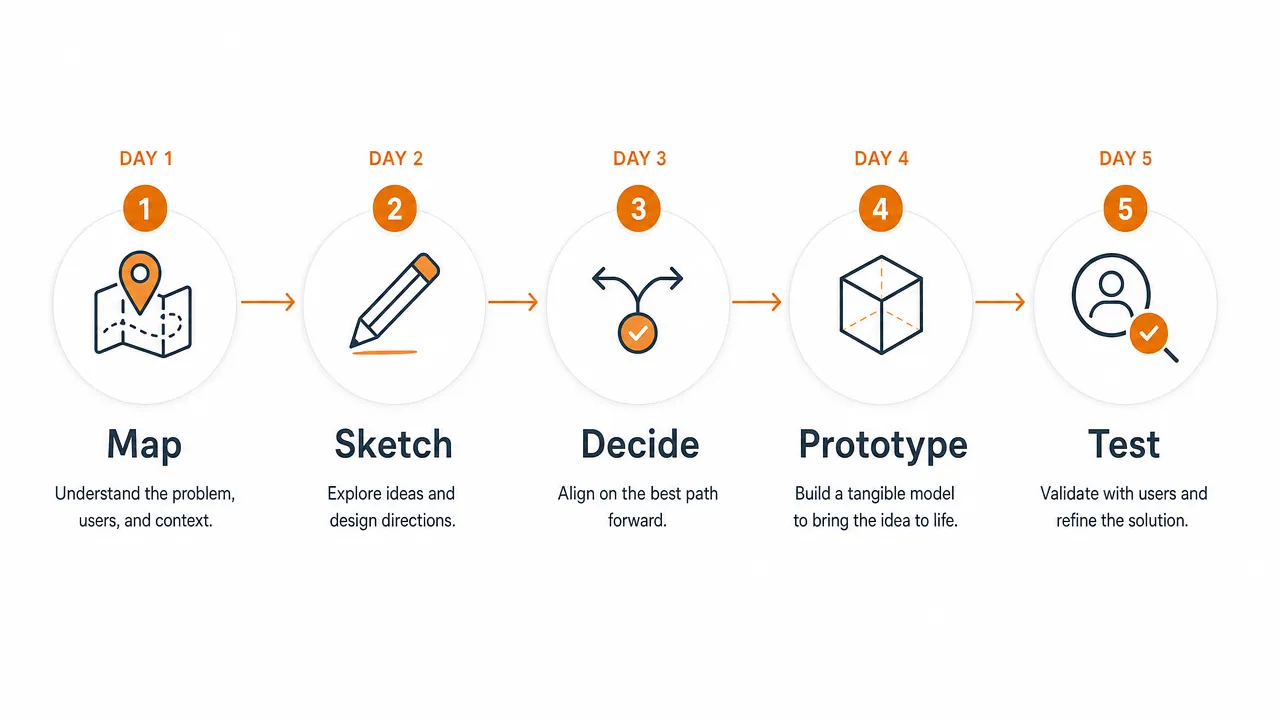
This guide shows you how to run a complete five-day sprint in a way that works in real organizations, not only in startup case studies. You will get a day-by-day operating model (Map → Sketch → Decide → Prototype → Test), practical setup instructions, facilitation rules, and specific fixes for where sprints usually break down in corporate environments.
TL;DR
- Use a sprint when the decision is high stakes, cross-functional, and still uncertain; do not use it for routine backlog grooming.
- Protect the five-day sequence: map the problem, generate options, choose one direction, build one realistic prototype, and test with target users.
- Assign clear roles before day 1, especially one Decider and one facilitator with authority to keep the process on track.
- Make decisions with explicit rules (silent voting, structured critique, tie-break authority), not with open-ended debate.
- Most failed sprints are preparation failures: broad challenge scope, wrong participants, weak user recruitment, or no post-sprint ownership.
When a Design Sprint Is the Right Tool
A design sprint is not a general workshop format. It is a decision acceleration method for situations where uncertainty is high and misalignment is expensive.
Use a sprint when:
- You need to choose between competing product directions.
- You are entering a new user segment and assumptions are untested.
- A strategic initiative is blocked by unresolved UX, service, or value proposition questions.
- Leadership wants confidence before investing in engineering-heavy delivery.
Do not run a sprint when:
- The core problem is already clear and your team simply needs execution capacity.
- The topic is too broad to test in one week (for example, “reinvent customer experience globally”).
- Decision-makers cannot attend or commit to outcomes.
- You cannot recruit suitable users for Friday testing.
A sprint is a focused decision instrument. If you treat it as a team-building exercise, you will get nice artifacts and weak decisions.
The Foundations You Must Lock Before Day 1
The fastest way to waste a sprint is to start facilitation before preparation is done. You should treat sprint prep as project work, not as admin.
1) Define One Sprint Challenge Statement
Write one sentence that sets clear boundaries:
“How might we help [specific user type] achieve [specific outcome] during [specific moment], without [critical constraint]?”
Good challenge statements are narrow enough to prototype and test in five days. If your statement has “platform,” “ecosystem,” or “transformation” language, it is probably too broad.
2) Choose the Right Sprint Team
A practical sprint team is usually 6–8 people:
- Facilitator: Runs time, method, and group energy; protects process integrity.
- Decider: Makes final calls when votes are close or conflict persists.
- Product lead: Owns business framing and follow-through.
- Designer: Translates ideas into concrete user flows and interfaces.
- Engineer or technical lead: Keeps feasibility grounded.
- Customer or market expert: Brings evidence about user behavior and segment dynamics.
- Operations/compliance representative (as needed): Flags real implementation constraints early.
If your CEO attends, assign a clear role upfront. Unframed executive participation is a common source of silent group bias.
3) Set Decision-Making Rules in Writing
Before Monday, define rules and share them with all participants:
- Discussion starts after individual thinking, not before.
- Everyone can critique; only the Decider breaks ties.
- Voting methods are explicit (dot votes, supervote, or forced ranking).
- Timeboxes are hard boundaries.
- “Parking lot” topics move out of the sprint room.
Decision rules reduce politics because participants know how choices will be made.
4) Recruit Friday Test Participants Early
You should recruit at least five users in your target segment before the sprint starts. That standard comes from the original GV sprint practice and remains useful because pattern-level signals often emerge within five interviews when the segment is tightly defined.
Recruitment checklist:
- Target profile matches the actual customer or user context.
- Interviews are scheduled before day 1, with backups.
- Incentives and consent are prepared.
- Moderator script is drafted and reviewed on Thursday.
If recruitment is uncertain by Monday, postpone the sprint. Running Friday tests with convenience participants is one of the most expensive self-inflicted errors in sprint work.
5) Prepare the Room (or Virtual Equivalent)
The sprint room should make shared thinking visible:
- One large wall for map, notes, and voting outputs.
- Separate space for sketching and quiet work.
- Timer always visible.
- Materials ready: sticky notes, markers, dots, templates.
For remote or hybrid sprints, create a digital board with distinct zones for each day and keep camera norms explicit. Virtual sprints fail when tool friction replaces facilitation.
The Five-Day Design Sprint Framework
The classic sequence Map → Sketch → Decide → Prototype → Test is still the most reliable structure because each day produces a specific decision artifact.
Day 1 (Map): Align on Problem, User, and Target Moment
Your goal on Monday is not solution design. Your goal is shared problem framing.
Outputs You Need by End of Day
- Long-term sprint goal
- Sprint questions (major unknowns)
- User journey or service map
- Chosen target moment to prototype
Suggested Flow
- Set the long-term goal: Ask what success looks like six to twelve months from now.
- Capture expert input: Short talks from product, customer, technical, and operational experts.
- Map the user journey: Keep at the right level; avoid premature UI detail.
- List sprint questions: Convert assumptions into testable unknowns.
- Choose a target: Decider selects one moment in the journey for this sprint.
Corporate Failure Mode to Avoid
Many enterprise teams spend Monday in presentation mode. You need synthesis, not slide reviews. Cap expert talks and convert every input into a visible assumption or decision.
Day 2 (Sketch): Generate Strong Options Without Groupthink
Tuesday works because it prioritizes individual ideation before social influence. The point is option quality, not team harmony.
Outputs You Need by End of Day
- Set of concrete solution sketches
- Each sketch understandable without verbal pitch
Suggested Flow
- Lightning demos: Quick examples from adjacent products or patterns worth borrowing.
- Notes and idea extraction: Individuals collect useful moves.
- Crazy 8s or equivalent divergence exercise: Fast variation to push beyond first ideas.
- Solution sketch: Detailed, self-explanatory storyboard of one concept.
Sketch Quality Standard
A good sketch is specific enough that someone else can prototype it without interpretation. A weak sketch is conceptual language with no interaction logic.
Corporate Failure Mode to Avoid
Senior voices can distort Tuesday if ideation becomes performative. Keep sketching silent and individual for most of the day. This single rule improves concept diversity more than any facilitation trick.
Day 3 (Decide): Select One Testable Direction
Wednesday is where discipline matters most. You are not selecting “the best idea in theory.” You are selecting the idea most worth testing now.
Outputs You Need by End of Day
- Chosen concept (or tightly combined concept)
- End-to-end storyboard for prototype
- Clear rationale linked to sprint questions
Suggested Decision Sequence
- Gallery review: Display sketches anonymously.
- Heat-map voting: Participants mark strong elements.
- Structured critique: Brief discussion on strengths, risks, and assumptions.
- Straw poll or ranking: Surface preference patterns.
- Decider call: Final choice when needed.
- Storyboard build: Create a detailed prototype script.
Decision Rules That Work in Political Environments
- Evaluate concepts against sprint questions, not hierarchy.
- Force trade-offs: if two directions conflict, pick one for this sprint.
- Timebox discussion and convert disagreement into testable hypotheses.
Corporate Failure Mode to Avoid
Teams often keep multiple directions “alive” to avoid conflict. That usually produces diluted prototypes and ambiguous Friday results. You should protect focus even when it feels uncomfortable.
Day 4 (Prototype): Build a Realistic Facade Fast
Thursday is about learning speed, not production quality. You are building enough realism to trigger authentic user reactions.
Outputs You Need by End of Day
- Test-ready prototype
- Interview script and task flow
- Observation framework for note-taking
Prototype Principles
- Prototype only what you need to answer sprint questions.
- Prioritize believable surface and coherent flow.
- Fake backend complexity when necessary.
- Assign clear build roles (maker, writer, asset collector, stitcher, reviewer).
Typical Prototype Stack
Depending on the challenge, you can use clickable UI tools, service scripts, slide-based interactions, or lightweight coded flows. The tool matters less than realism in the target interaction moment.
Corporate Failure Mode to Avoid
Perfectionism kills Thursday. If your team treats the prototype as a launch candidate, you will ship polish instead of learning. Keep repeating: this is an experiment artifact.
Day 5 (Test): Validate Assumptions With Real Users
Friday is the evidence day. If done well, it reduces strategic debate because the team sees user behavior directly.
Outputs You Need by End of Day
- Interview notes organized by sprint question
- Pattern summary across participants
- Decision on next step: continue, revise, or stop
Interview Structure
- 45–60 minute moderated sessions
- Consistent script across participants
- Observers capture evidence silently
- Rapid synthesis between interviews
What to Look For
- Points of confusion or trust breakdown
- Moments of high perceived value
- Mismatch between team assumptions and user mental models
- Repeated barriers across multiple participants
Close the Sprint With a Decision
End Friday with a decision memo that includes:
- What you learned
- Which assumptions are now stronger or weaker
- What decision is made now
- Who owns next actions and dates
Without this closure, sprint output becomes “interesting research” that never changes roadmap decisions.
How Corporate Environments Break Design Sprints (and How to Prevent It)
Design sprint methods are simple. Organizational context is not. Most enterprise failures are predictable and preventable.
Breakdown 1: Challenge Is Politically Safe but Strategically Vague
Teams choose broad or generic challenges to avoid conflict. Result: unclear prototype target and weak Friday signal.
Prevention: Force one target user, one target moment, one decision the sprint must inform.
Breakdown 2: the Decider Exists on Paper Only
In some organizations, the nominal Decider cannot actually commit resources or override cross-functional vetoes.
Prevention: Confirm decision authority with the sponsor before day 1. If authority is distributed, define explicit tie-break process in advance.
Breakdown 3: Functional Gatekeepers Arrive Too Late
Legal, security, procurement, or operations concerns appear after the sprint and invalidate outcomes.
Prevention: Include these constraints during Monday expert input and Wednesday decision review. You are not asking for full approval, but you need known boundaries.
Breakdown 4: Friday Insights Are Filtered Through Internal Narratives
Teams reinterpret user feedback to fit preferred directions.
Prevention: Use structured note capture tied to sprint questions. Summarize only repeated patterns, not isolated comments.
Breakdown 5: No Bridge to Delivery System
Sprint teams leave with insight but no integration path into product planning or funding.
Prevention: Schedule the post-sprint decision review before the sprint starts. Include roadmap owners in Friday synthesis.
Named Examples and What You Can Learn From Them
Gv’s Original Sprint Work at Google
The original Design Sprint approach developed at GV focused on reducing startup uncertainty quickly. The practical lesson is not the sticky notes; it is the rigor of sequencing and decision ownership. You can adapt the format, but if you remove clear tie-break authority and Friday evidence capture, you remove the method’s core advantage.
Slack’s Early Product Testing Culture
Slack became known for close feedback loops during early product shaping. The relevant sprint lesson is to test concrete interaction experience early, before engineering scale-up locks direction. You should use sprint prototypes to catch workflow friction and language clarity problems while change is still cheap.
Ideo’s Human-Centered Design Overlap
IDEO’s human-centered design practice reinforces a key sprint principle: useful solutions start with specific user context, not internal assumptions. In sprint terms, that means Monday framing and Friday interviews are not optional process steps; they are the evidence spine of the week.
A Practical Checklist You Can Reuse
Use this checklist to run your next sprint with fewer surprises.
Pre-Sprint Checklist
- Challenge statement is specific and testable.
- Team roles are assigned, including facilitator and Decider.
- Decision rules are shared before day 1.
- Five target users (plus backups) are booked for Friday.
- Sponsor agrees to act on outcomes.
- Room or virtual board is fully prepared.
In-Sprint Checklist
- Monday ends with one target moment.
- Tuesday sketching stays mostly individual.
- Wednesday produces one clear concept and storyboard.
- Thursday prototype is realistic enough to test behavior.
- Friday evidence is synthesized against sprint questions.
Post-Sprint Checklist
- Decision memo completed and shared.
- Owners and deadlines assigned for next actions.
- Open risks documented with mitigation plan.
- Follow-up experiment or delivery plan scheduled.
Internal Definitions to Deepen Your Sprint Practice
If you want to strengthen your sprint execution across teams, these related definitions are useful:
FAQ
Can We Do a Sprint in Two Days?
Yes, but you should treat it as a compressed decision workshop, not a full design sprint. Two-day formats can work for narrower questions, such as choosing between two onboarding flows. You usually lose depth in mapping, concept divergence, and user testing quality. If your decision risk is high, the full five-day sequence is safer.
What If the CEO Is the Decider?
It can work very well if expectations are explicit. You should align the CEO on process rules before day 1: when to contribute, when to hold back, and when to make tie-break calls. Problems start when executive preferences are treated as continuous direction changes instead of bounded decisions.
How Do We Pick the Right Challenge for a Sprint?
Choose a challenge that is important, uncertain, and testable in one week. If the team cannot name a specific target user and target moment, the challenge is still too broad. A useful test is this question: “By Friday, what decision will this evidence let us make?” If you cannot answer, refine scope before scheduling.
What Should Happen After the Sprint Week?
Within one week after testing, convert findings into a delivery or experimentation plan with clear ownership, timeline, and success criteria. Run a sponsor review to confirm resource decisions. Sprints create momentum only when they connect directly to roadmap, funding, and accountability mechanisms.
Final Takeaway
A five-day design sprint works when you treat it as a disciplined decision system, not as a creativity event. If you prepare scope well, protect role clarity, enforce decision rules, and close with accountable next steps, you can replace months of circular debate with one week of focused evidence and faster product direction.
Ravi @ravi_p
Writes about startup ecosystems, growth experiments, and evidence-based product strategy.