 Share
Share  Reddit
  X.com
X.com  Facebook
  Pinterest
  Threads
  Bluesky
  WhatsApp
  Telegram
  Messenger
  Email
Email The Agentic AI Opportunity Innovation Leaders Are Missing
73% of product development teams are not using AI agents. Learn the agent adoption paradox and a three-lever framework for innovation leaders.
Innovation teams exist to spot new technology early, test it fast, and turn it into something the business can use.
So the current data should make you uncomfortable. McKinsey’s 2025 global survey found that 73% of respondents in product and service development said their organizations were not using AI agents in that function. At the same time, MIT Sloan Management Review and BCG reported broad enterprise interest in agentic AI and a growing shift toward treating agents as part of how work gets done.
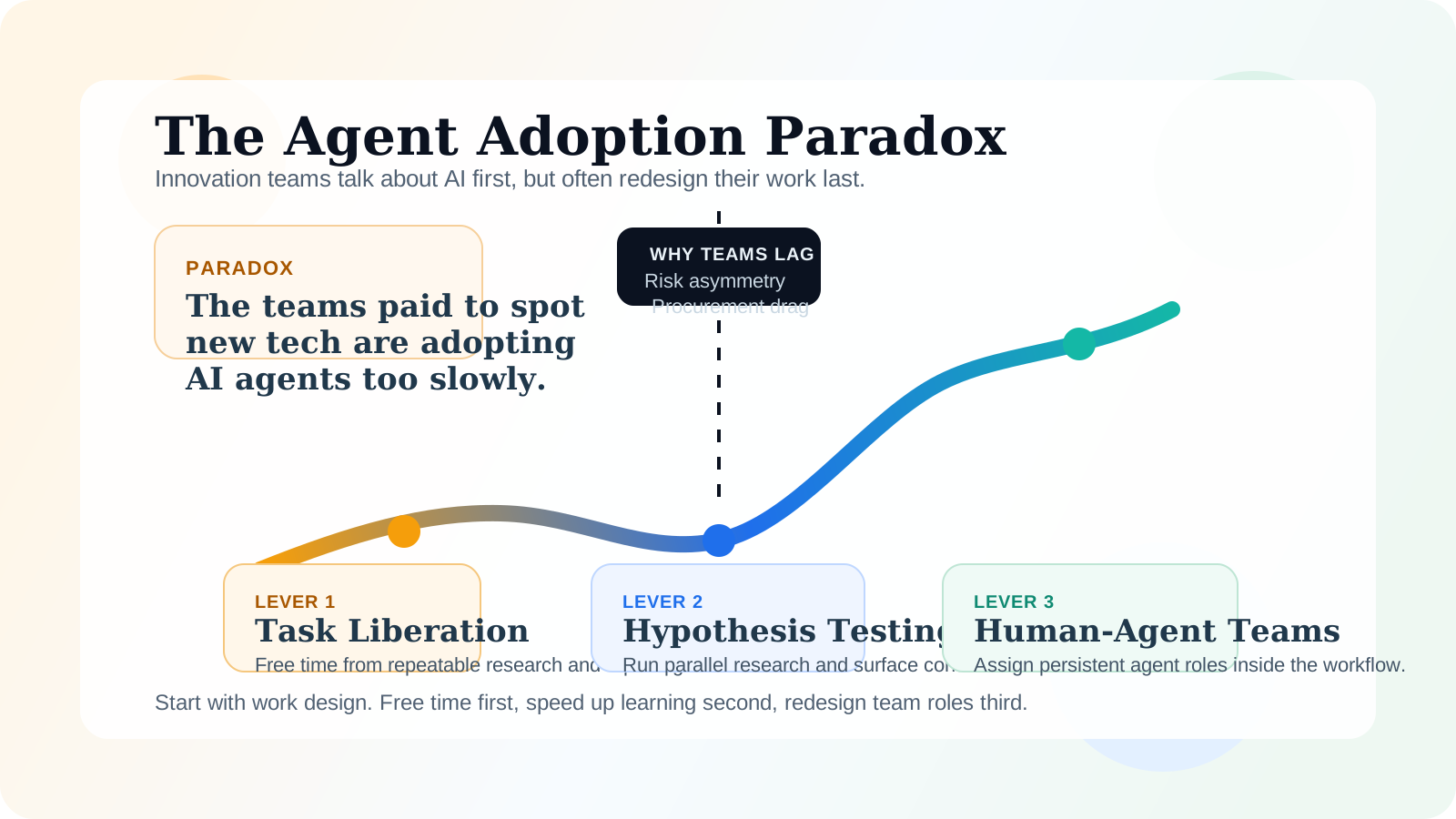
That is the real tension. The teams paid to move first are often adopting last.
This guide calls that pattern the agent adoption paradox. It explains why innovation teams lag, what agentic AI means in practice, and how to close the gap without turning your team into a lab for random AI experiments.
What Agentic AI Actually Means
Agentic AI refers to AI systems that pursue a goal across multiple steps, use tools and external data, and adapt their actions as conditions change without waiting for a human prompt at every step.
That is different from a chatbot or copilot.
- A chatbot responds when you ask a question.
- A copilot suggests the next move while you stay in control.
- An agent keeps working toward an outcome, checks its own progress, and decides what to do next inside defined limits.
Three traits matter most:
- Goal persistence. The system keeps the objective in view across a chain of tasks.
- Tool use. The system can search, retrieve, compare, summarize, and trigger actions in other systems.
- Self-correction. The system changes course when the evidence changes.
If you work in innovation, this matters because your team rarely does one-step work. You gather signals, test assumptions, compare options, and move between messy inputs and a decision. That is exactly the kind of work where agentic AI, artificial intelligence, and intelligent automation start to overlap in useful ways.
The Agent Adoption Paradox
The paradox is simple. Innovation teams are structurally close to new technology, but organizationally far from permission to redesign their own work around it.
Most companies are more comfortable deploying AI agents in functions with cleaner metrics, tighter process boundaries, and clearer operational owners. Service operations, IT, software engineering, and workflow-heavy support functions fit that pattern. Innovation teams usually do not. Their work is exploratory, political, and hard to score in the short term.
That creates three forms of drag.
First, there is risk asymmetry. If an innovation lead changes how discovery work gets done and the result looks weaker, the team owns the failure. If the same lead keeps running a familiar human-heavy process, the cost is hidden inside business as usual.
Second, there is procurement drag. Agentic systems often need access to documents, market data, internal notes, and collaboration tools. That means security review, data approval, and budget conversations. Innovation teams move in sprints. Enterprise access decisions often do not.
Third, there is the pilot trap. Innovation teams are good at small experiments. They are not always good at workflow redesign. McKinsey’s 2025 survey found that high performers were much more likely than others to redesign workflows fundamentally. That is the part many teams skip. They test an agent beside the old process instead of rebuilding the process around what the agent changes.
The result is predictable. IT gets the first serious agent deployments. Operations gets the second wave. Innovation teams keep talking about the future while someone else learns how to work in it.
The Three-Lever Framework
If you want agentic AI to matter inside an innovation team, start with work design, not model demos. The practical path is a three-lever sequence.
Lever 1: Task Liberation
Start with the work your team does every week and nobody should romanticize.
That includes desk research, source collection, first-pass synthesis, meeting recap generation, status reporting, and competitive scan updates. These tasks matter, but they do not require your best people to spend half a day assembling material from five tabs and three docs.
Task liberation does not mean removing judgment. It means handing the repetitive scaffolding to an agent so your team can spend more time framing decisions, challenging assumptions, and choosing what to test next.
This is the lowest-risk starting point because the output is easy to review and the time savings show up fast.
Lever 2: Agent-Assisted Hypothesis Testing
The next lever is more valuable. It is also where many teams hesitate.
Early-stage innovation work depends on hypothesis testing. Is the market large enough. Is the pain real. Are customers solving the problem already. Which adjacent competitors are moving in. What signals matter by geography, industry, or buyer type.
An agent can run several research threads in parallel, compare findings, flag contradictions, and assemble a first recommendation package in hours instead of days. Your team still judges the output. The speed gain comes from compressing the time between question and evidence.
This is where decision intelligence, innovation management, and digital transformation become practical, not abstract. Better inputs make better bets.
Lever 3: Human-Agent Team Structure
The highest-value move is not “use AI more often.” It is defining stable roles for agents inside the team.
Instead of treating AI as an assistant you occasionally ask for help, give persistent agent roles names and responsibilities. One agent handles landscape scans. Another tracks evidence against active hypotheses. A third keeps decision logs and open questions current between meetings.
This is the real operating-model shift. The team stops thinking in terms of tools and starts thinking in terms of contributors. Human leads still own judgment, prioritization, and accountability. Agents own bounded flows of work that benefit from persistence and speed.
Most teams should not start here. They should earn their way here through the first two levers. But this is where the structural gain lives.
Why Sequencing Matters
Teams stall when they jump from curiosity straight to reorganization.
If you skip Task Liberation, your first agent experiments will feel expensive and abstract. If you skip Agent-Assisted Hypothesis Testing, you will struggle to prove that agents improve the actual quality and speed of innovation work. And if you skip both and try to redesign the team immediately, people will hear “headcount story” instead of “better work design.”
The useful order is simple:
- Free time from repetitive work.
- Use that time to improve the speed of learning.
- Redesign roles once the value is visible.
Three Named Examples
1. Operations Before Innovation
This is the usual enterprise sequence. Customer support deploys triage agents. Finance automates reconciliations. IT uses agents for ticket routing and internal support. Product and innovation teams watch from the side.
The lesson is not that operations is more innovative. The lesson is that operational functions usually have cleaner measures, clearer owners, and fewer debates about what “good” looks like. Innovation teams are competing with that simplicity.
2. The Job Satisfaction Signal
MIT Sloan Management Review and BCG reported that employees in organizations with extensive agentic AI adoption were much more likely to say the technology improved job satisfaction.
Innovation leaders should not read that as a soft culture point. The harder read is better. People value having repetitive synthesis and coordination work taken off their plate. Innovation teams carry more of that work than they often admit. The satisfaction lift is a clue about cognitive load, not a side note about morale.
3. The Management-Layer Warning
The same body of research points to a likely shift in how work gets coordinated. If agents take on more of the tracking, routing, and information-shaping work that sat between specialists and leaders, team structure changes with it.
For innovation functions, that does not automatically mean fewer people. It means fewer coordination chores disguised as management work. Leaders who understand that early will redesign roles on purpose. Everyone else will be forced into it later.
Five Things Innovation Leaders Should Do This Quarter
- Run a time audit. Track two weeks of team time before you buy anything. Most innovation groups underestimate how much effort goes into synthesis, admin, and reporting.
- Pick one delayed hypothesis. Choose a market or user question your team keeps postponing because the research feels too slow. Use an agent to run the first pass in parallel with normal work.
- Move security conversations forward. If agent workflows will touch internal material, involve IT and security before the pilot becomes urgent.
- Name roles, not tools. In your next sprint kickoff, define which agent role would own scans, evidence tracking, or recap generation.
- Review workflow design, not only output quality. Ask whether the team changed the process enough to benefit from agents. If not, you are testing a feature, not adoption.
Localization Note for Multilingual Teams
Agentic AI language is still unstable across markets. That matters if your team works across regions or plans localized content.
- In German, teams often use agentische KI or keep the English phrase agentic AI.
- In Spanish, you will see IA agéntica and sometimes sistemas de IA agentes.
- In Portuguese, IA agêntica is emerging, but English phrasing still appears in vendor content.
- In Arabic, many teams explain the concept descriptively rather than relying on one settled term.
Treat the concept as more stable than the label. The shared idea is persistent, autonomous, tool-using AI systems, not a perfectly standardized translation.
FAQ
What is agentic AI?
Agentic AI is AI that works toward a goal across multiple steps instead of answering one prompt at a time. It can use tools, gather information, and adjust its actions as new evidence appears.
How is agentic AI different from a copilot or chatbot?
A chatbot answers. A copilot suggests. An agent continues the task. The key difference is not whether the model sounds smart. It is whether the system initiates the next step on its own inside clear boundaries.
Why are innovation teams slow to adopt AI agents?
Because the barriers are structural. Innovation teams face unclear success metrics, slow approval cycles, and a habit of running pilots without redesigning the workflow around what agents change.
What does an agentic AI system do in an innovation context?
It can scan markets, compare competitors, pull together evidence, track active hypotheses, summarize customer signals, and keep decision logs current. Human team members still decide which evidence matters and what the team should do next.
Closing: The Gap Is Structural, Not Personal
The agent adoption paradox is not proof that innovation leaders lack curiosity. It is proof that curiosity alone is not enough.
Teams close this gap when they redesign how work is structured, not when they add another AI tab to the browser. The practical move is to start small, free time, speed up learning, and then build a human-agent team model around the work that benefits most.
If your team talks about agentic AI every week but still runs discovery the same way it did a year ago, the opportunity is no longer theoretical. It is already passing through another function.
Explore related concepts:
- Agentic AI
- Artificial Intelligence
- Intelligent Automation
- Decision Intelligence
- Innovation Management
- Digital Transformation

Ravi @ravi_p
Writes about startup ecosystems, growth experiments, and evidence-based product strategy.