
Building Absorptive Capacity in the Age of AI: Why More Inbound Knowledge Won't Save You
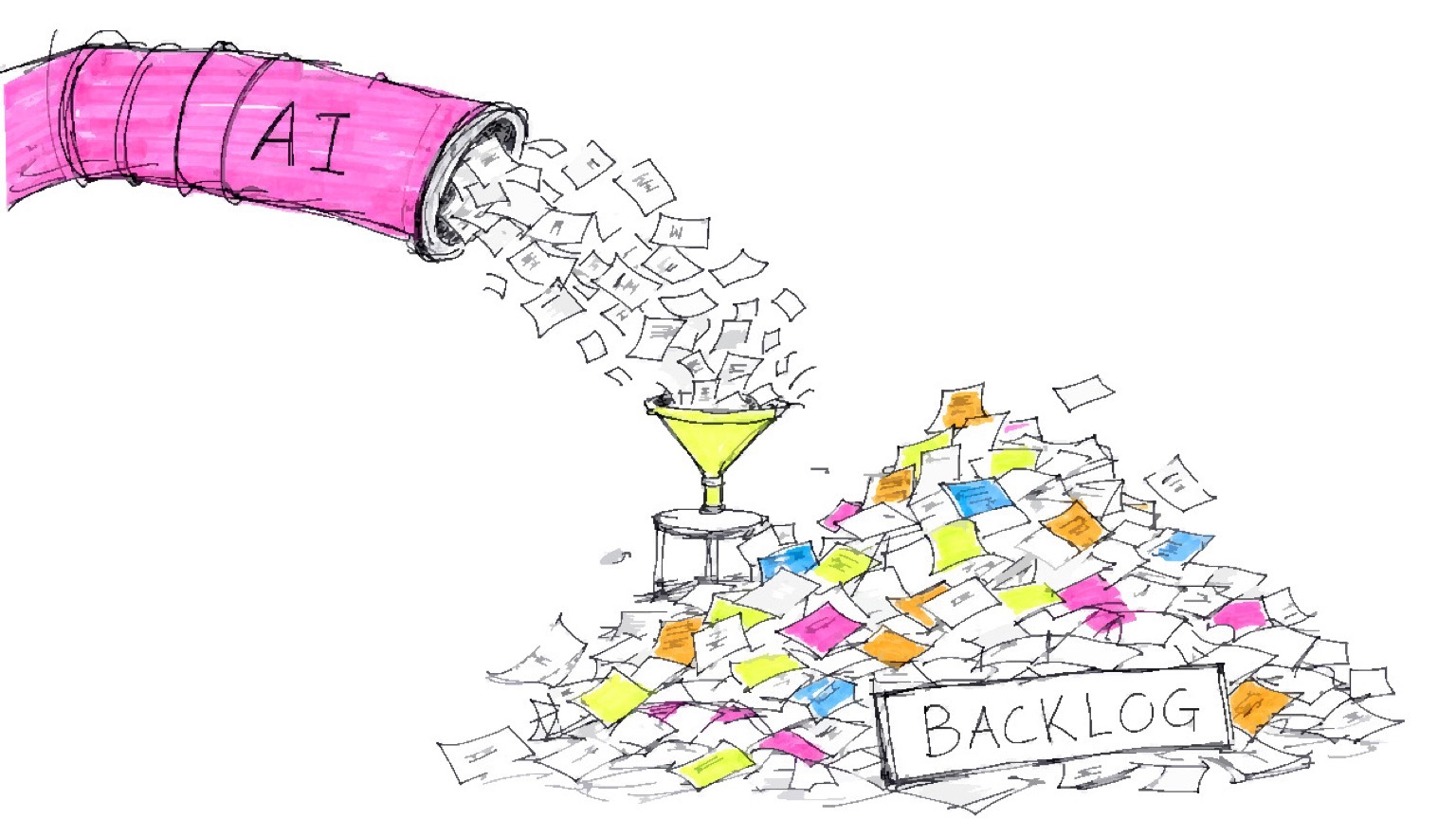
AI multiplies inbound knowledge but not your ability to use it. Build the absorptive capacity that turns the flood into applied ideas, not backlog.
Your innovation team has more inputs than it has ever had. AI scouting tools surface ten times the patents, papers, startup launches, and competitor moves they saw two years ago. Applied ideas, the ones that reach a budget and a launch date, have not moved. That gap is the whole story.
The short version: building absorptive capacity in the age of AI is now the binding constraint on innovation, because AI made external knowledge almost free to acquire and changed nothing about your ability to use it. By 2026, organizational AI adoption reached 88%, according to Stanford's 2026 AI Index, with generative AI reaching population-level adoption "faster than the PC or the internet." Yet, per McKinsey's State of AI 2025 survey, "nearly two-thirds have not yet begun scaling AI across the enterprise," and only 39% of firms reported any EBIT impact. Sourcing knowledge is solved. Receiving it is not.
This guide is for heads of innovation, R&D and strategy leaders, and anyone running an open-innovation or scouting program who is adding AI tooling and watching the backlog grow instead of the pipeline. It explains why the gap widens, then walks through how to build the human and organizational "receiver" that converts inbound knowledge into decisions. AI belongs in that receiver. It cannot be the receiver.
Why does more AI-sourced knowledge produce the same number of applied ideas?
The bottleneck was never knowledge supply. What scales when you add AI is the inflow. What does not scale (what has never scaled automatically) is the organization's ability to recognize what matters in it, connect it to what they already know, and move it toward a decision. The inflow going up does not move that needle.
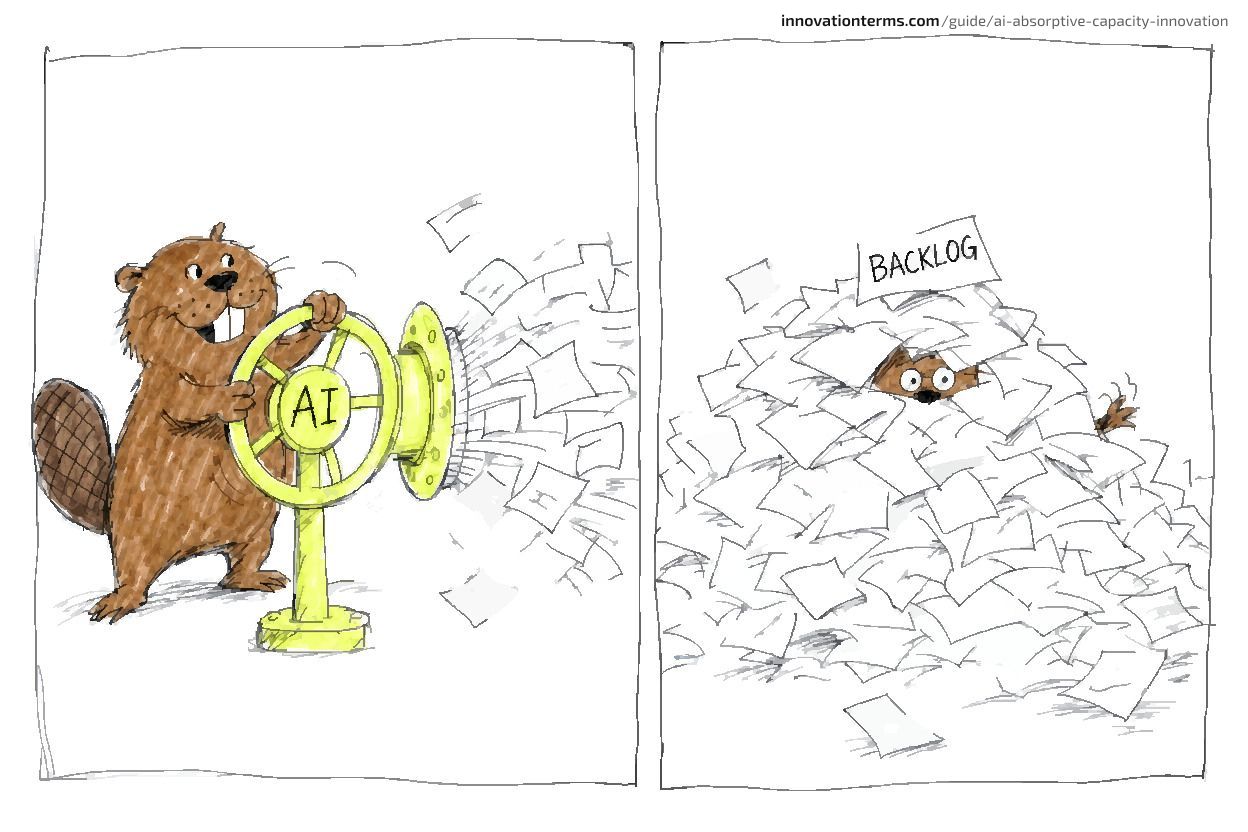
Henry Chesbrough, who coined the term open innovation, made the point years before generative AI existed: outsourcing without collaborative integration produces fewer value-added products. AI supercharges the outsourcing half. A scouting tool that once returned a curated shortlist now returns a firehose. Most of what innovation teams surface gets tabled. The bucket was already overflowing. StartUs Insights documents teams "drowning in patents, papers, startup launches, and shifting competitor moves" before AI tools entered the picture and began generating still more signals for those same teams to process.
The cost is measurable. A 2025 study of 1,150 U.S. workers by BetterUp Labs and Stanford's Social Media Lab found that 41% had received "workslop" in the prior month, plausible-looking AI output that creates downstream work rather than removing it, at a cost the authors put above $9 million a year in lost productivity for a 10,000-employee company. Separately, "95% of organizations see no measurable return on their investment in these technologies." More inbound volume is not a neutral input. Past a threshold it is a tax.
AI is churning out content, drafts, and good-looking slop faster than organizations can process it. That mismatch is widening into a real gap between what AI can produce and what organizations can realistically metabolize. — Rebecca Hinds, Work AI Institute / Glean (2026)
"Metabolize" is the right verb, and it is a near-exact restatement of absorptive capacity from a vendor that sells AI tools. Metabolizing the volume was always the hard part. Producing it was never the constraint. That capacity is what the rest of this guide is about, and why a strong open-innovation program depends on it.
What is absorptive capacity, briefly?
Absorptive capacity is an organization's ability to recognize the value of new external knowledge, assimilate it, and apply it to commercial ends. Prior related knowledge is the gate: you can only absorb what you are already equipped to understand.
The term comes from a 1990 paper by Wesley Cohen and Daniel Levinthal that has been cited more than 34,000 times. They defined it as a firm's ability to "recognize the value of new, external information" and "apply it to commercial ends," a capability they called "critical to its innovative capabilities." The non-obvious part is the gate. A pharmaceutical lab can absorb a new assay technique because it already employs people who understand assays. The same technique is invisible to a firm with no prior knowledge to attach it to. Knowledge does not transfer into a vacuum. It binds to what is already there.
The absorptive-capacity definition page covers the history, the measurement debates, and the evergreen potential-versus-realized argument in depth. What matters here is the AI-era consequence of one specific feature of the construct, which the next section sets up: the split between the half of absorptive capacity AI makes cheap and the half it leaves untouched.
What is the difference between potential and realized absorptive capacity, and why does AI break the split?
Potential absorptive capacity is acquiring and assimilating external knowledge. Realized absorptive capacity is transforming and exploiting it into products and decisions. AI slashes the cost of the first pair and barely touches the second, so the ratio between them collapses.
In 2002, Shaker Zahra and Gerard George split the construct in two, and that split is what makes the AI problem legible. They distinguished "potential absorptive capacity (knowledge acquisition and assimilation)" from "realized absorptive capacity (knowledge transformation and exploitation)," and named an "efficiency factor" that "explains why some firms are less efficient than others in leveraging their absorptive capacity." The efficiency factor is the ratio of realized to potential capacity. It is the share of what you take in that you actually convert.
| Dimension | Half | What AI does to it | Cost trend |
|---|---|---|---|
| Acquire | Potential | Scouts, retrieves, and surfaces external knowledge at scale | Collapsing |
| Assimilate | Potential | Summarizes, clusters, and tags inbound material | Collapsing |
| Transform | Realized | Recombining with internal know-how; barely moved by tooling | Roughly flat |
| Exploit | Realized | Turning recombined knowledge into shipped products and decisions | Roughly flat |
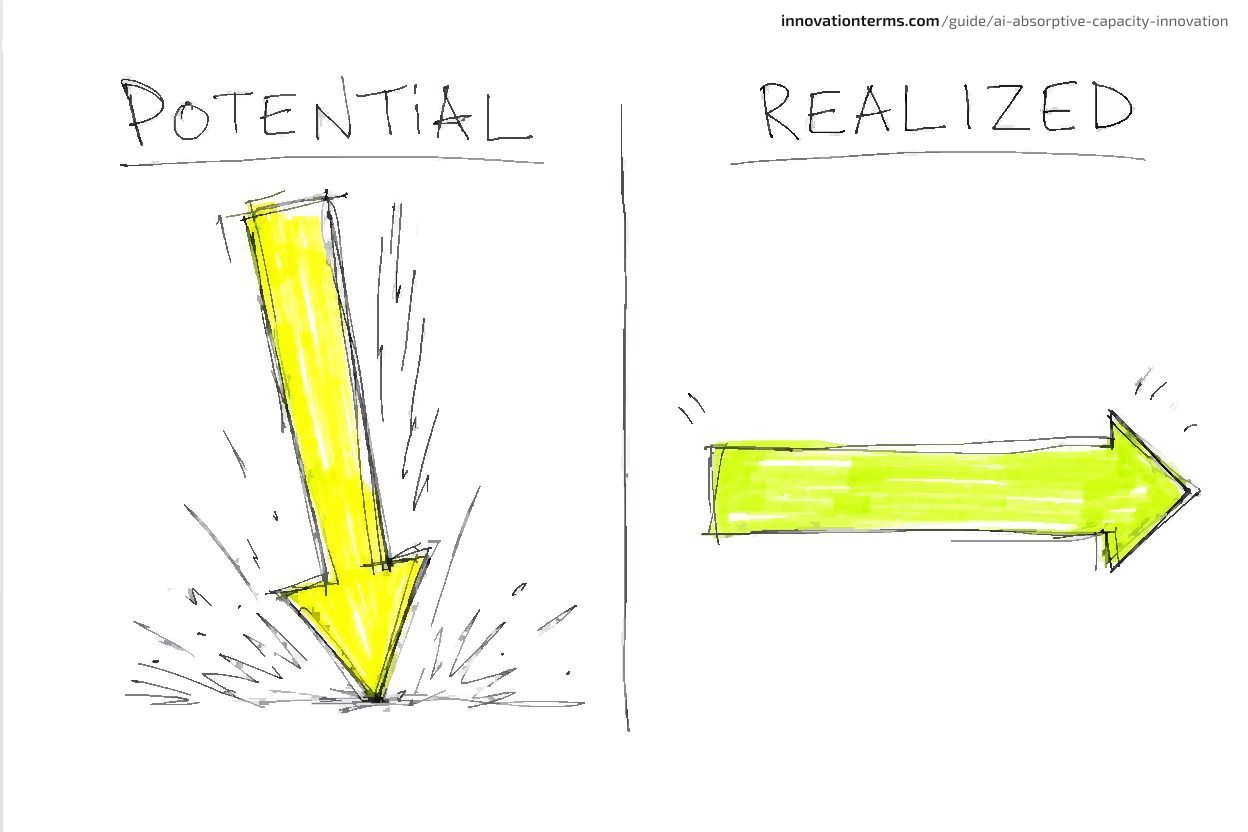
AI is a potential-capacity machine, it collapses the cost of the two stages where the construct was never the binding constraint, and does almost nothing to the two stages where it always was. The realized half stays gated by prior knowledge, by cross-functional routines, by tacit integration that does not live in a training corpus. The efficiency factor (the ratio of realized to potential) falls. Buying AI to process more external knowledge makes innovation worse, not better, until you have rebuilt the human receiver AI can only amplify.
Pedota's 2024 paper develops the conceptual argument.
The rapid emergence of artificial intelligence (AI), which bypasses the gap between data and knowledge, challenges the conception of absorptive capacity as we know it. — Mattia Pedota, SSRN (2024)
Vendors make the operational version: Glean's CEO says its assistant "takes action across tools like Salesforce, Jira, GitHub." If AI does the transform and exploit steps, the realized half moves too.
The boundary they tend not to name is what happens when it does not. A 2025 systematic review of 80 studies found AI's "potential for driving sustained competitive advantage remains contingent on firms' absorptive capacity." That review establishes correlation, not mechanism, but the distinction doesn't change what you should do next: until someone shows AI's payoff arriving independent of absorptive capacity, the safe assumption is that it doesn't. In the meantime, an agent that updates Salesforce faster still routes its output into the same human pipeline. The speed of the tool does not change the throughput of the receiver.
What do people get wrong about AI and absorptive capacity?
Three beliefs do the most damage: that R&D spend measures absorptive capacity, that AI can be the receiver, and that more open-innovation channels always help. Each one quietly widens the conversion gap while looking like progress.
"R&D spending is a proxy for absorptive capacity." The reality: it measures input rather than conversion. A 2006 review of 289 absorptive-capacity papers warned that the field had quietly collapsed the construct onto crude proxies. The authors concluded that five critical assumptions had "led to its reification," reification being the error of treating a living process as a static thing you can buy. R&D intensity tells you what a firm pours in. It says nothing about what comes out the other side. The full measurement argument lives on the absorptive-capacity definition page. The practical takeaway is that a bigger AI budget is the same category error in new clothing.
"AI is the receiver." The reality: AI moves the half that was never the problem. The cleanest evidence comes from a 2025 survey of 290 Chinese manufacturing firms. AI lifted both explicit and tacit knowledge sharing. Absorptive capacity, however, only strengthened the tacit-to-innovation path. The transform and exploit work still ran through people. Buying an agent that "takes action" upgrades acquisition and assimilation, the cheap half, and leaves the gated half where it was.
"More open-innovation channels always help." The reality: returns invert past a point. Adding another inbound channel is the easiest action AI makes available, and section six shows why doing it past a threshold reduces innovative performance rather than increasing it. Absorptive capacity is a staffed, instrumented function rather than a culture slogan or a procurement line. A common habit of widening "absorptive capacity" into generic "innovation capacity" hides exactly this, by making the receiver sound like an attitude rather than an operating system you have to build.
What are the four dimensions: acquire, assimilate, transform, exploit?
The four dimensions are the stages knowledge passes through inside a firm. Acquire and assimilate are potential capacity, the intake. Transform and exploit are realized capacity, the conversion. AI is strong on the first two and weak on the last two, which is the entire argument in miniature.
A 2025 multiple-case study of AI startups traced how firms run these mechanisms in practice, embedding in the market during acquisition and engineering for serendipity during assimilation.
Acquire: finding and bringing in external knowledge
This is scouting, monitoring, partnerships, hiring, and literature review. A medtech firm running a standing patent watch and conference-attendance program is acquiring. AI is overwhelmingly strong here. It is the one stage where "ten times the inputs" is literally true, and the stage that has lulled leaders into thinking the whole construct got cheaper.
Assimilate: interpreting and connecting it to what you know
Assimilation is routing, summarizing, and tagging so a new input attaches to existing understanding. A research librarian who clusters incoming papers by internal project is assimilating. AI helps here too, drafting summaries and surfacing connections, though its summaries are exactly the "good-looking slop" that needs human verification before it counts as understood.
Transform: recombining external and internal knowledge into something new
Transformation is the cross-functional act of fusing an outside idea with proprietary know-how. A cross-functional review where engineers, regulatory staff, and a product lead reshape an acquired technique into a roadmap item is transformation. AI does not do this. It has no access to the tacit, political, and contextual knowledge the recombination requires.
Exploit: turning the recombination into products, processes, and revenue
Exploitation is shipping: the budget decision, the line on the roadmap, the launched feature. A stage-gate review that kills three concepts and funds one is exploitation. This is where ideas die in low-capacity firms, and where AI's contribution is thinnest. Greg Smith, a former Google, Microsoft, and Amazon product executive, put it bluntly: ideas are abundant and "the problem is execution."
Why does AI raise the noise floor faster than it raises capacity?
AI cuts the marginal cost of opening one more inbound channel to nearly zero, and openness has a known ceiling. Past an optimal breadth, searching more widely reduces innovative performance instead of increasing it. AI gets you to that ceiling faster and then carries you past it.
The empirical anchor is Keld Laursen and Ammon Salter's study of external search. Their 2006 study of roughly 2,700 UK manufacturers found that searching widely is curvilinearly related to performance, an inverted U.
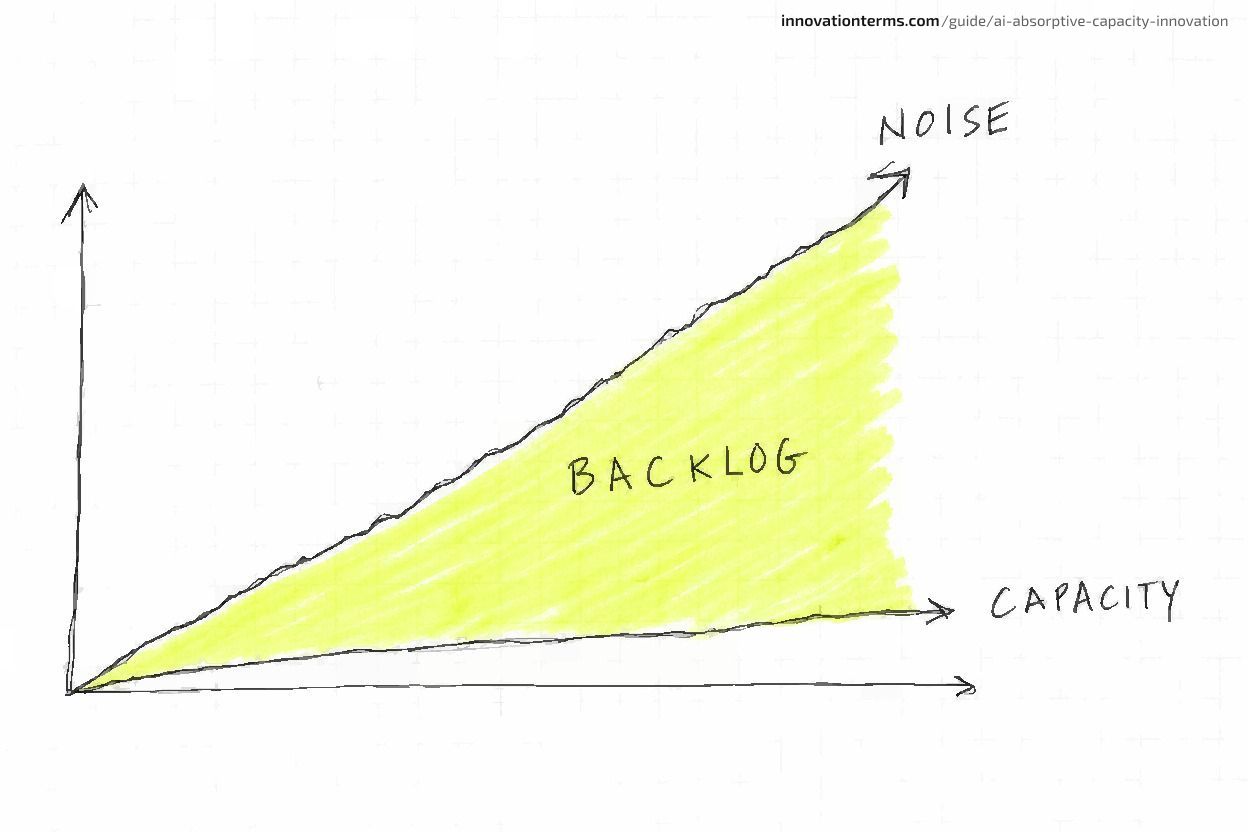
Before AI, cost was the brake. Monitoring another domain meant another analyst, another subscription, another standing meeting. Budgets held firms near the productive part of the curve not by design but by accident, the constraint enforced the right behavior without anyone naming it as such. AI lifted the constraint without moving the curve. Adding a scouting domain is now a prompt. Teams sail past the peak without noticing because the signal that used to fire (rising cost) no longer does.
The noise floor rises with breadth. InnovationCast captures the failure crisply: software that surfaces every possible insight "overwhelms participants and becomes nothing more than noise." Once the signal-to-noise ratio drops below what your assimilation stage can handle, additional sources do not add options. They bury the good ones. This is why "we added three more AI feeds" so often precedes "our hit rate dropped." The same dynamic underlies the case for continuous foresight as a disciplined practice rather than a volume contest. The fix is not more channels. It is matching channel breadth to the receiver's throughput.
What part of absorptive capacity can AI not absorb for you?
Tacit knowledge: the context-bound, hard-to-codify know-how that the transform and exploit stages run on. AI absorbs explicit, written knowledge well. The part where innovation value concentrates stays human, which is why the receiver stays load-bearing.
The distinction is Michael Polanyi's, and the science-of-science researcher Lingfei Wu framed it directly in a 2021 seminar, quoting Polanyi's maxim that "we know more than we can say." Some knowledge cannot be moved around because it was never written down and often cannot be, what knowledge-transfer research calls "stickiness": knowledge that resists distribution no matter how much budget or willingness you throw at it. It lives in a senior engineer's judgment, a team's worked-out shorthand, a customer-facing rep's feel for objections. Ethan Mollick's research points the same way: AI works best as a collaborative teammate rather than a replacement, which only holds if there is a capable teammate on the human side to collaborate with.
| Knowledge type | What AI does well | What still requires the human receiver |
|---|---|---|
| Explicit / documented | Retrieves, summarizes, translates, cross-references | Verifying it is correct and relevant, never merely plausible |
| Tacit / experiential | Almost nothing; it is not in the training data | Mentorship, secondment, side-by-side work |
The strongest single empirical line behind the thesis renders as the section's prime quote.
AI facilitates both types of knowledge sharing, yet only the link between tacit knowledge sharing and innovation is significantly strengthened by higher absorptive capacity. — Lin & Wu, IEEE Transactions on Engineering Management (2025)
AI helped move both explicit and tacit knowledge. But the path that actually strengthened innovation, the tacit one, only paid off through absorptive capacity, a human property. A firm with weak tacit-integration routines gets the AI assist on the half that does not convert and misses it on the half that does. HBR's Matthias Holweg and Thomas Davenport warn of the organizational version: a "decay in the accuracy and quality of organizational knowledge," the company-level form of workslop.
By the numbers: what does the research say about AI and absorptive capacity?
The evidence converges on one finding: absorptive capacity, rather than AI, is the variable that determines whether AI produces innovation. Each study and survey below lists its sample and one-line implication.
- 88% organizational AI adoption, per the Stanford HAI 2026 AI Index — acquiring AI is near-universal; it is not a differentiator.
- 39% of firms report any EBIT impact, per McKinsey's State of AI 2025 survey — the realization gap is the absorptive-capacity gap.
- ~6% qualify as "AI high performers", in the same McKinsey survey — conversion, not adoption, separates the field.
- AC-to-innovation effect ~2× larger in the smartphone era than pre-internet, per Stettler et al. (JPIM, 2025) — digital tooling amplifies AC where it exists.
- 41% of workers received "workslop" monthly, per the HBR / BetterUp & Stanford 2025 study — volume without capacity is a net cost.
Spanning 145 studies and 434,985 firms, the Stettler meta-analysis cuts across the thesis from both directions.
The effects of absorptive capacity on innovation are almost twice larger in the smartphone era as they were during the preinternet or early internet era. — Stettler et al., Journal of Product Innovation Management (2025)
Digital tooling multiplies the payoff of absorptive capacity, which is the optimists' best empirical card. The catch sits in the same paper and drives section nine.
When does more AI input make things worse?
Low realized absorptive capacity inverts the AI benefit. The same studies that show AI amplifying strong receivers show it amplifying the downside for weak ones. Below a capacity threshold, adding AI inbound tooling raises risk rather than output.
The optimists' best evidence contains its own refutation. Stettler found the AC-to-innovation effect is largest in low-tech, less knowledge-intensive sectors, "two times larger" than in high-tech. The firms with the most to gain are the ones that tend to have the least of it. Add AI to that firm before building the receiver, and a 2025 study of Chinese listed firms shows what follows: absorptive capacity attenuates the downside risk AI adoption otherwise introduces, low-capacity firms get no such protection. The firms that get the biggest payoff from absorptive capacity are exactly the firms most exposed when they add AI without it.
AI is a multiplier. Multipliers act on whatever sign you feed them.
The downside-risk study covers Chinese-listed firms, but the mechanism needs no geographic qualifier: a multiplier amplifies whatever capacity you feed it, anywhere. Jean-Francois Gagne, the former Element AI CEO, described how this failure looks from inside: companies cycling "proof of concept to proof of concept" with nothing reaching production, stuck because scaling is a realized-capacity skill that pilots do not teach.
How did one SME try to close the gap?
A small firm can close the conversion gap. The prerequisite is building the receiver alongside the tooling. A 2025 study of Chinese apparel MSMEs adopting AI shows the pattern: absorptive capacity is what mediates whether AI adoption turns into open-innovation outcomes, and the firms that skip it stall.
Consider a composite drawn from that study's population: a mid-sized apparel manufacturer, call it the firm, employing a few hundred people in a sector under intense cost and speed pressure. China is the world's largest apparel producer, and the study frames the sector's cost and speed pressure as the reason integrating AI there is especially difficult. The firm's leadership did what the headlines recommended. They bought an AI trend-forecasting and design-scouting suite. Within a quarter, the design team had access to vastly more inbound signal: runway data, social trends, competitor drops, raw-material movements.
For two quarters, nothing changed downstream. Sample-to-production conversion was flat. The design team was busier and no more productive, filtering a flood the way the StartUs report describes. The firm had bought potential absorptive capacity and assumed realized capacity would follow. It did not. This is the proof-of-concept graveyard at SME scale.
The turn came when leadership stopped buying tools and started building the receiver. They assigned two designers as gatekeepers with explicit authority to kill or escalate inbound concepts, a structure the study's absorptive-capacity construct predicts matters. They added a weekly cross-functional review pairing design with production and sourcing, so an external trend was tested against what the factory could actually make before it consumed development time. They cut the number of trend feeds. Within two quarters of that change, the conversion rate from scouted concept to production sample rose, because the AI was now feeding a receiver instead of a backlog. The tool did not change. The organization around it did. That is the entire lesson of building absorptive capacity in the age of AI, compressed into one firm.
How do you build the receiver?
You build it in a deliberate order: prior knowledge first, then the people who route knowledge, then the structures that move it across silos, then the routines and time that let integration happen, and only then AI as a screening layer. Tooling is the last step because it amplifies whatever the first four steps built.
Each step depends on the one before it. Adding AI (step five) to a firm that skipped steps one through four is the exact mistake this guide warns against.
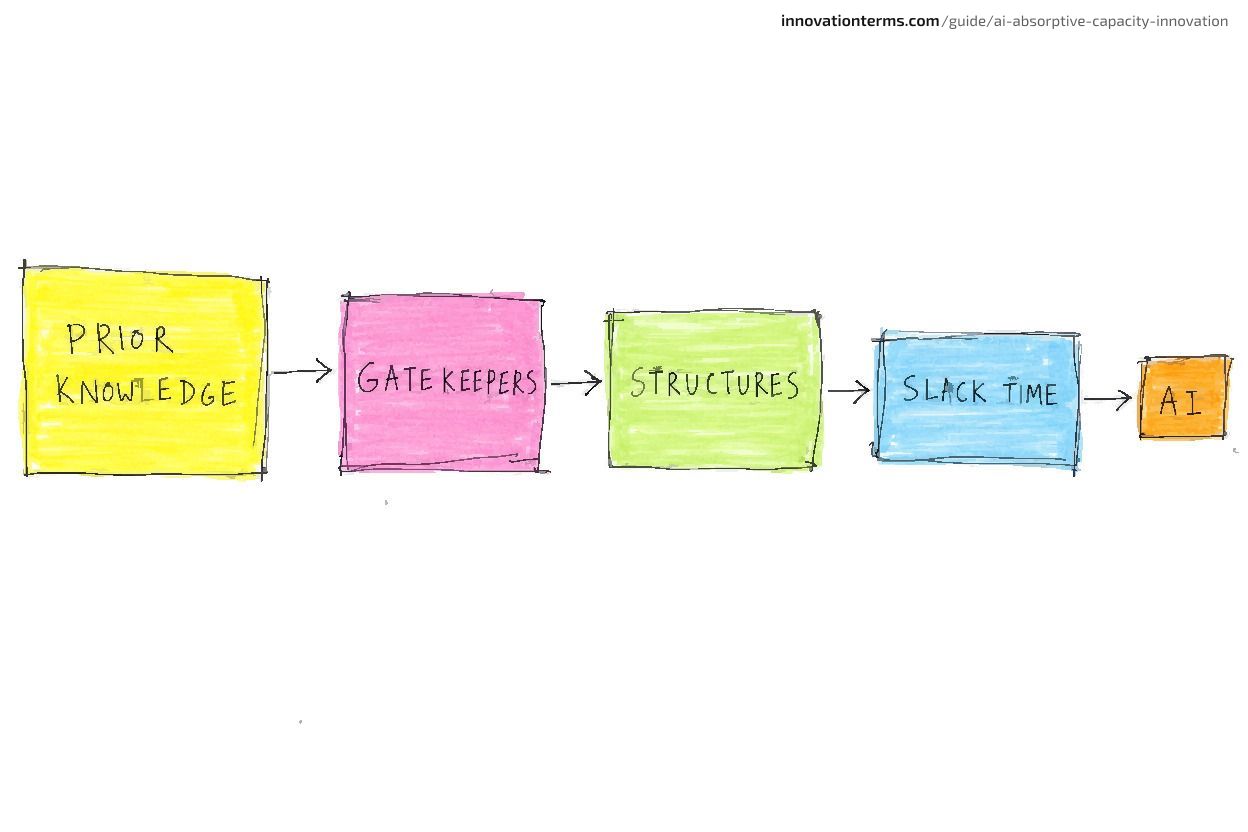
Step 1: Invest in prior related knowledge as the foundation
You can only absorb what you are equipped to understand, so the receiver starts with domain depth. Maintain the R&D, technical hiring, and continuous learning that give your people something to attach new knowledge to. Cutting "redundant" expertise to fund tooling removes the gate the tooling needs.
Step 2: Staff boundary spanners and gatekeepers
Name specific people whose job is to scan, evaluate, and route external knowledge into the organization. A 2025 study in Industrial and Corporate Change examined how returns from absorbed knowledge depend on "the specialization of gatekeepers and the delegation of decision-making." The receiver has to be a named role with real authority. Give gatekeepers authority to reject, because rejection is what keeps the inverted-U from tipping — but watch for NIH syndrome (the reflexive bias toward rejecting external ideas simply because they didn't originate inside the firm), which is the opposite failure and just as costly. See innovation roles and hierarchies for how this function reports.
Step 3: Build cross-functional integration structures
Transformation happens when external knowledge meets internal know-how across functions, so the structure has to force that meeting. Standing cross-functional reviews, innovation councils, and rotation programs move knowledge across silos that would otherwise hoard it. This is the machinery of the transform stage, and it is where most idea-management programs under-invest, treating capture as the hard part when integration is.
Step 4: Create routines and slack time for integration
Integration is work, and work without time does not happen. Protect explicit slack, for example a standing portion of team time reserved for digesting and recombining inbound knowledge rather than producing. Mollick's steam-engine point applies: the value came from people redesigning how work was done rather than from the machine.
What made the industrial revolution happen was thousands of skilled artisans who figured out how to adopt the back and forth motion of the steam engine into running mills and equipment within factories. — Ethan Mollick, Outthinker (2025)
Step 5: Deploy AI as the screening and routing layer
Now, and only now, point AI at the receiver you built. Use it to screen, route, and match external knowledge to internal needs the way agentic AI tools now do automatically, organizing intake like a digital second brain rather than opening more inbound channels. A 2026 study argues AI can help firms "systematically acquire and match high-quality external resources," which is genuinely useful as the receiver's intake filter. The framing that matters: AI is one instrument inside the receiver, the screening layer rather than the receiver itself. Sequenced last, it amplifies a working system. Sequenced first, it floods a broken one.
How do you measure and audit absorptive capacity?
Measure conversion: the fraction of acquired external knowledge that reaches a decision. R&D spend, headcount, and tool count tell you what you put in. Absorptive capacity is about what comes out, so the useful metrics track the rate at which inbound knowledge becomes applied decisions.
Of the five candidate proxies, two carry real signal: new-product revenue share, which measures realized exploitation directly, and concept-to-launch conversion rate, which makes the efficiency factor operational. R&D intensity and patent citations are pre-conversion proxies that stop at investment and external acknowledgment.
The efficiency factor Zahra and George named is now operational: the fraction of acquired external knowledge that actually reaches a decision. That ratio is worth tracking longitudinally, because an AI rollout that lifts acquisition while stalling conversion will surface as a falling number before any other signal does. The absorptive-capacity definition page covers the broader measurement literature. For an operating team, conversion ratio and time-to-application are the metrics to instrument first.
What are the common mistakes that keep the gap open?
The recurring mistakes all share one root: treating absorptive capacity as a product to purchase. Each one looks like progress and widens the conversion gap.
Buying tools before building the receiver. AI on a weak receiver amplifies the backlog. Sequence the receiver first.
Mistaking adoption for transformation. 88% adoption, ~6% high performers. Charles Good calls the gap "a human capability design problem," not a technology one. Counting seats licensed is not measuring capacity built.
Over-opening inbound channels. AI makes adding a feed free, so teams sail past the inverted-U's peak. More sources past the threshold reduce hit rate.
Leaving gatekeepers unempowered. Scanning without authority to reject produces a graveyard of unexecuted concepts, where, as Ideawake describes it, staff stay "busy filtering through thousands of duplicate entries."
Chasing pilot novelty. Pilots improve for the newest, flashiest use case, which is rarely the one that scales. As advisor Alex Roberson observes, teams start with "the sexiest thing," and "those things don't usually scale."
Cutting expertise to fund tooling. Removing the prior knowledge that does the absorbing to pay for the tool that needs it. The fastest way to shrink realized capacity while looking efficient.
What does building absorptive capacity not replace?
AI operates as a tool that human judgment must direct and interpret. It is a partial substitute for some knowledge sourcing, which changes who you need to receive from, but external collaboration remains necessary. As acquisition improves, your scarce advantage shifts further toward the conversion work AI cannot perform.
The practical edge: AI's spillover and matching benefits accrue mainly where readiness is already high, so the partnerships still worth keeping are the ones supplying tacit, relational knowledge AI cannot reach.
McKinsey estimates "$360 billion to $560 billion of potential annual economic potential" from AI in R&D, where "potential" is the same qualifier Zahra and George used for the half AI inflates without converting, and the contingency in both cases is the receiver. As AI tooling matures over the next year, the acquisition advantage will commoditize further, which only raises the premium on realized capacity. The firms that win will not be the ones with the most inbound knowledge. They will be the ones that built the human receiver first and pointed the machine at it second. Whatever AI-for-innovation playbook you adopt next, reverse that order and it just feeds a faster backlog.
TL;DR
- AI made acquiring external knowledge nearly free. Your ability to convert it stayed exactly where it was.
- Absorptive capacity splits into potential (acquire, assimilate) and realized (transform, exploit). AI inflates the first half and leaves the second gated.
- Adding AI to a weak receiver widens the conversion gap and raises downside risk, especially for low-capacity firms.
- Tacit knowledge, where innovation value concentrates, stays human. The receiver is a staffed, instrumented function.
- Build the receiver first (prior knowledge, gatekeepers, cross-functional structures, slack time), then deploy AI as the screening layer.
By 2026, AI solved external-knowledge sourcing. Realized absorptive capacity remains the binding constraint: it determines whether inbound knowledge becomes applied ideas or accumulates as backlog and risk when AI is bolted onto a weak receiver. Build the receiver first.
Frequently asked questions
What is absorptive capacity in simple terms? It is an organization's ability to recognize valuable external knowledge, connect it to what it already knows, and turn it into products and decisions. Coined by Cohen and Levinthal in 1990, it hinges on prior related knowledge: you can only absorb what you are already equipped to understand. The fuller treatment is on the absorptive-capacity definition page.
Does AI increase absorptive capacity or just inbound volume? Volume. AI makes acquiring and assimilating external knowledge, the "potential" half of absorptive capacity, far cheaper, but transformation and exploitation, the "realized" half, run on tacit knowledge and cross-functional routines that AI does not reach, which is why a 2025 systematic review found the innovation payoff from AI stays contingent on the capacity that already exists.
How do you build absorptive capacity in an organization? In order: invest in prior knowledge, staff empowered gatekeepers and boundary spanners, build cross-functional integration structures, protect slack time for integration, and only then deploy AI as a screening and routing layer. The sequence matters. AI added first amplifies a broken pipeline.
Why do open-innovation and scouting programs fail when absorptive capacity is low? Because sourcing and receiving knowledge are distinct organizational functions. An HBR IdeaCast framing of Henry Chesbrough's research put it this way: firms end up "outsourcing, but not collaborating." Without a receiver to integrate inbound knowledge, more sourcing produces a larger backlog of unexecuted concepts rather than more applied innovation. See how to run open innovation.
What is the difference between potential and realized absorptive capacity? Potential absorptive capacity is acquiring and assimilating external knowledge. Realized absorptive capacity is transforming and exploiting it into commercial outcomes. Zahra and George (2002) named the ratio between them the "efficiency factor." AI inflates the potential half while the realized half stays roughly flat, so the ratio falls.
Can adding AI tools cause information overload for an innovation team? The 2025 workslop study put the cost above $9 million a year for a 10,000-employee firm, which suggests yes and that the stakes are real. External search follows an inverted-U with performance: past an optimal breadth, more sources reduce innovative output rather than increase it. AI removes the cost brake that previously held teams below that threshold.
How do you measure or audit absorptive capacity? Use conversion metrics, not investment metrics. Concept-to-launch conversion rate, the share of acquired external knowledge that actually reaches a decision, is the most informative single number, paired with time-to-application. R&D spend captures inputs rather than outputs and is a misleading proxy for both.

Mikkel @mkl_vang
Covers operational innovation, AI implementation patterns, and how teams ship useful change without theater.