Reddit
  X.com
X.com  Facebook
  Pinterest
  Threads
  Bluesky
  WhatsApp
  Telegram
  Messenger
  Email
Email Invention: Definition, Examples, and the Innovation Gap
Quick answer
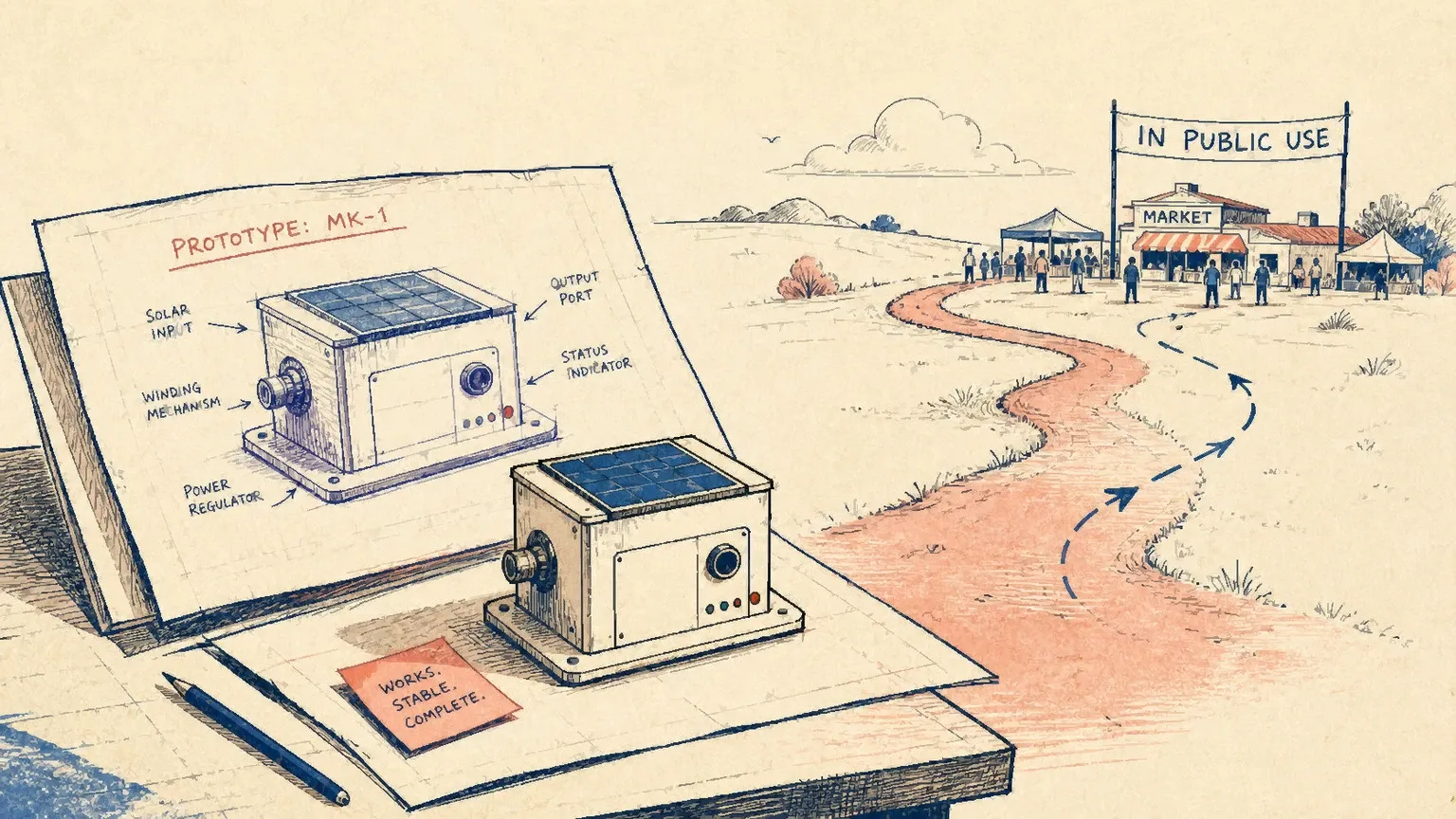
Invention is the creation of something new and useful. It is complete at novelty, even before commercialization or public adoption.
Invention is the act of creating something new. It can be a product, a process, or a technical method that did not exist before. What matters first is novelty and usefulness, not whether the market has adopted it yet.
That distinction sounds academic until you see where teams get into trouble. Many organizations treat invention as an early phase of innovation, then keep building, testing, and polishing long after the inventive step has already happened. The result is often avoidable delay around disclosure, filing, ownership, and strategy.
What is the definition of invention?
An invention is a new and useful creation. In practice, the cleanest working definition comes from patent systems and standards bodies: the thing must be novel, it must do something identifiable, and it must be more than an obvious tweak anyone in the field would make.
That is why invention should not be defined by commercial success. WIPO describes a patentable invention as a new technical solution or a new way of doing something. The threshold is technical novelty with practical application. Sales do not appear in the definition.
You can see the same idea in older historical definitions. In James Burke’s Britannica-linked history of invention, invention is framed as bringing ideas or objects together in a new way to create something that did not exist before. The center of gravity is the creative act itself, not the launch plan.
Invention vs. innovation
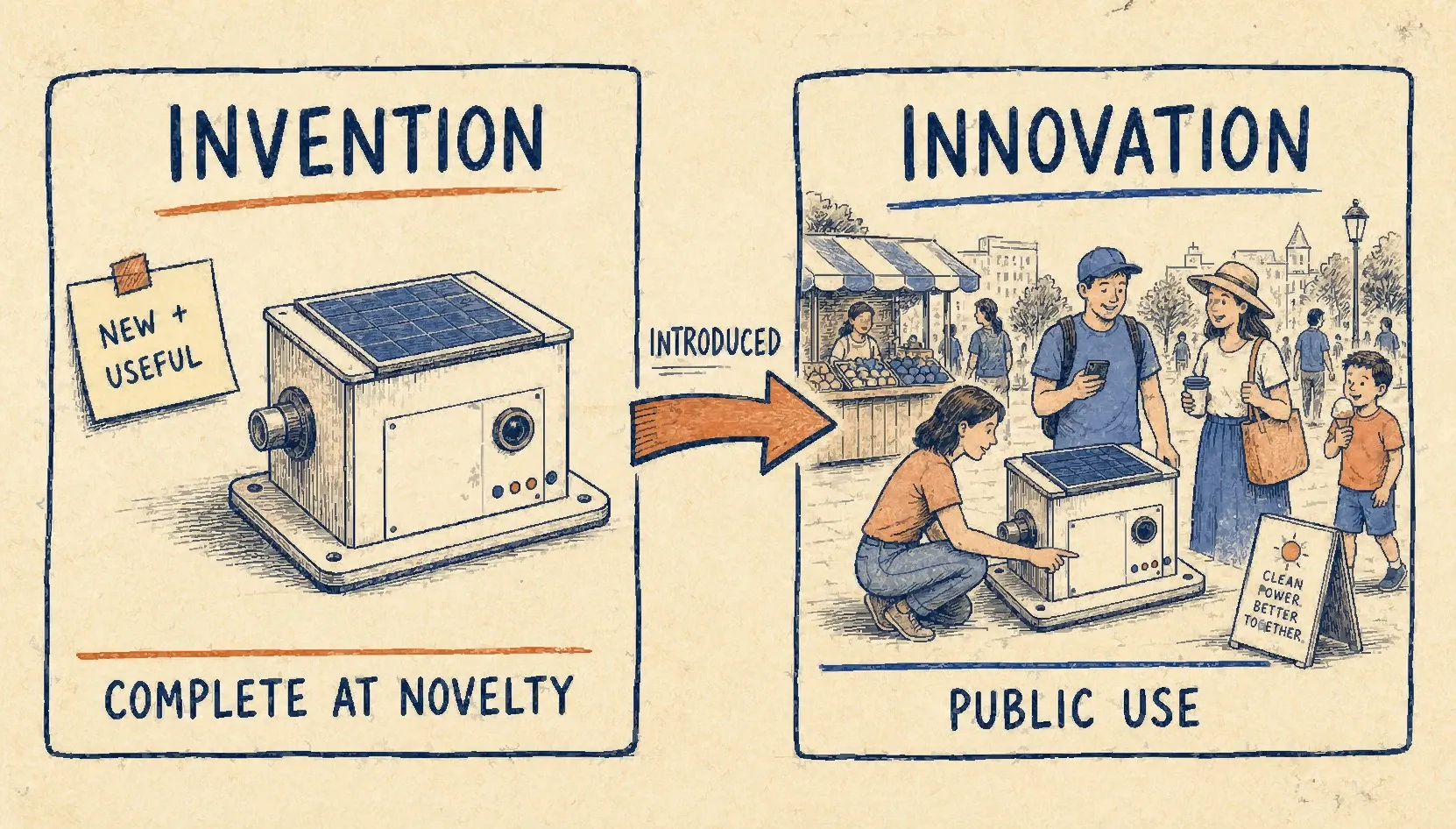
This is where most confusion starts. Invention creates the new thing. Innovation is what happens when that thing reaches use.
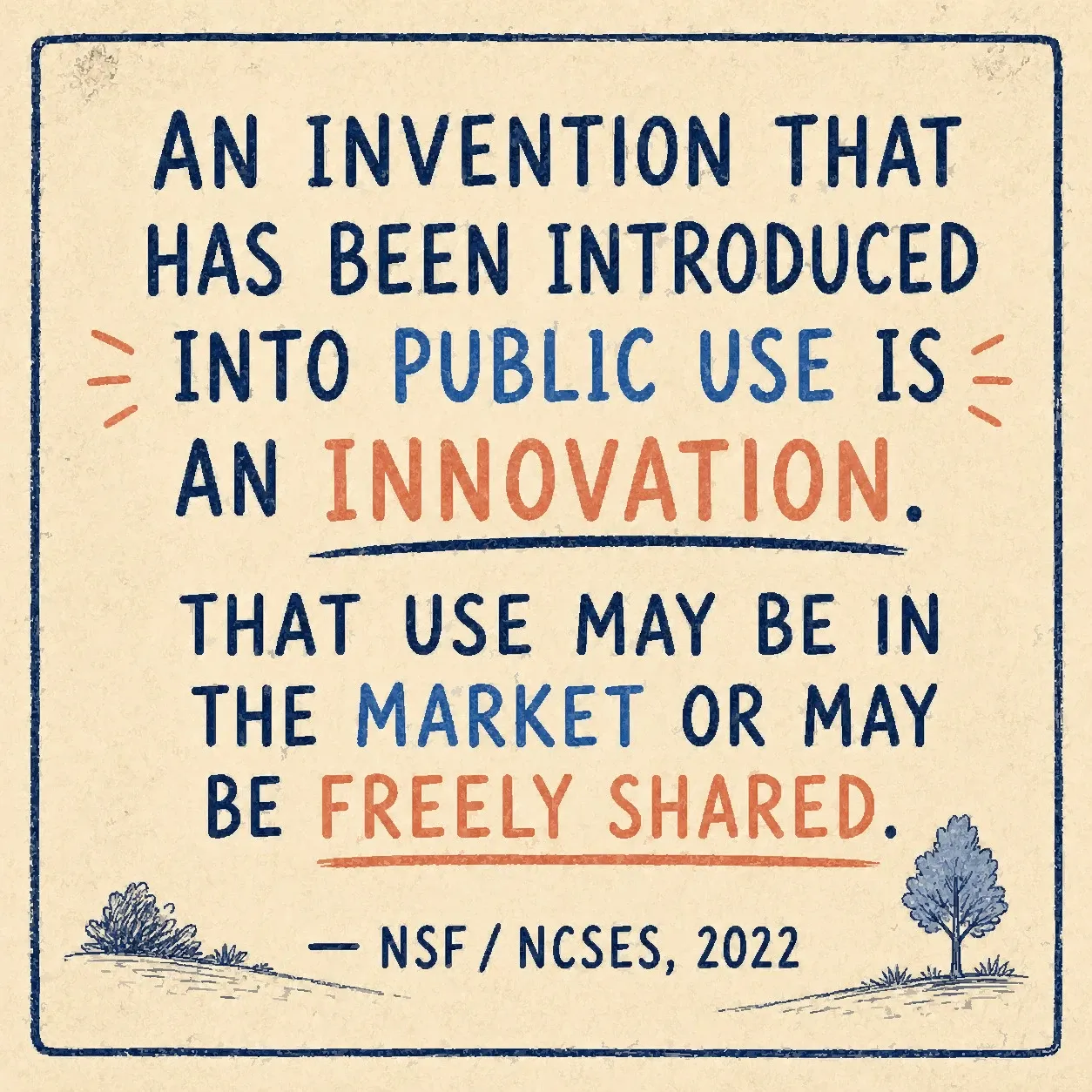
The U.S. National Science Foundation puts it plainly: an invention introduced into public use becomes an innovation. That is the line. Before public use, the work may be complete as an invention even if nobody has commercialized it.
That difference matters because invention and innovation ask different questions.
- Invention asks whether something new has been created.
- Innovation asks whether the new thing is being adopted, used, or diffused.
MIT professor Ed Roberts describes innovation as invention multiplied by commercialization. That framing is useful because it shows why the terms should not collapse into each other. If commercialization is zero, innovation is zero. The invention can still be real.
Leonardo da Vinci’s parachute sketch is the classic example. The design existed centuries before it had practical uptake. It still counts as an invention. The lack of adoption in his lifetime does not erase the inventive act.
Invention is complete at novelty. Innovation begins at use.
If you want the related concepts, compare this page with incremental innovation and radical innovation. Those pages describe how organizations apply and scale novelty after the inventive step.
Does an invention need a patent or market success?
No. A patent protects priority and rights. It does not create the invention itself.
Teams often confuse legal recognition with conceptual existence. Those are separate questions. You can invent something and never file. You can also file something that never finds a market. In both cases, the invention status turns on novelty and utility, not on revenue.
This is one reason the definition matters inside R&D. If your team assumes an invention is not “done” until it has market validation, you can wait too long to document it, file it, or decide who owns it. The novelty may still exist, but your protection window gets weaker.
The same distinction appears in management literature. Ed Roberts’s work in Research-Technology Management separates invention from innovation because the organizational jobs are different. One group generates the novel thing. Another group gets it into use. Sometimes the same people do both, but the decision points are still different.
Can small improvements count as inventions?
Yes. Not every invention is a moonshot.
Many inventions are narrow improvements to an existing product, process, or component. A new material mix, a better control method, or a more efficient algorithm can all be inventions if they clear the novelty bar. That is why invention should not be treated as a synonym for breakthrough theater.
This is also where people confuse invention with the later innovation story. A small technical improvement may be an invention long before anyone decides whether it deserves a product launch, a licensing strategy, or a broader platform bet.
If the improvement reaches users and changes performance in the field, you are now talking about innovation outcomes. If it remains a documented new technical solution inside the lab, you are still talking about invention.
Where invention happens in organizations
Most invention work happens in R&D, engineering, and applied product development. Those are the places where teams test new methods, materials, architectures, and workflows. But R&D is a context, not a synonym.
Not all R&D produces inventions. Some projects validate existing knowledge. Some reduce uncertainty without creating anything novel. The reverse is also true. Inventions can emerge outside formal R&D when an operations team, product team, or individual specialist finds a genuinely new solution to a stubborn problem.
That is why good organizations separate three moments clearly:
- the moment a new solution is created
- the moment it is documented and protected
- the moment it is introduced into real use
Blurring those moments makes portfolio decisions harder. It also creates sloppy language in strategy discussions. If leaders say “innovation” when they mean “invention,” they can miss the point where the technical novelty already exists but the adoption plan does not.
Frequently asked questions
What is the difference between an invention and an innovation?
An invention is the creation of something new. An innovation is an invention in use. Invention starts with novelty. Innovation starts with adoption, whether through a market, an organization, or public use.
Does an invention have to be patented?
No. A patent is a legal protection mechanism, not the definition of invention. An unpatented technical solution can still be an invention if it is new and useful.
Can an invention fail commercially and still be an invention?
Yes. Commercial failure does not cancel the inventive act. It only tells you the invention did not become a successful innovation.
Are incremental improvements inventions?
They can be. If an improvement is genuinely new and not obvious in context, it can qualify as an invention even if the scope is narrow.
Why does this distinction matter for teams?
Because teams make different decisions at each stage. Invention decisions are about novelty, documentation, and ownership. Innovation decisions are about adoption, distribution, and value creation in use.

Clara @cla_reinholt
Focuses on innovation communication, facilitation, and turning frameworks into team habits.