
How to Avoid Innovation Theater: A Diagnostic Guide

Innovation theater is activity that signals innovation without funded outcomes. Use this 12-tell checklist to diagnose it, trace the root causes, and fix it.
Does the function have its own P’s L line, and can the team kill or fund its own projects without asking permission from the executives who run the core business? If the answer is no, you are running innovation theater, whatever the branding on the door says.
Most advice on the topic hands you a mood check. Too much innovation talk (showy labs, sticky notes) with no link back to strategy. That list describes symptoms and then prescribes sincerity: get leadership buy-in, care more, set better metrics. This guide argues something narrower and more useful. Innovation theater is a structural condition with a structural cure. Below is the one-line test, the twelve tells you can run against your own org, the three root causes that keep producing them, and the three fixes that remove the cause rather than the symptom.
What is the one test that tells you if your innovation program is theater?
Capsule. The test is ownership of consequences: a real innovation function controls a budget it can spend, a project it can kill, and a bet it can fund, and it is measured on outcomes those choices produce. A theater function does activity and hands the consequences to someone else. Run your program against that single axis before any checklist.
Everything else is downstream of this. When an innovation team cannot kill a dying project and cannot fund a promising one without routing the decision through a core-business executive, its incentives point at looking busy, not at shipping value. The activity accumulates. The outcomes do not. This is a question of innovation capital: who actually controls the money behind a bet, not just who gets credit for having an idea.
An innovation lab with no P&L and no authority to kill or fund its own projects is theater by design, and no rebrand, metrics dashboard, or leadership pep talk changes that. This is a claim about mechanism, not motivation. The people in these labs are usually committed and capable. The structure they sit inside rewards the appearance of innovation and punishes the risk that real innovation requires, so the appearance is what it produces.
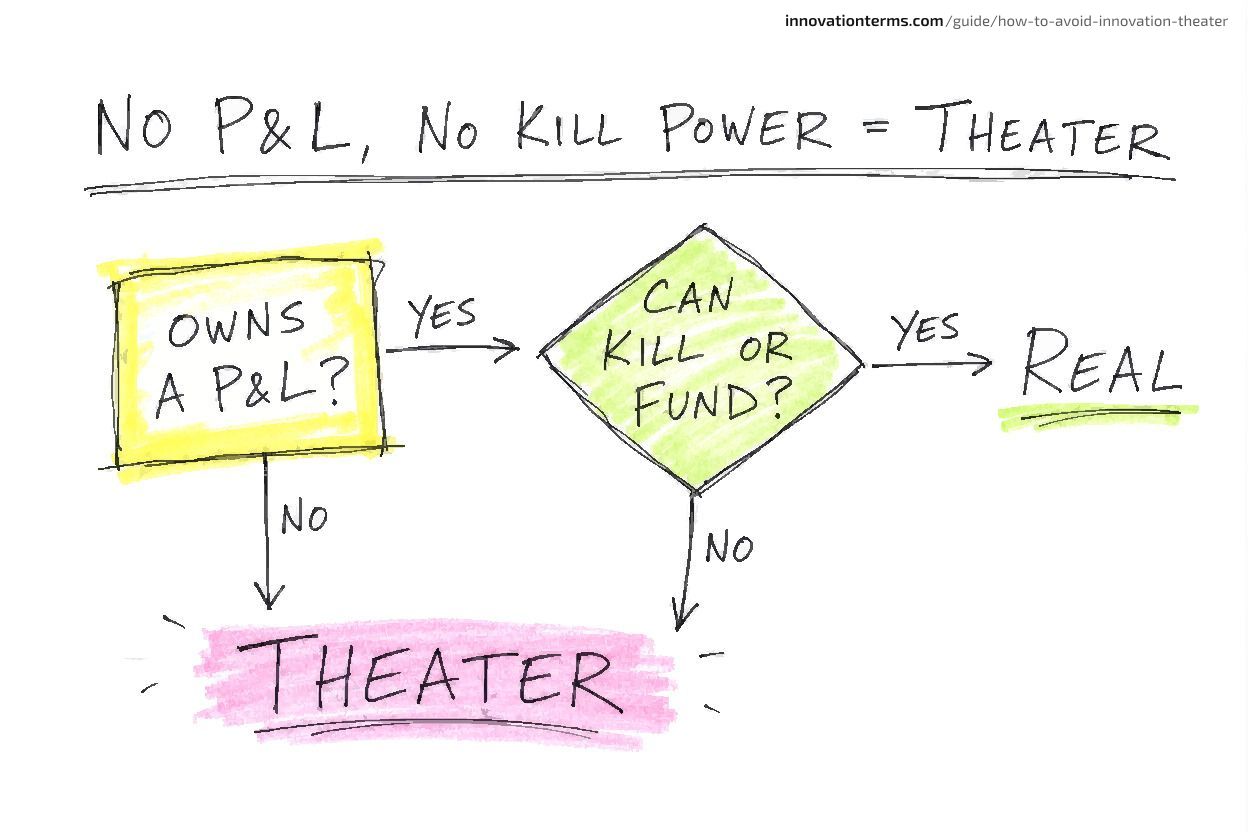
The defense sector shows the same pattern outside the corporate world. Reviewing the Pentagon’s innovation offices, CSIS analyst Todd Harrison concluded that without funding and authority, these efforts amount to little more than theater. The variable is decision rights, not enthusiasm. The book Corporate Explorer describes what the working version looks like: at Amazon, a two-pizza team with a single agreed metric and the freedom to act “becomes the equivalent of a profit and loss (P&L),” and the team leader operates “like a mini general manager.” Hold that image next to your own program. That comparison is the test.
What is innovation theater, and where does Steve Blank’s definition stop short?
Capsule. Innovation theater is organizational activity, such as hackathons, that produces the appearance of innovation without shippable output or movement on revenue, profit, or market share. Steve Blank named it. The definition is correct. It just stops one step short of the actual cause.
Steve Blank coined the phrase innovation theater in a 2019 Harvard Business Review essay, and the definition has held up. He described reorgs, design-thinking classes, and workshops that create the appearance of transformation while rarely delivering deployable product, and his accounting was direct: none of it would “increase revenue, profit or market share for companies.” On video a few years later, Blank put it in plainer language, and the image stuck:
decide to run accelerators or incubators... thinking that somehow that’s the magic fairy dust of actually creating new value for the company, but in fact what it actually usually creates is coffee cups, lanyards, posters... and very little output that moves the top or bottom line.
— Steve Blank, InnoLead panel (2022)
Writing in Forbes in 2020, Tendayi Viki put the test in a single line: “whether it is creating value for the company.” The next question (the one this guide is built around) is what structural property makes that possible.
Innovation theater vs. real innovation: how does the test play out?
Capsule. Real innovation and innovation theater can look identical from the outside, same demos, same energy, same slide decks. They diverge on five structural axes: who owns the budget, who can kill a project, who holds decision rights, which metric counts, and whether there is a path back into the business. Score your program on all five.
The difference is not visible in the activity. It is visible in the wiring behind the activity. A lab that reports outside the business with an enterprise-wide mandate to disrupt looks impressive and tends to get reabsorbed, because the same book that praises the Amazon model notes that top-down labs of this kind lead “many corporations to question the value of these teams.” The table below is the test made concrete.
| Structural axis | Innovation theater | Real innovation | Source |
|---|---|---|---|
| Budget | Central overhead line, spent whether or not anything ships | Its own P&L, funded against milestones the team owns | Corporate Explorer |
| Kill authority | Projects die by neglect, reorg, or a distracted sponsor | The team can vote to kill its own bets | Corporate Explorer |
| Decision rights | Approvals route through core-business executives whose careers are tied to the existing model | The team leader acts as a mini general manager | maccelerator / Corporate Explorer |
| Primary metric | Activity: ideas submitted, events run, demos staged | Throughput: revenue captured, projects funded or killed | Maurya |
| Reporting line | Ring-fenced outside the business with no route back | Integrated, with a documented path into operations | Corporate Explorer / Walmart |
Read the left column and you have a diagnosis. Read the right column and you have a specification for the fix. Most programs score theater on four axes and real on one, usually the metric they wish they were measured on, rather than the one they’re actually accountable for. The honest exercise is to mark where you sit today, not where the org chart flatters you. A program that scores theater on budget and kill authority produces theater regardless of how outcome-focused the dashboard looks, because the dashboard cannot fund or kill anything. It just counts. What the right column specifies is what organizational theorists call an ambidextrous organization, one structured to simultaneously exploit the existing business and explore genuinely new bets, which requires separated P&L lines and decision rights, not just separated floors of the same building.
What are the signs of innovation theater? A 12-tell checklist
Capsule. The tells cluster into four groups: rituals with no follow-through, labs with no P&L, idea portals that make no decisions, and KPIs that count activity instead of outcomes. If you recognize six or more of the twelve below, your program is closer to theater than to innovation.
Run this against your own org. Each tell is a symptom of a missing structural property, which is why fixing the tell without fixing the structure does nothing.
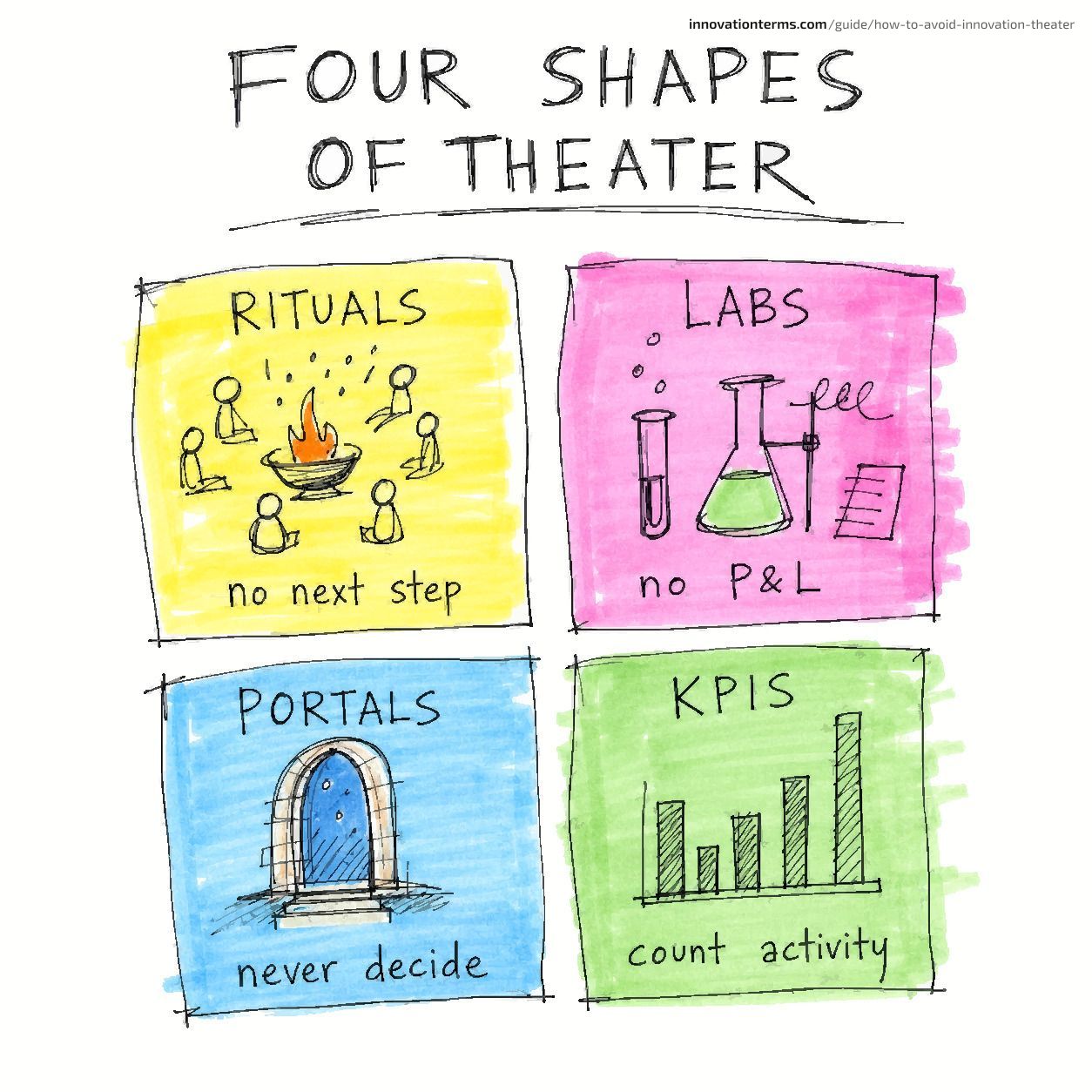
Rituals with no follow-through
- Hackathons and demo days run on a calendar, but no winning project has a funded next step. Blank’s own diagnosis of ritual failure is the unanswered question of where the output goes, met with “these are unbudgeted and unscheduled activities so we’ll get to them next year.”
- An annual innovation summit with an executive keynote and zero decisions logged afterward.
- Design thinking workshops that generate sticky notes and photographs, then nothing.
Labs with no P&L
- An innovation lab with a budget it did not set and cannot defend against milestones.
- A lab that reports outside every business unit and has no route to hand a product back into operations.
- A lab whose success is described in adjectives (vibrant, forward-thinking) rather than in a number it is accountable for.
Idea portals that make no decisions
- An idea portal or suggestion box with thousands of submissions and no published record of what was funded, killed, or why. This is where idea management collapses into collection without adjudication.
- Ideas that stall because “revenue or profit goals are applied prematurely,” a failure Wolcott and Lippitz warned about in their 2010 book Grow from Within.
- A portal whose headline metric is submissions received, not decisions made.
KPIs that count activity, not outcomes
- A dashboard that tracks ideas submitted, events held, and people trained, with no line for revenue shipped or projects killed.
- Maurya cites NSF I-Corps’ “100 customer interviews” target, where teams stop at 100 regardless of what they learned.
- Any KPI you could hit in full while the company’s top and bottom line stay flat.
Six or more is a diagnosis, not a mood. The next three sections explain why these tells recur, because the checklist is only useful if it points at a cause you can change.
Why do companies build innovation theater on purpose?
Capsule. The counterintuitive root cause: theater is often rational. Organizations under pressure to look innovative can gain real legitimacy from visible innovation activity, independent of whether it ships anything. Sincere effort does not fix it. The problem is structural, embedded in how decisions get made, not a failure of will.
Here’s the thing most virtue checklists miss entirely. A 2023 study in Technovation examined why firms under pressure to innovate choose symbolic over substantive action, and found that symbolic acts “have no bearing on the innovation process but act as mechanisms of legitimation.” Which is to say: a lab launched for an investor narrative or a big-customer signal is doing exactly what it was built to do. It just was not built to ship product. The uncomfortable truth is that the lab is succeeding, just at a different job than the one on the brochure.
The lab’s structure rewrites what a fix can be. Call it the “try harder” trap, if theater were a sincerity problem, more sincerity would work. (It never does.) Because it is a legitimacy strategy responding to external pressure, exhortation bounces off it like motivational Post-its on a structural beam. The lab is producing the output its structure rewards, cheerfully, efficiently, and with absolutely no reason to stop.
There is a second, quieter incentive underneath: local optimization. Maurya’s framing captures how a well-run process still produces the wrong result.
This divide and conquer approach seems logical but it favors local optimization at the expense of longer-term system throughput i.e. real results.
— Ash Maurya, LEANSTACK (2019)
But without funding, authorities, and a focus on leveraging rather than leading, these efforts will amount to little more than theater.
— Todd Harrison, CSIS Defense360 (2023)
What are the other root causes of innovation theater?
Capsule. Beyond legitimacy signaling, two structural root causes remain. Incentive mismatch, where activity KPIs reward local busyness over system throughput. Absent decision rights, where approvals route through executives whose careers depend on the core business they are being asked to disrupt. Both are measurement and authority problems, not attitude problems.
Incentive mismatch: the measurement-architecture failure
Theater is not a sincerity failure. It is a measurement-architecture failure that rewards the wrong people for the wrong things. Ash Maurya named the mechanism in a 2019 essay: sub-funnel optimization. When you attach incentives to a local activity metric, people hit that metric and the system gets worse. Maurya’s example: optimize for leads and the ad budget fills, lead volume rises, and conversion rates fall. Swap leads for ideas submitted and you have the innovation portal problem in one sentence.
No decision rights: the approval-layer problem
The second cause is authority. A lab operates under what one analysis calls a contradictory mandate. It is told to experiment and take risks, yet it reports into structures that punish failure and route approvals through management layers, and “the people funding them have careers tied to those [existing] models.” HBR’s own study of why innovation labs fail lands on the same territory: labs fail from lack of alignment with the business, lack of metrics that track success, and lack of balance on the team. An executive whose bonus depends on this quarter’s core-business margin will not greenlight a bet that threatens it — this is dominant logic, the cognitive frame that orients core-business leaders toward existing customers and away from disruptive bets, working exactly as designed, regardless of the innovation rhetoric in the all-hands. The decision right sits in the wrong place.
Is innovation theater ever rational? The boundary cases
Capsule. Sometimes. When the job is signaling innovativeness to customers, investors, or the talent market, visible activity delivers. No product required. The steelman is real and worth conceding before the rebuttal: recognizing legitimate signaling is different from mistaking signaling for innovation.
A 2024 paper in the Journal of Product Innovation Management argues theater can be a constructive process. It studies the playful cultural design of corporate venturing units (the foosball tables, the startup lingo, the Lego bricks) and identifies a real function those signals perform: offering an escapist counterculture inside a rigid firm. The paper points “to the possibility of innovation theater as a constructive process in contemporary innovation management practices.” The constructive function it describes is attention-direction inside a rigid firm, which is a real job. It is not a license to fund the foosball table out of the innovation budget and call it a venture portfolio.
you actually may not need to generate real growth from the innovation activities themselves — you might just need to show that the organization is innovative.
— Alex Slawsby, InnoLead panel (2022)
Signaling can be the whole point of a program, and that is a marketing job. The problem is funding signaling out of your innovation budget and reporting it as innovation. Blank’s rebuttal on the same panel draws the line cleanly: if the goal is to look innovative, “that’s more marketing for the company,” and the money would do more good in the marketing budget or handed to the existing product-development groups.
By the numbers: why do activity KPIs guarantee theater?
Capsule. Activity metrics and outcome metrics track different things, and a program tuned on activity will pile up activity while starving outcomes every time. The table below separates the two. The rule is simple: if you can hit a metric in full while revenue stays flat, it is an activity metric.
The empirical backing is blunt. A 2019 study behind the book Innovation Scorecard found most mid-to-large firms track innovation with financial and non-financial measures that carry no logical link between them. That is the quiet engine of theater: the dashboard is full and the connection to the top or bottom line is missing.
| Metric type | Typical examples | What it actually rewards | Source |
|---|---|---|---|
| Activity | Ideas submitted, hackathons run, people trained, demos staged | Local busyness and gameable quotas | Maurya |
| Throughput | Ideas funded, projects killed, revenue shipped, time-to-revenue | System-level value capture | Corporate Explorer |
Maurya’s antidote is a single macro-metric, throughput, measured as traction: “the rate at which a business model captures monetizable value from its customers.” The counterexample that proves the point is a real number, not a slogan. At Bosch’s accelerator, described in Corporate Explorer, the accelerator cuts the time to deliver revenue from a new venture by 400% versus a project that skips the accelerator. That is an outcome metric doing work an activity metric never could. A program that measured ideas submitted would have no way to see it.
Fix 1: How do you give an innovation function a P&L and kill authority?
Capsule. Give the function a real budget line and a single outcome metric it owns. Add standing authority to kill its own projects and fund the survivors. This converts the team into a small profit-and-loss center whose leader acts like a general manager, which is the structural difference between innovation and theater.
Skip this fix and every other fix is cosmetic. A decision log with no authority behind it is a nicer-looking activity dashboard. The mechanism, drawn from the Amazon model in Corporate Explorer, is to collapse the team’s success into one agreed metric plus the freedom to act, so the unit “becomes the equivalent of a profit and loss (P&L)” and the leader runs it “like a mini general manager.” Ownership of the number changes behavior, because now the team eats its own outcomes.
Kill authority is the half that gets skipped. It matters most. A healthy innovation function kills more than it ships.
as many as two-thirds of teams vote to kill off their own ideas at this stage
— Binns, Harreld and O’Reilly, Corporate Explorer (2022)
Voluntary kills are only possible when the team is measured on portfolio outcomes rather than on defending any single project. Alphabet’s X reached the same discipline through funding structure: its 2024 restructuring lets projects spin out as independent startups backed by outside investors, replacing a model where the parent solely funded everything and “could only accommodate so many Other Bets.” External capital imposes the kill-or-fund discipline that internal overhead never does. Once the function owns a P&L, building a culture of experimentation becomes a constructive project rather than a slogan, because the experiments now have stakes.
Fix 2: How do you replace the activity dashboard with a decision log?
Capsule. Retire the dashboard that counts ideas and events. Replace it with a decision log that records, for every bet, the choice made (fund, pivot, kill), the date, the reasoning, the person accountable, and the outcome. The anti-theater metric set is kill rate, fund rate, and operating-line attribution.
The unit of real innovation is a decision, not an activity. Corporate Explorer frames experiments as existing so leaders can “decide what to do next: invest, pivot, or kill the venture.” A decision log instruments exactly that. Each row is one bet, with columns capturing the essentials (decision, date, rationale, owner, outcome). Over a quarter the log answers the only questions that matter: how many bets did we fund, how many did we kill, and what did the survivors return. This is the same instrumentation problem that innovation feedback loops solve at the portfolio level: design the circuit before you trust the signal.
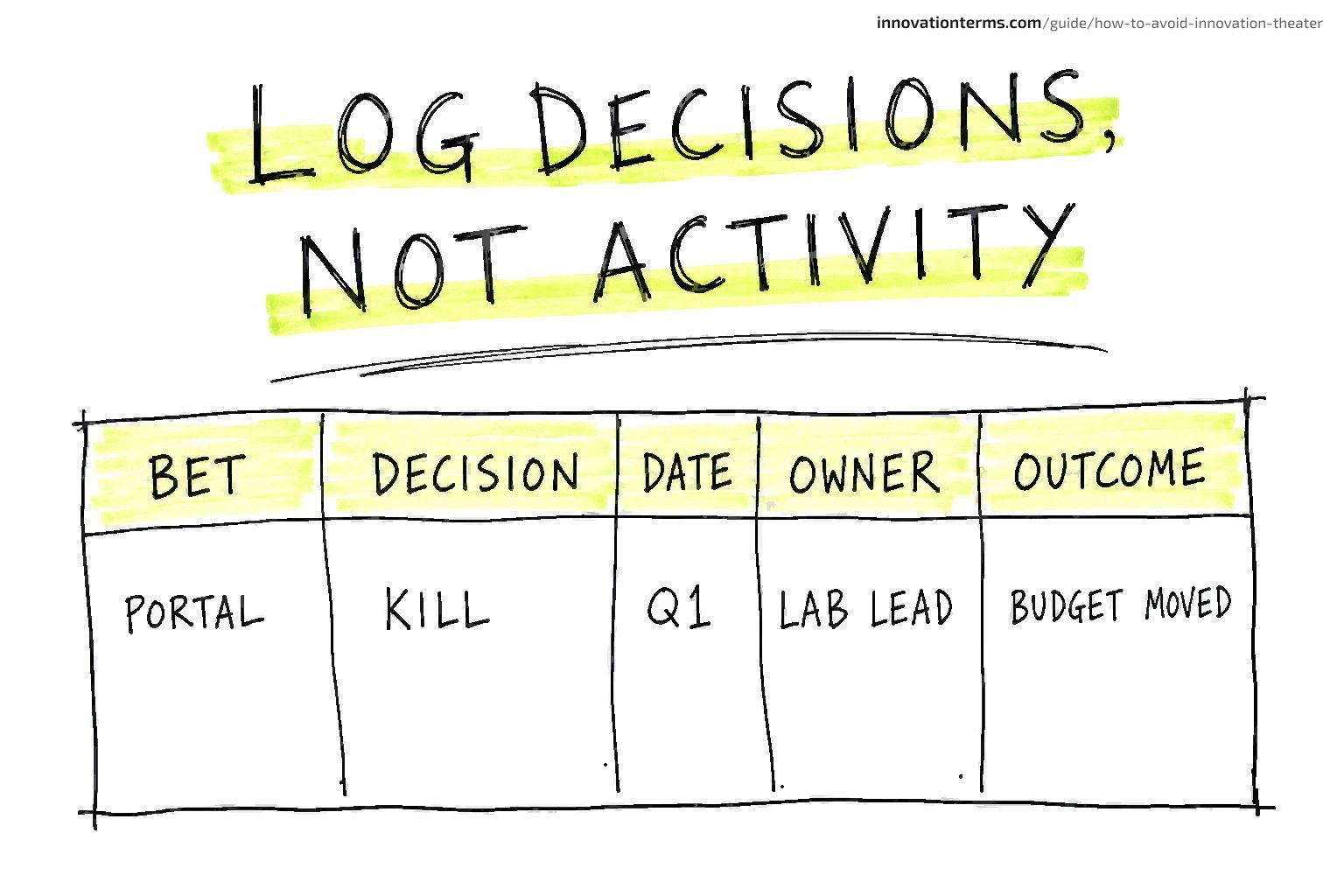
This directly repairs the measurement failure from the previous section. Where activity metrics carry no logical link to value, the decision log’s columns are the causal chain: choice to outcome, traceable. Route your idea management submissions straight into this log so that a portal entry is not filed, it is adjudicated with a dated, owned decision.
Two design notes. First, track kill rate as a health metric, not a failure metric. A function killing nothing is not disciplined. It is not deciding. Bosch’s two-thirds self-kill rate is a signal of health, not waste. Second, attribute outcomes to the operating line. The log should end at revenue moved, cost avoided, or a documented capability handed to a business unit, not at a demo. Absent that final column, you have rebuilt the activity dashboard with better fonts.
Fix 3: How do you kill the rituals that don’t produce decisions?
Capsule. Audit every recurring innovation ritual against one question: does it end in a funded, killed, or documented decision? Kill the ones that do not, and redirect the budget. Not all activity is theater. A ritual that builds a real capability or produces a decision stays. One that only produces photographs goes.
The whole fix is one question asked before anything goes on the calendar: what decision does this produce, and who has the budget to act on it? Blank locates ritual failure in the absence of that conversation. The question of where output goes gets deferred with “we’ll get to them next year,” which functions as a polite “never.” Make the conversation the entry criterion. Before a hackathon, demo day, or summit gets a slot, name the decision it will produce and the budget line that will act on the winner. If no one can name it, the calendar slot is better spent.
The test is the same one applied throughout: does a decision come out? A demo day that feeds three ventures into a funded pipeline is not theater, it is a decision-forcing event. A hackathon that trains engineers on a new platform builds real capability even if nothing ships that weekend. The tell is not the ritual’s format, it is whether a decision or a durable capability comes out the other end. Distinguishing a kept ritual that builds capability from a theater ritual that only signals is the same judgment that underpins building a culture of experimentation: keep the practices that compound, cut the ones that perform. Kill the ritual, keep the budget, and move it to the funded pipeline the decision log now makes visible.
What are the common mistakes when you try to fix innovation theater?
Capsule. The predictable failures all share one shape: changing the surface while leaving the structure intact. Renaming the lab, adding more metrics, or demanding more leadership enthusiasm each treats theater as a branding or sincerity problem. It is neither. Here are the four mistakes that waste the most effort.
“We just need more leadership buy-in.” Decision rights, not rhetoric. Executives who publicly champion a bet still block it in private when their own incentives punish the risk. Buy-in without a transferred right is theater about fixing theater. Move the right — the innovation leaders who succeed at this are the ones who trade their approval authority for accountability, not the ones who cheerlead loudest.
“We’ll add better metrics.” More metrics on an activity dashboard produce a bigger activity dashboard. Metrics fix theater only when they are attached to a decision and a budget, which is Fix 2, not a standalone move.
“Let’s rebrand and relaunch the lab.” A new name on a ring-fenced, no-P&L unit is a new name on theater. The structure that produced the last failure produces the next one.
“How do we give decision rights without losing governance?” This is the real question, and the answer is a bounded mandate, not a blank check. Grant the function authority to invest, pivot, or kill inside a fixed budget envelope and a single outcome metric, with a stage-gate that escalates only when a bet exceeds a defined threshold. Governance moves from approving every step to setting the envelope and auditing the decision log.
The graveyard and the survivors: which named labs died, and which escaped?
Capsule. The recent record is a natural experiment. The innovation theater examples below make the pattern concrete: ring-fenced labs with no route back into the business get reabsorbed or shut down, while the functions that survived rebuilt themselves around market funding backed by real kill discipline and structural integration. The dividing line in every case is the same structural test from the opening section. These are innovation case studies in the strict sense: the method under the result, not the win alone.
A 2015 Capgemini study put the failure rate of corporate innovation labs at up to 90 percent. Placed here, as evidence rather than as a hook, the number frames a pattern the named cases fill in.
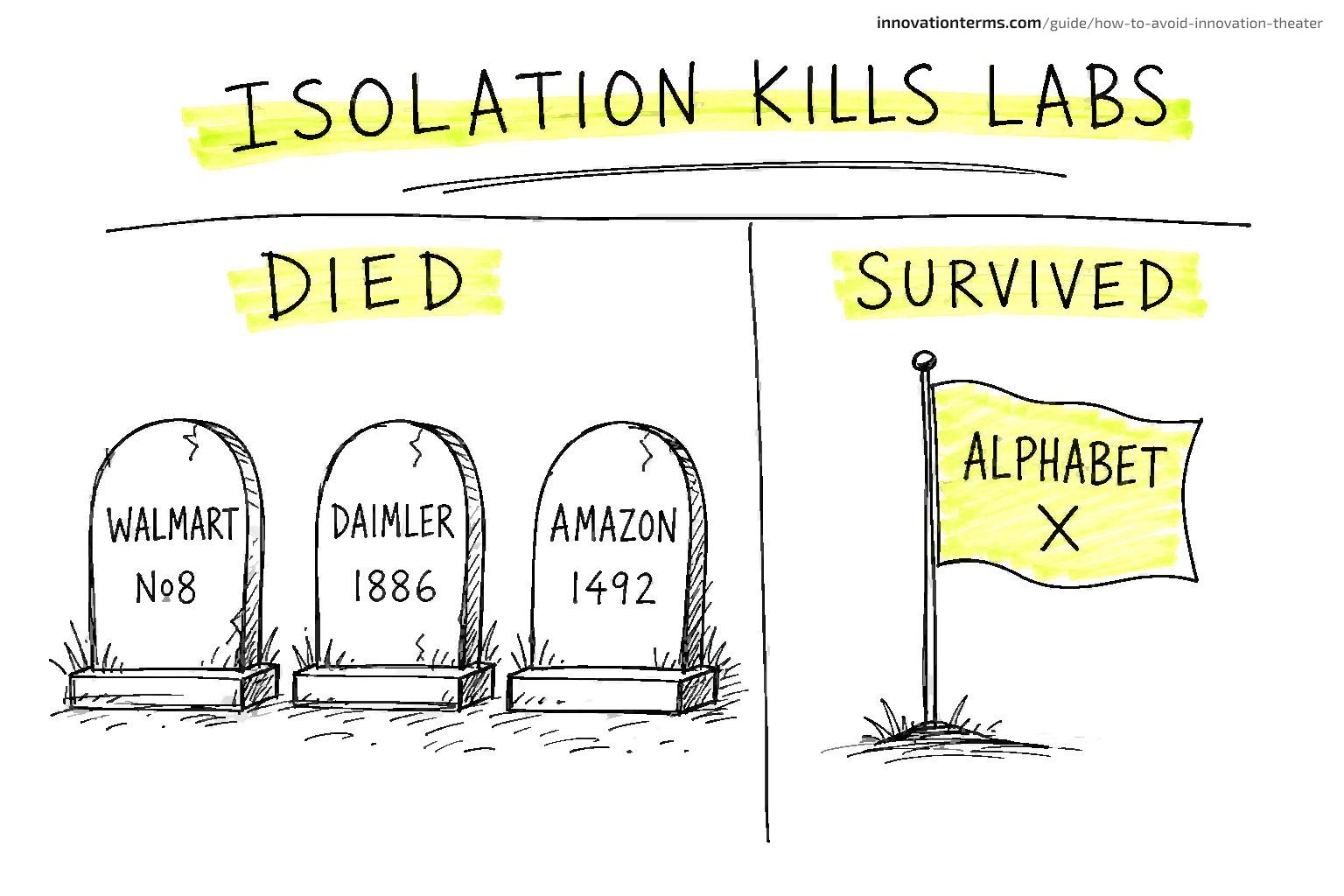
Walmart Store No. 8. Launched in late 2017 and ring-fenced from the parent to run like a startup, the incubator was folded back into core operations in January 2024, and roughly 300 staff were reassigned. Walmart’s CFO framed it as graduation: the capabilities were “now fully embedded,” and “responsibility to shape the future of retail is now shared across the company.” A unit walled off from the business, with no standing path back, gets reabsorbed once the novelty fades.
Daimler Lab 1886. Corporate Explorer records the same failure mode with the cause named: Daimler shut the lab because “few of its innovations were commercialized in the parent company,” which made 1886 “more like an independent venture accelerator than a true corporate unit.” Isolation was the flaw.
Amazon’s Grand Challenge. The moonshot group known internally as 1492, launched around 2014, lost its founding leader in 2022 and shut its secret “Encore” fertility project in late 2024, cutting roughly 100 jobs.
The survivor contrast: Alphabet X. X curtailed spending in early 2023 (a move driven in part by Alphabet-wide cost pressure, not solely by a chosen structural fix) and by 2024 restructured so projects spin out as independent startups with outside backing rather than open-ended parent funding. The survivors rewired the funding path. They imposed the market-funded kill-or-fund discipline that a ring-fenced overhead line never carries. A scanning function built on continuous foresight survives for the same reason: its visible activity feeds real decisions instead of substituting for them.
Frequently Asked Questions
What is innovation theater?
Innovation theater is organizational activity that creates the appearance of innovation, such as hackathons, labs, accelerators, and idea portals, without producing shippable output or movement on revenue, profit, or market share. Steve Blank coined the term in a 2019 Harvard Business Review essay. The distinguishing feature is not the activity itself but the absence of a structural link between that activity and a funded, killed, or shipped outcome.
Are hackathons and innovation labs just theater?
Not necessarily. A hackathon or lab is theater only when it has no route to a funded decision. Run the test: does the activity end in a bet that gets funded, killed, or handed to a business unit? A demo day that feeds three ventures into a funded pipeline is a decision-forcing event. A hackathon whose winners never get a next step is theater, regardless of how good the demos looked.
How is innovation theater different from real innovation?
They can look identical from the outside. The difference is structural: a real innovation function owns a P&L, holds the authority to kill or fund its own projects, and is measured on outcomes those decisions produce. A theater function does activity and hands the consequences elsewhere. Score your program on budget ownership, kill authority, decision rights, metric type, and whether there is a path back into the business.
Why do companies engage in innovation theater?
Often because it is rational. Under external pressure to look innovative, visible activity earns real legitimacy with investors, customers, and talent, independent of whether anything ships. A 2023 Technovation study found symbolic acts serve as “mechanisms of legitimation” with no bearing on the innovation process. That is why exhortation to “try harder” fails: the theater is producing exactly the signal its structure rewards.
How do you measure real innovation outcomes instead of activity?
Replace the activity dashboard with a decision log. Record every bet’s decision (fund, pivot, kill), date, rationale, owner, and outcome. Track kill rate and fund rate as health metrics, and attribute results to the operating line: revenue moved, cost avoided, or capability transferred. If you can hit a metric in full while the top and bottom line stay flat, it is an activity metric and it is measuring theater.
Should we shut our innovation lab down or restructure it?
Restructure first, using the P&L test. Most labs fail not because innovation is impossible inside a big company but because the lab is ring-fenced with no budget authority and no path back. Give it a real P&L, the standing right to kill and fund its own projects, and a documented route to hand outcomes into a business unit. Shut it down only if leadership will not transfer those decision rights, because without them a relaunch reproduces the same theater.
How do I tie an idea portal to funded decisions?
Route every portal submission into a decision log rather than an archive. Each idea gets an owner, a dated decision to fund, pivot, or kill, and a recorded rationale. Publish the kill and fund record so submitters see that ideas are adjudicated, not collected. This turns idea management from a suggestion box into a decision pipeline, which is the single change that stops a portal from becoming the most visible piece of theater in the building.
TL;DR
- One test decides it: does the function own a P&L and the authority to kill or fund its own projects? If not, it is theater.
- The tells cluster in four groups: rituals with no follow-through, labs with no P&L, portals that make no decisions, KPIs that count activity.
- Three root causes: legitimacy signaling under pressure, incentive mismatch (local activity beats system throughput), and decision rights sitting in the wrong place.
- Three fixes: give the function a P&L and kill authority, replace the activity dashboard with a decision log, and kill rituals that produce no decisions.
- The graveyard (Walmart Store No. 8, Daimler Lab 1886, Amazon’s 1492) shares one flaw: isolation. The survivors (Alphabet X) restructured around market funding and kill discipline.
The structural condition is fixable. Hand the function a real P&L along with standing authority to kill its own bets, then retire the activity dashboard in favor of a decision log. Everything else is theater about fixing theater.

Mikkel @mkl_vang
Covers operational innovation, AI implementation patterns, and how teams ship useful change without theater.