
Strategic Innovation Capability: How to Build One

A strategic innovation capability is the standing system that makes innovation repeatable. Build it spine-first: governance and portfolio before culture.
Most innovation programs die the same way. The launch came with the usual organizational noise behind it. Then quiet. A strategic innovation capability is the standing system that stops that cycle: a governed way to fund, decide on, and scale new bets that survives the next budget cut and the next CEO. The build order matters more than the parts list. Install the decision-and-funding spine first, then the portfolio and resourcing that run on it. Culture follows once the spine works.
Researchers studying innovation failure consistently identify the same missing piece. The evidence for a structural gap is strong. What follows is a build order, not a menu.
What is a strategic innovation capability?
A strategic innovation capability is the standing organizational system that turns novel bets into shipped outcomes repeatably, owned and governed like any other operating function. It compounds knowledge across cycles instead of resetting each time. That compounding depends on absorptive capacity, which is a firm’s ability to recognize the value of external knowledge, assimilate it, and apply it to commercial ends. Capabilities built entirely on internal expertise plateau faster because they lack a mechanism for recognizing what they do not already know.
The strategy scholar David Teece defined dynamic capabilities in 1997 as the firm’s ability to integrate, build, and reconfigure competences to address changing environments. The definition separates three things people routinely blur.
- An innovation strategy is a plan: where you will place bets and why.
- An innovation program is an event: a hackathon, an accelerator cohort, a design sprint with a start and an end date.
- A capability is the standing machinery that executes many bets over time, whatever this quarter’s strategy says.
A strategy tells you where to point. A program produces a burst of activity. Only the capability persists, which is why the term is worth defending against collapse into either neighbor. The book literature agrees: Terziovski, building on Lawson and Samson, calls innovation capability “the ability to continuously transform knowledge and ideas into new products, processes and systems.” The operative word is continuously. A capability is a system, and if you already run a governed idea-management workflow, that is one subsystem of it, not the whole (how ideas get captured and triaged is the intake layer this system feeds on).
If innovation is a competence you build and reconfigure, then the real question is build order: in what sequence you install the parts. The rest of this guide answers that.
Why does a standing capability beat one-off programs?
A standing capability beats one-off programs because outputs need a governed place to land and a funded path to survive contact with the core business. Programs generate ideas and hand them to an organization with no decision rights and no designated owner for what happens next. The capability supplies those things. That is why it persists while campaigns do not.
The gap between wanting innovation and being able to deliver it is not a motivation problem.
83% of senior executives rank innovation among their top three priorities, but only 3% of companies qualify as “innovation ready.” That gap, reported in BCG’s 2024 innovation study, is down from 20% “innovation ready” in 2022 — priority is rising while readiness is collapsing.
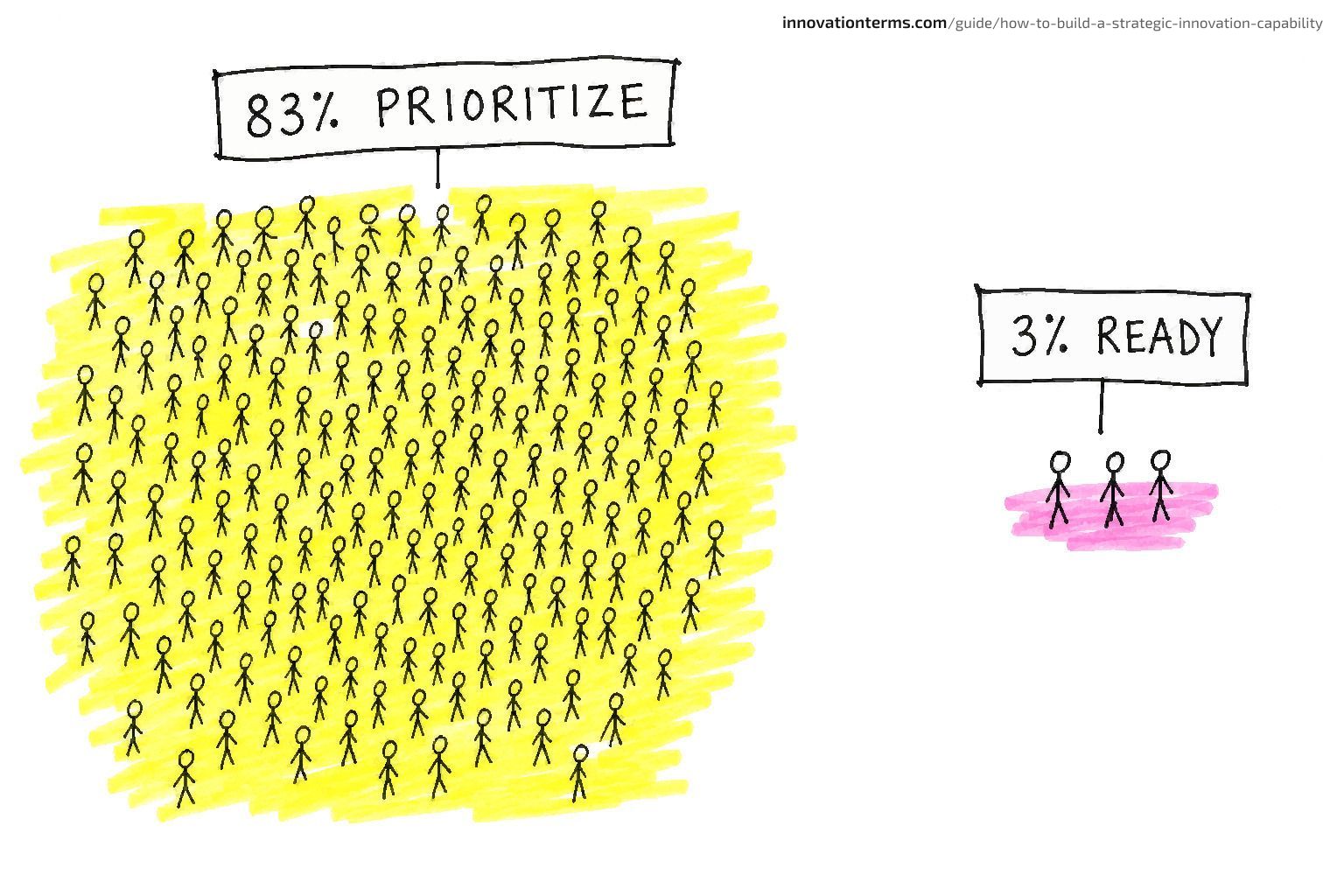
Enthusiasm is abundant. Standing infrastructure is rare. The 2025 HYPE State of Corporate Innovation report reaches the same place from survey data: 80% of organizations concentrate on early-stage ideation while 30% or fewer advance concepts into deployed solutions. Ideas are not the bottleneck. The governed path from idea to outcome is.
The recent scale-failure research adds the mechanism. In HBR’s March 2026 analysis of why great innovations fail to scale, the authors find that as initiatives depend on collaboration across groups, they stall because “the partnerships meant to deliver them break down.” A one-off program is precisely the arrangement with no durable partnership: it borrows attention, spends it, and dissolves. There is no standing owner to hold the cross-boundary seams together when the launch energy fades.
The andon cord, a length of rope strung along a factory line so any worker can stop the operation the instant something looks wrong, has unnerved visiting executives for nearly a century. Pulling it once proves nothing. What matters is the standing system behind the cord, the one that responds every time. A hackathon is a cord pulled once, for show. A capability is the machinery that catches what the cord surfaces, funds it, ships it, and repeats until stopping the line stops being an event.
What should you build first, governance or culture?
Build governance first. Culture is the residue of a working governance spine. Build the decision-and-funding structure first and the behaviors leaders want will arrive without a mandate. A decision-and-funding structure produces the behaviors leaders wish they could install directly. A culture campaign launched into a governance vacuum produces enthusiasm that evaporates at the next reorg.
In McKinsey’s 2008 survey, senior executives were near-unanimous that culture drives innovation:
Senior executives almost unanimously—94 percent—say that people and corporate culture are the most important drivers of innovation. — McKinsey Quarterly, Leadership and Innovation (2008)
Culture is not optional. It is the wrong first move. Note what that 94% measures: belief. It is attitudinal data, not outcome data. A falsification search for this piece found no longitudinal study showing culture-led programs institutionalize at higher rates than governance-led ones. The strongest pro-culture number on record is a survey of what executives think works.
The 2025 HYPE report contradicts the culture-first position with more specific data, finding that leadership tends to focus on culture while, in its words:
few set the strategy or provide structure, resources, and accountability — HYPE Innovation, 2025 State of Corporate Innovation Report
Leaders reach for the lever they believe in (culture) and skip the levers that actually gate outcomes (strategy, structure, resources, accountability). The result is the ad-hoc regression the failure literature keeps describing. This guide’s downstream siblings on building a culture of experimentation and the innovation culture health score are not in tension with this claim. They describe what to reinforce after the spine exists. Sequencing is the argument, not culture denial.
How do the components fit as a build order, not a checklist?
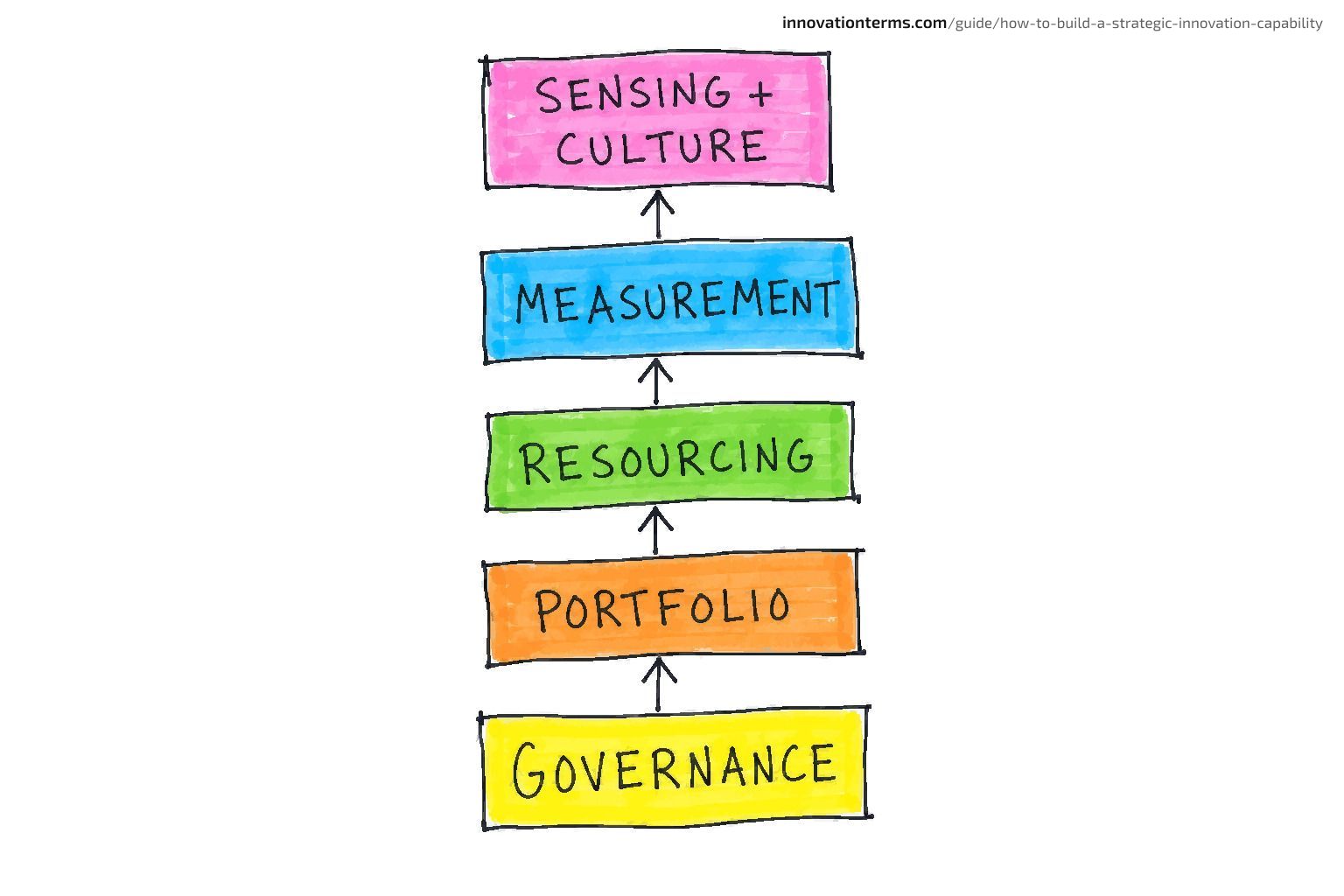
Reframed as an innovation operating model, the components stop being a flat menu and become an ordered stack: a governance layer decides and funds, a portfolio layer allocates across risk, a resourcing layer staffs and tools the work, a measurement layer closes the loop, and a sensing-and-culture layer keeps the whole thing pointed outward. Each layer runs on the one beneath it. That dependency is why order matters.
Every competitor on this search result presents the same parts as a simultaneous checklist. The Innov8rs seven factors name overlapping components, as does the ISO 56002 management-system standard. The MIT Sloan account names “the eight core principles of strategic innovation,” and tellingly, culture is not one of the eight. The problem is never the inventory. It is the implicit claim that you assemble the parts in parallel. You cannot. A portfolio process with no funding gate is a spreadsheet. Metrics with no decision rights attached are a dashboard nobody acts on.
| Layer (build order) | Innov8rs seven factors | MIT Sloan "eight principles" | What it decides |
|---|---|---|---|
| 1. Governance | Strategic alignment, governance | Defined domains of intent, permanent function | Who funds and kills |
| 2. Portfolio | Structure, function, design | Portfolio of opportunities, four uncertainties | Where bets go |
| 3. Resourcing | Environment, motivation | Discovery-incubation-acceleration roles | Who builds |
| 4. Measurement | Metrics | Tuning the innovation function | What advances |
| 5. Sensing + culture | Culture, common language | Common language | What stays pointed outward |
Govindarajan and Trimble make the same case more bluntly in Beyond the Idea, arguing that companies overspend on the front end:
Innovation is a two-part challenge. Part one is ideas; part two is execution. — Govindarajan & Trimble, Beyond the Idea (2013)
Ideas are cheap. The spine is execution. That is why the build order starts at governance, not at the culture and common-language items every menu lists last and every failed program installs first.
Step 1: How do you install governance?
Governance is the decision-and-funding layer: named people with the authority to fund, advance, or kill innovation bets against explicit criteria, tied to the corporate strategy so that what gets funded reflects where the company is actually going. Without it, a portfolio accretes pet projects and a program has nowhere to send its winners. Install it first because every later layer inherits its authority.
Start with three decisions.
Who decides
Name the gatekeepers and their authority explicitly. The alternative is the mess Rita McGrath describes when you audit a typical corporate portfolio:
if you pick up the lid on a corporate portfolio it’s typically a mess, somebody’s pet duck from four CEOs ago — Rita McGrath, “Creativity & Innovation in Corporate Venture” (2022)
A pet duck survives because no gate ever killed it. A zombie project is an initiative that fails every stated criterion but is never formally killed, so it keeps drawing budget and headcount long after anyone believes in it. Decision rights are what make a kill possible.
How funding gates work
Robert Cooper’s Stage-Gate model has been the near-canonical reference since the 1980s, and its core mechanism is what Cooper calls “gates with teeth”: named gatekeepers, explicit go/kill criteria, and rules for which projects keep their funding at each stage. The mechanics are decades old. What most programs skip is the discipline behind them, because a gate with no real kill option is just a status meeting with better branding. Amazon’s PR-FAQ process is the gate reduced to its barest form: an idea has to survive a one-page press release and a short FAQ before a single resource is committed, and most PR-FAQs die right there, unlaunched. That is filtering before funding, doing exactly the job it was built for.
How it aligns to strategy
The stronger the alignment between gate criteria and strategic intent, the less the portfolio drifts toward whoever argues hardest in the room. Governance is not bureaucracy. It is the mechanism that lets you say no to a well-liked idea because it does not fit, and yes to an awkward one because it does.
Step 2: How do you build the portfolio?
The portfolio layer allocates innovation resources across time horizons and risk classes, sitting on governance because allocation without enforced gates is aspiration rather than constraint. Near-term extensions and longer-horizon bets require different funding structures and oversight cadences, and the layer exists to manage that differentiation.
The reference framework is McKinsey’s Three Horizons, from The Alchemy of Growth: Horizon 1 defends and extends the core, Horizon 2 builds emerging businesses, and Horizon 3 creates viable options for the future. Ambidexterity research explains why you cannot run all three the same way. O’Reilly and Tushman define organizational ambidexterity as the ability to pursue incremental and discontinuous innovation at once by “hosting multiple contradictory structures, processes, and cultures within the same firm.” Explore and exploit need different architectures, which is a portfolio-design decision, not a motivational one.
| Horizon | Focus | Typical allocation | Risk class |
|---|---|---|---|
| Horizon 1 | Defend and extend the core | ~70% | Low, incremental |
| Horizon 2 | Build emerging businesses | ~20% | Medium, adjacent |
| Horizon 3 | Create future options | ~10% | High, discontinuous |
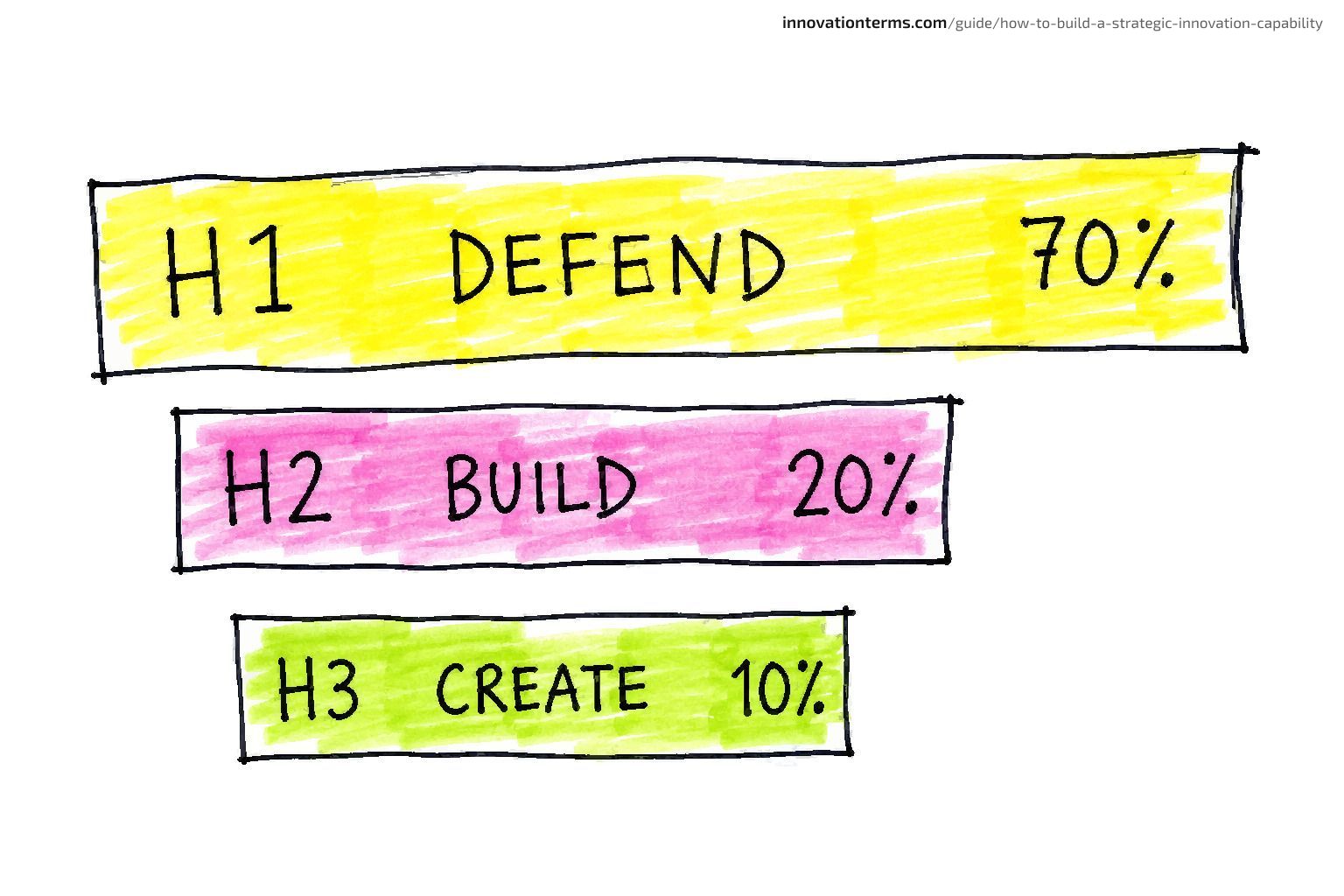
The 70/20/10 split is a popularized heuristic that postdates The Alchemy of Growth. Treat it as the default anyway: run it until a specific constraint says otherwise. Varun Parmar, CPO of Miro, describes governing Miro’s portfolio on roughly that split across the three horizons. The mechanism that keeps Horizon 3 from starving is the gate, not goodwill: ring-fence the 10% so it cannot be raided to hit a Horizon 1 number in a bad quarter. Starvation of the future is a governance failure disguised as prudence.
Step 3: Which resourcing model, and where does AI fit?
The resourcing layer decides who does the work: a dedicated central team, a federated model where business units own delivery, or a hybrid. Choose by portfolio size, funding maturity, and regulatory risk. Then tool the model, and note that AI changes what resourcing costs without changing the governance spine that decides where it points.
Name the criteria before recommending, then commit to a rule. The axes below track the same portfolio-size and funding-maturity logic ITONICS uses for build-vs-buy-vs-partner decisions.
| Criterion | Points to dedicated | Points to federated | Points to hybrid |
|---|---|---|---|
| Portfolio size | Under ~10 initiatives | 15–20+ or 3+ business units | Growing across units |
| Funding maturity | New, needs protection | Established per-unit budgets | Mixed |
| Regulatory risk | High, needs central control | Low, distributed is safe | Sector-dependent |
The decision rule: default to a dedicated team when the capability is young and needs shelter, shift toward a federated model as the portfolio scales past a handful of units, and run a hybrid hub-and-spoke once both a central standard and local delivery are needed. Named proof points anchor each end. 3M’s long-running 15%-time model is federated resourcing, distributing innovation effort across the workforce. Govindarajan and Trimble’s Dedicated Team plus Performance Engine model is the centralized end, each initiative run with its own plan and scorecard. A fourth lever sits outside all three: P&G’s Connect+Develop program sourced roughly half its innovation externally, treating open innovation as a resourcing choice rather than a culture initiative. This is the same choice the federated-innovation model formalizes.
AI shifts the cost curve of the resourcing layer, not its logic. McKinsey’s State of AI survey, reported in March 2026, found:
23% of organizations are actively scaling an agentic AI system in at least one business function. — McKinsey State of AI survey, reported in Forbes (March 2026)
No more than 10% of respondents were scaling AI agents broadly. That is adoption maturity, not a headcount-savings figure. The practical read: agentic tooling can lower the marginal cost of running discovery and analysis, which is why teams are using AI for innovation work, but it does not decide which bets deserve funding. The gate still does that.
How do you measure the capability?
Measurement is the layer that tells you whether the spine is working, split into leading indicators (activity that predicts future outcomes) and lagging indicators (results that confirm past ones). Lead with leading metrics, because they are the ones a governance function can act on in time to change the result. Report both to the people holding the gates.
Zizlavsky’s Innovation Scorecard provides the structure, building on an input-process-output-result chain that treats inputs and process as leading signals and outputs and results as lagging ones. A dashboard heavy on lagging revenue numbers tells you what already happened when it is too late to steer.
| Type | Example metrics | What it answers |
|---|---|---|
| Leading | Idea-to-pilot velocity, funded-gate throughput, share of portfolio in each horizon | Is the machine moving? |
| Lagging | Revenue from products launched in the last 3 years, portfolio survival rate | Did the machine pay off? |
87% of organizations name turning ideas into outcomes as their top obstacle, per the same HYPE 2025 survey cited above — a leading-indicator failure, not an ideation shortfall. No lagging revenue report will diagnose jammed idea-to-outcome throughput regardless of how frequently it runs. Wire the leading metrics into gate reviews so the innovation feedback loops actually close, then give the CFO one lagging number that survives scrutiny.
How do sensing and culture hold the spine together?
Sensing and culture are the outward-facing layer: a standing practice of watching for change at the edges, plus the leadership behaviors that keep the governed system honest. This layer comes last in the build order because it amplifies a working spine already in place. Sensing feeds the portfolio new signals. Culture keeps gatekeepers from defaulting to safe bets.
Sensing is the discipline of noticing inflection points early. Rita McGrath frames it as being “present at the edges,” where change shows up before it is obvious in the numbers. Institutionalized as a standing continuous-foresight practice, sensing is what keeps Horizon 3 supplied with real options instead of last year’s assumptions. It is a subsystem, not a mood.
Culture enters as the reinforcement layer: once gates, portfolio, and resourcing exist, the behaviors leaders wanted (candor about killing projects, tolerance for intelligent failure, willingness to fund the awkward Horizon 3 bet) become rational responses to a system that rewards them. Culture is what a working spine produces and then, in turn, sustains. A dedicated culture-of-experimentation practice belongs downstream of this point, reinforcing the spine, never standing in for it.
What are the maturity stages and how do you assess yours?
Innovation capability maturity moves along a four-stage arc, and the useful skill is spotting the regression that pulls each stage back toward the one before it. An innovation capability maturity model is a diagnostic you apply after you know the build order. Assess your stage by asking what breaks when leadership attention moves elsewhere.
The academic anchor is the Innovation Capability Maturity Model. Published by Essmann and du Preez in 2009, it defines a five-level ladder from Level 1 “Ad hoc and limited” through Level 3 “Formalisation and predictability” to Level 5 “Integration, synergy and autonomy”. This guide compresses those five into four named stages for clarity; the mapping is close, with the ICMM’s two intermediate levels folded into the managed stage.
| Stage | What good looks like | Regression trigger (what pulls it back) |
|---|---|---|
| Ad hoc | Sporadic projects, no owner | Default state; any lull ends the activity |
| Project-based | Repeated programs, still event-shaped | Reorg dissolves the borrowed team |
| Managed / governed | Gates, portfolio, funded owner | Budget cut raids the ring-fenced future bets |
| Institutionalized | Capability survives leadership change | Complacency; sensing atrophies, options dry up |
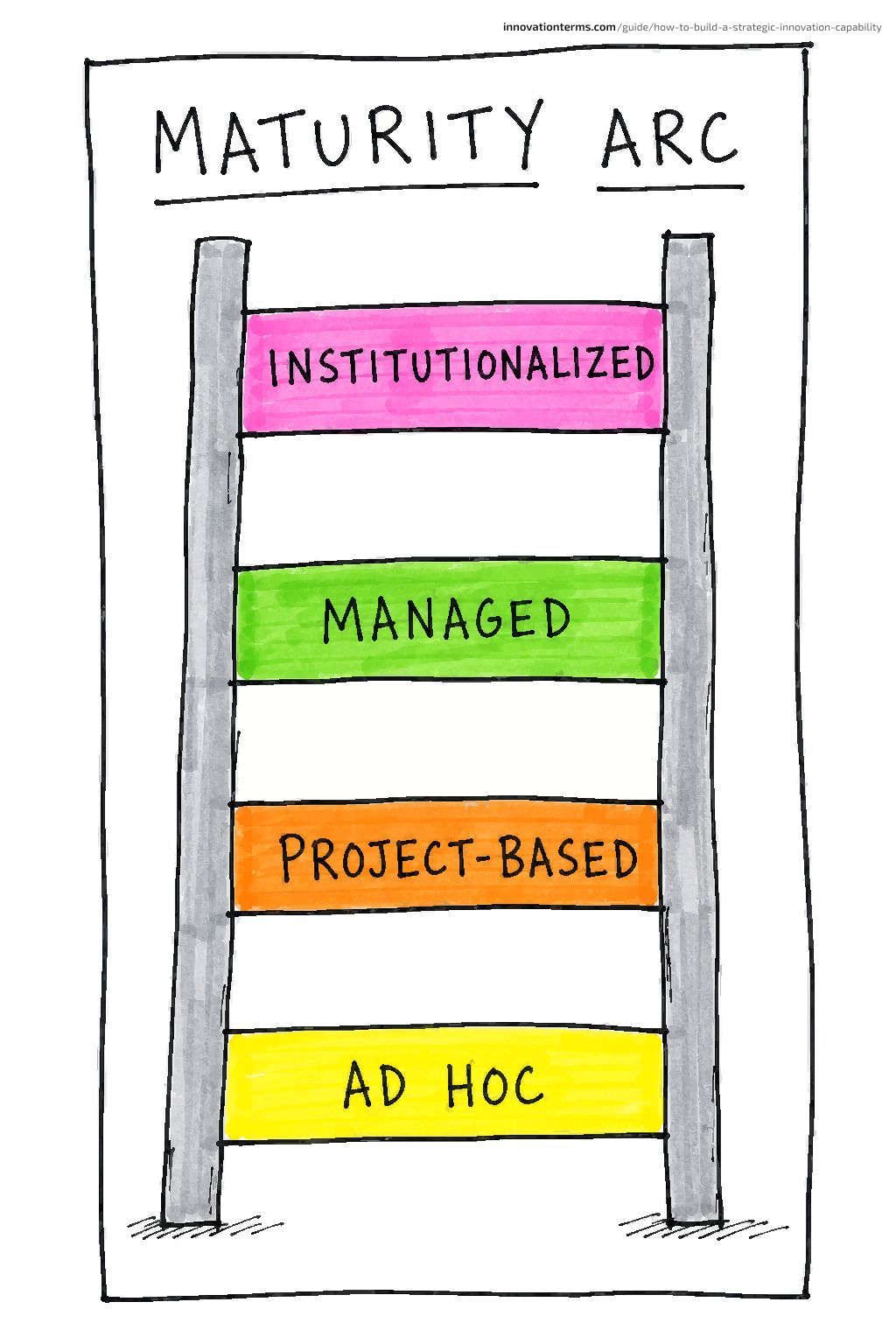
Programs fail at predictable transitions. Project-based collapses back to ad hoc when a reorg dissolves the team that had no permanent home. Managed collapses when a bad quarter raids the Horizon 3 allocation because no rule protected it. HBR’s 2026 scale-failure work names the cross-boundary version of this collapse: the partnerships meant to deliver break down when no standing owner holds them together. To run a real innovation capability assessment, place yourself on the arc and then look one step down: the regression trigger for your current stage is the specific thing to defend against, and the next subsystem from §5 to §9 is what you build next.
What are the common misconceptions?
Installed capability requires governed infrastructure, decision rights, and funded gates. Workshops and rising idea counts are treated as proxies for that infrastructure, though neither one builds it. Each is contested by evidence already established above.
- “Culture change is the fastest lever.” It is the slowest. It is also the most reversible, which means culture installed without underlying structure tends to disappear at the first reorg, leaving no trace in the system it was ever there.
- “More ideas means more innovation.” Wrong direction. HYPE 2025 shows 80% of effort pooled at ideation while 30% or fewer of concepts reach deployment, a ratio that points to a blocked pipeline rather than a thin one. Adding volume to an ungoverned path makes the jam worse.
- “An accelerator or lab equals a capability.” Actually a standalone unit with no governed home is theater. Steve Blank’s coinage is exact: what innovation theater usually produces is
coffee cups, lanyards, posters, and very little output that moves the top or bottom line — Steve Blank, “Innovation Theater” (2022)
If nothing is shipping, the activity is theater regardless of how it feels.
It cannot, and the mechanism is almost physiological. A capability accumulates institutional knowledge the way a body accumulates scar tissue: which patterns failed, which gatekeepers can be trusted, which Horizon 3 bets are worth the wait, and that accumulated context is the actual compounding asset. The practitioner literature calls this “a repeatable and measurable competence, not a series of isolated events”, a tidy way of saying it is a system rather than a stunt. Programs that reset with every new engagement pay the same tuition twice, without ever noticing the bill. Call it contextual debt: the knowledge a program discards at each reset does not vanish so much as it goes owed.
When does spine-first not apply cleanly?
Spine-first is the right default for a standing enterprise innovation function, but three boundary conditions bend it. Small or early-stage organizations, heavily regulated industries, and companies mid-reorg each change what “install governance first” means in practice. The sequence holds; the weight of each layer shifts.
Small and early-stage organizations
A ten-person company does not need a stage-gate committee. Here the governance layer collapses down to a single funding decision, made by the founder, usually somewhere between the coffee machine and the next meeting. Heavy portfolio machinery at that scale is not rigor; it is a costume borrowed from a much larger company. The principle survives (someone, somewhere, has to own the gate) but the apparatus is one person, not a function. No dedicated small-org study backs this. It’s the enterprise governance logic applied at its floor: one accountable founder is the gate a committee would be at any larger scale.
Regulated industries
In pharma or financial services, a governance spine already exists, imposed by the regulator, before any innovation choice is made. ISO 56002 is explicit that an innovation management system runs through leadership, planning, and operation clauses, with culture as a support element rather than the organizing spine. In these sectors the spine-first argument is almost redundant: the constraint is pre-installed, and the real work is fitting the portfolio and resourcing layers into a governance structure you did not get to design.
Mid-reorg and post-M&A
When an acquisition or reorg tears up the spine mid-stream, the contextual-debt risk spikes: accumulated judgment walks out the door, and the rebuilt gate has to relearn what the old one knew. The move is to preserve decision-rights continuity through the transition even when the org chart is in flux, because the spine is harder to rebuild than to protect.
By the numbers: what does the capability gap look like?
The gap is structural, not motivational, across three independent surveys. 83% of executives rank innovation a top-three priority, yet only 3% of companies qualify as “innovation ready.” 87% name turning ideas into outcomes as their top obstacle. Priority is universal. Readiness has collapsed.
McKinsey’s 94% culture-belief figure is the outlier that proves the point: it measures what executives think works, not what does. The cost of skipping the spine is measurable, and Walmart Store No. 8 is what it looks like in practice.
Mini-case: what does skipping the spine cost?
Walmart Store No. 8 is the cautionary case: a well-funded standalone innovation lab that produced activity for seven years and then closed when the budget tightened, because it never had a governed home in the core business. It is the resourcing-and-governance failure mode made concrete, a lab without a durable spine to land its work.
Walmart shut Store No. 8 in January 2024, seven years after launch, reassigning roughly 300 staff back into the governed core. Retail Dive’s reporting on the closure is corroborated by Forbes, where Andrew Binns noted Walmart’s move joined GM and Intel in shuttering innovation units, raising the concern that short-term budget cuts were killing innovation. Two independent sources corroborate the timeline and the framing.
A well-resourced lab with no governed output path to the core business is structurally easy to cut. Store No. 8 was built as a separate bet, a classic dedicated-team arrangement, and dedicated teams survive only as a managed partnership with the core business, the arrangement Govindarajan and Trimble describe, where every initiative has a home address and a scorecard tied back to headquarters. A separate unit with no governed path for its outputs to reach the rest of the company is exactly the structure that looks like innovation from a distance and ships almost nothing up close — the theater Blank names. When the budget cycle turned, there was no institutionalized gate standing up to argue for it. There was only a cost line. Cost lines do not get a vote.
Map it onto the regression arc from the maturity section: Store No. 8 sat at “project-based,” an impressive standing program that never crossed into “managed/governed” with decision rights durable enough to survive a down quarter. The spine was the missing piece, and skipping it cost seven years and a 300-person team. That is the price the rest of this guide is written to help you avoid.
TL;DR
- A strategic innovation capability is a standing system, governance, portfolio, resourcing, measurement, and culture, that ships bets repeatably.
- Build it spine-first: governance and portfolio and resourcing before culture.
- Culture is a lagging indicator of a working system, not the lever that builds it.
- Programs regress because outputs have no governed home. The capability supplies one.
- Assess maturity on the ad hoc to institutionalized arc, then defend the regression trigger for your stage.
FAQ
What is a strategic innovation capability? It is the standing organizational system of governance and portfolio management that turns novel bets into shipped outcomes repeatably. It is owned and funded like any operating function, and it holds across budget cycles and leadership changes as a permanent organizational asset.
What’s the difference between an innovation strategy, a program, and a capability? An innovation strategy is a plan for where to place bets. A program is a time-bound event, a hackathon or accelerator, that produces a burst of activity. A capability is the standing machinery that executes many bets over time. Strategy points, programs spike, only the capability compounds.
What should you build first, governance, culture, or a portfolio process? Governance, because decision rights and funding gates are what every other layer of the system borrows its authority from. Culture tracks a working system. It does not create one. Build the spine first.
What are the stages of innovation capability maturity, and how do you know your stage? The arc runs ad hoc, project-based, managed/governed, and institutionalized. To place yourself, ask what breaks when leadership attention moves elsewhere. If a reorg would dissolve your team, you are project-based. If a bad quarter would raid your future bets, you are managed but not yet institutionalized.
Why do most innovation programs fail to sustain past the first year or two? Because their outputs have no governed home and no funded path into the core business. Without a standing owner to hold the cross-boundary seams together, programs dissolve when borrowed attention runs out. HYPE 2025 data shows the jam is at idea-to-outcome throughput, not idea supply.
Should you resource a dedicated team, a federated model, or both? Start dedicated. Portfolio size, funding maturity, and risk tolerance all shift the answer over time, with federated delivery becoming viable only once the portfolio spans multiple business units and the capability is stable enough to survive distribution without losing coherence.
What metrics prove the capability is working, and what convinces a CFO? Lead with leading indicators: idea-to-pilot velocity and funded-gate throughput, which predict results in time to act. Pair them with one credible lagging number, revenue from products launched in the last three years, for the CFO. A full CFO-facing budget case is its own topic beyond this guide’s scope.

Mikkel @mkl_vang
Covers operational innovation, AI implementation patterns, and how teams ship useful change without theater.