

Da Vinci, Edison, and Tesla top most ranked lists of innovation leaders. The list tells you who crossed the finish line. It does not tell you what decisions got them there. The constraints that shaped those choices, and the failure modes that would have stopped a less fortunate version of the same leader, remain invisible.
The innovation leadership profiles are organized around one question: what decisions did each constraint regime force, and what did those decisions cost? That question is what practitioners can actually use. An innovation manager at a 200-person company cannot replicate Steve Jobs's vertical integration control. But they can study how constraint-driven standardization forces a specific decision architecture. Grace Hopper's case makes that mechanism visible in ways most profiles do not.
The collection spans historic figures and contemporary practitioners because constraint regimes recur across eras. Grace Hopper's 1952 hardware limitation and the regulatory constraint a biotech team faces today are different problems. The underlying decision pattern (standardize against short-term resistance to survive the long game) is structurally the same. Use the tag filter to route by constraint type. The profiles are where the analysis lives.
TL;DR
- These profiles are structured around decision architecture: which constraints forced which choices, and where the method broke.
- Historic innovators (Galileo, Hopper, Jobs) serve as maximum-constraint case studies with fully documented causal chains, including failures.
- A 6-year study of 3,500 executives found innovative CEOs spend 50% more time on discovery activities than non-innovative peers. That behavior transfers. The biography does not.
- 83% of companies say innovation is a top-three priority. Only 3% are ready to translate priorities into results. The gap is leadership behavior.
- Use the tag taxonomy as a constraint-regime router: find the profile whose constraint type matches your challenge, not the one whose industry matches.
These profiles are a decision-architecture library, not a hall of fame. The research confirms what biography hides: the behaviors that produce innovation are specific, measurable, and transferable — the constraints that shaped them are not. Matching your constraint type to the right profile is the discipline the collection is built to support.
What Is an Innovation Leader?
Innovation leadership is a distinct practice from general management. It is not invention. That distinction is the entire point, because it determines what is actually worth studying.
A general manager improves known conditions. An inventor makes the discovery. An innovation leader's primary job is changing the context that makes a discovery viable as a system — per Kremer, Villamor & Aguinis (2018). The same discovery can sit inert for decades under one leader and scale rapidly under another. The innovation is the adoption, not the discovery, as Carmeli, Gelbard & Gefen (2010) established empirically.
Kremer, Villamor & Aguinis, whose 2018 Business Horizons review carries over 400 citations, define innovation leadership as requiring active facilitation of creative environments, not directing execution. Carmeli, Gelbard & Gefen established the empirical link: CEO visionary innovation leadership improves connectivity among knowledge workers, which then drives firm innovation outcomes.
Three practical boundaries:
- Innovation leader vs general manager. The manager improves known conditions. The innovation leader makes decisions under genuine uncertainty, where the right answer is not established and must be constructed.
- Innovation leader vs inventor. The inventor makes the discovery. The innovation leader absorbs the institutional risk required to get that discovery adopted. Hopper's compiler was the discovery. Her years-long fight for machine-independent code to become standard practice was the innovation leadership — the distinction Kremer et al. identify as innovation leadership's defining characteristic.
- Innovation leader vs innovation manager. An innovation manager administers a process: ideation funnels, stage-gate reviews. An innovation leader reshapes the process when it stops working. These profiles cover the latter, per the multi-component practice framework.
What Does Every Ranked List of Innovators Get Wrong?
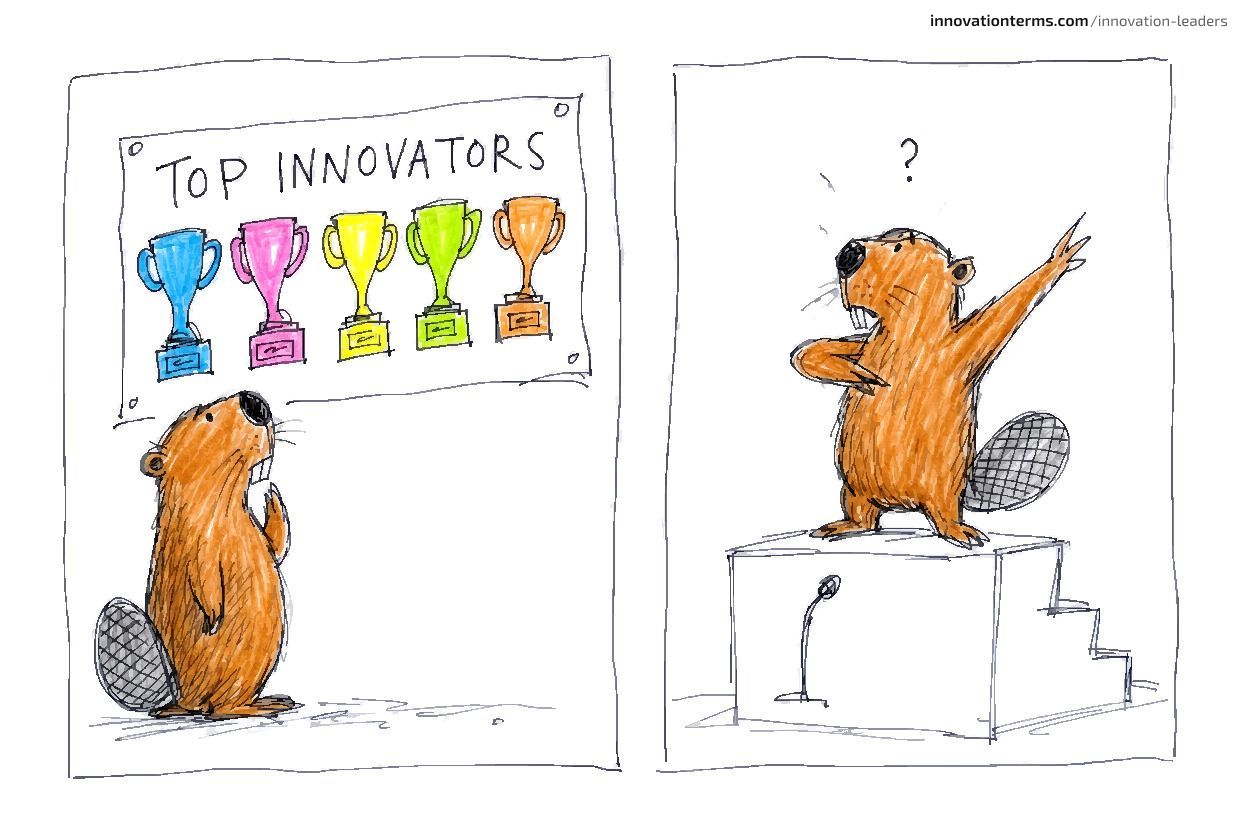
Every ranked list of great innovators is a map of finish lines, not a training plan, and teams that study outcomes without studying decision architecture learn nothing transferable — a structural failure both Phil Rosenzweig and Daniel Kahneman have documented from different angles.
Outcome-Focused Profiles Teach What Was Built, Not What Was Decided
Biography paragraphs, achievement lists, and trait inventories show the chosen outcome with alternatives edited out. It does not show you the constraint that forced the decision that produced it. Remove the constraint, and the lesson becomes circular: Jobs succeeded because he had vision. How do you get vision?
Daniel Kahneman documented the cognitive mechanism:
"Leaders who have been lucky are never punished for having taken too much risk. Instead, they are believed to have had the flair and foresight to anticipate success, and the sensible people who doubted them are seen in hindsight as mediocre, timid, and weak. A few lucky gambles can crown a reckless leader with a halo of prescience and boldness."
— Daniel Kahneman, Thinking, Fast and Slow
Phil Rosenzweig named the decision-context problem:
"When managers, when leaders are making decisions in real-world settings, those kinds of controls don't exist. You're not just selecting options that are presented in front of you. You can actually change the options... You oftentimes also have a competitive dimension."
— Phil Rosenzweig, EconTalk
The options available to an innovation leader are not given. They are constructed under competitive, institutional, and resource constraints specific to that moment. Rosenzweig documented the practical cost in a case he returned to: a CEO told him directly that when the key decision arrived, "I used the wrong case study." The case felt analogous. It was not.
Biography gives you the chosen option with alternatives edited out.
Trait Inventories Mistake Correlation for Method
Dyer, Gregersen & Christensen's 6-year, 3,500-executive study found that innovative CEOs spend 50% more time on discovery activities than non-innovative peers. That is a behavioral difference. Personality traits don't change. Time allocation does.
Andrew Grant named the selection problem directly:
"We won't hear about him because it's survivorship bias. So you own, this is the danger of us worshipping these sort of entrepreneurs and thinking we can create a, you know, they go on and they do their TED talk and they come up with their five stages of how they were successful."
— Andrew Grant, Uncomfortable Conversations with Josh Szeps
The five stages work only if the leader survived long enough to give the talk. Every equally committed innovator whose method was sound but whose context turned against them is absent from the dataset. You do not study them because you cannot find them.
How Are These Profiles Built — the Decision Architecture Frame?
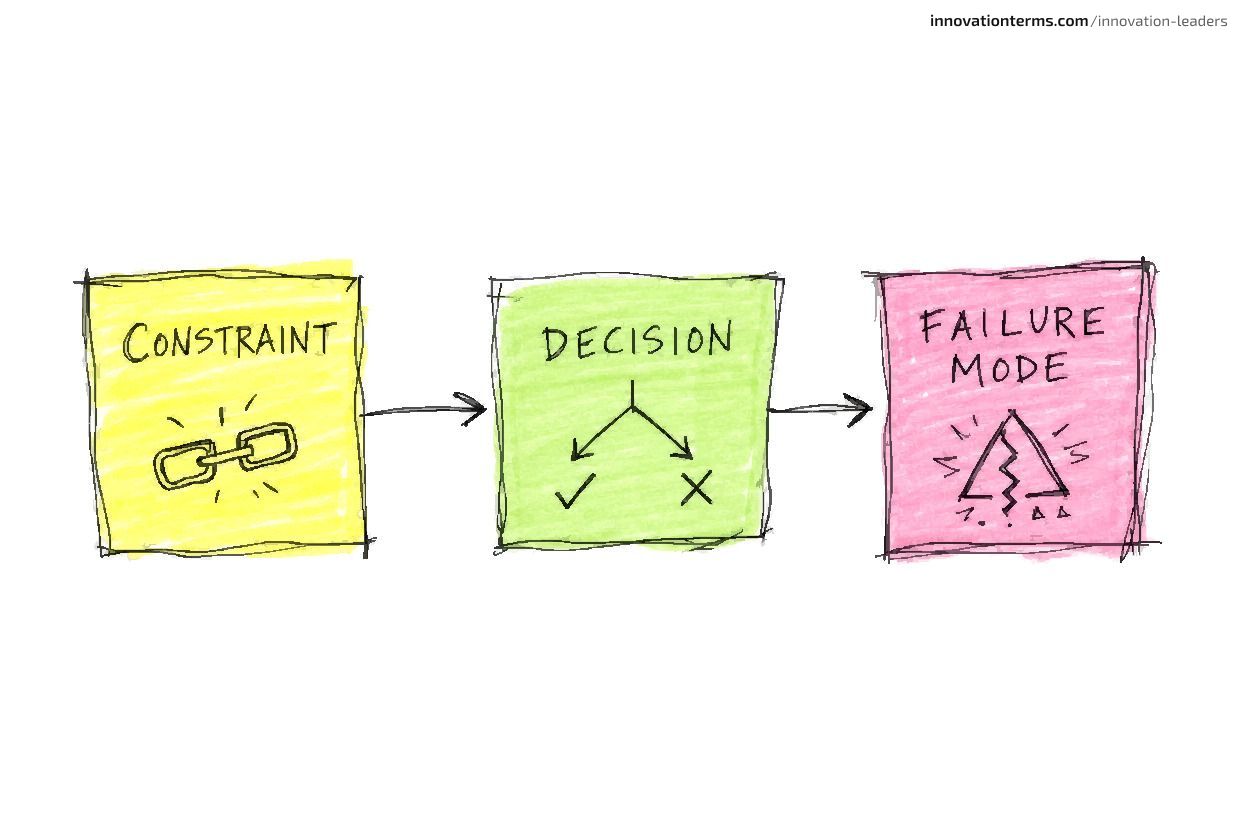
Dyer, Gregersen & Christensen identified five discovery behaviors that innovative leaders practice at measurably higher rates, with questioning and associating as the most empirically distinct. These map directly onto decision-architecture analysis: associating recognizes a constraint from one context as applicable in a different domain, a transfer that requires absorptive capacity (the prior knowledge that lets an organization recognize outside information as usable). Networking builds the coalition that absorbs the institutional cost of the decision.
Linda Hill's 2026 research with co-authors Tedards and Wild reaches the structural conclusion: leading innovation means creating culture and capabilities that make people want to co-create the future, not presenting a vision and directing people toward it.
Each profile is a record: how a specific leader created or failed to create the conditions for innovation under specific constraints. Wartime urgency produces different conditions than platform-building use. That difference is the transferable lesson, not the personality, not the era, not the industry.
Why Are Historic Innovators the Most Useful Constraint Labs?
Historical distance is analytical advantage. For Galileo Galilei, Grace Hopper, and Steve Jobs, the full causal chain (decision, consequence, cost, and failure mode) is documented. No contemporary figure offers that completeness. The outcome is still unresolved for most leaders working today.
Galileo under Institutional Resistance
Galileo's constraint was institutional: a legitimacy apparatus controlled by theological authority that evaluated scientific claims against doctrinal compatibility, not empirical evidence. The binding constraint was not lack of evidence. The Starry Messenger (1610) was compelling. The binding constraint was who controlled the legitimacy of scientific claims — the same pattern Kremer, Villamor & Aguinis identify as the core challenge in institutional-resistance constraint regimes.
The decision architecture this forced: build patronage networks that provide institutional cover to publish. Avoid direct doctrinal confrontation long enough to establish empirical precedent. Absorb the cost of recantation if the patronage fails. These were calculated responses to a specific power structure.
Modern practitioners in organizations where innovation proposals require senior-leadership sign-off and legal review face the structurally identical constraint. The pattern (build the evidence base before the approval process starts; identify who can provide institutional cover) is directly transferable, per the Business Horizons review.
Grace Hopper under Hardware Constraint
Grace Hopper's 1952 machine-independence work and the COBOL standardization campaign are the subject of the §10 mini-case and the Grace Hopper profile. The full decision arc (what the constraint forced, what standardization cost, and what transfers) is documented there.
Why Do Contemporary and Historic Innovation Leaders Belong in the Same Collection?
Constraint regimes recur. The specific technologies and institutions differ across centuries. The underlying decision patterns do not. That structural continuity is the argument for a collection that spans Galileo Galilei and Lê Anh Sơn in the same index.
Innovation360's research across 2,900 companies over 52 months found that radical innovators apply multiple leadership styles simultaneously and switch between them as the constraint regime changes. Single-style organizations show higher failure rates — confirmed across two separate publications from the same dataset. No single method works across all constraint types.
The constraint mapping that connects historic and contemporary profiles: institutional-resistance profiles (legitimacy-building as the primary constraint) pair Galileo Galilei with Ngô Tuấn Anh. Hardware and resource-scarcity constraint maps to Grace Hopper and Lê Anh Sơn. Platform-building with value-chain control pairs Steve Jobs with Nguyễn Tử Quảng. Scientific legitimacy under uncertainty links Galileo with Uğur Şahin & Özlem Türeci. Agricultural and food-system constraints span Damian Józefiak, Stefan Palzer, and Przemysław Żelazowski.
The constraint mapping is a routing tool. If your challenge involves platform-use decisions, the Jobs and Ngô Tuấn Anh profiles give you structurally similar decision architecture in two different institutional contexts. Wharton's analysis documents exactly what made Jobs's method work and why it doesn't transfer without the structural preconditions. The Technology cluster profiles name what preconditions each approach requires.
What Does the Research Say about How Great Innovators Actually Operate?
The most rigorous large-scale study of this question is Dyer, Gregersen & Christensen's six-year, 3,500-executive research. Innovative entrepreneurs who also serve as CEOs spend 50% more time on discovery activities (questioning, observing, experimenting, and networking) than CEOs with no innovation track record.
Dyer et al. compared CEOs at companies with unique value propositions against a matched control group of equally successful non-innovative CEOs. The innovative group did not score differently on personality measures. They allocated time differently.
Huang et al.'s 2022 meta-analysis in Frontiers in Psychology adds the organizational layer:
"The production of ideas positively impacts leadership, leading to growth and competitive advantage for the organization."
— Huang et al., Frontiers in Psychology (2022)
McKinsey's survey across 2,500+ executives in 300+ companies found that senior leaders most commonly inhibit innovation by performing interest without modeling it. Active opposition is the rarer pattern.
What Do the Numbers Say about Innovation Leadership?
The quantitative picture is consistent across independent large-sample studies. The leaders producing outsized results behave differently in specific, measurable ways.
| Statistic | Source | Sample | Year |
|---|---|---|---|
| Innovative CEOs spend 50% more time on discovery activities | Dyer et al., HBR | 3,500 executives | 2009/2011 |
| 83% of companies say innovation is a top-three priority; 3% are ready to execute | BCG 2025 | 1,500+ executives | 2025 |
| Serial innovators outperform broader market by 2.4 pp annually (TSR) | BCG 2025 | 50 companies, 20-year track | 2025 |
| SMEs with multiple simultaneous leadership styles outperform single-style organizations in radical innovation | Innovation360 | 2,900 companies, 52 months | 2020 |
| ~80% of innovative ideas implemented by employees, not directed by leaders | Huang et al., PMC | Academic R&D | 2022 |
| >70% of executives say innovation will be a top growth driver in the next 3–5 years | McKinsey | 2,500+ executives | 2008 |
| Only 12% of executives say their company has a strong link between business strategy and innovation strategy | BCG 2025 | 1,500+ executives | 2025 |
The BCG (2025) finding is the most operationally significant entry. 83% of companies say innovation is a top-three priority. Only 3% are ready to translate priorities into results. That is a leadership behavior gap.
The Huang et al. figure reframes what to measure. If 80% of innovative ideas come from the organization rather than the leader, evaluating leadership quality by counting leader-generated ideas measures the wrong variable.
The Innovation360 multi-style finding grounds the tag routing logic in this collection. Matching the constraint regime before drawing on a profile is the discipline the taxonomy is built to support.
How Do You Use the Tag Taxonomy to Find the Right Example for Your Context?
The tag clusters here are constraint-regime routers. Technology groups profiles where the binding constraint was technical or platform-based. Science groups profiles where it was legitimacy-building under epistemic uncertainty. Biotechnology, Agriculture, AI, and Cybersecurity tags narrow the constraint regime further.
| If your challenge involves... | Start here | Profiles to check |
|---|---|---|
| Technical standardization or platform decisions | Technology | Hopper, Jobs, Ngô Tuấn Anh |
| Scientific legitimacy under uncertainty | Science | Galileo, Şahin & Türeci, Andrysiak |
| Agricultural and food innovation | Agriculture, Food & Beverage | Żelazowski, Palzer, Józefiak |
| AI in regulated sectors | AI, Cybersecurity | Lê Anh Sơn, Nguyễn Tử Quảng |
| Internal institutional resistance | Leadership, Historic | Galileo, Hopper — full causal chains documented |
The Cauldron style (productive in crisis, Horizon 2) is a different constraint match than the Explorer style (Horizon 3, large-scale plans), per Innovation360's five-style taxonomy. Matching the constraint regime before drawing on a profile is the core discipline the taxonomy supports.
What Are the Most Common Misconceptions about Innovation Leaders?
"Great Innovators Work Alone"
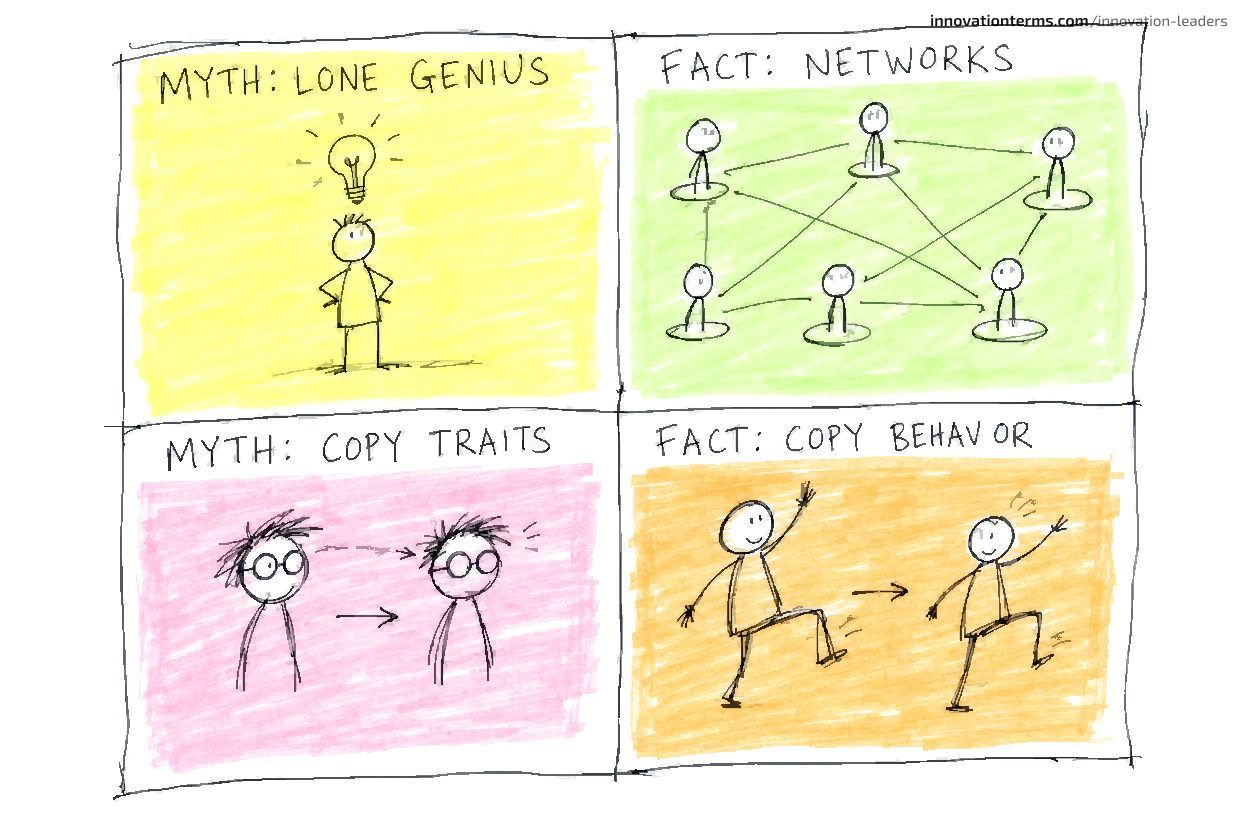
Steven Johnson's analysis of innovation history finds that collaborative networks produce significant ideas far more often than individuals. The lone genius narrative persists because it makes a better story than the documented reality. Huang et al.'s data puts a number on it: approximately 80% of innovative ideas in R&D settings come from employees, not leader direction. The solo-genius story survives because it is compelling. It does not survive empirical examination.
"Studying Their Traits Tells You How to Innovate"
Trait inventories fail on both input and output. Input: traits are identified by studying people who succeeded, which excludes everyone with identical traits who failed. Output: even an accurate trait profile identifies correlation, not causation — as Kahneman's work on outcome bias and Andrew Grant's survivorship analysis both document.
"Their Methods Transfer without Modification"
Mehraein et al.'s 2023 systematic review of 145 empirical studies on leadership and innovation outcomes concluded: "Research in this area is sparse, contradictory, and overly confusing, particularly regarding how different leadership styles affect innovation outcomes." The field has no consensus. Practitioners applying a single style across contexts are working without an evidence base for that choice. The Innovation360 finding (context-fit styles outperform single-style organizations) is the correct citation for the transferability claim: the decision architecture transfers. The specific method is context-bound — as Wharton's analysis of Jobs's platform conditions makes concrete.
"Success Proves the Method Worked"
Nassim Taleb:
"Thus, if a twenty-five-year-old played Russian roulette, say, once a year, there would be a very slim possibility of his surviving until his fiftieth birthday — but, if there are enough players, say thousands of twenty-five-year-old players, we can expect to see a handful of (extremely rich) survivors (and a very large cemetery)."
— Nassim Nicholas Taleb, Fooled by Randomness
The innovators on every "greatest" list include leaders whose methods were no better than alternatives that failed. They encountered better conditions at the critical moments. That is not a reason to avoid studying them. It is a reason to study the constraint architecture rather than the personal qualities.
How Did Grace Hopper Turn a Hardware Constraint into Computing History?
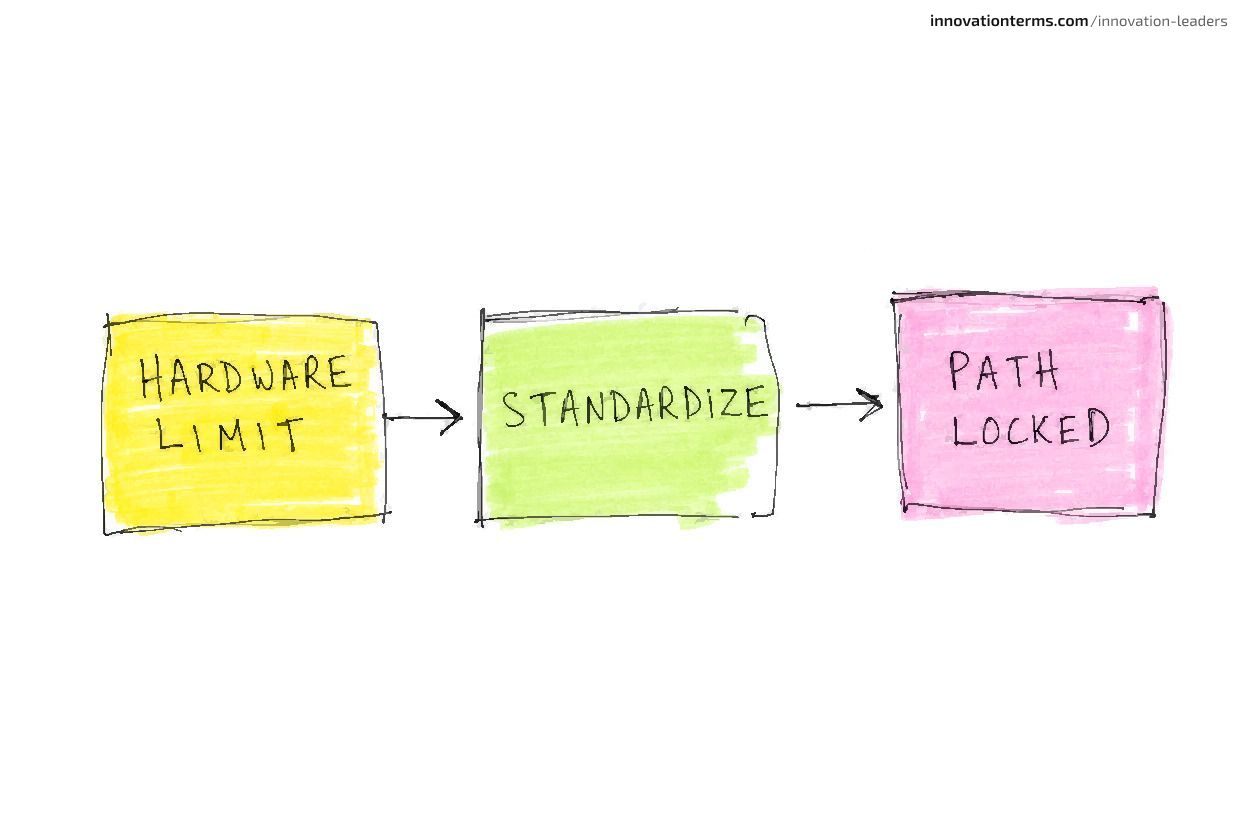
Grace Hopper's most important decision was not technical. It was institutional: spending years fighting for machine-independent code in an environment where hardware vendors actively opposed standardization and where the computing establishment believed human-written code would always outperform compiled output.
By 1952, every program written for one hardware platform required complete rewriting for any other, and Navy computing operations ran across multiple hardware systems. Every hardware upgrade rendered the existing software library worthless. The replication cost was operationally prohibitive at the scale the Navy needed.
Hopper's A-0 compiler demonstrated that machine-independent code was technically feasible. The innovation leadership challenge was harder: getting the computing establishment to accept it as a standard, against resistance from hardware vendors profiting from per-platform service contracts. She framed the argument in cost-reduction and reliability terms, the language her institutional audience could evaluate. The CODASYL conference (1959) and the Defense Department's subsequent mandate for machine-independent code came after years of evidence-building and coalition-forming — the same institutional playbook that Kremer, Villamor & Aguinis identify as the multi-component core of innovation leadership.
What it cost: COBOL's verbose English-like syntax, designed to lower adoption barriers, became a barrier for programmers trained on more compact languages. Standardization locked in design choices (verbose syntax, absence of pointer arithmetic, specific data-division architecture) that became liabilities in the 1980s–90s transition to object-oriented programming.
Constraint-driven standardization produces infrastructure that outlasts the constraint that necessitated it. That is a feature until the constraint changes and path dependence (the tendency of early technical choices to constrain later options) turns the encoded assumptions into obstacles. Organizations facing platform standardization decisions today (AI infrastructure stacks, cloud provider architecture, software development standards) face the identical trade-off: durable adoption now, at the cost of assumptions that will require revisiting when the underlying constraint shifts. The Grace Hopper profile documents the full sequence.
When Does Studying Innovation Leaders Mislead — the Edge Cases?
The decision-architecture approach produces more transferable lessons than biography or trait profiling.
When the Method Required a Context Most Organizations Cannot Replicate
Jobs's innovation method required conditions Wharton's analysis documents precisely: "full control of the value chain by controlling the intricacies of the hardware, software, design, marketing and distribution of the device." The most common misapplication is adopting the "bold vision, no compromise" stance without possessing the platform use that made it executable. These profiles name preconditions explicitly so practitioners can assess whether the constraint match is real before drawing on the method.
The Survivorship Problem
Andrew Grant: "We need to look at all innovation leaders, not just the outliers that happen to be the ones that were in the right place at the right time." The outliers get studied. The equally talented leaders who used structurally similar methods and hit worse conditions at the critical moment do not appear in any collection, including this one. The discipline this calls for: focus on what the constraint forced, not on whether the outcome succeeded. A correct decision can still fail if the context changes unexpectedly.
The Non-Western Gap
Canonical lists are structurally biased toward Western, English-language, institutionally affiliated figures. Srinivasa Ramanujan was told by established mathematicians that his work was too novel, too unfamiliar, and presented in unusual ways — Quanta Magazine's 2024 account documents how his contributions are still being absorbed a century later. Ibn al-Haytham developed the scientific method and foundational optics centuries before the European Renaissance figures who anchor most innovation history narratives. C.V. Raman won the Nobel Prize in 1930 and produced 400+ papers; he appears in almost no general collections. The structural reason is historiographical: colonial-era frameworks systematically underrepresented non-Western intellectual traditions, and citation networks reinforce the existing canonical lists.
The three historic figures here (Galileo, Hopper, Jobs) appear because their decision chains are fully documented. That gap in non-Western coverage is a failure of the record itself, not evidence that non-Western constraint regimes are rare or less instructive. For global innovation practitioners, the constraint regimes most relevant to teams in the Global South (colonial institutional resistance, legitimacy-building without peer-network access) are underrepresented in what is available for study. Treat the absence of documented cases the way you treat survivorship bias: as a data problem.
Frequently Asked Questions about Innovation Leaders
What is innovation leadership? Creating conditions under which novel methods, products, or processes can be developed and adopted. Not the same as general management, which improves known processes. Not the same as invention, which produces discoveries.
The primary job is adoption. That means building the institutional, resource, and coalition conditions that make a discovery viable as an operating system rather than a curiosity that disappears when its champion leaves — per the Kremer, Villamor & Aguinis multi-component framework.
Who are the most important innovation leaders in history? This collection profiles Galileo Galilei, Grace Hopper, and Steve Jobs as historic figures. Each has fully documented constraint analysis, including failure modes. Contemporary practitioners span biotechnology (Uğur Şahin & Özlem Türeci, Justyna Andrysiak, Damian Józefiak), AI and engineering (Lê Anh Sơn), cybersecurity and software (Ngô Tuấn Anh, Nguyễn Tử Quảng), food science (Stefan Palzer), and agriculture (Przemysław Żelazowski). All 11 profiles are analyzed by decision architecture rather than ranked by achievement.
What separates innovation leaders from regular leaders? Behavioral difference, documented at scale: innovative CEOs spend 50% more time on discovery activities (questioning, observing, experimenting, and networking) than non-innovative peers, per Dyer, Gregersen & Christensen's six-year study. Regular leaders allocate most of their attention to execution. Innovation leaders allocate disproportionately to the activities that surface new information and build cross-domain connections.
Is Elon Musk a useful model for corporate innovation? Musk faces the same platform-dependency issue as Jobs: his most effective methods depend on ownership-level control or access to capital enabling failure absorption that would close most organizations. Specific practices (aggressive first-principles problem decomposition, for instance) are transferable, but require specific institutional context. The profiles in this collection include precondition analysis; applying the same lens to Musk through Wharton's vertical-integration framework is a reasonable extension.
How do I apply these examples inside a large organization? Use the tag taxonomy as a constraint-regime router. Facing internal approval-process resistance? The Historic and Leadership clusters have the most completely documented constraint analysis. Making platform standardization decisions? The Technology cluster is more applicable. The constraint regime you face matters more than the era or industry of the profile you draw from — which is the core argument of Innovation360's multi-style research.
Are there profiles that focus on failure, not just success? Yes. Each profile in this collection documents where the leader's method broke: what Jobs's approach depended on that most teams don't have, what Hopper's push for standardization cost in the long run, what Galileo's patronage strategy required and what happened when it failed. The analytical frame is deliberately bilateral. Every documented success in this collection has a documented failure mode alongside it. That is the differentiator between a decision-architecture library and a highlights reel.