
Innovation Capital

Quick answer
Innovation capital is the banked credibility that gets ideas funded, often more than idea quality. What it is, its four components, and how to build it.
Innovation capital is the stock of reputation, relationships, and attention a person or organization has banked, and can spend, to win the resources that turn an idea into something real. It is the reason two people can pitch the same idea and only one gets funded. Nathan Furr and Jeff Dyer, the researchers who popularized the leadership reading of the term, put it plainly.
Innovation capital is an intangible capital, like political capital, that helps you win resources to commercialize novel ideas. — Nathan Furr and Jeff Dyer, Forbes (2018)
Thomas Edison did not out-invent Nikola Tesla. He out-banked him. That gap between the better idea and the better-backed idea, visible in Edison's Menlo Park financing and Tesla's unbacked decline, is what this page is really about.
TL;DR
- Innovation capital is banked: the reputation, relationships, and attention you spend to win resources for an idea, per Forbes' original definition.
- It has four components — human, social, and reputation capital, plus the underrated impression amplifiers — in Dyer and Furr's four-part model.
- Two readings, an individual one (Dyer/Furr, 2018) and an organizational one from Skandia's 1995 intellectual-capital report, describe the same asset at different scales.
- The binding constraint on innovation is usually credibility, not idea quality: one Swiss funding-agency study found novel researchers 31% less likely to be funded.
- It compounds through a track record and depletes fast through visible failure — Ron Johnson's JC Penney exit shows the withdrawal side. Earned slow, spent fast.
What Is Innovation Capital?
Innovation capital is reputation, relationships, and attention, banked over years, spent to win the budget, headcount, and buy-in that get a new idea off the ground, per Furr and Dyer's original definition. The standing that gets the idea backed is the variable that actually decides outcomes. Two people, same proposal, different capital: completely different results.
The political capital analogy built into the original definition is exactly right. Furr and Dyer describe it as a store of goodwill and credibility you accumulate and then draw down to move something through a system that could otherwise ignore you, as the Forbes piece puts it. That framing matters because it converts a fuzzy word, "credibility," into something with a balance you can grow or burn. You are not managing a feeling. You are managing a balance sheet.
Why the definition needs the Edison teaser
Edison and Tesla are the reason the definition is not academic. Edison ran a company capitalized by J.P. Morgan and the Vanderbilts. Tesla, the more original mind by most accounts, died broke. The difference in outcome tracked the difference in banked backing far more than the difference in inventive talent. That is innovation capital doing its quiet work, and it is why a reader watching a good idea stall inside their own organization should care about the term at all. For the neighboring distinction between having an idea and shipping it, see the difference between invention and innovation.
Innovation capital sits alongside the older resources every operator already tracks, financial capital, human capital, and the messier social kind. Innovation capital is spent to acquire the others. You cash reputation to get budget. That is the mechanism this page keeps returning to.
Why Do Search Results Disagree About What Innovation Capital Means?
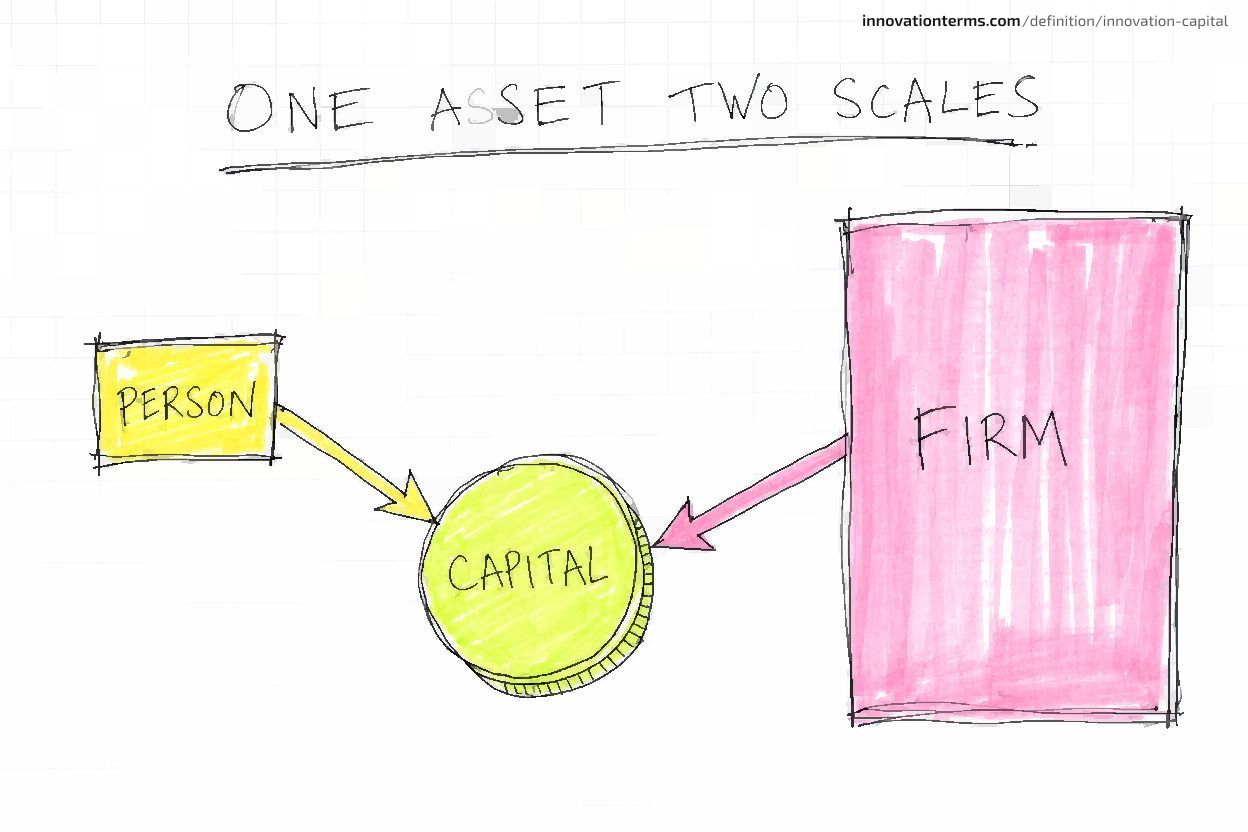
Search "innovation capital" and you meet two answers that never acknowledge each other. One camp treats it as a leader's intangible, the credibility a person banks and spends. The other files it as a line item inside a company's intellectual capital, close to patents. Both are correct. Both terms describe the same underlying asset at different scales, one individual and one organizational. The organizational label, still current in Corporate Finance Institute's knowledge-capital taxonomy, is actually the older of the two: it traces back to Skandia's 1990s intellectual-capital report, which predates the leadership reading by roughly two decades.
Where the term came from
Credit for the leadership reading usually goes to Jeff Dyer, Nathan Furr, and Curtis Lefrandt. Their 2018 Forbes piece and 2019 book put the four-component framework into wide circulation. The academic scaffolding under it is older: Dyer, Furr, and Hendron's Overcoming the Innovator's Paradox in MIT Sloan Management Review established impression amplifiers and winning buy-in as researched constructs rather than a magazine idea.
But the organizational term predates all of that. In the 1990s intellectual-capital accounting tradition, the Swedish insurer Skandia published the world's first intellectual-capital annual report in 1995. Its first Director of Intellectual Capital, Leif Edvinsson, mapped a structure where structural capital divides into organizational capital, which divides into innovation capital and process capital, per Edvinsson's original account. The label "innovation capital" was sitting inside a corporate balance-sheet framework roughly two decades before it became a leadership buzzword. The two readings are not rival dictionary entries. They are the same idea measured at different altitudes.
The two readings on one scale
| Leader reading | Organizational reading | |
|---|---|---|
| Unit of analysis | An individual person | A firm or business unit |
| What it is | Banked reputation, relationships, attention | A sub-component of structural / intellectual capital |
| Primary sources | Dyer, Furr, Lefrandt's Forbes framework | Edvinsson's Skandia report and Kijek's valuation formula |
| How it is spent | To win backing for a specific idea | Converted into commercialized innovations |
| How it is measured | Track record, network, visibility | Intangible-asset valuation formulas |
The Corporate Finance Institute keeps the organizational reading narrow enough to see the tension clearly.
elements that... protect the company's intellectual properties, in other words, protect the rights to the company's innovations. — Corporate Finance Institute, Knowledge Capital
That IP-flavored definition describes the same asset from the firm's vantage, measured account by account rather than meeting by meeting. Readers coming from market validation or open innovation will recognize the same pattern: the asset only matters at the moment resources change hands.
What Are the Four Components of Innovation Capital?
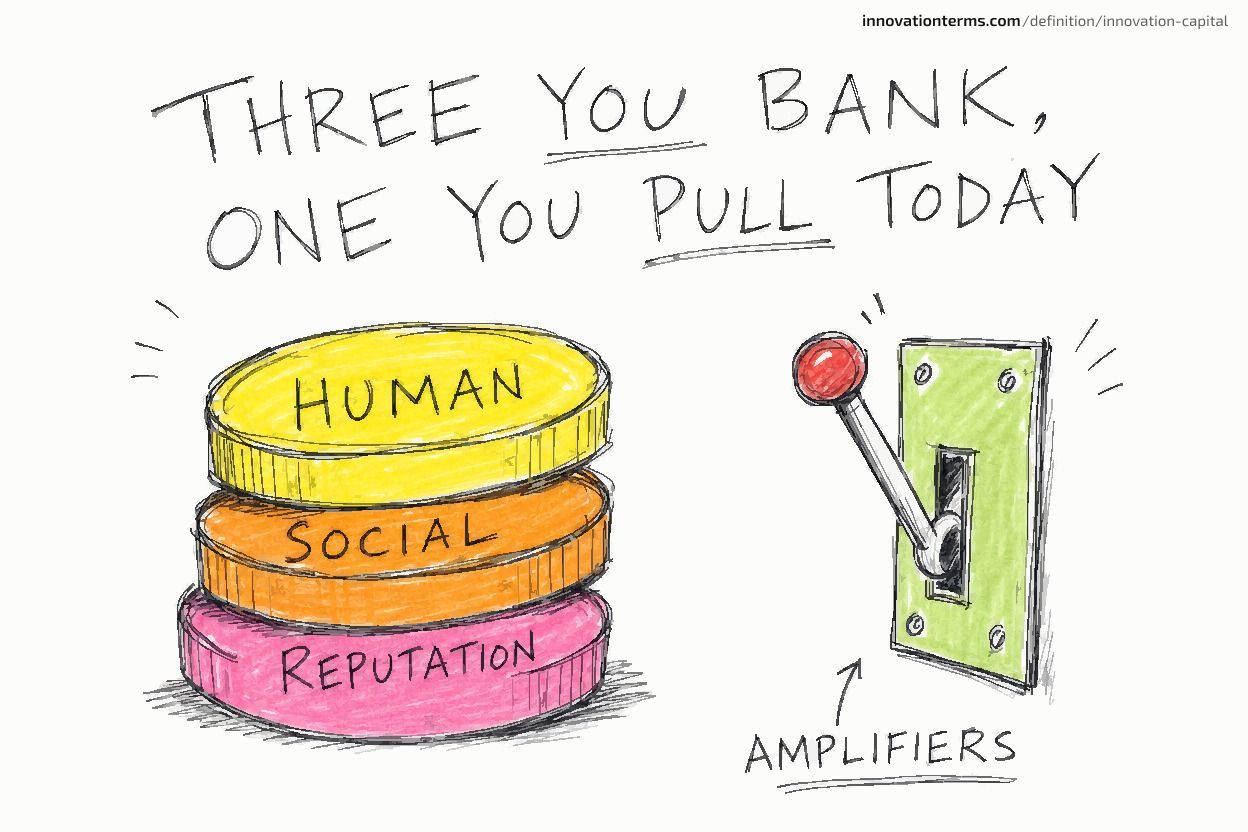
Innovation capital breaks into four components: human capital (who you are), social capital (who you know), reputation capital (what you are known for), and impression amplifiers (the deliberate actions you take to shape how others see your ideas), per Forbes' four-component breakdown. The first three are stocks you accumulate. The fourth is a lever you can pull today, which is exactly why most summaries skip it.
Human capital: who you are
Human capital, in this framework, is the innovation-specific version of skill and knowledge (much of it tacit knowledge, know-how that lives in practice and judgment, not in any manual), your demonstrated ability to spot, shape, and ship new ideas, in the Forbes framework. There's overlap with a firm's absorptive capacity. What differs is the unit of analysis, since credibility lives in one person's track record while absorptive capacity lives in the systems an organization uses to recognize and apply new knowledge.
Social capital: who you know
Social capital is the network you can call on, the people who will vouch for you, fund you, or open a door. It is the component that makes buy-in transferable. When a senior sponsor lends their standing to your proposal, they are spending their social and reputation capital on your behalf, a mechanic that later sections return to.
Reputation capital: what you are known for
Reputation capital is the compressed judgment other people carry about you before you have said a word in the room. Marc Benioff built Salesforce's reputation deliberately through the 1-1-1 philanthropy model, a move that read as values first and turned into standing that helped the company win attention and talent for two decades.
Impression amplifiers, the component most summaries skip
Impression amplifiers are the actions you take to change how people perceive you and your ideas, and they are the one component a reader can start using this week. Furr describes them in the HBR podcast as the deliberate activities that win support. The canonical example is Robin Chase pitching Zipcar not as "car sharing" but as "wheels when you want them," a reframing that made an unfamiliar idea feel obvious. Storytelling with characters, conflict, and resolution is another amplifier, as is avoiding what Furr calls the expectations curse, over-promising early and spending credibility you have not yet banked. The three stocks take years. This lever takes a sentence.
Innovation Capital Is an Account, Not a Trait
Innovation capital behaves like an account because it can be deposited into, drawn down, and overdrawn. You earn it through delivered results, spend it to back new bets, and lose it when those bets fail publicly, per Furr's account of the mechanic. This is not a metaphor for polite cocktail conversation. It is the operating reality that separates the leaders who get their bets funded from the ones who do not.
The strongest textual warrant for the ledger reading comes from Furr's own description of how the asset moves over a career.
something that people... build up over time; they use it to pursue new ideas, win support, change something; and they can also lose it. — Nathan Furr, HBR On Leadership Ep.142 (2025)
Three verbs sit inside that sentence: build, use, lose. Those are the movements of an account balance. A fixed trait has none of them. The build-early argument follows directly. Furr notes in the same episode that innovation capital takes time, and that the leaders who spent it well were the ones thinking about accumulating it early, before they needed to draw on it.
Where the account metaphor strains
The ledger model is a metaphor. Press on it. Unlike a bank balance, innovation capital is not fungible across contexts. Standing earned in one company or field does not always transfer to another, a limit a later section treats as its own edge case. It also compounds non-linearly: a track record does not add credibility one unit at a time, it multiplies the credibility of everything that came before. The metaphor is a handle for reasoning, and it is not an equation. Use it to think about deposits and withdrawals rather than to compute a precise balance. For teams trying to make the deposits systematic, the discipline of managing employee ideas is where individual credibility becomes an organizational habit.
Why Does the Best Idea Usually Lose? The Binding Constraint
The best idea usually loses. What ships is the idea attached to the person with the most banked credibility, per the Forbes framing of the term. In most organizations the constraint on innovation is not the quality of the idea but the innovation capital of the person carrying it, which is why a better-backed mediocre idea routinely beats a better idea that no one will fund. The rest of the page defends this claim. A reasonable expert can dispute it.

The evidence that novelty is penalized
The bias runs against boldness. In a study of the Swiss National Science Foundation's Sinergia program, researchers with track records of publishing genuinely novel work scored lower with reviewers and were 31% less likely to receive funding.
That study covers grant-funding rather than corporate budgeting, so treat it as an analogue rather than a proof of the boardroom case. It shows that where humans allocate scarce resources under uncertainty, the safe, credentialed bet beats the novel one. Epistemic authority, meaning the standing to be believed on knowledge claims in a domain, is the tiebreaker. If good ideas from low-credibility people were funded at the same rate as good ideas from high-credibility people, this thesis would collapse. The funding data points the other way.
Borrowing someone else's capital
The sponsor-transfer insight sharpens the claim. The capital that funds an idea often comes from the sponsor's balance. When a respected executive says "I'll back this," they are lending a slice of their own reputation and social capital to a proposal that could not win on its own standing, the mechanic Furr describes as capital moving between people. This reframes the tired instruction to "get buy-in." Buy-in is not agreement. It is a loan of capital from someone whose balance is larger than yours. Which is why the same idea dies under a junior name and ships under a senior one.
What Does Edison vs. Tesla Teach About Banked Capital?
Edison and Tesla are the canonical case because they isolate the variable. Both were extraordinary inventors. One commanded capital and backers. The other did not. The one with the banked resources won the commercial war and most of the historical credit, which is the binding-constraint thesis playing out over a lifetime rather than a budget meeting.
In 1878, Edison's Edison Electric Light Company was capitalized by J.P. Morgan and Co. led a syndicate of wealthy, connected backers (including the Vanderbilts), per Hagley Museum's history of Edison Electric. It was, in effect, a patent-holding entity built to fund his incandescent experiments and, just as important, to publicize them. When Edison staged his Menlo Park demonstration on New Year's Eve 1880, roughly 3,000 spectators came to see the lights. That crowd was an impression amplifier at industrial scale. Edison's edge was not that he invented electric light alone. He had marshalled the money. He had also lined up the backers and the audience needed to make his version the one that mattered.
Nikola Tesla ran the opposite ledger. Around 1897 he tore up his royalty contract with George Westinghouse, relinquishing royalties that bankers later valued at roughly $12 million, a fortune that would have made him independent. He kept inventing and kept losing ground. Tesla died in 1943, bankrupt in a New York hotel room, his rent quietly covered for years by Westinghouse Electric, the company he'd once let off the hook. The more brilliant inventor died without the resources his rival wielded routinely.
What the stock story usually leaves out
Most pages name-drop Edison versus Tesla and move on, treating it as a fable about marketing. Edison's J.P. Morgan backing and Tesla's torn-up Westinghouse royalties explain the outcome. The gap was not charisma in the abstract. On one side sat Morgan's money and a Vanderbilt-backed commercialization vehicle, capped by a demonstration engineered for 3,000 witnesses. On the other, a torn-up contract.
Is Innovation Capital Only a CEO Asset?
No. Innovation capital operates wherever someone has to win resources for an idea. The product manager asking for three engineers. The R&D lead pitching next year's budget. The first-time founder in a seed meeting. The mechanic, spend standing to get backing, is identical at every level. The famous examples are CEOs because their ledgers are public. That visibility bias does not change the underlying reality: every person who needs a yes from someone else is playing the same game.
The Nadella deposit
Nadella took over a cash-rich Microsoft whose innovation reputation had eroded, and the rebuild he led aimed at restoring internal and market credibility rather than shipping any single product. Value tells the story: Microsoft's market value went from roughly $300B in 2014 to over $3T by 2024.
Why it matters for individuals at all levels
The honest gap in the evidence is that clean, documented cases of mid-level operators building innovation capital are rare, because the ledgers of non-executives are not public. The mechanic works at any scale. A team lead who ships three reliable projects earns the standing to be trusted with a risky fourth. That is a smaller version of the Nadella arc. The reader watching a good idea stall two rungs below the C-suite is not exempt from the thesis. They are its most common subject.
One caveat covers every named leader in this section. Edison, Nadella, and Benioff appear here because their capital paid off, with public ledgers to prove it. The leaders who banked equivalent standing and lost their bets are not in this article, which is the survivorship problem the evidence has not yet solved.
How Does Innovation Capital Differ From Financial, Human, Intellectual, and IP Capital?
Innovation capital is the credibility you spend to acquire the resource. Financial capital is money. Human capital is skill. Intellectual and IP capital are protected knowledge. Innovation capital is the standing that convinces someone to hand over the money, assign the skilled people, or fund the patent in the first place, in Forbes' definition. Conflating it with those other capitals is the most expensive mistake readers make, and the most common.
The IP conflation, and why the taxonomy fights itself
The sharpest confusion comes from the organizational reading itself. The Corporate Finance Institute places innovation capital under structural capital, as a sibling of process capital, defined largely by the protection of intellectual property. That placement is coherent inside an accounting tree. It also directly conflicts with the leader reading, where innovation capital is a personal, relational asset that has nothing to do with legal rights. Same words, opposite location on the org chart. The resolution from the earlier section applies: one is the firm-level ledger, the other is the individual's, and IP is an output the individual's credibility helped fund. For the related distinction between an idea and a defensible position, the value proposition is a useful neighbor, and Stage-Gate is where funded ideas meet formal review.
How Does Innovation Capital Compound and Deplete?
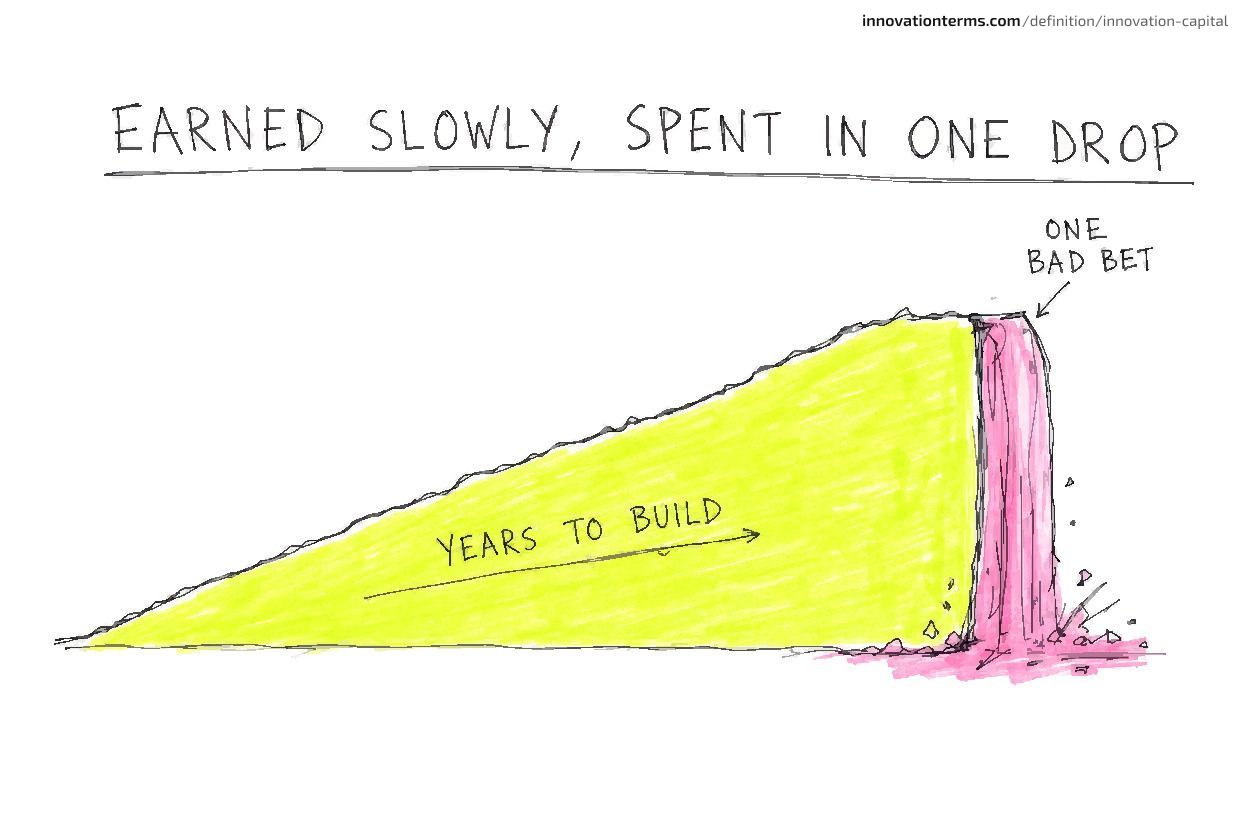
Innovation capital compounds through a track record. Every delivered win makes the next bet easier to fund, which yields more wins and more standing, a flywheel. It also depletes through visible failure. The asymmetry is brutal because standing is earned slowly across years and spent in a single bad launch. Knowing both directions turns the definition into something a person can manage.
The compounding flywheel
A track record does not add credibility linearly. Each success raises the credibility of everything that came before, which is why established innovators get the benefit of the doubt that newcomers cannot. The same loop shows up at the team level in healthy innovation feedback loops, where delivered results feed the trust that funds the next experiment.
The depletion asymmetry
The withdrawal side is faster and less forgiving. Ron Johnson arrived at JC Penney in June 2011 as the "Steve Jobs of retail," carrying enormous innovation capital from building Apple's retail arm. He was gone by April 2013. In roughly 18 months, the stock price had halved and the company had shed close to $4 billion in sales.
Warren Buffett named the asymmetry as an operating rule for his managers.
We can afford to lose money, even a lot of money. But we can't afford to lose reputation, even a shred of reputation. — Warren Buffett, to Berkshire managers (2017)
The folk version of this, that a reputation takes 20 years to build and five minutes to ruin, is widely attributed to Buffett but its earliest documented print source is a 2005 book by Dan Anderson, so treat the exact numbers as illustrative rather than sourced. The underlying pattern, slow to earn and fast to burn, is real and is why a single public failed bet is so expensive.
By the Numbers: What Can and Can't Be Measured About Innovation Capital?
Innovation capital resists a single clean number. There is no accepted index that outputs your balance. What exists is a conceptual measurement tradition from intellectual-capital accounting and one much-cited valuation formula, both of which describe an intangible that behaves the way economists say intangibles behave, sunk, scalable, and hard to price, rather than like cash in a ledger.
A 2012 valuation paper in the Journal of Entrepreneurship, Management and Innovation is still the most-cited attempt to put a number on it. Tomasz Kijek proposed computing an organization's innovation-capital value from its intellectual capital multiplied by an extracting coefficient and an efficiency coefficient. Kijek's own framing keeps the concept anchored to commercialization.
Innovation capital is regarded as an element of intellectual capital that reflects the ability of an organization to create and commercialize new knowledge. — Tomasz Kijek, JEMI 8(4) (2012)
To see what the formula produces in practice: if a firm's intellectual capital is valued at $50M, and its extracting coefficient is 0.6 (meaning 60% of that knowledge base is actively commercialized rather than sitting idle) and its efficiency coefficient is 0.8 (an 80% conversion rate from commercialization effort to realized value), Kijek's method outputs an innovation-capital figure of $24M. The formula works as a diagnostic for locating where the extracting or efficiency drag sits.
| Measurement attempt | What it produced | What it cannot do | Source |
|---|---|---|---|
| Skandia intellectual-capital report (1995) | First corporate disclosure locating innovation capital in a structural tree | Assign a person-level balance | Edvinsson, Skandia |
| Kijek valuation method (2012) | A formula: intellectual capital × extracting × efficiency coefficients | Output a single agreed number | Kijek, JEMI |
| Intangible-asset economics | Explains why the asset is sunk, scalable, spillover-prone | Fit innovation capital onto a clean balance sheet | Haskel & Westlake |
The measurement gap is what genuine intangibles look like: easy to feel, hard to audit, impossible to price with precision. Teams that want a proxy usually build one internally, the way an innovation culture health score turns a felt intangible into a trackable metric.
What Are the Common Misconceptions About Innovation Capital?
Three misconceptions do the most damage: that innovation capital is just IP, that only CEOs have it, and that it is a fixed trait rather than a managed balance. Each one leads a reader to misuse the term in a real document, so each is worth correcting directly.
Myth: "innovation capital is just IP or patents." Reality: it is the credibility that funds the work patents protect. The confusion is understandable, because the organizational reading files innovation capital near IP under structural capital. IP is downstream of the work. Innovation capital is the standing that funds the work to begin with. A portfolio of patents no one will fund to commercialize is a cost center.
Myth: "only leaders and CEOs have innovation capital." Reality: every person who has to win resources for an idea holds a balance. The famous cases are CEOs because their ledgers are public, which quietly teaches readers that the asset is a C-suite thing. The mechanic is identical for a mid-level operator pitching a budget. The scale differs. The asset does not.
Myth: "innovation capital is a fixed trait you either have or lack." Reality: it is an account you deposit into and draw down. This is the misconception the ledger model in the earlier section exists to kill. Furr's own language, build it, use it, lose it, from the HBR podcast, describes a balance in motion. Reading it as a trait makes it fatalistic. Reading it as an account makes it actionable.
What Are the Edge Cases and Boundary Conditions of Innovation Capital?
The main boundary condition is portability: innovation capital does not always transfer cleanly across companies, industries, or contexts. Standing is partly built on relationships and reputation that are local to a specific arena, so a leader who commands enormous capital in one setting can find much of it does not follow them to the next. This is the asset's most important limit. Ignoring it is how expensive hires go wrong.
Does innovation capital transfer when someone changes companies?
Partly, and less than people expect. Ron Johnson's move from Apple to JC Penney is the cautionary case: the retail-visionary standing he built at Apple did not survive the transfer to a different customer base and category, and roughly 18 months later the capital, and about $4 billion in sales, was gone. Some innovation capital is portable, the general reputation for shipping, the network that takes your call. But the context-specific portion, meaning credibility inside a particular market and its gatekeepers, often stays behind. High-profile hires fail this way more often than the headlines admit.
Can a single failure zero out a balance?
Overdrafts arrive in a single quarter. A visible failed bet can drain the account fast, and recovery drags because of the earn-slow, spend-fast asymmetry from the section on compounding, though the balance rarely reaches zero. Deep reserves absorb one bad launch. A newer operator running lean does not have that cushion, which is why the build-early advice matters most for people who have not yet had to make a big withdrawal.
When does merit actually win?
The thesis is that credibility beats merit in most resource decisions. Merit wins more often in systems designed to blind the evaluator to reputation, structured funding rubrics, double-blind review, and objective performance thresholds. The SNSF result shows how hard that is to achieve even in science, where the norms favor it. The practical reading: if you want your idea judged on merit, reduce the room for reputation to be the tiebreaker. Absent that design, banked capital decides.
Frequently Asked Questions
What is innovation capital in simple terms? It is banked standing. More precisely, it is the reputation, relationships, and attention a person or organization can spend to win the resources needed to turn an idea into reality, per the Forbes/HBR definition. It is why two people can pitch the same idea and only one gets funded. Think of it as a credibility account you deposit into through delivered results and draw down to back new bets.
Who coined the term innovation capital? Two lineages coined it. The organizational reading is older: Leif Edvinsson used "innovation capital" inside Skandia's intellectual-capital framework in the mid-1990s, when the firm published the world's first intellectual-capital annual report in 1995. Jeff Dyer, Nathan Furr, and Curtis Lefrandt named the now-popular leadership reading in a 2018 Forbes article. Their 2019 book carried it further.
What are the components of innovation capital? Four components: human capital (who you are), social capital (who you know), reputation capital (what you are known for), and impression amplifiers (the deliberate actions you take to shape how others perceive your ideas), per Forbes' four-component model. The first three are stocks built over years. The fourth, amplifiers like Robin Chase's "wheels when you want them" framing of Zipcar, is a lever available immediately.
How is innovation capital different from intellectual capital and human capital? Three layers. Human capital covers your skill and knowledge. Innovation capital is the standing your track record earns, spent to win backing, per Forbes' definition. Intellectual capital covers a firm's codified knowledge assets including IP, with the organizational reading treating innovation capital as a sub-component. Innovation capital sits one step above the resource because it buys the resource.
How do you build innovation capital as a leader? Deposit before you need to withdraw. Deliver visible results to build human and reputation capital, invest in relationships for social capital, and use impression amplifiers (sharp framing, storytelling, avoiding over-promises) to shape perception, per the HBR podcast's playbook. Furr's core advice is timing: start early, because the asset accrues slowly and the leaders who spent it well banked it before they needed it. Systematizing the deposits is what managing ideas well does at team scale.
Can innovation capital be lost or depleted? Yes. Faster than it is earned, in fact. A visible failed bet drains the account in one stroke while rebuilding takes years, the earn-slow, spend-fast asymmetry Warren Buffett warned his managers about. Ron Johnson spent a decade of Apple-built standing at JC Penney in roughly 18 months, alongside about $4 billion in lost sales.
Does innovation capital transfer when someone changes companies? Partly. General reputation and your personal network tend to travel, but context-specific credibility (standing with a particular market, board, or technical domain) often stays behind, the same pattern Ron Johnson's move illustrates. This is why celebrated hires underperform more often than expected: they spend a portable balance they no longer fully have.

Mikkel @mkl_vang
Covers operational innovation, AI implementation patterns, and how teams ship useful change without theater.