
VUCA

Quick answer
VUCA stands for Volatility, Uncertainty, Complexity, and Ambiguity. Each dimension demands a different response. Use it as a diagnostic, not an excuse.
VUCA: What It Means and How to Use It
TL;DR
- VUCA stands for Volatility, Uncertainty, Complexity, and Ambiguity — four distinct types of strategic challenge, not four words for the same problem.
- Each letter demands a different organizational response: Vision (V), Understanding (U), Clarity (C), Agility (A). This is the VUCA-Prime framework.
- Treating VUCA as a single condition and responding with a generic "be more agile" program is the most common and costliest misapplication of the framework.
- The term originated at the U.S. Army War College in 1987, drawing on the work of Warren Bennis and Burt Nanus, and entered mainstream business vocabulary after the 2008 financial crisis.
- BANI and RUPT have not replaced VUCA. They describe how turbulence feels; VUCA describes what kind of decision problem you face.
- Before choosing a response, diagnose which dimension is dominant. An ambiguous environment needs scenario planning. A volatile one needs a hedged portfolio. Applying agility to the wrong condition makes strategy worse, not better.
- AI adoption is a textbook A-condition: more data has not resolved the strategic question of whether incumbent models survive the transition.
VUCA is a diagnostic framework that assigns a specific analytical move to each type of environmental challenge. The framework is most useful when it forces leaders to state which dimension is dominant — and act accordingly. When used as a catch-all for "things are hard," it accomplishes nothing.
What is VUCA?
VUCA is four problems wearing one acronym. Volatility is not uncertainty, complexity is not ambiguity, and each letter demands a different organizational response. Conflate them and you lose the signal. The value is in the split, not the label. Distinction = leverage. Bennett & Lemoine (2014)
These four conditions are not synonyms, and treating them as interchangeable strips the framework of its practical value. That is precisely what happens when organizations adopt VUCA language without adjusting how they act on each dimension.
The four dimensions, precisely defined
Volatility describes environments where change happens frequently and the magnitude of that change is difficult to predict. The challenge is not that the future is unknown — it's that the known range of outcomes is wide. Markets, commodity prices, and consumer demand are volatile. The right question is not "will things change?" but "across how wide a range?"
Uncertainty describes environments where data is missing or insufficient to support confident predictions. Uncertainty is distinct from volatility: a volatile environment has a probability distribution (you can model the range); an uncertain one does not yet have enough data to define the distribution. PMI Disciplined Agile The right question is "what information, if gathered, would change our decision?"
Complexity describes environments where many interacting variables produce emergent effects that make it hard to predict how interventions will land. Complex systems are not merely complicated — a complicated system has many parts but those parts behave predictably. In a complex system, the interdependencies create non-linear effects. PMI Disciplined Agile
Ambiguity describes environments where the interpretive frame itself is in dispute. Same data, multiple plausible readings. The right question is not "do we have enough information?" — it's "do we even agree on what this information means?"
As researchers Nathan Bennett and G. James Lemoine wrote in Business Horizons, "VUCA conflates four distinct types of challenges that demand four distinct types of responses. That makes it difficult to know how to approach a challenging situation and easy to use VUCA as a crutch, a way to throw off the hard work of strategy and planning." Bennett & Lemoine (2014) That conflation — treating all four letters as variations on "things are hard" — is the failure mode that makes the framework worthless.
"It's become a trendy managerial acronym: VUCA, short for volatility, uncertainty, complexity, and ambiguity, and a catchall for 'Hey, it's crazy out there!' It's also misleading: VUCA conflates four distinct types of challenges that demand four distinct types of responses."
— Nathan Bennett & G. James Lemoine, Harvard Business Review, 2014
Where did VUCA come from?
At the U.S. Army War College in 1987, officers needed language for the post-Cold War strategic problem, so VUCA was codified using ideas from Warren Bennis and Burt Nanus. Herrmann (2023)
The term moved into mainstream business vocabulary after the 2008 financial crisis; the Emerald systematic review of 833 studies published between 1999 and 2021 confirms the inflection. Taskan et al. (2022)
The intellectual origin: Bennis and Nanus
Before the Army gave it an acronym, the core idea existed in organizational leadership theory. Warren Bennis and Burt Nanus published Leaders: The Strategies for Taking Charge in 1985. Bennis & Nanus (1985) Their central observation was that leaders operate in environments where change is rapid and direction is unclear — what they described as "the contexts of apathy, escalating change and uncertainty make leadership seem like maneuvering over ever faster and more undirected ball bearings."
The Army War College recognized that this framing captured the post-Cold War strategic environment exactly. The collapse of the Soviet Union removed the predictable adversary planners had long assumed. In its place rose a multi-polar, asymmetric order, with alliances and threats shifting quickly — conditions that no longer matched Cold War planning assumptions.
The Army codification
Documentary evidence from the Army Heritage and Education Center places the term in the AY1988 curriculum. U.S. Army War College Commandant MG Thompson (the War College's senior officer at the time) ordered the review, likely in response to the Goldwater-Nichols Act of 1986, which restructured joint operations across service branches.
The Goldwater-Nichols Act required joint operations across service branches — a complexity challenge. The War College responded by equipping officers to diagnose the type of challenge they faced before selecting a response. VUCA was the diagnostic vocabulary. U.S. Army War College
The business adoption inflection point
VUCA remained a military leadership term for roughly two decades. The Emerald Publishing systematic review of VUCA literature — covering 833 potentially relevant studies published between 1999 and 2021 — confirms the pattern: sparse academic steady uptake through the 1990s, wider traction across the 2000s, and a surge in published work after 2008. Taskan et al. (2022)
After the 2008 financial crisis, corporate strategists adopted the term more quickly, and business schools followed. ---
How do researchers measure VUCA conditions? Key statistics
The VIX and the EPU Index do not move together, and that divergence is one reason volatility, uncertainty, complexity, and ambiguity should not be treated as synonyms. The CBOE Volatility Index (VIX) and the Economic Policy Uncertainty Index (EPU) track two of the four dimensions empirically, and their divergences prove the distinction matters in practice. Baker, Bloom & Davis CBOE VIX data
The data
| Metric | What it measures | 2008 GFC peak | 2020 COVID peak | 2025 (latest) |
|---|---|---|---|---|
| VIX (CBOE) | S&P 500 implied volatility (Volatility) | 89.53 intra-day (Oct 2008) | 85.47 intra-day (Mar 2020) | ~15–20 (normalized) |
| EPU Index (Baker et al.) | Policy uncertainty (Uncertainty) | Elevated but below COVID | 503.96 (May 2020); 425.78 (Mar 2020) | 724.94 (Apr 2025) |
| VUCA publications | Academic adoption of the framework | Sparse 1990–2007 | Growing post-2008 | 833 studies reviewed, 26 retained as rigorous (Taskan 2022) |
Why the divergence matters:
[DATA CALLOUT 1] The VIX reached its all-time high of 89.53 on 24 October 2008 — a pure volatility reading. CBOE VIX data Policy uncertainty (EPU) lagged because the policy response was not yet contested. By contrast, in April 2025 the EPU Index hit 724.94 — nearly 7× the historical mean of 101.8 — while market volatility remained subdued. Baker, Bloom & Davis The same organization faces a high-uncertainty, low-volatility environment in 2025, not a high-volatility environment. Prescribing the same response to both misses the diagnostic point entirely.
What does Volatility demand from an organization?
Volatility wants a fixed point, so Vision matters because range expands while the target does not. In a consumer market swing, for example, you may adjust inventory every quarter without changing the three-year position you are trying to defend. If you re-aim with every swing, you pay the price of reaction. Stable intent beats reactive tactics. Johansen (2007)
What volatility describes is environments where change is frequent and the magnitude is unpredictable — not unknowable, but variable across a wide range. Volatility is measurable risk, not unknowable uncertainty. PMI Disciplined Agile Energy prices, demand cycles, and exchange rates are volatile — they move frequently, the range of movement is wide, but the possibility space is known. Organizations that cannot tolerate price swings across that range have a risk management problem. They do not necessarily have an uncertainty problem.
The Vision response
Bob Johansen's VUCA-Prime framework — developed at the Institute for the Future and detailed in Get There Early (2007) — maps Vision as the direct response to Volatility. Johansen (2007) The logic: when the environment swings, a stable shared vision absorbs the noise. Teams know what they're aiming at even when the conditions around them are moving. Without that anchor, every swing in the environment triggers a strategy revision, which costs more than the swing itself.
In operational terms, the Vision response translates to:
- Portfolio hedging — holding positions across a range of scenarios rather than concentrating on one
- Long-range horizon locks — committing to a 3–5 year direction while allowing quarterly tactics to flex
- Pre-committed decision rules — agreeing in advance which conditions trigger which pivots, rather than deciding reactively
Named example: retail supply chains, 2020–2021
COVID-19 demand volatility produced a clean natural experiment. Retailers using multi-supplier networks and buffer stock, effectively a portfolio hedge against volatility, absorbed the demand swings. Single-source retailers lost stock when their one supplier went offline. Deal et al. (2020) The strategic difference was not agility — it was the prior Vision decision to build a redundant supply network precisely because demand is historically volatile.
The Organizational Dynamics survey of 1,152 leaders across 280 organizations found the pattern is general: without context-specific a surface-level diagnosis, "leadership becomes a one-sized-fits-all activity that may only be effective by coincidence." Deal et al. (2020)
What does Uncertainty demand from an organization?
Uncertainty isn't a lack of resolve—it's a missing variable. You can't summon the data through sheer will, yet you can usually afford the next useful answer cheaply, long before you lock in the expensive commitment. Practically speaking, that means running a probe, watching what shifts, and only afterward deciding how much to invest. Johansen (2007)
What uncertainty describes is environments where the data needed to forecast outcomes doesn't yet exist. The distinction from volatility is epistemological. Volatility: "I know the range of outcomes but the exact value will vary." Uncertainty: "I don't yet have the data to know what the range of outcomes is." PMI Disciplined Agile A volatile market has a distribution you can hedge against. An uncertain environment has a question you can answer with enough probing.
PMI Disciplined Agile captures the operational implication: "VUCA is dynamic and situational — sometimes things can be fairly clear but then suddenly shift due to outliers, adjacencies, and disruptions." PMI Disciplined Agile The practitioner's task is to detect the shift and identify which type of problem it is.
The Understanding response
Johansen's Understanding response prescribes probe-and-learn before commitment: run low-cost experiments that generate the missing information, use that information to narrow the decision set, then commit. Johansen (2007) This is distinct from generic agility because it has a clear goal — reducing uncertainty — and a clear endpoint: when enough information exists to forecast, the organization shifts from probing to executing.
Named example: vaccine development, January–March 2020
Early pandemic conditions (January–March 2020) were a genuine uncertainty environment. No probability distribution could be assigned to COVID-19's transmission rate, severity, or duration. Vaccine developers responded with Understanding-type behavior: parallel probe experiments across multiple platform technologies (mRNA, adenovirus vector, protein subunit) before committing to scale. The mRNA platform succeeded and was scaled. The parallel probing was not agility — it was structured uncertainty reduction.
What does Complexity demand from an organization?
Complexity means second-order effects dominate first-order intentions. In a global supply chain, a change to inventory targets can alter supplier cash flow, which then delays component deliveries and breaks service levels somewhere else entirely. The move before the move is mapping, because clarity is usually the cheapest intervention. Map the system, then act. Johansen (2007)
What complexity describes is environments where multiple interdependent variables interact in ways that make single-lever interventions unpredictable. The distinction from complicated is not semantic. A complicated system — a jet engine, a tax code — has many parts that behave predictably according to rules. A complex system — a supply chain spanning 60 countries, a healthcare delivery network, a financial market — has interdependencies that produce emergent behavior. Intervening without mapping the interdependencies is how well-intentioned decisions produce counterproductive outcomes. PMI Disciplined Agile
The Clarity response
Johansen's Clarity response prescribes systems mapping before any intervention: document the key interdependencies, identify which variables are directly controllable versus emergent, and design interventions that account for non-linear effects. Johansen (2007) In an innovation portfolio, this means understanding how projects compete for resources and talent before launching new programs — not because you're being cautious, but because the complexity of the portfolio means addition and subtraction have non-obvious effects.
Named example: supply-chain complexity
A global supply chain is a classic complex system: a change to inventory targets can alter supplier cash flow, delay component deliveries, and break service levels somewhere else entirely. Organizations that optimize each node for just-in-time efficiency without mapping interdependencies are vulnerable when a disruption shifts system behavior. The Organizational Dynamics survey of 1,152 leaders found that without context-specific diagnosis, leadership becomes "one-sized-fits-all" and "effective only by coincidence" — the same risk applies to supply-chain interventions. Deal et al. (2020) The Clarity response is mapping the system before acting and building organizational resilience into the network.
What does Ambiguity demand — and why AI adoption is the defining A-condition of this decade?
Ambiguity calls for Agility, not the "move fast" version but the "preserve optionality" version. More data will not resolve the frame, so teams need to keep multiple futures in play and make operating choices that leave room to change direction later. The winner is usually the one that can still change bets after others have gone all-in. Johansen (2007)
What ambiguity describes is environments where the interpretive frame for a situation is itself contested — same data, multiple legitimately plausible readings. More information will not resolve it. The difference from uncertainty is this: uncertainty has a correct answer that evidence can reveal. Ambiguity has a question whose framing is contested. Ambiguity arises when the same event can be legitimately interpreted through multiple frameworks, and choosing a framework before acting requires a judgment call that data cannot make.
AI adoption as an A-condition
AI adoption is not an uncertainty problem. Organizations do not lack data about AI capabilities; the public literature on model performance is extensive. It is an ambiguity problem: the interpretive question of whether incumbent competitive advantages survive AI-driven market shifts is genuinely contested, and additional evidence has not resolved it.
[DATA CALLOUT] McKinsey's 2024 State of AI survey found that 72% of organizations used generative AI in at least one business function, but only 5.3% of surveyed companies (46 of 876) qualified as "gen AI high performers" attributing more than 10% of EBIT to gen AI. McKinsey (2024) The organizations generating competitive advantage from AI are pursuing "wholesale transformative change that stands to alter their business models, cost structures, and revenue streams — rather than proceeding incrementally." The gap between widespread adoption (72%) and durable competitive advantage (5.3%) is not an uncertainty gap — it's an ambiguity gap. The winning model is contested.
The correct response to AI adoption — if VUCA-Prime is the framework — is Agility: maintain positions across multiple possible AI-enabled futures, run scenario planning and assumption-surfacing sessions to make explicit which incumbent advantages are most threatened, and avoid committing strategy to a single model of how AI will reshape the industry.
What is the VUCA-Prime diagnostic framework?
The matrix solves a practical problem first: once you separate the four VUCA conditions, you need a matching response for each one, and Bob Johansen's VUCA-Prime framework provides it in Get There Early (2007). It maps each VUCA dimension to a specific counter-response: Vision counters Volatility, Understanding counters Uncertainty, Clarity counters Complexity, Agility counters Ambiguity. Johansen (2007)
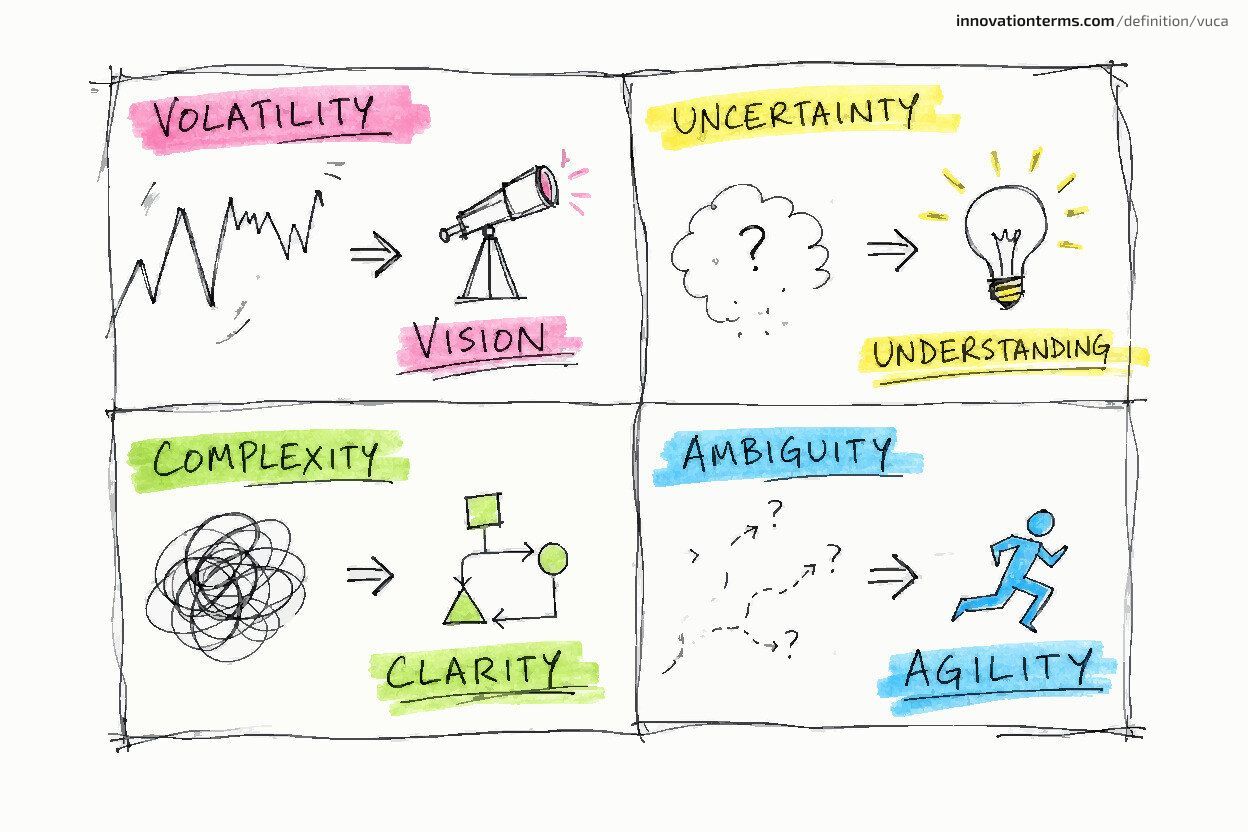
The full diagnostic matrix
| VUCA Dimension | What it describes | Dominant question | VUCA-Prime response | Innovation actions |
|---|---|---|---|---|
| Volatility | Frequent change, wide range of magnitude | How wide is the range we need to survive? | Vision | Portfolio hedging; horizon locks; pre-committed decision rules |
| Uncertainty | Missing data; question is answerable with evidence | What information, if gathered, would change our decision? | Understanding | Probe experiments; low-cost tests before commitment; research partnerships |
| Complexity | Dozens of entangled variables; non-linear, often surprising effects | Which interdependencies are we not mapping? | Clarity | Systems mapping; dependency audits; staged interventions |
| Ambiguity | Interpretive frame is contested; more data won't resolve | Which assumptions are we treating as facts? | Agility | Scenario planning; assumption-surfacing; strategic optionality |
How to diagnose which dimension dominates
Ask directly: which of the four is the primary constraint right now? PMI Disciplined Agile gives the practitioner's version: identify whether the primary obstacle to good decisions is (a) the range of possible outcomes, (b) missing evidence, (c) system interdependencies, or (d) interpretive disagreement about what outcomes mean. PMI Disciplined Agile Then apply the corresponding VUCA-Prime response.
A compound VUCA environment — high on multiple dimensions simultaneously — requires parallel responses. But most organizational crises have one dominant dimension. The 2020 pandemic started as uncertainty (we lacked evidence), shifted to complexity (intervention effects were non-linear and interdependent), and produced ambiguity (the correct post-pandemic business model is still contested in many industries).
Identifying which dimension was dominant at each phase would have prescribed different leadership behaviors at each stage. In practice, many firms used the same response, "be agile," the whole way through.
Why does "be more agile" fail the VUCA test?
Calling your environment VUCA without acting differently on each letter is just expensive pessimism with a military acronym attached. The failure pattern is a uniform agility program applied to all four dimensions. When the diagnosis is not revisited, the acronym becomes a substitute for strategy.
This is the central failure mode documented in the peer-reviewed literature: organizations adopt VUCA language in leadership communications, identify a response program ("we're launching an agility transformation"), and then apply that program uniformly across all four types of challenge — as if Vision, Understanding, Clarity, and Agility were synonyms for the same intervention.
They are not. Agility is specifically the Ambiguity response. Applied to a Volatility problem, it misses the diagnostic: what a volatile environment needs is a stable Vision, not the flexibility to respond to each swing. Applied to a Complexity problem, generic agility programs accelerate interventions before the system has been mapped, so teams make the same non-linear mistakes faster.
"Rather than as a static descriptor, we should see VUCA as a dynamic tool for sensemaking, a lens through which to understand the nature of different situations and determine appropriate responses."
— Alessandro Lanteri, California Management Review, 2023
Alessandro Lanteri's argument in the Berkeley California Management Review (2023) is precise: the problem is not the VUCA framework itself, but its misuse as a label rather than a lens. Lanteri (2023) When "we live in VUCA times" becomes a rhetorical anchor for strategic communications rather than a starting point for diagnosis, it licenses a familiar pattern: acknowledging turbulence in order to avoid differentiating the strategic response.
"Agility: In a volatile environment, the ability to quickly adapt to change is crucial... Yet, agility can lead to hasty decision-making in contexts of uncertainty or ambiguity. Decisions made with incomplete or unclear information may lead to unfavorable outcomes."
— Alessandro Lanteri, California Management Review, 2023
Martin Lenz and colleagues put it bluntly in a California Management Review article: "VUCA is both an outcome of disruptive innovation and a driver of it; and frequently VUCA is used as an excuse to avoid planning and action." Lenz et al. (2018)
The VUCA-as-excuse pattern
- Senior leadership designates the environment as "VUCA" in quarterly communications.
- An agility transformation program is launched across the organization.
- The program is applied uniformly to business units facing volatility, uncertainty, complexity, and ambiguity simultaneously.
- After 18–24 months, the program is assessed against generic metrics (team velocity, sprint completion rates). The dimension-specific strategic outcomes — did portfolio hedging reduce volatility exposure? did probe experiments reduce uncertainty? — are never measured.
- The program is either declared successful on process metrics or quietly wound down. The original VUCA diagnosis is not revisited.
Jennifer Jordan (IMD) described the structural problem this way in an HBR leadership video: "A good leader is never standing fully on one side of that tension or fully on the other... If you rely on one side exclusively, the downsides of that side are going to become apparent." Jennifer Jordan
The failure mode has systemic evidence behind it. The Center for Creative Leadership found clients not only failing to differentiate dimension-specific responses but explicitly asking consultants to stop using the term VUCA altogether — "partly because VUCA seems to capture neither what they're experiencing, nor how to lead through it." Center for Creative Leadership That disillusionment is not a failure of the framework. It is the predictable result of applying one of its four responses — Agility — as a universal prescription for all four conditions.
The diagnostic question is not "are we in a VUCA environment?" Almost every enterprise is, to some degree, all the time. The diagnostic question is "which dimension is sufficiently elevated to change how we make decisions right now?" To answer that, you need a customized response for your particular situation — not a single label that justifies a standing program.
What does a real VUCA diagnostic look like? A mini-case
Kaiser Permanente's Strategic Leadership Program, implemented between 2011 and 2015, is one of the most clearly documented examples of VUCA-Prime applied dimension-by-dimension, with measurable turnover and succession outcomes. It shows what changes when an organization diagnoses each condition rather than defaulting to agility.
Healthcare is a canonical high-VUCA environment. The early 2010s compressed all four dimensions into a single elevated moment: regulatory volatility (the ACA passed in 2010 and restructured reimbursement models across the industry), uncertainty about population health outcomes, in multi-site care delivery, and genuine ambiguity about the long-term competitive role of integrated health systems.
Kaiser Permanente did not respond with a uniform "become more agile" mandate. Its Strategic Leadership Program (SLP) was designed as a dimension-specific response. Groves (2018)
The Volatility response: Vision-anchored succession
The most visible organizational vulnerability in a volatile environment is leadership continuity. Frequent regulatory and reimbursement changes meant senior leaders faced a wide range of scenarios for their roles and responsibilities. Kaiser's response was a Vision-anchored succession pipeline: develop leaders aligned with a stable long-term direction, rather than optimizing each hire for current conditions.
[DATA CALLOUT] In 2014, the annual turnover rate for SLP completers at Kaiser Permanente was 0%, compared to 5.9% for high-potential leaders who did not complete the program and 6.8% for the general SLP group. Groves (2018) The Vision response — investing in leadership development that communicated a stable long-term direction — reduced turnover in the most volatile period of healthcare regulatory change in a generation.
The Uncertainty response: evidence-based cohort selection
Kaiser used data from its existing talent assessments to select SLP cohorts, running structured probe-and-learn cycles to identify which leadership competencies predicted performance in an uncertain regulatory environment. Rather than guessing which leaders would succeed under conditions that hadn't yet stabilized, the organization gathered evidence before committing development resources. Groves (2018)
The Complexity response: cross-functional mapping
The SLP explicitly mapped the interdependencies in Kaiser's multi-site, multi-service delivery model. Leaders rotated through different functional roles to build system-level understanding before taking senior positions. This is the Clarity response to Complexity: building a map of the system before placing leaders who would need to make interventions in it. Groves (2018)
The Ambiguity response: assumption testing
For Kaiser, the dominant ambiguity was strategic: in 2010–2011, it was genuinely unclear whether integrated health systems would emerge stronger or weaker from ACA restructuring. The SLP was designed to develop leaders who could operate across multiple plausible futures, not optimize for one policy regime. Performance criteria centered on competencies that held value regardless of which regulatory scenario materialized. Groves (2018)
Kaiser did not declare healthcare VUCA and launch an enterprise-wide agility program. Each dimension received a specific response. The contrast with organizations that applied uniform responses — documented in the Organizational Dynamics survey as producing leadership that is "one-sized-fits-all" and "effective only by coincidence" Deal et al. (2020) — is the point the mini-case makes.
What are the most common misconceptions about VUCA?
The most common misuse is to flatten VUCA into uncertainty, and once that happens the four letters start to look interchangeable. They don't. Treating them as synonyms destroys the framework's practical value — and the peer-reviewed literature documents this conflation across both academic and practitioner sources. Taskan et al. (2022)
Misconception 1: "VUCA means things are uncertain"
Perhaps the most common mistake is the one reinforced by the popularity of the second letter — volatility isn't uncertainty, complexity isn't chaos, and ambiguity shouldn't be treated as uncertainty. Each of these words has a precise meaning that shapes how an organization should respond, just in different ways. Once "VUCA" becomes shorthand for "uncertainty," the whole framework flattens into a single dimension, so the other three never get the responses they actually need.
The Taskan systematic review — which screened 833 studies and retained 26 as rigorous — found definitional overlap between the four dimensions to be the most consistent problem across three decades of VUCA literature. Taskan et al. (2022)
Misconception 2: "VUCA is a description of the current era"
You hear "we are in a VUCA world" in leadership decks and keynote slides as if VUCA names a historical moment rather than a diagnostic category. This is the failure mode Lanteri identifies as the static-descriptor problem. Lanteri (2023) Every era has VUCA conditions; what differs is which dimension is dominant and how intensely. The Cold War ran hot with volatility, spanning nuclear standoff and conflicts. The 1990s had high ambiguity (internet business models were contested). The 2008–2009 period had high complexity (financial system interdependencies). Saying "we live in VUCA times" without identifying the dominant dimension produces no actionable output.
Misconception 3: "The right response to VUCA is agility"
This conflates one specific VUCA-Prime counter-response (Agility, which specifically addresses Ambiguity) with a universal prescription for all four conditions. Lenz et al. (2018) The misconception is so widespread that the Center for Creative Leadership found clients "specifically asked to avoid using the term VUCA" precisely because its association with agility programs had undermined confidence in the framework's diagnostic value. Center for Creative Leadership
Misconception 4: "VUCA is a framework for communication, not decision-making"
The framework's widespread use in leadership communications ("we face a VUCA environment") has created an impression that it exists to name a feeling rather than to structure a decision. This is what Lenz, Salge, and Huysman identified as the "excuse" pattern: VUCA names the difficulty of a decision; it doesn't lay out the next steps. Lenz et al. (2018) A VUCA analysis that does not end in a specific response selection has not been completed.
When does VUCA analysis break down?
A consumer business that mistakes routine seasonal swings for VUCA can overreact immediately: stable conditions get mislabeled, false positives trigger over-response, and the dominant dimension gets called wrong. The framework is a diagnostic tool, not a mandatory label. Stable industries with predictable competitive dynamics, mature technology platforms, and well-understood customer segments are not VUCA environments by default. Lanteri (2023)
Edge case 1: over-diagnosis in stable environments
The Berkeley CMR paper's title — "Stop Saying We Live in VUCA Times" — is a provocation aimed at this specific failure mode. Lanteri (2023) Not every challenge is VUCA. A retail business managing seasonal demand fluctuations is facing a predictable pattern (volatility in one dimension, stable in three) — not a full VUCA condition requiring Vision + Understanding + Clarity + Agility simultaneously.
When a stable-industry organization applies VUCA framing to a routine competitive challenge, it produces several costly outcomes:
- Scenario planning and assumption-surfacing sessions consume senior leadership time on questions that have deterministic answers
- Portfolio hedging adds cost to situations where commitment is the correct response
- "Strategic optionality" delays decisions that the available evidence already supports
"VUCA is a Matter of Degree... It is not the presence of VUCA conditions per se, but the degree to which they alter the status quo, that necessitates a change in our decision-making techniques."
— Alessandro Lanteri, California Management Review, 2023
Edge case 2: dimension misidentification
If you treat uncertainty (a data problem) as ambiguity, you'll run scenario planning when what you need is a probe experiment. The distinction matters because the responses are different in cost, timeline, and expected output.
Probe experiments generate evidence that can resolve uncertainty. Scenario planning stress-tests assumptions in environments where evidence won't resolve the question. Running scenario planning in an uncertainty environment produces strategy that sounds thoughtful but has no evidence behind it.
The reverse error — treating ambiguity as uncertainty — is equally damaging: organizations run market research to "gather more data" on a question that data cannot answer, spend resources, and remain stuck because the issue is interpretive, not empirical. AI adoption (§7) serves as the large-scale example.
Edge case 3: the threat-rigidity trap
Behavioral research on threat perception (Staw, Sandelands & Dutton, 1981) documents what they called "threat rigidity effects": the perception of threat triggers information restriction and centralization, which are the opposite of the exploratory behaviors VUCA-Prime prescribes. Lanteri (2023) If you diagnose VUCA conditions under stress, you are likely to under-respond with flexibility and over-respond with control by tightening governance, slowing approvals, and centralizing decisions.
Leaders can react to a VUCA diagnosis by tightening control instead of exploring options if the diagnosis intensifies anxiety rather than clarifying the analytical move. The framework works best when applied as a structured analytical tool with a time-boxed outcome (a response selection), not as a standing narrative about organizational vulnerability.
How does VUCA compare to BANI and RUPT?
BANI and RUPT have not replaced VUCA. They answer a different question. VUCA answers "what type of decision problem is this?" BANI answers "how does this environment feel to the people inside it?" RUPT answers "what characterizes the pace of change?" These are complementary frames, not competing ones. Cascio (2018) Center for Creative Leadership
VUCA, BANI, and RUPT look like three labels for the same turbulent reality. Practitioners can be forgiven for treating them as interchangeable acronyms for volatility and uncertainty. But here's the thing: each diagnoses a different dimension — VUCA the type of decision problem (is the primary constraint a range to hedge, evidence to gather, interdependencies to map, or an interpretive frame that evidence cannot settle?), BANI how that environment feels inside an organization (brittle systems crack under pressure, anxious teams catastrophize, nonlinear events produce disproportionate effects), and RUPT the pace and character of change (rapid, unpredictable, paradoxical, tangled). An organization can therefore face a VUCA Complexity condition that is simultaneously BANI-Brittle and RUPT-Rapid — and each diagnosis prescribes a different type of response.
BANI: affect, not decision type
Jamais Cascio created BANI in 2018. His own description of its purpose is precise:
"I created BANI as an acronym in 2018 to better describe an increasingly chaotic world. BANI is not saying something about the world, but rather about how we perceive it. It comes from a human inability to fully understand what to do when pattern-seeking and familiar explanations no longer work."
— Jamais Cascio, i2insights.org, 2026
BANI is an emotional register framework. Brittle organizations are fragile under pressure. Anxious teams catastrophize risk. Nonlinear events produce disproportionate effects. Incomprehensible developments resist cognitive processing. These are real and important organizational phenomena — but they are descriptions of how the environment is being experienced, not of what type of analytical response is appropriate. RSIS
A manager using the BANI framework can see that the team is anxious about AI adoption. A VUCA diagnosis of the same situation tells you that AI adoption is an Ambiguity condition requiring Agility and scenario planning. Both diagnoses are true and neither replaces the other.
RUPT: practitioner-fatigue response
The Center for Creative Leadership's RUPT framework (Rapid, Unpredictable, Paradoxical, Tangled) emerged partly from practitioner fatigue with VUCA's military origins. Center for Creative Leadership CCL found clients explicitly asking them to avoid the term. RUPT covers similar territory to VUCA — its dimensions map roughly to V (Rapid), U (Unpredictable), C (Tangled), A (Paradoxical) — yet it has not developed the same diagnostic-plus-response framework that VUCA-Prime provides.
The RSIS analysis of BANI versus VUCA captures the structural distinction: "the VUCA framework provides a broad overview of the challenges faced by organisations, while BANI delves deeper into the psychological and systemic fragilities of the environment." RSIS
For a practitioner, the choice is not either-or. VUCA tells you what kind of analytical problem you face. BANI lets you trace how your organization is experiencing the turbulence. RUPT gives leadership developers a framework their clients will accept without military-origin baggage. The three serve different purposes; reaching for just one misses the others' contribution.
FAQ
What does VUCA stand for?
VUCA stands for Volatility, Uncertainty, Complexity, and Ambiguity—four distinct strategic challenges, each demanding its own organizational response. Volatility is about wide-range change in known variables; Uncertainty captures a data gap that evidence can close; Complexity stems from system interdependencies that produce non-linear effects; and Ambiguity reflects interpretive disagreement that more data cannot resolve. Bennett & Lemoine (2014)
What is an example of VUCA in practice?
Each dimension has a different real-world exemplar. Volatility: energy price swings 2014–2016 and 2020, where the range was wide but the possibility space was known. Uncertainty: early COVID-19 (January–March 2020), where missing epidemiological data made outcome forecasting impossible. Complexity: the global semiconductor shortage (2020–2022), where interdependent supply chains produced non-linear disruption. Ambiguity: current AI adoption, where the strategic question of whether incumbent business models survive the transition has no data-driven answer. McKinsey (2024) CBOE VIX data
What is VUCA-Prime?
VUCA-Prime is Bob Johansen's response framework from Get There Early (Institute for the Future, 2007). It maps four counter-responses to the four VUCA dimensions: Vision counters Volatility, Understanding counters Uncertainty, Clarity counters Complexity, and Agility counters Ambiguity. Johansen (2007) VUCA-Prime transforms VUCA from a label into a decision tool by prescribing a specific organizational action for each type of challenge.
Is VUCA outdated? Has BANI replaced it?
No. BANI (Brittle, Anxious, Nonlinear, Incomprehensible), introduced by Jamais Cascio in 2018, describes how turbulence feels to people inside an organization — not what type of analytical response is appropriate. Cascio (2018) VUCA describes decision-condition type; BANI describes organizational affect. They answer different questions. The Emerald systematic review confirms that VUCA remains the dominant framework in organizational research despite BANI's growing use. Taskan et al. (2022)
How do I know which VUCA dimension applies to my situation?
Ask four diagnostic questions:
- Can I define the range of possible outcomes? If yes — that's Volatility.
- Would more evidence change my decision? If yes — that's Uncertainty.
- Are there interdependencies I haven't mapped that could make my intervention backfire? If yes — that's Complexity.
- Do my colleagues disagree on what the available information means? If yes — that's Ambiguity.
In compound environments, rank the dimensions by severity and start with the dominant one.
What is the difference between uncertainty and ambiguity in VUCA?
Uncertainty is a data problem: the question has a correct answer that evidence can expose the truth, but it remains out of reach for now. The smart response is to go get it. Ambiguity is an interpretive problem: the question's framing is contested, and no amount of evidence will resolve the disagreement until a new interpretive consensus forms. AI adoption is currently ambiguous, not merely uncertain — more AI performance data has not resolved the strategic question of which business models survive, so the right response is agility rather than more research. McKinsey (2024)
How does VUCA apply to innovation management?
VUCA gives innovation management practitioners a vocabulary for diagnosing why a specific portfolio decision is hard — and which analytical move to apply. A volatile innovation environment calls for portfolio hedging. An uncertain one calls for probe experiments and lean startup-style validated learning. A complex one calls for systems mapping before launching new programs. An ambiguous one calls for scenario planning and assumption-surfacing — tools from strategic foresight and design thinking. Applying the right tool to the wrong VUCA dimension is not better than applying no tool at all. PMI Disciplined Agile

Clara @cla_reinholt
Focuses on innovation communication, facilitation, and turning frameworks into team habits.