
Managing Employee Ideas in Germany: The Compliance Rules
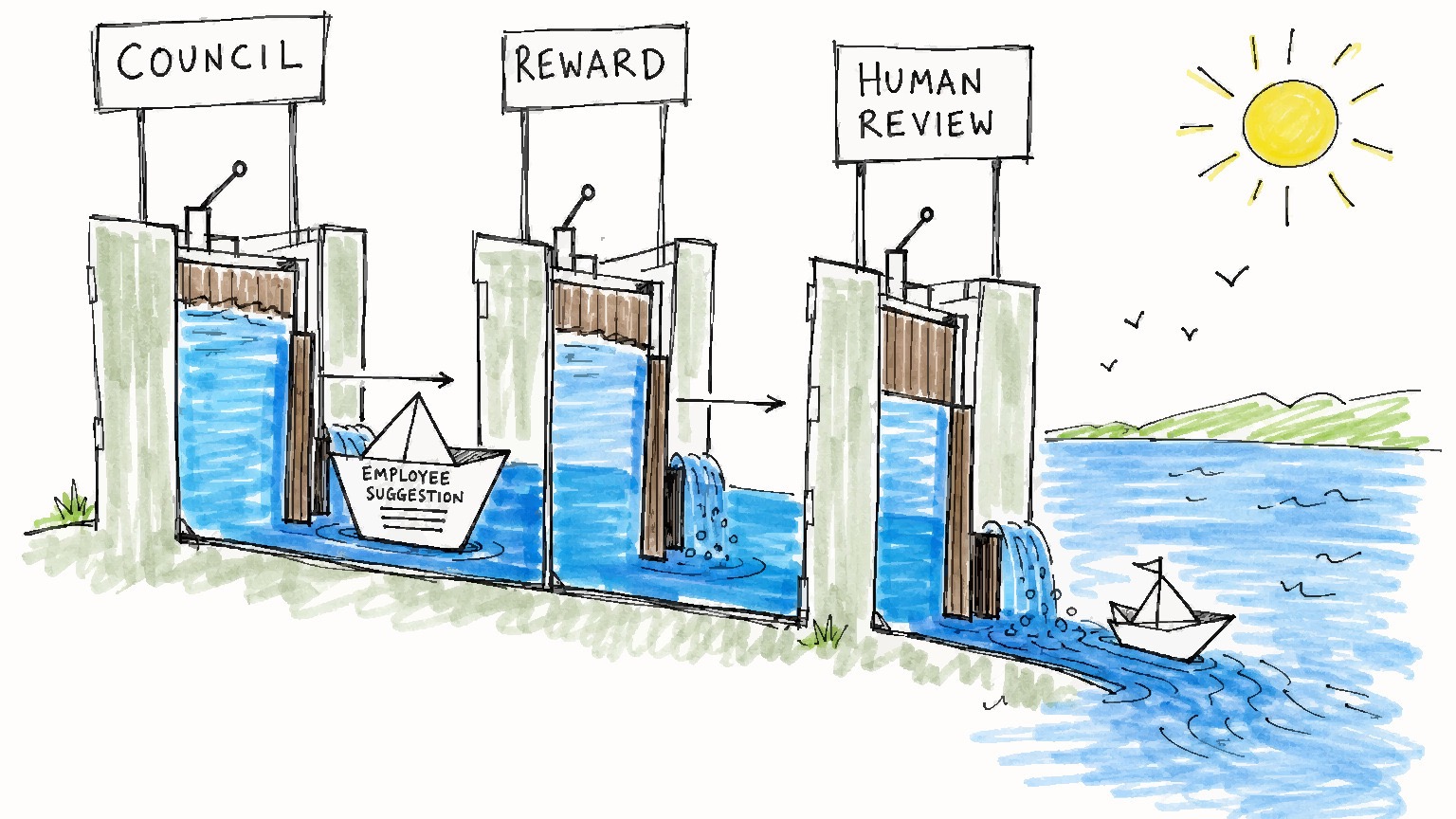
The rules for managing employee ideas in Germany: works-council vetoes, ArbnErfG rewards, GDPR data limits, and AI-review rules for idea tools.
TL;DR
- Works council holds genuine veto power over scheme and platform design.
- Qualified technical suggestions carry a binding, court-enforceable reward claim.
- Auto-rejecting employee ideas with no human step breaches two EU laws.
In Germany, employee idea management is a legal operating system, not a lightweight HR program. The program stays compliant only when co-determination, reward law, and human-reviewed data processing are designed into the workflow from day one.
Buy an "AI-powered" idea platform. Then switch on auto-scoring so low-ranked submissions get binned quietly. In Germany, that single configuration choice can break two laws at once. The rules for managing employee ideas in Germany go well beyond HR style preference. They form a layered legal regime, and the newest product feature in the category is the part most likely to make your program illegal. (Nobody puts that in the sales deck.)
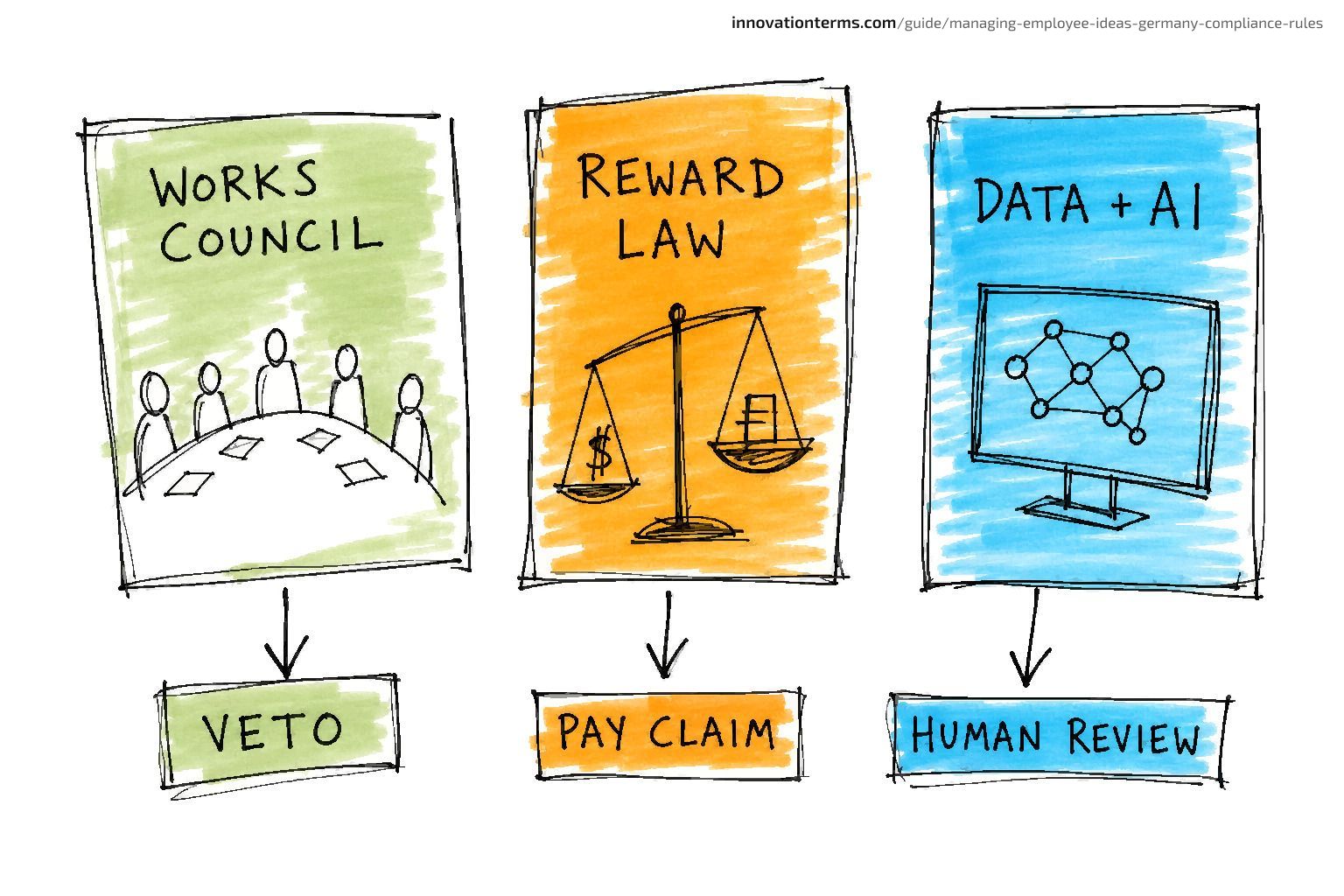
A German employee idea program has to satisfy three legal layers. The Works Constitution Act (BetrVG) hands the works council a genuine veto over how the scheme runs. The Employee Inventions Act (ArbnErfG) turns certain technical suggestions into court-enforceable pay claims. The data rules (GDPR, the German BDSG, and the EU AI Act) govern how submissions are processed and evaluated. The German term for the suggestion scheme itself is betriebliches Vorschlagswesen. None of this is exotic. What trips companies up is treating a co-determined legal instrument as a procurement decision, and treating automated idea-filtering as a harmless efficiency. As of 2026, with the EU AI Act's high-risk obligations phasing in, that mistake is getting expensive.
What makes an employee idea program legal in Germany?
An employee idea program is legal in Germany when it satisfies three statutes at once: works-council co-determination under the BetrVG, the reward obligations of the ArbnErfG, and the data and AI rules in GDPR, the BDSG, and the EU AI Act. Miss one layer and the failure mode is different each time: a frozen platform, a back-pay claim, or a regulatory fine.
Most English-language guides pick one statute and explain it well. The reader leaves with a third of the picture, which is, incidentally, the third that involves the least liability. The value of seeing all three statutes together is that the layers interact in ways each individual guide politely omits. A works agreement that ignores data handling fails the GDPR test. An AI evaluation step that skips human review breaches the AI Act even if the works council signed off.
The works council layer
Under §87(1)(12) BetrVG, the works council co-determines the principles of a company suggestion scheme (BetrVG §87). This is not a niche body. According to 2018 IAB-Betriebspanel data, works-council coverage in establishments with more than 500 employees ran above 90 percent for most of the prior decade and had eased to roughly 85 percent in western Germany (IAB-Betriebspanel data). For most large German employers, the works council is already in the room. This is a structured idea-management program with a defined lifecycle rather than an ad-hoc box on the wall. Peer-reviewed work on idea management notes the field "lacks a general model" and supplies a submission-to-evaluation-to-reward checklist that German practice has run for decades (Gerlach and Brem (2017)). The governing document is the Betriebsvereinbarung, the works agreement.
The reward layer
The ArbnErfG separates ordinary ideas from qualified technical improvement suggestions. The second category carries a binding pay claim (ArbnErfG §20). Section 3 unpacks this fork, because almost every international guide collapses the two into one and gets the legal obligation wrong.
The data and AI layer
Idea submissions are personal data. Their processing needs a lawful basis, usually BDSG §26 (BDSG §26). When AI scores or filters those submissions, the EU AI Act treats the system as high-risk and demands human oversight (Gibson Dunn).
Does the works council have veto power over your suggestion scheme?
Yes. Section 87(1)(12) BetrVG gives the works council co-determination over the principles of any suggestion scheme, which is a genuine veto, not a consultation (BetrVG §87). Run the scheme without a Betriebsvereinbarung and you expose the company to an injunction that can freeze it.
In Germany, choosing an idea-management platform is a co-determined legal act. It is a legal act the works council gets to veto. The reason sits in a second provision. Section 87(1)(6) BetrVG gives the works council co-determination over any technical system capable of monitoring employee performance or conduct. A German employment lawyer puts the test plainly:
Section 87(1)(6) covers devices or software that can store employee-related data allowing the employer to draw inferences about performance or conduct, if it wanted to. Then the works council has a genuine co-determination right.
— Dr. Henning Kluge, Fachanwalt für Arbeitsrecht
An idea platform can meet the §87(1)(6) monitoring threshold if it logs who submitted what, when, and how their ideas scored. Germany's Federal Labour Court reinforced the principle in July 2024: in case 1 ABR 16/23, a works council moved to block an in-store headset system introduced without co-determination, and the court held that the mere capability to monitor is enough to trigger the right (BAG 1 ABR 16/23).
What the Betriebsvereinbarung must specify
Who may submit comes first. So does the evaluation method. A workable works agreement for a suggestion scheme should state both, then place the remaining terms into clear operating categories such as governance, rewards, data handling, and platform setup. The committee is co-determined, which means the employer cannot simply appoint it.
What happens if you skip it
Skipping the works agreement defers a stoppage rather than avoiding it. The works council can seek an interim injunction against the platform's introduction. Until agreement is reached, the program stalls. Worse, any rewards already paid to some employees and withheld from others can resurface as claims.
Are you legally required to pay employees for their ideas in Germany?
The dividing line is sharp. A qualified technical improvement suggestion under the ArbnErfG triggers a binding, court-enforceable reward claim (ArbnErfG §20). An ordinary, non-technical idea carries no statutory reward at all. The employer may fund a prize pool voluntarily, and then the works council co-determines the rules for how that pool is shared.
| Qualified technical improvement suggestion | Ordinary (non-technical) idea | |
|---|---|---|
| Trigger | Technical character, novel within the firm, usable (ArbnErfG §20) | Any other useful suggestion |
| Legal basis | §20 ArbnErfG (and related invention rules) | §87(1)(12) BetrVG for the scheme's rules (BetrVG §87) |
| Reward obligation | Binding statutory claim to appropriate compensation | None; employer funds a pool voluntarily |
| Who sets the amount | Statutory method, disputes to the DPMA arbitration board | Employer sets the fund; works council sets the distribution rules |
| Enforceable in court | Yes | Only the agreed scheme rules, not a payout |
The qualified-technical row is where guides go wrong
This row carries real money and real risk. Treat the distinction between a service invention and a free invention as a side note and you mishandle ownership too, which §10 covers. For the boundary between an improvement suggestion and a patentable invention, the technical-character test is the hinge.
The discretionary row still has a works-council string
Even where no statutory reward applies, the employer does not get a free hand. Fund a bonus pot for non-technical ideas and the works council co-determines the distribution rules under §87(1)(12) (BetrVG §87). The employer decides whether to fund. The works council decides the fairness rules once it does.
The statutory regime is real, and it is also burdensome. In a 1995 study of the Act, Leptien found the consensus in industry was unfavourable:
the general consensus in industry is unfavourable to the German Act.
— Leptien, R&D Management (1995)
The same study linked the Act to a "high administrative effort" and even to secrecy among R&D staff. The law is enforceable. Companies that ignore it pay the heavier price.
How is the reward for a technical improvement suggestion calculated?
The standard method comes from the BMAS Richtlinien, the federal remuneration guidelines for employee inventions. They express compensation with the formula V = E · A: the value of the reward (V) equals the invention value (E) multiplied by a share factor (A) (the BMAS guidelines). Disputes go first to the arbitration board at the German Patent and Trade Mark Office (DPMA) (the DPMA annual report).
The BMAS formula, factor by factor
The invention value E is itself derived from a reference figure and a license-analogy rate (E = B · L). The share factor A is built from three value-numbers: the origin of the task, the way it was solved, and the employee's position in the company. Add those value-numbers. The resulting percentage shows the share of the license-equivalent value the employee receives.
A worked illustration. A qualified technical suggestion can save a plant roughly 100,000 euros in its first year. Apply the BMAS structure: reference figure B = €100,000 and a 10% license-analogy rate L would produce an invention value E = €10,000. The final payout then depends on the guideline's share-factor tables rather than a free-form negotiation (the BMAS guidelines).
The factor values above are the structure of the BMAS method, not fixed published constants for every case, so any real calculation needs the current guideline tables (the BMAS guidelines).
When the two sides disagree: the DPMA Schiedsstelle
53 new filings. In 2023 the DPMA Schiedsstelle took 53 new filings, completed 51 procedures, and reported that over 60% of its settlement proposals were accepted within the objection period (the DPMA annual report).
When employer and employee cannot agree on the result, the DPMA Schiedsstelle steps in. The evaluation committee that scores suggestions in the first place is itself co-determined, which ties the calculation back to the works agreement. For the broader logic of staged evaluation gates, see the Stage-Gate model.
Can AI score or reject employee ideas automatically?
No, not without a human reviewer who can overrule the machine. An AI system that filters, scores, or rejects employee ideas without meaningful human review triggers two independent obligations: GDPR Article 22, which bars solely automated decisions with significant effect, and EU AI Act Article 14, which mandates human oversight for high-risk AI in employment (Gibson Dunn). This is the contested core of the whole topic.
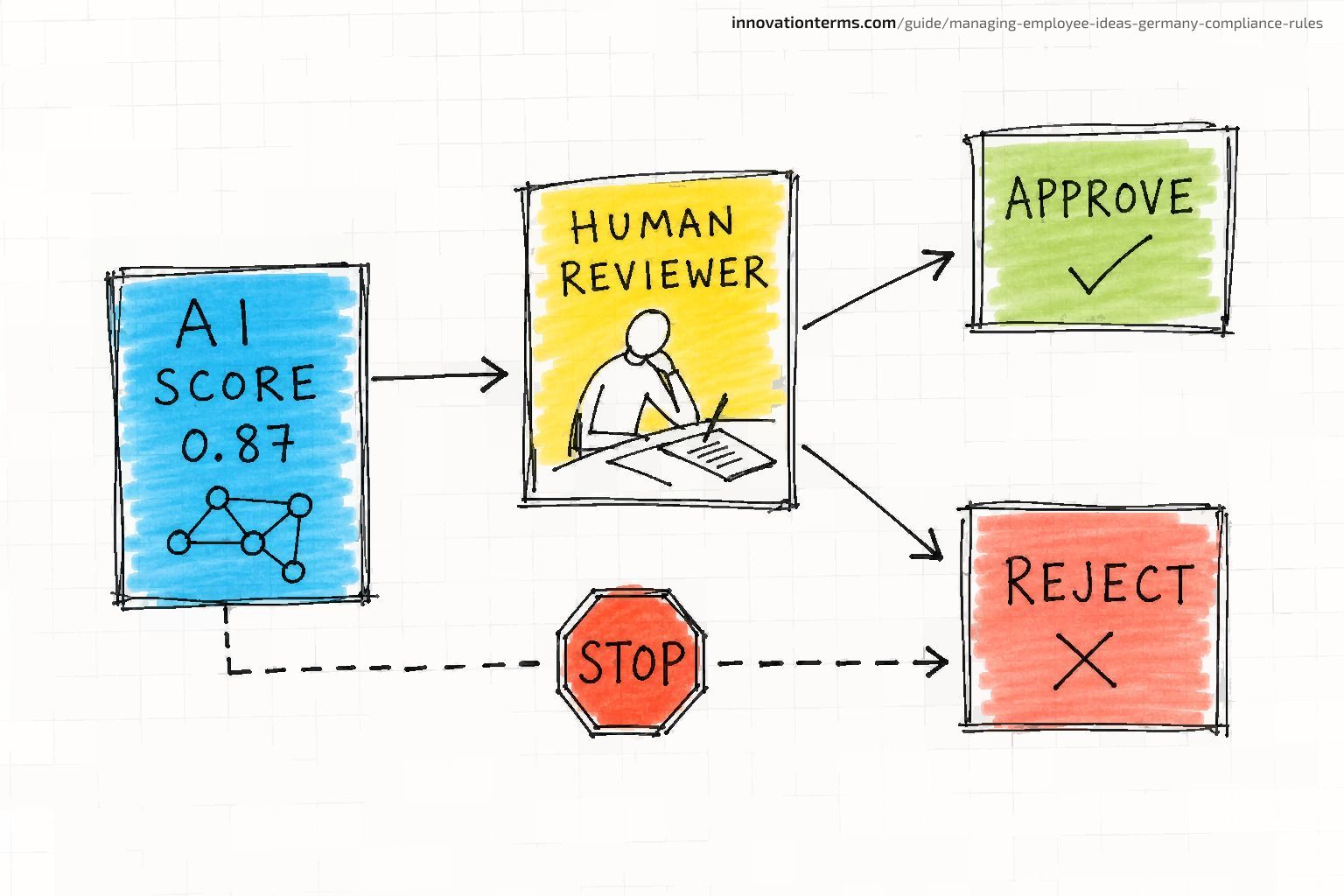
Most AI-powered idea tools sold in Germany are a compliance trap: auto-rejecting an employee's idea with no human review breaches GDPR Article 22 and the EU AI Act.
Why idea evaluation is high-risk under the EU AI Act
Annex III(4) of the AI Act classifies AI used in employment and worker management as high-risk. The risk is not abstract. DeepInspect names the exact mechanism: the danger is "the hiring manager who accepts the AI's ranking without independent assessment" (DeepInspect). An AI that filters employee ideas before a human sees them is the same shape. High-risk status pulls in Article 14, which requires an overseer who understands the system and can act against it (Evil Legal's Article 14 explainer) (Kenniscentrum Data & Maatschappij).
What GDPR Article 22 adds on top
Vendors lean on one defense: our AI only ranks, it does not decide. The Court of Justice of the EU closed that gap in the SCHUFA case (C-634/21), holding that producing a score is itself the decision:
the establishment of that value must be qualified in itself as a decision producing legal effects concerning him or her or similarly significantly affecting him or her.
— CJEU, C-634/21, quoted in Cloisters analysis (2023)
A&O Shearman read the ruling the same way: Article 22 bites when a third party "draws strongly" on the score (A&O Shearman's SCHUFA analysis). Automation bias closes the gap between a ranking and a rejection.
The two regimes reinforce each other
the AI output must not be treated as the decision, a human reviewer must have genuine discretion, not rubber-stamp authority.
— Knowlee, AI Act Annex III HR obligations
Crowell & Moring put the relationship directly: the AI Act's oversight duty is "distinct from but reinforces" the GDPR's Article 22 right against solely automated decisions (Crowell & Moring). German law adds a third clamp. Christian Solmecke of WBS Legal stated the right directly in German: das Recht haben darauf einzuwirken, dass ein Mensch in eine automatisierte Entscheidung eingreift (WBS Legal). People must have the right to have a human intervene, not only a machine. Ideanote's Automatic Progression page is useful here because it makes the feature risk legible: ideas can move to the next phase without manual intervention when workflow rules are met, so the human-review step has to be explicit before any legally significant rejection or archive.
What do compliant programs actually deliver? The numbers.
German companies running co-determined idea programs report some of the highest documented returns on employee suggestion schemes anywhere. The headline figures run into hundreds of millions of euros per company, generated by programs that operate inside the full BetrVG and ArbnErfG framework. Compliance, it turns out, is not what killed the golden goose. In this case it raised the thing from a chick.
Primary press and benchmark sources document returns from co-determined employee suggestion schemes, the kind of operating evidence teams use when they need to change innovation culture and process together.
| Company / group | Period | Documented savings | Volume signal |
|---|---|---|---|
| Siemens (3i) | Fiscal 2017 | Over €300 million in benefits (Siemens FY2017 results) | 160,000+ suggestions, ~125,000 implemented (Siemens FY2017 results) |
| Bosch (Germany) | 2004-2014 | ~€395 million saved (Bosch press release) | ~21,900 associates submitting (Bosch press release) |
| Daimler | 2014 | ~€70 million saved (Automobilwoche's Daimler report) | 69,000+ suggestions in one year (Automobilwoche's Daimler report) |
| German benchmark (dib-Report) | 2011 | €1.46 billion total benefit across firms (dib-Report 2011) | 374 suggestions per 100 employees in metalworking (dib-Report 2011) |
€395 million. That is what Bosch's German workforce saved over a single decade through the suggestion scheme (Bosch press release). The program runs under full works-council co-determination. The combined Audi, Daimler, and BMW figure sometimes cited at around €170 million for 2014 is snippet-grade and not independently verified. The confirmed anchor is Daimler alone at roughly €70 million in 2014 (Automobilwoche's Daimler report).
Every figure in that table comes from a program that operates inside the full BetrVG and ArbnErfG framework. The legal scaffolding and the productivity coexist. The next section shows the longest-running example of why.
Siemens 3i: what 150 years of co-determined idea management looks like
Over more than a century, Siemens built its idea program through German law. The outcome is one of the most quantified corporate innovation programs in the world, which makes it a sharp rebuttal to the idea that compliance kills participation. That idea fails, and it fails in an expensive way.
Premiums for "improvement suggestions" were offered for the first time in October 1910 at Siemens' Kleinbauwerk in Berlin.
Siemens first paid premiums for improvement suggestions in October 1910 (Siemens history press release). Its earliest surviving list of implemented ideas dates from 1913. The modern program was named 3i in 1997. It operates under a Betriebsvereinbarung and uses a co-determined evaluation committee, with statutory rewards for qualifying technical improvements. None of those features were bolted on to satisfy a compliance audit. They are how the program has always worked.
160,000 suggestions. In fiscal 2017 Siemens employees submitted more than 160,000 suggestions, implemented nearly 125,000 of them, and booked more than €300 million in benefits (Siemens FY2017 results).
Siemens has run written suggestion rules since 1910 and still books over 300 million euros in annual savings. Co-determination sustained participation. It built the most productive idea program in the country.
The works council sits inside scheme governance, co-determining the evaluation rules and the reward structure.
What HR and legal teams get wrong about German idea programs
Four misconceptions produce most compliance failures, and three of them are actively sold by vendors pitching the tools that create the problem. Each one feels reasonable in a sales call. Each one is wrong in a way that eventually shows up as a legal bill.
"AI only ranks. It doesn't make a decision." This is the load-bearing vendor claim, and SCHUFA dismantled it: a score is itself the Article 22 decision when a downstream actor draws strongly on it (the SCHUFA ruling) (A&O Shearman's SCHUFA analysis). Products that use AI scoring to triage ideas still need a named human decision-maker. Ideanote's AI Idea Scoring page presents scoring as initial triage while keeping the team in control over which ideas move forward, which is closer to the governance pattern Article 22 and Article 14 demand.
"We don't need the works council for a simple suggestion box." Section 87(1)(12) covers the principles of any suggestion scheme, and §87(1)(6) covers any platform capable of monitoring (BetrVG §87). A digital box is still co-determined. The Federal Labour Court's 2024 ruling on monitoring-capable systems leaves little room here (BAG 1 ABR 16/23).
"Any idea reward is discretionary." It collapses the instant a qualified technical improvement suggestion is filed, at which point §20 ArbnErfG converts discretion into a binding claim (ArbnErfG §20). The discretionary-versus-statutory fork in §3 is the whole point.
"GDPR doesn't apply because our idea box is anonymous." Most idea boxes are not anonymous in GDPR terms. The combination of department, role, and idea content frequently re-identifies the submitter, which keeps the submission inside personal-data rules and BDSG §26 (BDSG §26).
What personal data can you collect when an employee submits an idea?
Idea submissions are personal data, and in Germany the right lawful basis for processing them is usually BDSG §26, the employee-data provision, not the general GDPR Article 6 grounds most international platforms default to (BDSG §26). Collect the minimum: submitter identity, idea content, and date. Add fields only with a documented justification, then route the result through a documented feedback loop.
Why a pseudonymous submission is still personal data
GDPR's definition of personal data is broad. A submission tagged only with a department and a job role can still single out one person, especially in a small team. Treating a "name-optional" form as anonymous is a frequent and expensive misread. Once re-identification is realistic, the full processing regime applies.
BDSG §26 as the preferred basis
Section 26(1) BDSG permits processing employee data where necessary for the employment relationship (BDSG §26). It is a cleaner fit than Article 6(1)(b) or (f) for idea submissions made in the course of work. §26 sits within the Beschäftigtendatenschutz framework, the body of German law specifically governing data processing in employment relationships, which applies stricter standards than the general GDPR grounds. Consent is a weak basis here. Under §26(2), you have to weigh the employee's dependence in the relationship, which is why Germany's federal data-protection authority has said consent should generally not support AI in recruitment (the BfDI FAQ). The dependence problem that weakens consent at hiring weakens it for idea evaluation too.
DPIA and data minimization
There is no fixed headcount that triggers a Data Protection Impact Assessment. The triggers are systematic monitoring, processing of vulnerable groups, and AI-supported profiling. An idea platform that scores submissions with AI can hit all three. The Zweckbindung principle, the GDPR rule that data collected for idea evaluation cannot later be repurposed, for instance, as input to a performance review or disciplinary process, further constrains how submission records are stored and accessed after evaluation is complete. Privacy-by-design under GDPR Article 25 starts early. Before launch, decide retention rules, access controls, and the minimum fields you need instead of waiting for the works council to force the issue. This is GDPR employee idea data handled as a design constraint rather than a disclaimer.
Where the rules get complicated: edge cases and boundary conditions
Three scenarios fall outside the standard playbook. Each reverses an assumption most teams start with. If any applies, the §12 checklist alone is not enough.
The employer may not own the idea
A free invention under §§18-19 ArbnErfG belongs to the employee, not the company (ArbnErfG §§18-19). The employee must report it in text form without delay. Under §18, if the employer does not object in writing within three months, it can no longer claim the invention as a service invention. Before exploiting a free invention that falls within the firm's field, the employee must offer the employer a non-exclusive right on reasonable terms under §19. The statute's acceptance window for that offer is three months under §19 (ArbnErfG §§18-19). Miss the deadline and the company loses the option entirely.
Contractors break the BDSG §26 basis
Section 26 covers employees. A freelancer or contractor submitting through the same platform is not an employee, so their idea-submission data needs a different GDPR Article 6 basis (BDSG §26). A mixed-population platform cannot run on a single legal basis, which most off-the-shelf configurations assume it can.
A foreign parent still carries the German duties
A non-German parent running a global idea platform that captures German employees' submissions does not escape these rules. BetrVG and ArbnErfG follow the employment relationship. The EU AI Act attaches deployer obligations to the place of use, regardless of where the software vendor is based. A foreign-firm reference treats the German invention regime as "a pitfall for companies from abroad" precisely because teams assume their home-country setup travels (IP2's white paper). It does not.
What happens when companies break the rules?
The consequences stack, and they arrive on different clocks. The fastest consequence is an injunction, followed by scheme suspension, back-pay, and GDPR fines.
- Injunction (days). The works council asks the Arbeitsgericht to freeze a platform introduced without co-determination.
- Scheme suspension (immediate). The program stops running until agreement is reached.
- Back-pay (retroactive). Unpaid statutory rewards for qualified technical suggestions accrue as enforceable claims.
- GDPR fine (investigative lag). Violations carry fines of up to 4% of global annual turnover under Article 83.
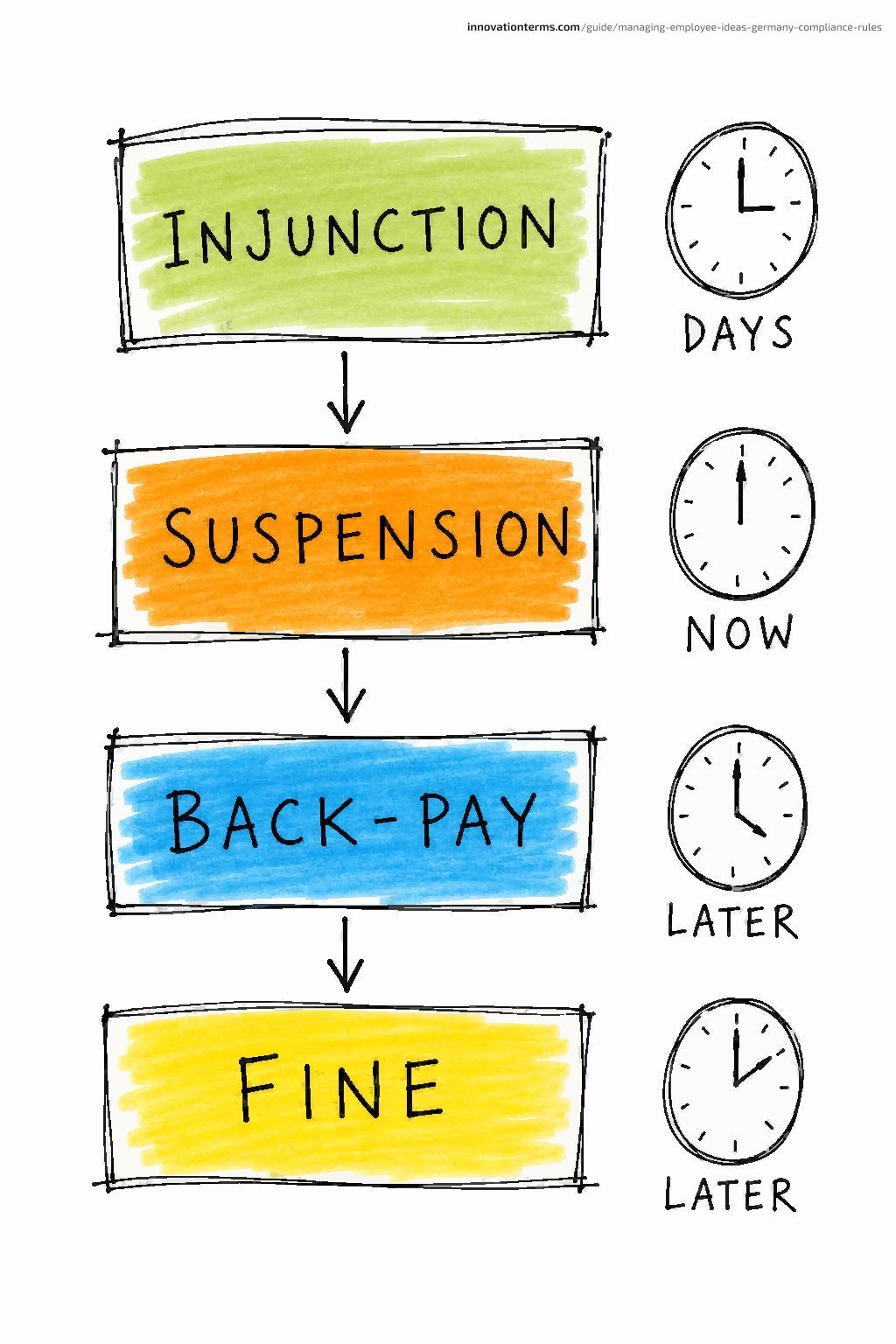
The fast risk and the expensive risk are not the same risk. Start with the fastest. A works council that has not agreed to a monitoring-capable system can seek an interim injunction. The Federal Labour Court's 1 ABR 16/23 ruling in July 2024 confirms the principle for any system "objektiv geeignet" to monitor performance, which an idea platform with scoring logs can be (BAG 1 ABR 16/23). No German court case on a suggestion scheme run without a Betriebsvereinbarung is publicly reported, so this monitoring-system line is the closest binding analogue, and it is close.
Next, the reward claims. A different claim type shows the order of magnitude a mishandled reward obligation can reach: under the employer's right of claim (§9 ArbEG), in January 2026 the OLG Düsseldorf awarded an employee inventor a total of €65,909.41 (the OLG Düsseldorf summary). The §20 improvement-suggestion route carries analogous risk at comparable scale.
Finally, the automated-decision risk. The clearest enforcement precedent sits in the gig economy: in 2021 Italy's Garante fined the delivery platform Foodinho €2.6 million for making decisions about riders based solely on automated processing, with no route to challenge the algorithm and no human-intervention safeguard (the Garante Foodinho case). An idea platform that auto-rejects submissions is the same legal defect in a different setting.
How do you build a compliant employee idea program in Germany?
Build in sequence: negotiate and sign the Betriebsvereinbarung before you touch any software, run a DPIA, then configure the platform so no idea can be rejected or archived without a documented human review step. Treat the rules for managing employee ideas in Germany as the launch order itself. Compliance designed in upfront costs far less than compliance retrofitted after a rollout, especially if the wider team is already testing AI for innovation.
Step 1: Works-council negotiation first
If a works council exists, the Betriebsvereinbarung comes before procurement. Agree the evaluation committee's composition and the named platform, then document the reward categories and data fields separately. This is the works council co-determination suggestion scheme stage. Skip it, and §11 is where the injunction comes from.
Step 2: Run the DPIA
Assess the processing before launch, not after. Document the lawful basis (BDSG §26 for employees), retention, access controls, and any AI-supported scoring. If AI evaluates submissions, the DPIA and the AI Act's high-risk obligations overlap, so run them together.
Step 3: Design the human-in-the-loop gate
Article 14 wants an overseer with genuine discretion, aware of automation bias, able to reverse the result (Knowlee's Article 14 explainer) (Evil Legal's Article 14 explainer). In practice that means no idea is rejected or hidden by the system alone. A reviewer with authority to disagree signs off first (Kenniscentrum Data & Maatschappij). Configurable workflows that insert a mandatory human review gate turn the legal requirement into a setup step rather than a blocker.
The timeline sets the urgency
From 2 August 2026, the EU AI Act was set to apply high-risk employment obligations (the public AI Act timeline). A possible Digital Omnibus deferral could delay the stand-alone Annex III category until 2 December 2027, though the earlier date still controls unless the measure is enacted (Gibson Dunn). Treat human review as a launch requirement. It is much harder to bolt on later.
What should you look for in an idea-management platform for the German market?
Four criteria decide whether a platform can be legally deployed in Germany: configurable human review gates before any idea decision, EU data residency, documented AI governance the works council can audit, and per-idea logs that prove human review happened. A tool that cannot meet these out of the box should not reach the shortlist, whether it is sold as an idea-management suite or part of a broader innovation guides stack.
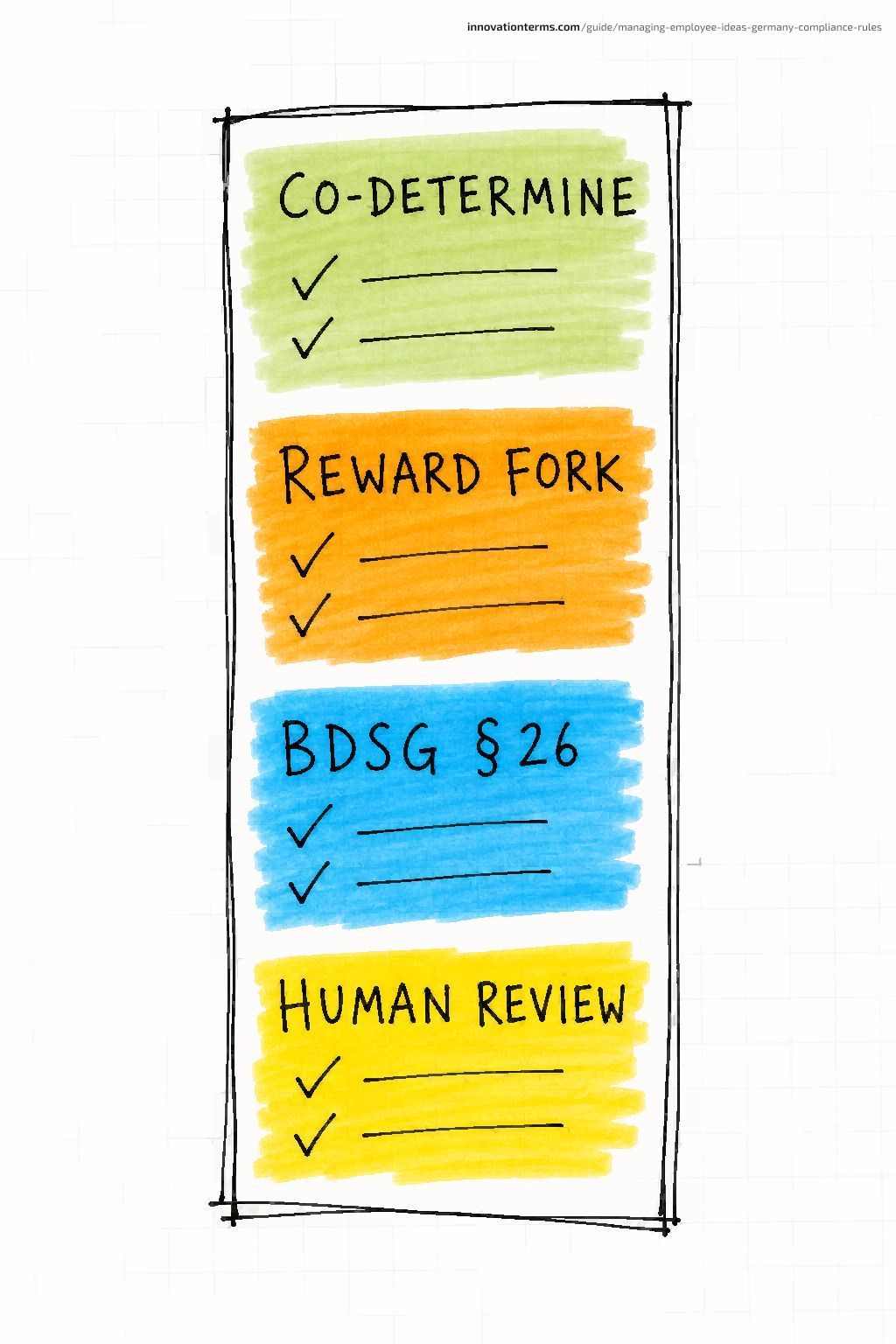
- Idea decisions: Mandatory human review gate before any rejection or archive, satisfying AI Act Article 14 (Knowlee's Article 14 explainer). If a platform uses progression or archiving rules, that logic has to sit behind a human review gate; Ideanote's Stage-Gate Reviews page shows the operational shape with named reviewers, thresholds, and explicit gate ownership before ideas move forward.
- Data residency: EU-hosted, BDSG §26 basis documented (BDSG §26). US-default hosting with generic Article 6 consent does not satisfy the employee-data requirement.
- AI governance: Logged, auditable scoring the works council can inspect (BAG 1 ABR 16/23). Opaque scoring with no audit trail fails the co-determination review.
- Reward workflow: Captures qualified-technical suggestions for §20 handling (ArbnErfG §20). A platform that treats all rewards as discretionary will miss the statutory obligation the moment a qualifying idea arrives.
Platform selection is a legal act in Germany, because the works council reviews the tool as part of the Betriebsvereinbarung negotiation. The test is this: can you prove, per idea, that a human with authority signed off? If the platform cannot show that log, it cannot pass a works-council review. That review is where deployment lives or dies in Germany. Teams that want proof should ask vendors for named case stories and audit-log walkthroughs rather than feature sheets.
Frequently asked questions
Does the works council have to approve our employee suggestion scheme? Yes. The key hook is Section 87(1)(12) BetrVG, which gives the works council co-determination over the scheme's basic rules. Skip the Betriebsvereinbarung and the scheme can be enjoined. Use a monitoring-capable platform, and §87(1)(6) is triggered as well (BetrVG §87) (BAG 1 ABR 16/23).
Do we legally have to pay employees for their ideas in Germany? Only for qualified technical improvement suggestions, which carry a binding claim under the ArbnErfG (ArbnErfG §20). Ordinary, non-technical idea rewards are discretionary: the employer chooses whether to fund a pool, and the works council co-determines how it is distributed (BetrVG §87).
Can we use AI to automatically score or reject employee ideas? No, not without a documented human review step. Solely automated rejection breaches GDPR Article 22, and the EU AI Act classifies idea-evaluating AI as high-risk requiring human oversight under Article 14 (the SCHUFA ruling) (Gibson Dunn). A human who can overrule the model has to sign off.
What personal data can we collect when an employee submits an idea? The minimum: submitter identity, idea content, and date, processed on the BDSG §26 employee-data basis (BDSG §26). Pseudonymous submissions usually still count as personal data, and extra fields need a DPIA-backed justification.
What should go in the Betriebsvereinbarung for our suggestion scheme? Scope (who may submit), the evaluation committee's composition, reward categories and calculation method, data-handling and retention rules, and the platform's name and hosting details (BetrVG §87).
Does a non-German subsidiary running a global idea platform fall under these rules? Yes for German employees. BetrVG and ArbnErfG follow the employment relationship, and EU AI Act deployer obligations attach to where the system is used, regardless of where the vendor is based (IP2's white paper) (Gibson Dunn).

Mikkel @mkl_vang
Covers operational innovation, AI implementation patterns, and how teams ship useful change without theater.