Nature-Inspired Design
Quick answer
Nature-inspired design is the umbrella term for design approaches that borrow from living systems, with the real dividing line being function versus decoration.
Nature-Inspired Design
Nature-inspired design is the umbrella term for any design practice that borrows from living systems to solve a problem. It covers biomimicry, biophilic design, biomorphism, bio-utilization, and bio-inspired engineering. These are siblings, not synonyms, and they differ in one thing that matters most: whether they copy how nature works or only how it looks. Only the functional version produces innovation.
Most project briefs miss that distinction. A leaf-shaped façade and a building that cools itself the way a termite mound does are both called "nature-inspired." Only one of them learned anything from biology. This piece sorts the umbrella from its siblings, then shows where a function-first version of the practice slots into an innovation workflow. For the broader vocabulary, see the design and innovation glossary.
TL;DR
- Nature-inspired design is an umbrella covering biomimicry, biophilic design, biomorphism, and bio-utilization.
- The sharp line inside it is function versus decoration: works-like-nature versus looks-like-nature.
- Janine Benyus's three levels (organism, behavior, ecosystem) double as an innovation-ambition ladder.
- Functional emulation produces measurable wins. the Shinkansen cut energy 15%, the Eastgate Centre runs near-HVAC-free.
- Transfer and scale are where attempts break down.
Nature-inspired design works as a reframing step inside ideation: define the function you need, then search biology for organisms that already perform it. Tools like AskNature make that search-by-function practical. The payoff is real only when the team chases how a living system functions.
What is nature-inspired design?
Nature-inspired design is the family of approaches that study how living organisms and ecosystems solve problems, then transfer those solutions into human-made products, buildings, services, or systems. It groups methods that differ sharply but share a common source: living systems. The unifying claim is that biology has already field-tested solutions to most engineering problems, so designers should consult it deliberately rather than by accident.
Underneath it sit several distinct disciplines, the best-known being biomimicry. Janine Benyus, the biologist who named the modern movement in her 1997 book, defined it plainly:
Biomimicry is the process of learning from and then emulating nature's genius.
— Janine Benyus, Biomimicry: Innovation Inspired by Nature (1997)
Benyus framed nature as "a model, measure and mentor": a model to imitate, a standard to measure designs against, and a mentor to learn from rather than merely extract from. The appeal is partly arithmetic. Living systems have been iterating for roughly 3.8 billion years, which makes biology the largest body of tested design solutions available. Nature has been running a 3.8-billion-year R&D lab. Almost none of it filed a patent, which means the barrier to using it is not legal clearance but the harder work of understanding what the organism is actually doing. The Springer (2023) typology that catalogs these approaches describes the common thread as "the conscious imitation of biological models."
The practical problem the practice tries to solve is rarely "make it look organic." The real targets are efficiency and material savings. The ambition has expanded into regenerative outcomes, where a building cools itself without compressors, a surface sheds contamination without cleaning agents, and a fastener holds without adhesive. Those are functional targets. A designer who keeps the target functional ends up with biomimicry. one who keeps it visual ends up with biomorphism. one who keeps it atmospheric ends up with biophilic design. Holding the functional question in view from the first sentence is what separates a useful definition from a decorative one, and it is the thread that runs through every section below.
What does nature-inspired design actually include? The umbrella and its siblings
Nature-inspired design has five siblings. Each one takes something different from nature and aims at something different. Treat them as interchangeable and you have already made the project's most expensive mistake.
The Springer (2023) typology, which surveys how the literature carves up the field, proposes a structured set of biomimetic approaches rather than one catch-all term. Drawing on that work and on the practitioner distinctions in the comparison literature, the umbrella sorts cleanly along two questions: what does it take from nature, and what is it trying to achieve.
Biomimicry emulates a biological strategy or mechanism (how an organism functions, not how it looks) to solve a functional problem. Its typical output is a product, structure, or process that performs measurably better. Biophilic design introduces the presence of nature (light, plants, water, views) to improve human wellbeing. its output is an interior or built environment that improves mood and productivity. Biomorphism borrows the form or shape of natural objects for aesthetic expression, producing objects that look organic without functioning like anything alive. Bio-utilization goes further: it recruits living material directly, growing insulation from fungal mycelium rather than abstracting a strategy from it. Bio-inspired engineering works at the level of abstracted physical principles (optimization algorithms modeled on ant foraging, structural geometries derived from bone) and its practitioners are as likely to be computer scientists as architects.
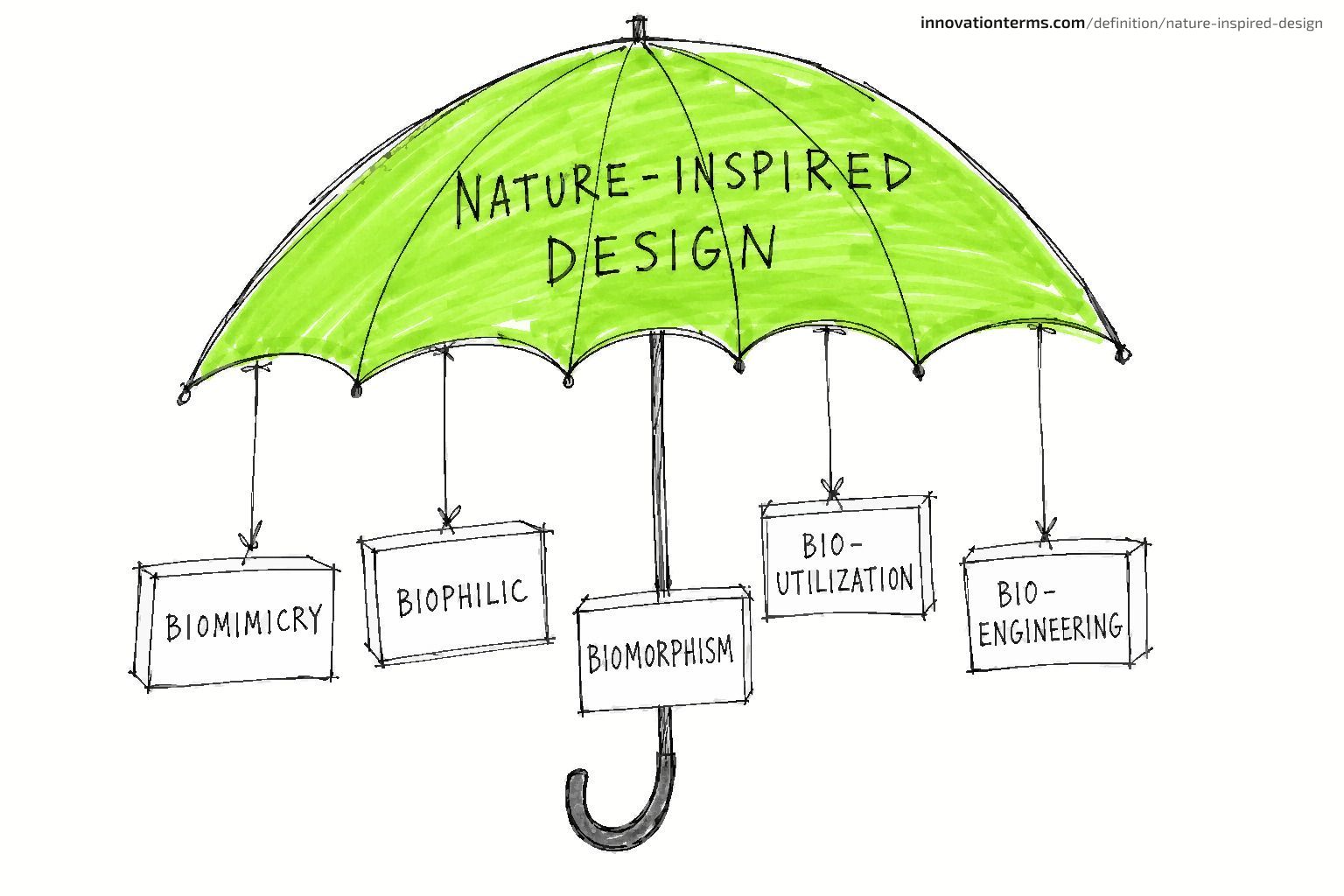
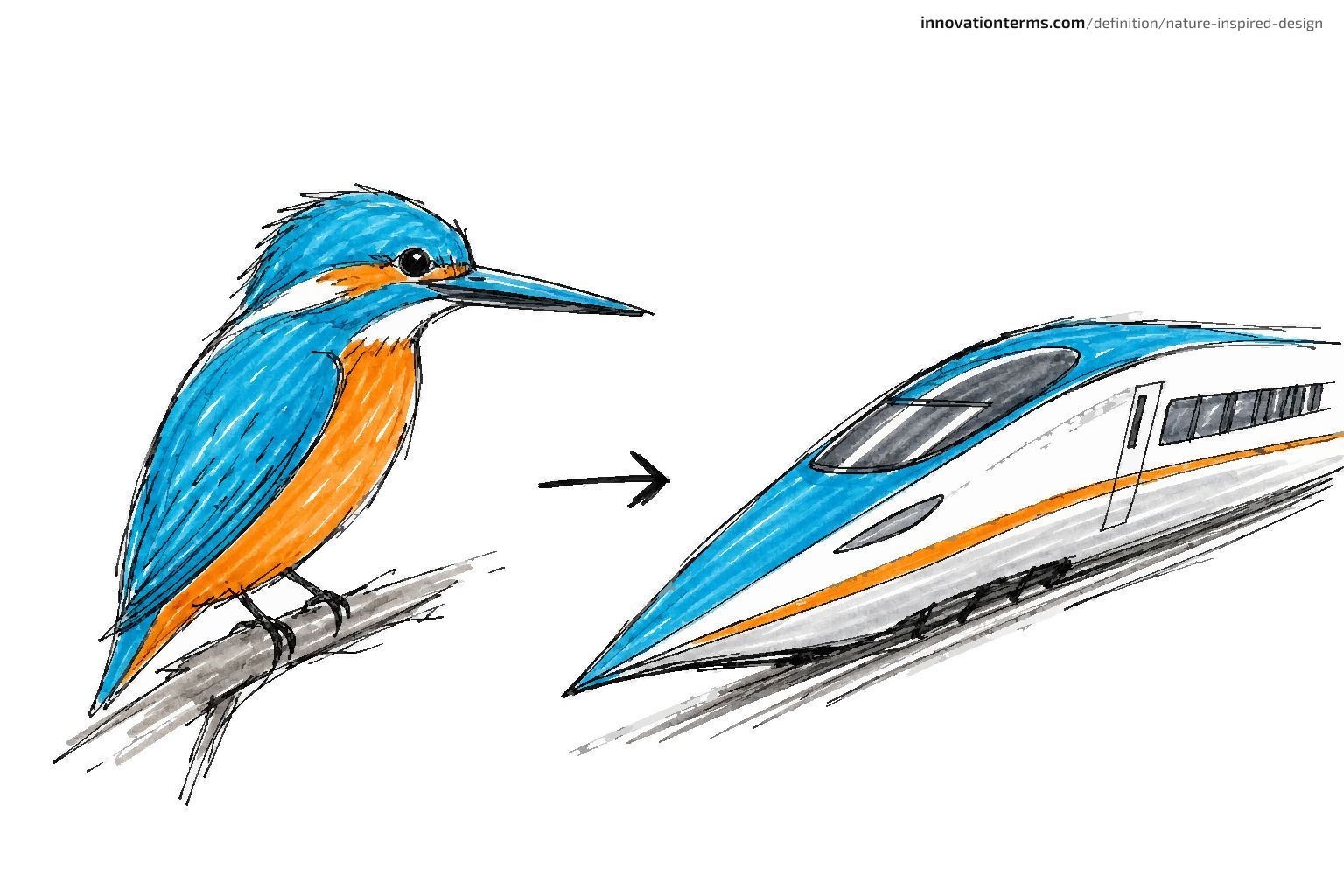
The sharpest line is between biomimicry and biomorphism. A biomorphic object resembles something living. A biomimetic object behaves like something living. The Shinkansen nose copies the behavior of a kingfisher's beak. A wave-shaped sofa copies the look of water. Bio-utilization skips the imitation entirely and recruits living material directly. Know which line you are crossing before you start.
Vendors and competitors usually present the field as a binary, biomimicry versus biophilic design, which forces the other three siblings to disappear.
Keeping all five siblings named in a brief means the team can specify what it actually wants rather than accepting a supplier's narrowed definition. For where this sits among ideation methods, compare it with open innovation as a way of sourcing solutions from outside the team.
What are the most common misconceptions about nature-inspired design?
The three most damaging conflations are: biomorphism mistaken for biomimicry, biophilic design mistaken for biomimicry, and nature-inspired design assumed to mean sustainable. All three are wrong, and each sends a project in the wrong direction before it starts.
The terminology overlaps, and the definitions do not agree. The 2023 biomimicry-in-architecture review notes that despite decades of work, "the field has become more fragmented," with multiple incompatible definitions in circulation at once. When the scholars disagree, practitioners inherit the mess.
"It looks like nature, so it's biomimicry." Actually it is biomorphism. The reference architecture here is the distinction drawn by designingbuildings:
Biomorphism is a formal and aesthetic expression; biomimicry is a functional discipline.
Beijing's National Stadium, the "Bird's Nest," is widely cited as biomorphic rather than biomimetic: it resembles a nest, but its lattice solves an architectural problem, not a biological one. Resemblance is not emulation.
"It brings nature inside, so it's biomimicry." Actually it is biophilic design, and its goal is human wellbeing, not functional problem-solving. A green wall is biophilic. A wall that regulates temperature the way skin regulates heat would be biomimetic. The two answer different briefs.
"Nature-inspired means sustainable." Not necessarily. Velcro, one of the most cited examples of the field, was a fastening solution copied from plant burrs. It carried no environmental goal at all. Sustainability is a frequent outcome of functional emulation, because biology tends to be frugal, but it is not the definition. Confusing the two leads teams to greenwash a product by giving it leaf motifs while changing nothing about how it works.
Where did nature-inspired design come from?
The modern movement was launched by a single book, Benyus's Biomimicry in 1997, and institutionalized within a decade. The underlying ideas, though, are decades older.
The vocabulary predates Benyus. The engineer Otto Schmitt coined "biomimetics" around 1969 to describe the deliberate copying of biological mechanisms. The related term "bionics" had been coined a decade earlier, in 1958, by Jack Steele at the US Air Force, a different person in a different context. The deeper lineage runs further back still, through designers and engineers who treated nature as an engineering reference long before the field had a name. What Benyus added was not the concept but the framing: a moral and methodological case that biology should be a systematic source of design intelligence rather than an occasional curiosity. She described the shift as an era built on what humanity can learn from nature rather than take from it, repositioning biology from a resource to a mentor.
From a book to an institution
Benyus moved quickly from writing to institution-building. She co-founded the Biomimicry Guild in 1998, then the Biomimicry Institute in 2006 with Bryony Schwan. The Institute launched AskNature in 2008, a free database that organizes biological strategies by the function they perform. That database matters more than it sounds: it turned "go look at nature" from advice into a searchable workflow, which is the difference between inspiration and method.
1997 succeeded where earlier coinages had not because of timing. The book arrived as corporate environmentalism was becoming mainstream and as engineers were running short on easy efficiency gains, so a framing that promised both performance and frugality found a ready audience. Benyus also wrote for practitioners rather than for journals, which let the idea cross from biology into boardrooms. The earlier terms, "biomimetics" and "bionics," stayed inside engineering departments. "Biomimicry" got a popular book, a TED stage, and eventually a curriculum. That popularization cut both ways. It gave the field reach and funding, but it also loosened the term, letting "nature-inspired" attach to anything with an organic curve. The institutional history and the definitional confusion grew from the same root: an idea that outran the boundaries drawn for it.
The infrastructure arrived before the evidence base did. By the late 2000s the field had a name, a canonical text, a professional body, and a tool. What it still lacked, and still lacks, was a settled definition and a track record of biological transfers that hold up once they hit manufacturing constraints. That gap is the recurring theme of the sections that follow.
How does biomimicry differ from biophilic design?
Biomimicry and biophilic design both start from nature as reference material, though their goals, outputs, and measurable results point in entirely different directions. Biomimicry emulates a natural strategy to solve a functional problem. Biophilic design introduces natural elements to improve human wellbeing.
The two get conflated because both put "nature" in the brief. They diverge the moment you ask what success looks like. Success for biomimicry is a performance number: less energy, less material, more strength. Success for biophilic design is a human number. A widely cited global survey of office workers found that those in spaces with natural elements reported 15% higher wellbeing, were 6% more productive, and 15% more creative, per the Human Spaces 2015 global survey. Those are real and valuable outcomes. They are also wellbeing outcomes, not engineering ones.
| Axis | Biomimicry | Biophilic design |
|---|---|---|
| What it copies | A biological strategy or mechanism | The presence of nature (light, plants, views) |
| Primary goal | Functional problem-solving | Human wellbeing and performance |
| Design output | Products, structures, processes | Interiors and built environments |
| Measured outcome | Energy, material, performance gains | Mood, productivity and creativity gains |
| Canonical example | Shinkansen nose, Eastgate Centre | Green walls, daylit atria, indoor planting |
The distinction matters most when writing a brief. Ask a vendor for "nature-inspired" offices and you will likely get biophilic design: planting, timber, daylight. That is the right answer if the goal is staff wellbeing. It is the wrong answer if the goal was a building that uses less energy, because biophilic interventions are not engineered to perform that job. Naming which sibling you mean is not pedantry. It decides what you get built.
What are the three levels of biomimicry, and why do they map onto innovation ambition?
Benyus's framework sorts biomimicry into three levels: organism, behavior, and ecosystem. They are usually taught as a taxonomy. They are more useful read as an ambition ladder, because each level corresponds to a different scale of innovation decision.
Organism. Behavior. Ecosystem. Each level changes what you copy and how far the change reaches. At the organism level, you extract a single feature from one creature: the shape of a beak, the texture of a shark's skin. At the behavior level, the source material is an action or interaction, how a termite colony ventilates its mound, how a slime mold routes itself efficiently. At the ecosystem level, you copy how a whole system organizes itself, the nutrient loops and feedback of a living community, and that is where the work stops resembling product design. Benyus captured why the top level is hardest with the image of an owl's feather:
The owl feather is gracefully nested—it's part of an owl that is part of a forest…
— Janine Benyus, via AskNature
An organism-level borrow targets a single trait: a kingfisher beak shape becomes a train nose, cutting noise and energy use. Behavior-level borrowing copies how an organism acts, so termite-mound airflow patterns becoming a building's ventilation logic already constitutes a process-level redesign rather than a product tweak. At the ecosystem level, the source is how a whole system self-organizes, its nutrient loops, circular flows, and feedback, and the target is business-model redesign. Which rung you are reaching for tells you how much of the organization the project will touch.
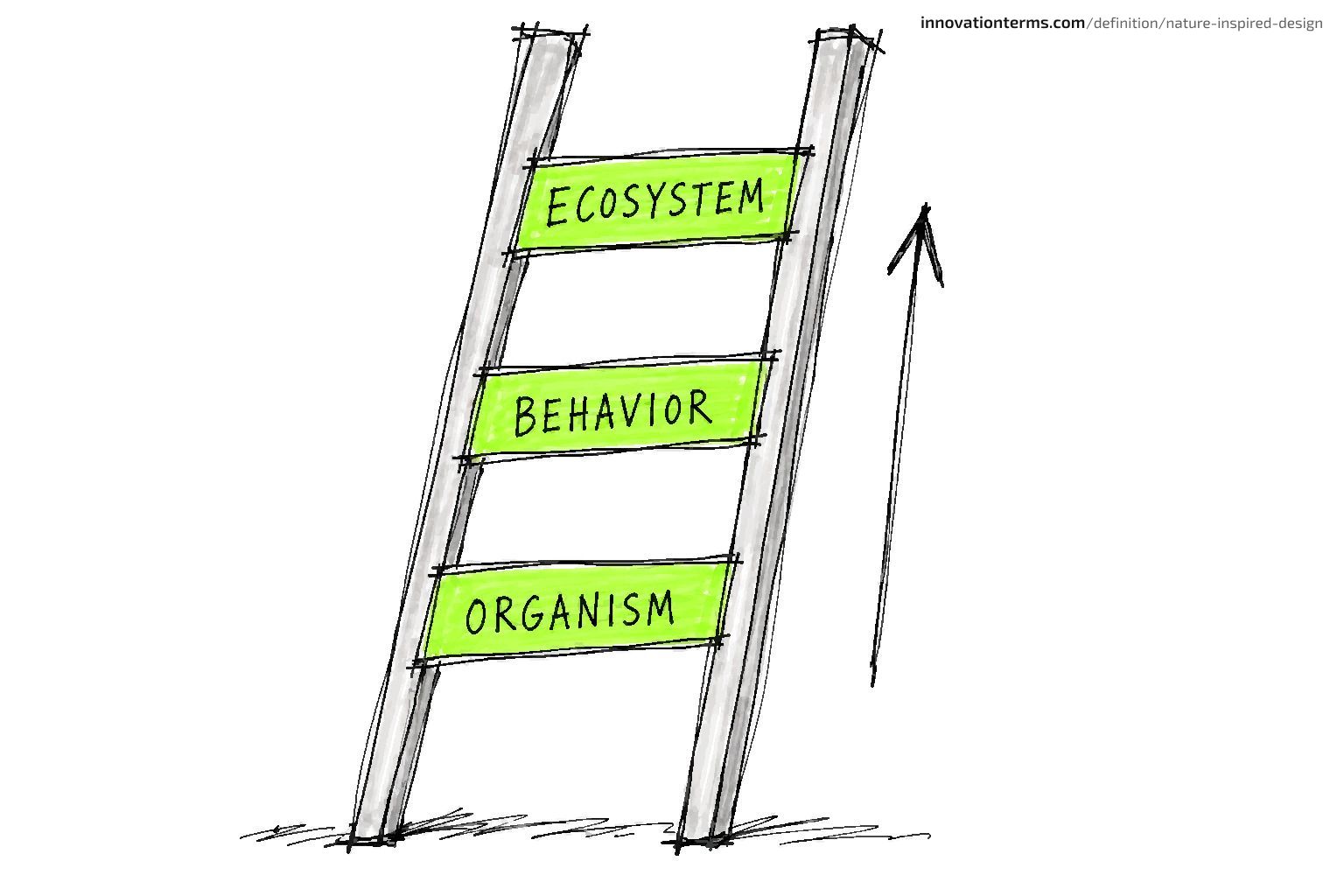
The levels function as a planning tool. An organism-level borrow is low-risk and contained, the kind of incremental feature gain that a stage-gate model was built to handle. Moving to the ecosystem level means redesigning how value and materials flow through the organization — it is a business-model-canvas level of intervention, not a product feature — and that is structurally closer to a disruptive-innovation bet.
Why most corporate nature-inspired work is decoration, not innovation
Corporate briefs for 'nature-inspired' work typically produce biomorphic or biophilic outcomes. It borrows nature's looks or feeling and skips its function. Calling that innovation is inaccurate, and the inaccuracy is expensive because it lets a team feel innovative while changing nothing about how a product performs.
Copying a leaf onto a façade does not make a building innovative. Only emulating how a living system solves a problem does. Most corporate nature-inspired work stops at the surface, borrowing shapes and patterns without ever asking how the underlying biology handles anything. Biomorphism looks like nature. Biophilic design feels like nature. Only biomimicry works like nature, and only the third one is innovation.
Benyus draws the depth-surface distinction in her own terms:
When you do biomimicry at a deeper level, not just a shallow, we're going to recreate the form or the shape of something.
— Janine Benyus, For The Wild podcast, ep. 71
A 2016 bio-inspired design study distinguishes "design pull" from "biology push." Design pull starts with a real function, then searches biology for organisms that already perform it. Biology push starts with a striking biological image and hunts for a problem to attach it to. Decoration is what biology push produces. The organic curve gets specified first, then sold as "nature-inspired" after the fact.
The tell is whether you can state a measurable function the design performs better because of its biological reference. The Bird's Nest stadium cannot, its lattice is an architectural choice that resembles a nest, widely cited as biomorphic rather than biomimetic. The same logic applies to Zaha Hadid's organic-curved buildings: the MAXXI Museum in Rome, for instance, flows with biological aesthetics that reference no functional mechanism. The Eastgate Centre, by contrast, answers the function question directly: it cools a building the way a termite mound does, and the energy bill proves it. A useful audit question for any "nature-inspired" claim is to ask what number changed. If the only honest answer is "it looks more natural," the project is biomorphism wearing a biomimicry label. That mislabeling is not harmless. It lets a roadmap show a nature-inspired initiative while the actual product gains nothing a competitor could not copy with a different render.
The honest caveat: biomorphic and biophilic work can create commercial value. Aesthetics sell consumer goods, and pleasant offices retain staff. The objection is not that decoration is worthless. It is that decoration is not innovation, and pretending otherwise lets organizations claim a functional advantage they have not built. A leaf-shaped logo is fine. Marketing it as biomimicry is not. A performance-validated biomimicry application builds a defensible value proposition that competitors cannot replicate by swapping a texture library.
Nature-inspired design in practice: the Shinkansen and the Eastgate Centre
Functional emulation produces measurable performance gains in energy, materials, and structural efficiency. The two cases below — a bullet train and a passive-cooled office building — show how organism-level and ecosystem-level borrowing produce different magnitudes of change and touch different parts of a project brief.
The Shinkansen and the kingfisher (organism level)
When Japan's 500-series bullet train was being designed in the early 1990s, it had a noise problem. Exiting tunnels at high speed, it generated a sonic boom loud enough to draw complaints. Eiji Nakatsu, the engineer leading the redesign and a keen birdwatcher, recognized the physics from nature. A kingfisher hits water to catch fish without a splash, because its beak is shaped to move between two media of very different resistance. As Nakatsu described the problem he was borrowing from:
The kingfisher dives from the air, which has low resistance, into high-resistance water, and moreover does this without splashing.
— Eiji Nakatsu, Japan for Sustainability interview (2005)
The train was entering tunnels the way a kingfisher enters water: from low resistance into high. Nakatsu reshaped the nose to match the beak's geometry. The redesigned 500-series ran roughly 10% faster, used about ~15% less electricity, and cut the tunnel pressure spike by ~30%, per Nakatsu's Japan for Sustainability interview. The pantograph was quieted by copying the serrations on an owl's wing. The podcast 99% Invisible called the result "a fascinating example of biomimicry," and the numbers make the case directly: none of those gains came from making the train look like a bird. They came from emulating how the beak functions.
The Eastgate Centre and the termite mound (ecosystem level)
In Harare, Zimbabwe, architect Mick Pearce and engineers at Arup faced a different problem: how to keep a large office and retail building comfortable in a hot climate without conventional air conditioning. Their model was the local termite mound, which maintains a stable internal temperature through passive ventilation, drawing cool air in low and venting warm air high. The Eastgate Centre, completed in 1996, copied that behavior with a network of vents, chimneys, and thermal mass instead of compressors. Building performance documentation shows it uses only 10% of the energy of a conventionally cooled building of the same size, runs around 35% below comparable buildings' energy use, and its Harare installation saved roughly $3.5 million by not installing a conventional cooling plant. Like the Shinkansen, the Eastgate Centre did not imitate a termite mound's appearance. It imitated how the mound regulates airflow. That gap matters. The reason functional emulation produces numbers a marketing department cannot fake is that it operates at the system level rather than stopping at an organism-level adjustment.
Nature-inspired design by the numbers
Functional emulation's outcomes, including energy savings, material efficiency, and the often-decades-long process of getting biology into product, tend to be large enough to hold up under scrutiny. They are also uneven, which is the honest part of the story.
Efficiency dominates the headline figures.
| Metric | Value | Source | Implication for innovators |
|---|---|---|---|
| Shinkansen energy reduction | ~15% less electricity | Nakatsu / JFS (2005) | Organism-level borrows can cut operating cost |
| Shinkansen tunnel-boom reduction | ~30% lower pressure spike | Nakatsu / JFS (2005) | Function transfer solves the original problem, not a proxy |
| Eastgate Centre energy use | ~10% of a conventional building | Wikipedia, Eastgate Centre | Ecosystem-level design can remove a whole subsystem |
| Eastgate capital saved | ~$3.5 million unbuilt cooling plant | Wikipedia, Eastgate Centre | Avoided cost can dwarf the design premium |
| Velcro timeline | 1941 observation → 1955 patent | National Inventors Hall of Fame | Transfer takes years, not sprints |
| Lotus self-cleaning effect | Coined 1977 (Barthlott) | National Inventors Hall of Fame | Naming a principle precedes productizing it |
| Ray of Hope startup survival | 97% past 5 years | Biomimicry Institute (2025) | Vetted nature-inspired ventures can be durable |
| Biomimetics market (projected) | $36.76B (2025) → $55.46B (2030) | Research-firm projections | Commercial interest is rising, directionally |
What Barthlott named in 1977 is now understood as superhydrophobicity (a surface condition in which a contact angle above 150° causes water to bead and roll, carrying dirt with it), and it is the mechanism behind a generation of self-cleaning architectural coatings and textiles. The Velcro and lotus timelines make the same point: the gap between a natural observation and a robust invention that works at scale is measured in decades, not product cycles.
The Biomimicry Institute reports that 97% of the startups in its Ray of Hope Accelerator survive past five years, and that alumni have raised more than $125 million after the program. Analyst projections put the global biomimetics market near $36.76 billion in 2025, rising toward $55.46 billion by 2030 at roughly 8.6% CAGR, though these single-firm figures should be read as directional rather than authoritative.
Across all of it, the idea is cheap and the transfer is expensive.
How do teams apply nature-inspired design inside an ideation workflow?
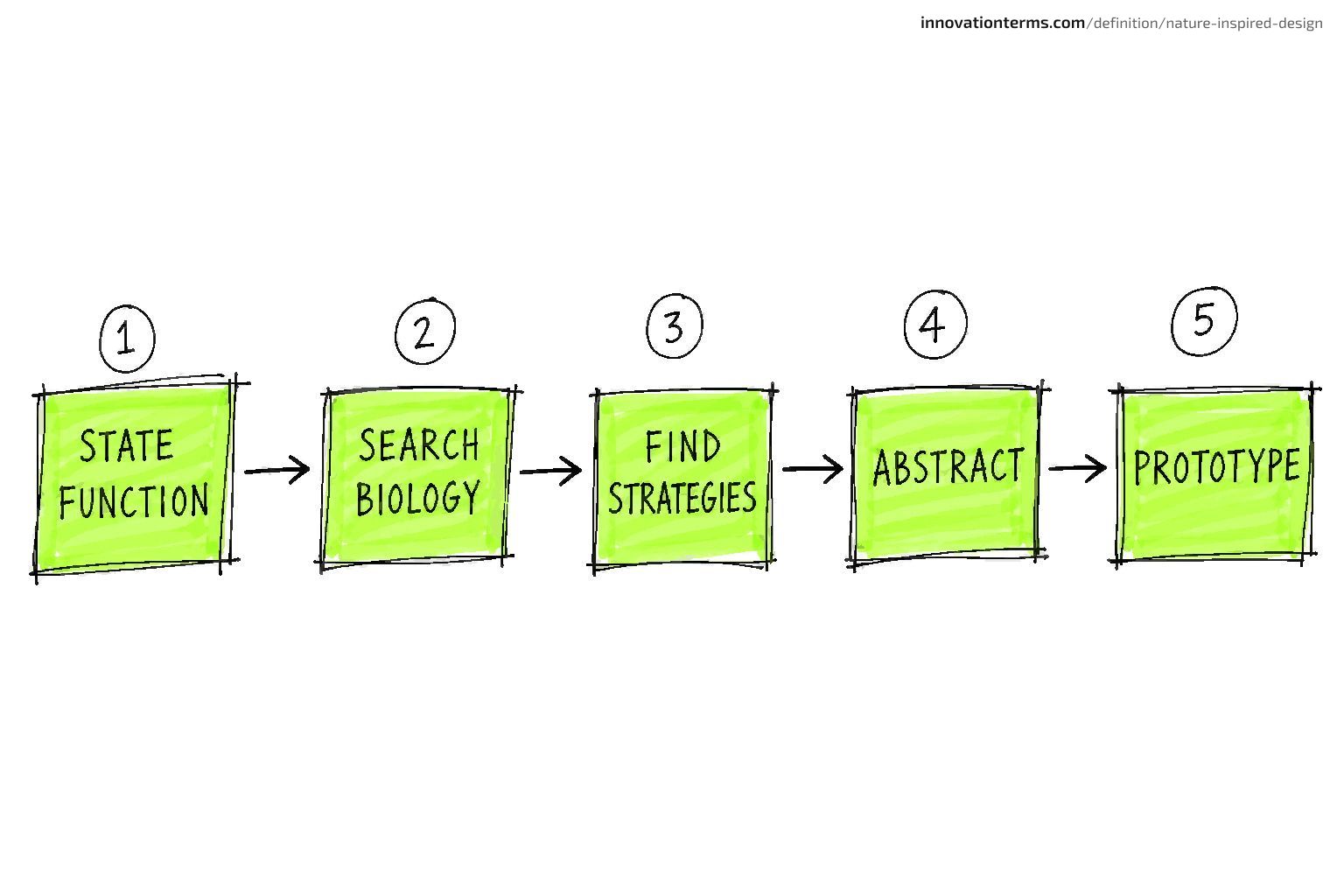
Use nature-inspired design as a reframing step: convert the challenge into a function. Then search biology for organisms that already perform that function. That sequence is the whole method.
The repeatable version looks like this:
- State the function, not the product. Replace "design a better fastener" with "how does nature attach and release reversibly?" This is the step that separates method from accident.
- Search by function. Use AskNature, the Biomimicry Institute's free database, which indexes biological strategies by the function they perform rather than by organism. Functional framing is what makes the search return useful results.
- Find two or three biological strategies that perform the function under different constraints.
- Abstract the principle away from the organism, so you are transferring a mechanism, not a picture.
- Prototype and test the transfer, which is where most attempts fail and where the real work starts.
The function-first step is a close cousin of jobs-to-be-done thinking: both insist on the underlying job before the form. It complements design-thinking rather than replacing it, supplying a structured source of candidate solutions during ideation that pure brainstorming and mind-mapping do not. A sensible rule of thumb: reach for it when the challenge is a physical or systemic function that an organism plausibly faces too, and reach for conventional ideation when the problem is social, organizational, or aesthetic.
The placement inside the funnel matters as much as the method. The practice earns its keep at the early divergent stage, where the team is still generating candidate mechanisms, not at the convergent stage where a stage-gate model is filtering for feasibility. Run the function-first search before the concept is locked, because once a form is chosen the search degrades into post-hoc justification. Two of the conversational questions teams bring are worth answering directly here. To search biological strategies by function, AskNature is the named, free starting point. specialist consultancies built on the Biomimicry 3.8 methodology go deeper for funded projects. To brief a vendor so you get functional emulation rather than decoration, write the brief as a performance specification ("reduce cooling load by X without mechanical HVAC") and refuse any proposal whose nature reference cannot be tied to that number. A brief that asks for "an organic, nature-inspired aesthetic" has already ordered decoration.
When does nature-inspired design fail to transfer?
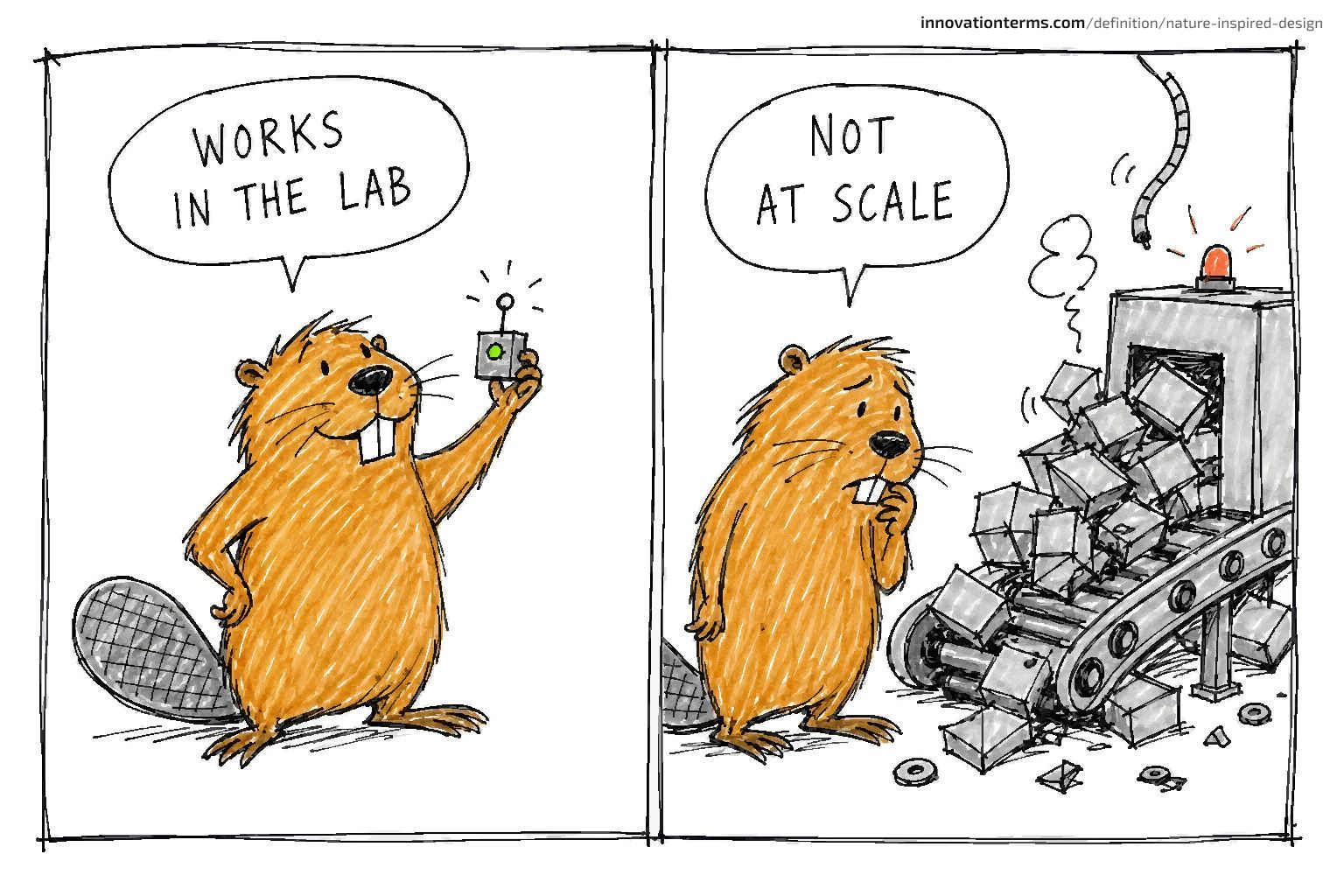
The common pattern is biology-push: a biological image gets forced toward a design problem it never actually fit. Teams push biology toward a problem instead of letting a functional need pull biology in. Or a strategy that works at organism scale hits manufacturing and breaks. The problem is never a shortage of inspiration.
One field review is plain about the reason: biomimicry is 'hindered by implementation, not inspiration', with strategies that perform at organism scale losing their advantage when scaled up — a recurring "problem of scale" that the same analysis names explicitly.
The gecko adhesive: a named scale-up failure
Gecko feet cling to walls through millions of microscopic hairs called setae (the branching fibres, one-tenth the diameter of a human hair, that split further into nanoscale spatulas to maximise contact area) that exploit van der Waals forces. The lab demonstrations are striking, and they have not become a commodity product, because Chemistry World (2018) documents how manufacturing the nanostructure reliably and at scale has stalled the transfer for years. The biology is sound. The factory is the bottleneck. This is the recurring shape of biomimetic failure: the principle survives the move from organism to prototype and then breaks on the move from prototype to production line, where tolerances, cost, and yield decide everything. A strategy nature runs for free across billions of cells can become prohibitively expensive when a factory has to manufacture each unit to spec.
Biology push versus design pull
The deeper diagnosis is the sourcing direction. The 2016 distinction between "design pull" and "biology push" identifies why so many attempts disappoint: a compelling biological image gets pushed toward a design problem it never actually fit, instead of a real functional need pulling biology in to answer it. The fragmentation of the field compounds the problem. The 2023 architecture review notes the discipline "has become more fragmented" over time, which means a team often cannot find an agreed method or a documented precedent for the transfer it is attempting, and so improvises one that fails quietly.
What are the edge cases where the definitions blur?
The hardest cases are where bio-utilization and biomimicry overlap, where biophilic interventions turn out to be functional, and where abstraction is so high that the "nature" connection becomes nominal. The umbrella has clean centers and fuzzy edges, but the blur lives at the edges, not at the center: the function-versus-decoration line remains the sharpest and most consequential distinction in the field.
Mycelium packaging is the cleanest puzzle. It is bio-utilization, because the fungal material itself becomes the product. Calling it biomimetic is also defensible, since the design emulates how mycelium binds and grows rather than merely borrowing its appearance. The Springer (2023) typology treats such overlaps as expected rather than as contradictions, since the categories describe emphasis, not hard walls. Living building materials sit in the same blur: the MDPI architecture review notes that a green roof installed for wellbeing can end up doing structural and thermal work, which moves it from biophilic toward biomimetic without anyone redrawing the brief.
At the far edge, practitioners abstract so far from the organism that the nature connection becomes nominal. A swarm-optimization algorithm borrows from flocking birds or foraging ants. Once it becomes pure mathematics, the label 'nature-inspired' is really just a credit line acknowledging where the idea came from.
Frequently asked questions
What is nature-inspired design in plain terms? Applied biology, broadly speaking. More precisely, it covers any product, building, or system whose designers started by observing how organisms handle a problem before drawing a single line. It includes biomimicry, biophilic design, biomorphism, and bio-utilization. The useful test is whether a design copies how nature functions or only how it looks. the first is innovation, the second is decoration.
How is nature-inspired design different from biomimicry? Nature-inspired design is the category. biomimicry is one approach inside it. Biomimicry specifically emulates a biological strategy to solve a functional problem, as Benyus defined it: "learning from and then emulating nature's genius." Other siblings under the umbrella, like biophilic design and biomorphism, borrow nature's presence or appearance instead of its function.
What is the difference between biomimicry and biophilic design? Both draw on nature but for completely different ends. Biomimicry emulates how a living system functions to solve an engineering problem. The Shinkansen's kingfisher-beak nose is the standard example. Biophilic design introduces natural elements (plants, daylight, views) to improve human wellbeing, with documented gains in mood and productivity. Engineering performance is what the first optimizes for. The second is measured in human experience.
Is biomorphism the same as biomimicry? No. Biomorphism is aesthetic. it makes objects that look organic. Biomimicry is functional. it makes objects that behave like an organism. As the designingbuildings reference puts it, "biomorphism is a formal and aesthetic expression. biomimicry is a functional discipline." Beijing's "Bird's Nest" stadium resembles a nest but is biomorphic, not biomimetic.
What are the three levels of biomimicry? Organism, behavior, and ecosystem. The organism level copies a single trait like a beak shape, while the behavior level copies how an organism acts, such as a termite mound's ventilation logic. The ecosystem level copies how a whole system self-organizes, like the nutrient loops of a circular economy, as detailed in the AskNature primer, and that is where the ladder stops being incremental.
How do teams actually use nature-inspired design in an innovation process? As a function-first reframing step. State the challenge as a function ("how does nature attach and release reversibly?"), then search a database like AskNature by that function to find biological strategies that perform it. Abstract the principle from the organism, then prototype the transfer. It complements design-thinking rather than replacing it.
When does nature-inspired design fail to work? Most often when a biological idea is pushed toward a problem it does not fit, or when a strategy that works at small scale collapses at production scale. The field's own assessment: biomimicry is "hindered by implementation, not inspiration." Gecko-inspired dry adhesives are the standing example, as Chemistry World documents: they work in the lab but have stalled at manufacturing scale.
Clara @cla_reinholt
Focuses on innovation communication, facilitation, and turning frameworks into team habits.